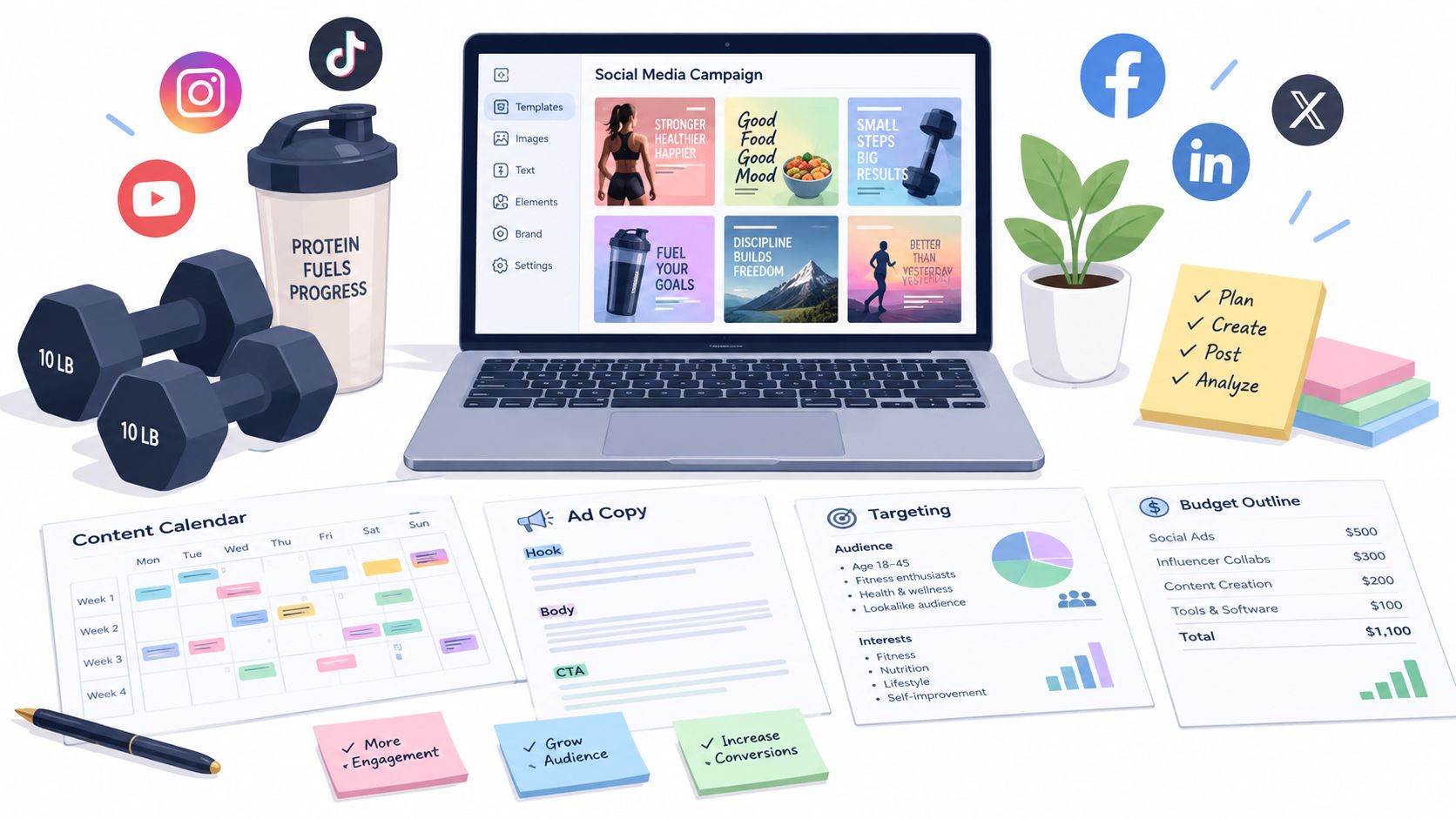
A gym team can have a strong membership offer, a full class schedule, and plenty of member success stories, yet still spend every week rebuilding the same campaign from scratch. One person creates Instagram graphics, another schedules Facebook posts, a manager edits ad copy, and nobody's quite sure which version is driving trial inquiries. The problem isn't a shortage of ideas. It's the absence of a repeatable system.
This list compares social media campaign template resources by the operational problem they solve, their workflow, limitations, and implementation effort. The path moves from accessible design and scheduling tools to attribution, governance, and email coordination. A useful template should hold the objective, audience, offer, content calendar, ad-copy variations, budget assumptions, approval steps, and success metrics in one working document. A social media calendar from Bruce and Eddy can provide a simple starting point, but gym teams usually need more than a publishing grid.
Trust also lives in operational details. Content about a clean training environment can naturally mention gym wipes, disinfecting wipes, and wipes for gym equipment, provided the claims match the facility's actual cleaning process. Choose the resource that fits the way your team works, then adapt it into an asset people will use.
1. Hootsuite Social Media Campaign Planner
Hootsuite makes the most sense when a gym team has multiple channels, recurring promotions, and more than one person touching the campaign. Its planner brings scheduling, collaboration, and reporting into a shared workflow, so membership promotions, class announcements, and member stories don't depend on someone remembering to post manually.
A local gym could use one campaign workspace for a seasonal membership drive. The calendar would show the offer, creative asset, landing page, audience, responsible team member, approval status, and planned post across Facebook, Instagram, LinkedIn, and other active channels. The important adaptation is to separate the campaign from the individual posts. The campaign brief explains why the offer exists, while the calendar explains what goes live and when.

Where the planner earns its place
Use the analytics view to compare which content generates meaningful actions, such as membership-page visits, consultation requests, or direct inquiries. Don't treat likes as the finish line. A post may receive attention without helping the front desk start a sales conversation.
The team structure matters just as much as the calendar. A content creator can draft a class announcement, a manager can check the offer and compliance details, and an approver can release it. That separation reduces accidental price errors, outdated schedules, and inconsistent brand language.
Practical rule: Build the approval step into the calendar before anyone creates the graphics. Otherwise, the team will treat review as an interruption instead of part of production.
Hootsuite can be more organization than a solo trainer needs. For a multi-location operator, however, the shared view is valuable because corporate messaging and local relevance can coexist. The central team can define the campaign, while each location adds nearby class details, trainer content, or community prompts.
2. Canva Social Media Template Suite
Canva solves a different problem. It helps a gym produce usable creative quickly when the marketing team doesn't include a dedicated designer. Its drag-and-drop workflow is especially practical for class cards, promotional graphics, testimonial layouts, short-form video covers, and social posts that need to be resized across channels.
The strongest setup isn't a collection of unrelated designs. It's a small visual system. Create editable versions for a membership offer, class spotlight, member moment, trainer tip, local prompt, and trial call to action. Lock the elements that shouldn't change, such as the logo position and brand colors, while leaving fields open for the headline, image, date, offer terms, and call to action.

Turn design files into campaign assets
A boutique studio promoting a new class might create one master layout, then adapt it for an Instagram feed post, Story, Facebook placement, and a paid social variation. The copy should change with the placement. A feed post can explain the class, a Story can use a short reminder and booking prompt, and an ad can lead with the local benefit and offer.
Canva's weakness is governance. An attractive design library won't tell the team whether a promotion is profitable, whether the audience is correct, or whether a member has approved the use of their photo. Add those fields outside the creative file, ideally in the campaign brief or calendar.
- Create reusable folders: Separate evergreen templates from active campaign assets so outdated offers don't get reused.
- Add approval fields: Record who checked dates, pricing, images, and claims before publishing.
- Preserve member trust: Secure permission before turning transformation photos or user-generated content into promotional creative.
Canva works well for lean teams that need speed and consistency. If several locations edit the same assets, establish naming conventions and a single source of truth. Teams comparing design subscriptions can also compare unlimited design plans, but the right choice still depends on how much design work the gym produces and who maintains the library.
3. Buffer Social Media Campaign Template
Buffer's planning approach is useful when a gym has plenty of content but no clear connection between posts and business objectives. Instead of starting with a blank schedule, build the campaign around the outcome first, then define the audience, message, content pillars, publishing plan, and measurement fields.
For a membership campaign, the template might begin with a goal such as generating trial bookings. The next fields should identify the local audience, the reason to act now, the offer, the landing page, the call to action, and the questions the sales team will ask when an inquiry arrives. This gives creative and front-desk staff the same explanation of what the campaign is trying to achieve.
Add copy testing without creating chaos
Create separate cells for the primary message, opening hook, offer framing, call to action, and audience. That structure makes it easier to compare a convenience angle for busy professionals with a community angle for people who feel uncomfortable joining a gym. Keep the visual asset consistent when testing copy, or keep the copy consistent when testing creative. Changing everything at once makes the lesson harder to interpret.
The calendar should also capture the content pillar. A gym might classify posts as education, member proof, community, offer, or behind-the-scenes. Reviewing performance by pillar is more useful than counting how many posts went live.
A template becomes valuable when it records the decision behind the post, not just the date it appeared.
Use a short review cycle during the campaign. Check inquiries, landing-page actions, comments, saves, and direct messages, then document what should change. For a deeper conversion workflow, connect the campaign plan to this social media lead generation guidance. Buffer is accessible for small teams, but it won't replace a CRM or a disciplined follow-up process. Someone still needs to own lead handling after the post does its job.
4. Later Instagram Marketing Campaign Template
Later is a strong fit when Instagram is the gym's primary discovery and community channel. Its visual planning model helps a team see how posts work together in the profile grid, while Stories and Reels can be planned as part of the same campaign rather than treated as last-minute extras.
A useful Instagram campaign for a neighborhood gym could combine a trainer-led Reel, member-generated proof, a class reminder, and a direct-message prompt. Each format has a role. Reels and other short-form video can introduce the facility or demonstrate a movement, Stories can answer objections and show current activity, and direct messages can move an interested person toward a tour or trial booking.
The broader fitness content environment is moving toward social search, community-led growth, user-generated content, micro-creators, and short-form video. One 2026 fitness marketing report claims TikTok fitness engagement at 4.2% and says short-form video drives 3× higher engagement than static posts. Those figures come from Webtonic's fitness social media statistics coverage, so treat them as directional evidence from that report, not a universal forecast for every gym.
Build the Instagram asset set
Don't copy one post into every placement. Prepare a visual brief for each asset, including the opening frame, on-screen text, caption, call to action, location cue, and response owner. If a member appears, document permission and any restrictions on how the image or video can be reused.
The trade-off is focus. An Instagram-specific template can produce better platform fit, but it may leave gaps in Facebook, email, paid media, or local search coordination. Use it as the channel execution layer inside a broader campaign brief. For practical Story planning, connect the calendar to this guide to a gym Instagram Story strategy.
5. HubSpot Social Media Campaign Planner
HubSpot is the better choice when the gym needs to connect social activity with lead nurturing and membership conversion. It encourages the team to define the audience more carefully, map content to a buyer journey, and connect calls to action with follow-up rather than ending the campaign at the click.
Start by creating audience profiles based on actual membership conversations. A busy professional may respond to flexible scheduling and a quick-start consultation. A former member may need a reactivation message that acknowledges a previous relationship. A beginner may need reassurance about coaching, atmosphere, and what happens during the first visit.
Make the handoff visible
The template should identify the offer, form or booking page, confirmation experience, lead owner, response standard, and follow-up sequence. Social copy, landing-page copy, and email copy should use the same promise, but they shouldn't be identical. A post earns attention, a landing page explains the decision, and follow-up answers hesitation.
A gym can also connect post-sign-up outcomes to the campaign record. Track whether a lead books, attends, joins, refers someone, or stops responding. That creates a more useful picture than reporting reach alone. Recent health and wellness coverage says brands average about a 2.5% social conversion rate, while also describing social search, AI-assisted creation, and community-oriented marketing as increasingly standard. The figure and context come from Webtonic's health and wellness statistics article, and should be used as a benchmark from that source rather than a promise for a particular facility.
Measurement discipline: Don't call a campaign successful until the gym can explain what happened after the inquiry.
HubSpot demands more setup than Canva or a basic scheduler. It pays off when the team has enough lead volume to justify lifecycle tracking and automated follow-up. For the strategic layer, pair the planner with this social media marketing strategy resource.
6. Sprout Social Campaign Management Template
Sprout Social addresses governance. It becomes relevant when a fitness brand has multiple locations, local marketing managers, corporate reviewers, and a public reputation that can't depend on informal approvals.
A multi-location operator can create a central campaign brief with approved positioning, visual rules, offer language, response guidance, and reporting definitions. Local managers can then adapt the approved framework to their market without rewriting the entire strategy. That balance matters. A corporate team that controls every caption may protect consistency but slow local publishing. A fully decentralized model may move quickly but produce conflicting offers and uneven member experiences.
Design the operating model before the dashboard
Define permissions by responsibility. Content creators need editing access, local managers need local publishing or customization rights, and corporate reviewers need approval visibility. Create separate reporting views for executives, regional leaders, and location managers so each group sees information it can act on.
The audit layer should go beyond follower totals. A practical benchmark is a rolling 90-day window with comparison against at least three competitor or peer accounts, covering follower growth rate, post frequency per week, engagement rate per post normalized by follower count, content pillar coverage, top-performing posts, share of voice, and hashtag overlap or divergence. This structure is recommended in the 2026 social media audit template.
Use those findings to change the content plan, not merely to decorate a monthly report. If local competitors dominate a conversation around beginner-friendly classes, the location team may need better educational content, clearer proof, or faster responses to questions.
Sprout's trade-off is administrative weight. A single-location gym may find the permissions and reporting framework excessive. A franchise or regional operator needs that structure because brand governance, escalation, and local flexibility become operational problems rather than marketing preferences.
7. Mailchimp Social Media Campaign Blueprint
Mailchimp is the practical choice when email and social need to tell one coordinated story. A gym's strongest campaign may begin with an email to existing members, continue with organic posts for prospects, and use a landing page that gives every audience a clear next step. The blueprint keeps those touchpoints aligned without forcing every segment to receive the same message.
Build audience-specific versions for active members, trial participants, interested prospects, and lapsed members. An active member might receive a referral or class-participation prompt. A trial participant may need a reminder about the next visit. A lapsed member may respond better to a reactivation message than to a generic discount. The campaign record should identify which segment receives which subject line, post, offer, and follow-up.
Coordinate the campaign clock
Write the email, social captions, landing-page copy, and front-desk talking points together. If the email announces a challenge, social content can show the community participating, while staff can explain how to join when members ask in person. Use tracking links or campaign tags so the team can distinguish email-driven inquiries from social-driven inquiries.
The limitation is attribution. Mailchimp can coordinate communication, but the gym still needs a reliable record of bookings, visits, joins, and reactivations. Don't assume that a click equals a membership. Ask the sales team to record the original source and campaign name during the inquiry.
A short satisfaction flow can strengthen the post-campaign loop. Survey guidance from Typeform recommends a mobile-friendly experience that takes about 2–3 minutes, with a clear introduction, conditional follow-up questions, and a thank-you screen. Responses can be collected through email, a website, SMS, social media, or QR codes, as described in Typeform's satisfaction survey templates. A gym could route dissatisfied respondents to a diagnosis question and satisfied respondents toward a testimonial or referral prompt.
Top 7 Social Media Campaign Template Comparison
| Tool | Core features | Best for | Unique selling point | Price & UX |
|---|---|---|---|---|
| Hootsuite Social Media Campaign Planner | Multi-channel scheduling (8+); drag‑drop calendar; team approvals; real‑time analytics | Multi-location gyms & marketing teams | Centralized scheduling + team workflows; competitor monitoring | Free tier available; paid plans can be costly for solos; moderate learning curve |
| Canva Social Media Template Suite | 5,000+ fitness templates; brand kit; auto‑resize; stock & video assets | Solo gym owners, trainers, small teams | Rapid, professional visuals without design skills | Affordable (~$120/yr Business); very easy to use; premium assets require subscription |
| Buffer Social Media Campaign Template | Pre‑campaign worksheet; content calendar; A/B testing; KPI dashboard | Gyms wanting strategic, measurable campaigns | Template-driven strategy + A/B test framework | Low–mid cost (varies); requires upfront planning; moderate complexity |
| Later Instagram Marketing Campaign Template | Visual calendar & feed preview; hashtag research; Reels/Stories planning; UGC tools | Instagram‑focused studios, influencers, trainers | Instagram‑first optimization with visual preview & UGC workflow | Paid tiers for advanced features; intuitive visual UX; Instagram‑only focus |
| HubSpot Social Media Campaign Planner | Buyer personas; content mapping; attribution reporting; automation | Growing chains, multi-location studios, revenue-focused teams | Direct link from social campaigns to membership revenue & lifecycle automation | Enterprise pricing ($800–$3,000+/mo); steep learning curve; powerful attribution |
| Sprout Social Campaign Management Template | Multi-level approvals; role management; centralized reporting; benchmarking | Large gym chains, franchises, corporate fitness ops | Enterprise governance, segmentation & competitive benchmarking | Premium ($249+/mo); complex onboarding; best for scale |
| Mailchimp Social Media Campaign Blueprint | Integrated email + social planning; segmentation; landing pages; automations | Gyms using email + social for coordinated campaigns | Combines email automation with social launches for higher conversion | Affordable ($20–$350/mo); moderate setup; requires good list hygiene |
Turn the Best Template Into a Repeatable Gym Campaign
The best resource isn't the one with the longest feature list. Choose according to team size, active channels, budget, reporting needs, and campaign complexity. A solo trainer may need Canva plus a simple calendar. A growing studio may benefit from Buffer or Later. A multi-location operator may need Sprout Social's approval and reporting structure. A gym investing in lead nurturing should consider HubSpot, while a team coordinating email and social may get more value from Mailchimp.
Use this implementation sequence:
- Define the membership goal: Choose one primary outcome, such as trial bookings, class enrollment, referrals, or reactivation.
- Select the audience: Separate prospects, trial users, active members, and former members when their motivations differ.
- Adapt the content calendar: Assign each post a channel, format, content pillar, offer, owner, approval status, and destination.
- Write copy variations: Prepare different hooks, benefits, calls to action, and audience angles rather than duplicating one caption everywhere.
- Assign a working budget: Record the planned spend, audience, campaign dates, creative version, and person responsible for monitoring delivery.
- Set approval responsibilities: Name the creator, reviewer, publisher, and lead owner before launch.
- Launch and monitor: Review inquiries, bookings, comments, direct messages, and conversions, then make changes while the campaign is active.
- Document reusable assets: Save approved graphics, captions, audience definitions, landing-page copy, responses, and lessons in a shared library.
Add retention to the reporting record. A campaign can attract attention and still fail to create durable membership value if leads don't attend, members don't engage, or former members don't return. Include referral behavior, attendance signals, and reactivation outcomes where your systems can support them.
Cleaning content can reinforce trust when it's specific and operational. CDC guidance for athletic facilities says shared equipment should be cleaned after each use and allowed to dry before the next use, and it points facilities toward EPA-registered detergents and disinfectants for removing MRSA from surfaces. CDC athletic-facility cleaning guidance supports that standard. EPA guidance also says a disinfectant wipe only works when the surface stays visibly wet for the full label contact time, so staff shouldn't wipe a machine dry immediately if the label requires longer wetness. EPA disinfectant guidance explains that principle.
For relevant gym posts, mention antibacterial wipes, a gym wipe dispenser, yoga mat wipes, bulk gym wipes, or commercial disinfecting wipes only when the product and process match the claim. If you're sourcing EPA registered disinfecting wipes, direct readers to Wipes.com and verify the product label, approved surfaces, and required contact time before publishing promotional copy. Then choose one template, assign an owner, and run the next campaign from a documented system rather than another blank page.
Use the template that best matches your gym's workflow, adapt its fields today, and schedule a campaign review after launch. Your next step is simple: define the membership outcome, name the audience, assign the owner, and build the first reusable campaign brief before creating another post.
Leave a Reply