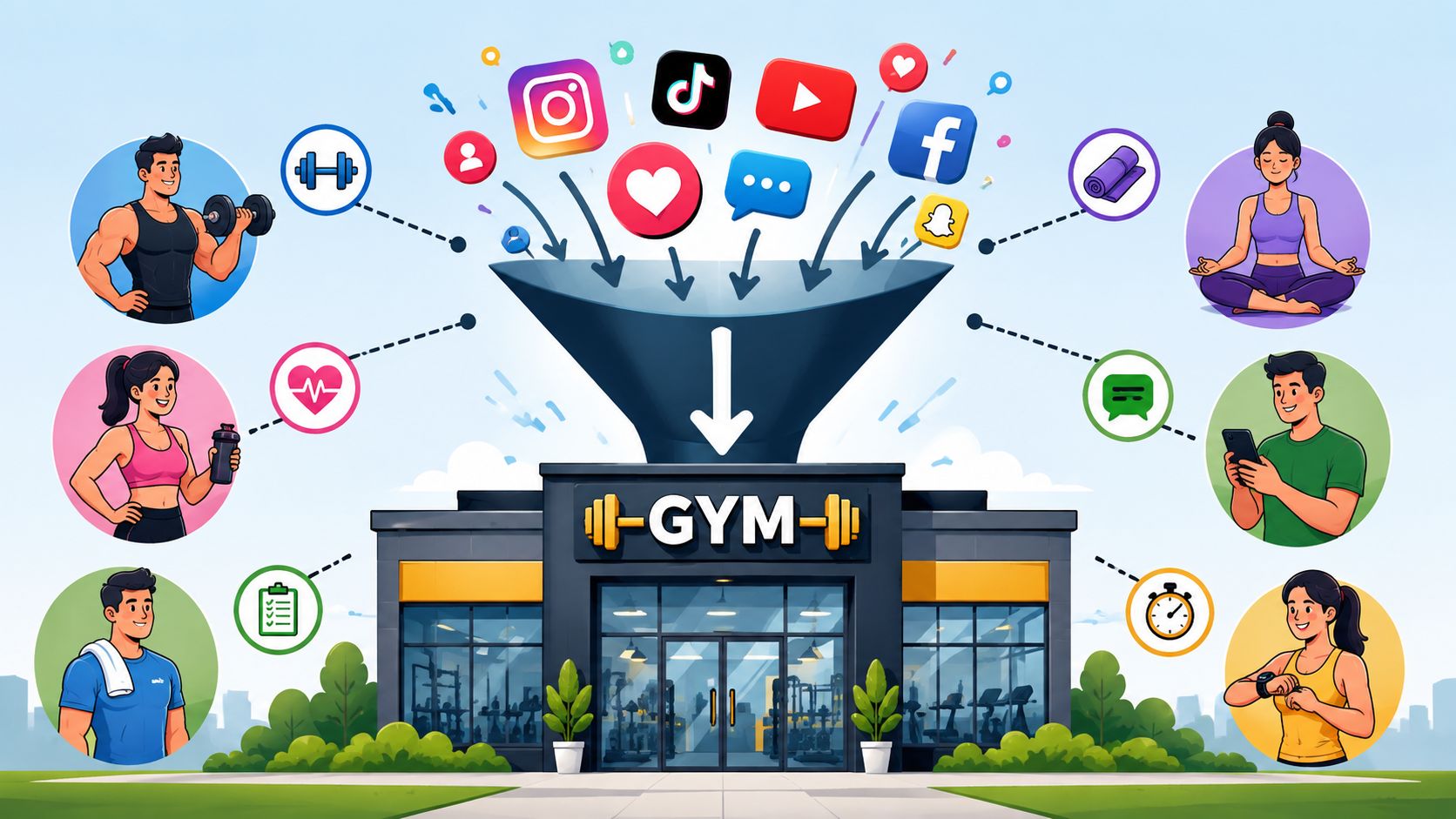
More posts won't automatically produce more gym memberships. A polished feed can attract attention while your front desk misses direct messages, your profile sends prospects to a confusing sign-up page, and nobody follows up after a trial inquiry.
A profitable social media marketing strategy treats every interaction as part of the sales process. Content earns attention, community management builds confidence, and local conversion tactics turn interest into tours, trials, and memberships. Global social media use reached 5.79 billion user identities in April 2026, with the typical user actively using 6.5 platforms each month and spending 18 hours and 36 minutes per week on social media, according to DataReportal's social media user data. Your gym doesn't need to dominate every platform. It needs to become the most responsive, recognizable fitness option for people nearby.
Why Most Gym Social Media Strategies Fail
Posting more rarely fixes a weak membership pipeline. Many gym owners still treat social media as a digital bulletin board: publish the class schedule, share a motivational quote, announce a discount, then wait for demand to appear.
That approach confuses visibility with conversion. A healthy follower count and frequent posting can hide a more expensive problem. Qualified prospects still may not know what the gym feels like, whether staff will help them, or how membership fits their routine. A discount does not answer those questions.
People have plenty of fitness options competing for attention. Social media reached more than two-thirds of the world's population monthly in April 2026, and users outnumbered non-users by more than two to one, according to DataReportal. Generic gym content adds little value. Prospects need a specific reason to pause, followed by a clear local action when they show interest.
The conversion gap
A prospect might comment, “How much is membership?” or ask whether beginners can join. A late reply, vague pricing answer, or unexplained form creates friction at the moment intent is highest. A 2026 benchmark reports that 73% of consumers will switch to a competitor if a brand doesn't respond on social media, as summarized in Sprout Social's 2026 content strategy research.
Practical rule: Treat comments and direct messages as sales conversations, not notifications.
A useful response answers the question, reduces uncertainty, and proposes a nearby next step. “Yes, we welcome beginners. Our team can show you the equipment and recommend a starting plan. Would you like to book a tour?” moves the conversation toward a visit. “Send us a DM” leaves the prospect with more work.
Broadcast less, participate more
Strong gym accounts show what membership feels like in practice. Trainers answer questions on camera, members share progress, and staff welcome newcomers by name. The comment section then becomes evidence of an active, supportive community, rather than a row of unconnected promotional posts.
This approach also requires clear ownership. A smaller stream of useful content, paired with dependable monitoring, can outperform a crowded calendar that nobody manages after publication. Assign responsibility for replies, set a response standard, and record social inquiries in the same system used for tours and leads. Engagement only matters when the team can move it toward a conversation, a visit, and a membership.
Defining Your Ideal Gym Member Audience
Before choosing a content format, identify the person most likely to visit, join, and remain active. “People interested in fitness” is too broad to guide creative, targeting, or follow-up. A 24-hour gym, a strength-focused facility, and a boutique yoga studio solve different problems for different local audiences.
Start with your current members. Look for patterns in goals, schedules, membership choices, objections, and referral behavior. Then compare those observations with platform analytics, inquiry records, tour notes, and conversations at the front desk. The most useful persona isn't a fictional profile with decorative details. It's a working description of a person's situation and buying trigger.
Build personas from behavior
A shift worker may care about access outside traditional hours, parking, and equipment availability. A busy parent may prioritize convenience, childcare options, short sessions, and a welcoming environment. A young professional may respond to community events, group classes, and content that fits a demanding schedule.
Use those differences to connect pain points with content:
- Routine barriers: Show access, class timing, parking, check-in, and quick workouts.
- Confidence barriers: Publish beginner guidance, trainer introductions, and equipment demonstrations.
- Belonging barriers: Feature member stories, group sessions, social events, and supportive staff interactions.
- Decision barriers: Explain membership options, trial steps, tour details, and what happens after sign-up.
The principle behind reaching audiences who feel understood is especially relevant locally. A nearby prospect should recognize their own schedule, concerns, and desired outcome in your content.

Turn audience insight into targeting
Use location as a practical filter, but don't stop there. Build separate creative for the audience segments your facility can serve well, then compare the quality of inquiries rather than just the reach.
For a more structured approach, review these customer segmentation methods. Ask each persona three questions: What makes joining difficult? What evidence would reduce that concern? What action feels easy enough to take today?
The answers should shape profile copy, video hooks, ad audiences, landing pages, and staff responses. If the gym can't provide a convincing answer, no amount of targeting will fix the underlying offer or experience.
Building Content Pillars That Convert Prospects
Content pillars prevent a gym's feed from becoming a cycle of promotions. They also give staff a reliable way to create posts that serve different stages of the membership journey. A useful framework combines education, inspiration, community, and promotion, with each category doing a distinct job.

Education earns the first pause
Demonstrate a movement, correct a common form mistake, or show how a beginner can use a machine safely. A trainer explaining one practical adjustment in a short video gives a prospect a reason to save the post and trust the facility.
Keep the subject narrow. “Three ways to make your first strength session less intimidating” is more useful than a broad lecture about exercise.
Inspiration supplies social proof
Member transformations can work, but they shouldn't rely only on dramatic before-and-after imagery. A member describing how they became consistent, a trainer celebrating a personal milestone, or a short class snippet can make progress feel attainable.
Fitness-focused research found that trendiness and user-generated content produced the highest engagement rates, while remunerative content produced the lowest, according to the University of Gothenburg study record. Use authentic permission-based stories, real language, and ordinary moments that show what participation looks like.
Community makes the gym feel accessible
Show staff preparing for class, members supporting one another, challenge updates, charity events, and behind-the-scenes work. Tag participants when appropriate and invite conversation with specific prompts, such as asking which class time suits a local schedule.
This pillar also gives your team material for replies. When someone asks about a class, the account can point to a real instructor, recent session, or member experience instead of sending a generic sales message.
Promotion gives attention somewhere to go
Promotional posts should explain the offer and the next step without making the entire feed feel transactional. Present the trial, tour, introductory session, or membership option alongside a clear reason it fits the audience.
Use a simple matrix: pair each audience segment with one concern, one content pillar, and one conversion action. A beginner segment might see an educational equipment walkthrough and receive an invitation to book a guided tour. A time-poor professional might see a quick workout and click to view convenient class options.
Choosing the Right Platforms for Your Fitness Business
A gym does not need to publish everywhere. It needs a reliable presence where nearby prospects already pay attention, while giving staff enough time to create suitable content and answer questions quickly. A neglected account can waste more trust than a smaller, well-managed presence.
Instagram and Facebook often deserve early consideration because they support visual proof, local interaction, promotions, and direct messages in one workflow. TikTok can extend organic discovery when the team can produce energetic, authentic short-form video. YouTube supports searchable tutorials, tours, and trainer education, but requires more consistent production.
Paid social is another acquisition channel, not a substitute for community management. Worldwide social media ad spend is projected to reach $317.33 billion in 2026, according to Sprout Social's social media statistics summary. That figure does not mean every gym should spend more. Before increasing budget, confirm that the profile explains the offer, the landing path works, and someone can respond promptly to comments and messages.
Platform comparison for gym marketing
| Platform | Best For | Key Format | Local Targeting |
|---|---|---|---|
| Visual proof, classes, trainers, member culture | Reels, Stories, carousels | Strong location, interest, and retargeting options | |
| Local groups, older audiences, offers, inquiries | Video, events, posts, lead ads | Strong geographic and community targeting | |
| TikTok | Discovery, personality, trends, authentic demonstrations | Short-form vertical video | Useful when creative feels native and locally relevant |
| YouTube | Tutorials, tours, trainer authority, search visibility | Shorts and longer videos | Useful for intent-led discovery and branded search |
| Corporate wellness and professional partnerships | Articles, video, company updates | Better for business relationships than direct memberships |
Instagram is widely used by marketers, with 70% adopting it in their strategy, while 69.6% use Facebook, according to the same Sprout Social's social media statistics summary. These figures describe marketer adoption, not guaranteed membership results. A local account with fast, helpful replies can outperform a larger account that leaves enquiries unanswered.
Allocate effort by conversion role
Choose one primary platform for consistent organic work and one supporting platform for adapted content. Add paid campaigns only after the profile, offer, tracking, and response process work together. Measure messages, tour bookings, trial visits, and memberships, rather than judging success by reach alone.
Creator partnerships can help when the creator's audience lives near the gym and the collaboration includes a trackable action, such as a code, booking link, or tour request. Review these social media strategies from Smarcomms for added industry context. The right platform is the one your team can operate consistently, respond on quickly, and connect to a local sign-up path.
Mastering Short-Form Video and Posting Cadence
Gyms have a natural video advantage. Movement, coaching, equipment, reactions, and group energy communicate more quickly than a static promotional graphic. Short-form video should sit at the center of your social media marketing strategy, but a video-first plan still needs a conversion purpose.
A cross-platform benchmark found TikTok delivered a 4.25% overall engagement rate, while Instagram Reels and carousels generated 44% higher median engagement than image posts, according to SociaVault's 2026 engagement benchmarks. Engagement isn't the same as a membership, but it can help the right prospect notice the gym before the account directs them toward a profile visit, message, trial, or tour.
Build a repeatable video system
Batch filming reduces the pressure on trainers and managers. During one content session, capture a facility walkthrough, a trainer tip, a class entrance, a machine demonstration, a member-approved testimonial, and several short clips of the space in use.
Each clip needs a local and practical hook:
- Beginner concern: “Nervous about your first gym visit? Start here.”
- Schedule problem: “A quick strength session before the morning shift.”
- Community question: “What makes this class easier to stick with?”
- Conversion invitation: “Tour the facility before choosing a membership.”
Add captions, show the gym early, and end with one action. Don't bury the next step under a long explanation.

Protect cadence from burnout
Choose a publishing rhythm your team can sustain while reserving daily attention for comments and messages. A smaller batch of useful, platform-native videos is preferable to a schedule that leaves nobody available to handle the responses those videos create.
Repurpose the idea, not always the exact file. A trainer tip can become a Reel, a TikTok, a Story poll, and a longer YouTube explanation, with each version adapted to the platform. For inspiration on creator-led fitness content, see TikTok fitness influencers.
Measuring What Actually Grows Memberships
Likes are feedback, not revenue. A useful measurement system follows the path from attention to action, then connects that action to a conversation and an eventual membership decision.
Start with a dashboard that separates discovery, intent, sales activity, and business outcome. Track profile visits, website clicks, direct messages, trial requests, booked tours, completed visits, new memberships, and cancellations linked to poor follow-up or experience. The exact values will vary by gym, so establish a baseline before judging performance.
Connect content to the sales process
Give each campaign a distinct landing page or tracked link. Record the source when a prospect calls, messages, books online, or walks in. Train the front desk to ask a natural question such as, “How did you hear about us?” and enter the answer consistently.
Review the numbers with three filters:
- Volume: Which posts and campaigns generate inquiries?
- Quality: Which sources produce people who book and attend?
- Efficiency: Which channel creates memberships without consuming disproportionate staff time or ad spend?
A high-engagement video that produces no local inquiries may be useful for awareness, but it shouldn't receive unlimited budget. A modest post that prompts serious tour requests deserves closer analysis.

Test the whole journey
Test one meaningful variable at a time, such as the video opening, audience, offer, landing page, or call to action. Compare the downstream result, not only the platform engagement. If two ads receive similar attention but one generates more completed tours, the second creative is doing more commercial work.
Use this guide to measuring marketing ROI to make the dashboard more useful to managers and owners. Review it regularly, then move budget and staff attention toward campaigns that create qualified conversations and completed membership actions.
Keeping Your Facility Clean and Your Brand Trusted
Your online promise meets its test at the front door. A prospect who sees clean equipment, organized spaces, and visible hygiene routines receives confirmation that the gym takes member experience seriously. A neglected facility can undo the trust created by weeks of content.
Create a simple routine for high-touch surfaces. Wipe cardio consoles, benches, handles, desks, door handles, and shared equipment throughout operating hours. Place visible supplies where members can use them, and train staff to check areas during regular floor walks.
For facilities seeking bulk gym wipes, Wipes.com lists disinfecting wipes that are EPA-registered and designed to kill bacteria and viruses on hard, non-porous surfaces when used as directed. The product lists EPA Reg. No. 1839-190-86745 and 800-count rolls, which are suitable for high-touch gym equipment, as described on the Wipes.com disinfecting wipes page.
Show the routine without making exaggerated health promises. A short clip of staff cleaning equipment, a clear sign explaining member use, and practical reminders about wiping shared surfaces can reinforce the same reliability your social media communicates.
Build your gym's social media marketing strategy around local conversations, not just a publishing calendar. Choose one priority audience, create content that reflects its real concerns, assign responsibility for fast replies, and track every inquiry through the tour and membership decision. Then audit your facility's cleaning routine and make the experience match the promise. Start this week by reviewing unanswered messages, filming one authentic member or trainer video, and giving every interested prospect a clear path to visit.
Leave a Reply