A gym can have excellent trainers, modern equipment, and a strong class schedule, yet still struggle to grow. The problem is often not one missing campaign. It's a disconnected member journey. People discover the facility, form an impression, request information, attend a trial, decide whether the offer fits, and then judge the brand by what happens after signup.
The strongest fitness marketing strategies connect those moments into one measurable growth system. They build attention, capture demand, convert prospects, expand local reach, and protect lifetime value. That matters in a large market. U.S. gym memberships reached a record 77 million in 2024, nearly one in four Americans, while total fitness facility customers approached 96 million when non-members were included, according to ABC Fitness industry statistics. Even modest improvements can matter when the addressable audience is this broad.
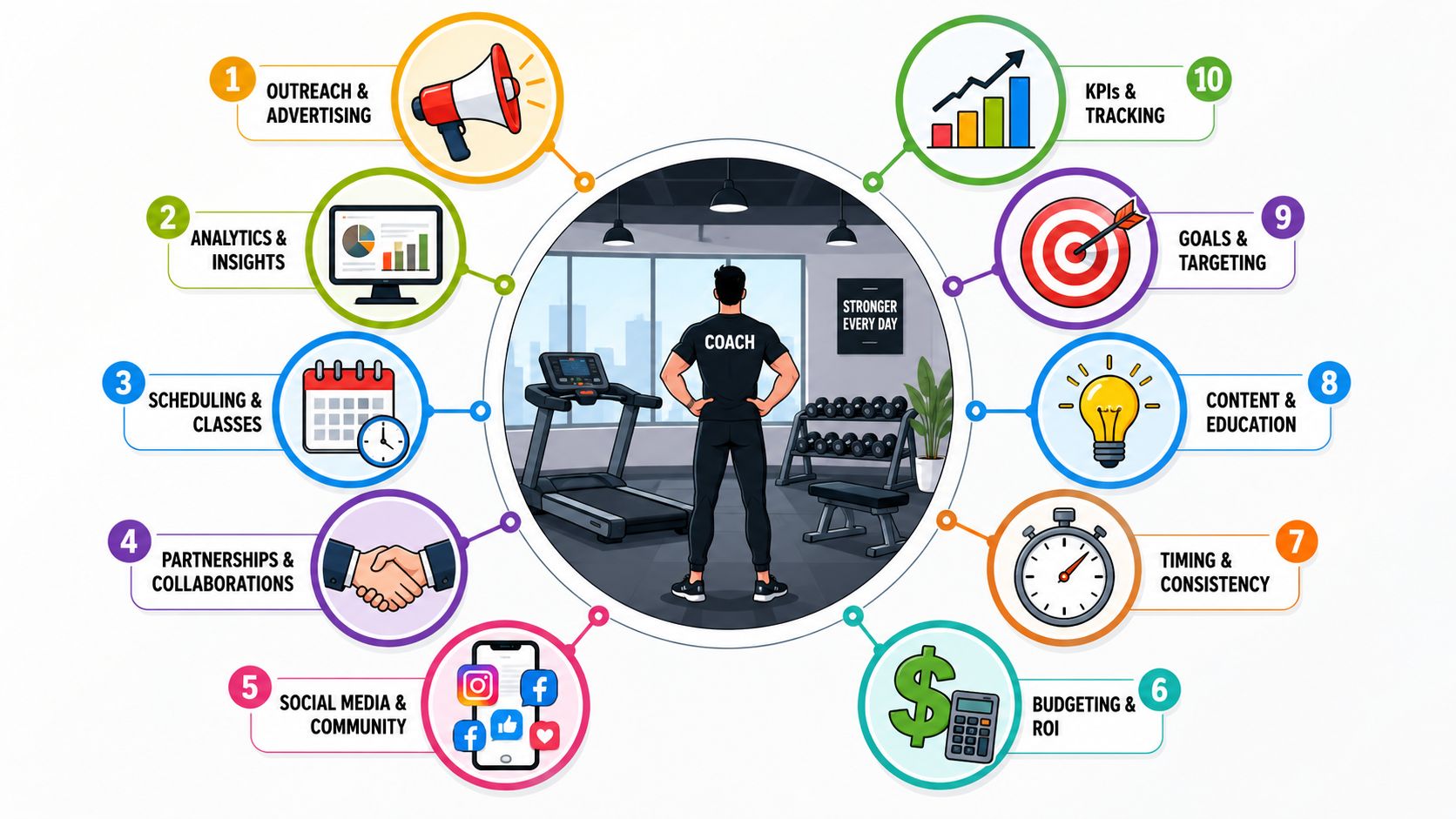
This guide breaks down 10 practical strategies, with an implementation sprint, a sample timeline or budget approach, a primary KPI, and a reusable example for each. Start with the bottleneck your gym can clearly see, then test one system before adding another.
The best marketing promise must match the experience members receive inside the facility.
1. Social Media Community Building and Engagement
Social media works best when your gym behaves like a local community, not a digital billboard. Post real member progress, trainer explanations, class energy, equipment demonstrations, and small moments that show what joining feels like. A polished offer can earn attention, but consistent human interaction builds trust.
Instagram is used by 89% of fitness businesses, Facebook by 76%, TikTok by 52%, and YouTube by 41%, according to fitness digital marketing benchmarks. Those figures don't mean you need four active channels. Choose the platform where your target members already spend time, then repurpose strong content without making every post identical.

Build a repeatable local content rhythm
Run a two-week sprint before judging the channel. Publish three to five useful or community-focused posts weekly, respond to comments within a day, and create one simple challenge that members can share. Assign filming and replies to a named staff member, because “everyone handles social” usually means nobody owns it.
Track profile visits, direct inquiries, trial bookings, and referral mentions, not follower totals alone. A local CrossFit box might post a daily workout explanation, tag its neighborhood, and invite members to share a scaled version. A boutique studio could publish a short trainer demo followed by a clear invitation to try the class.
Use this online fitness community resource to shape member-led engagement, and review guidance on how to grow your brand with social media. The reusable template is simple: member moment, practical lesson, local prompt, trial CTA.
2. Referral and Affiliate Marketing Programs
Your current members already explain your gym in language prospects understand. A structured referral program turns those conversations into trackable demand without forcing staff to cold prospect all day. The trade-off is operational clarity. If rewards are confusing, delayed, or difficult to claim, even satisfied members won't participate.
Create one referral path with a shareable link or code. Reward the existing member and the new member when the referral completes the agreed action, such as joining or purchasing a package. Rewards might include membership credit, a training session, merchandise, or access to a member event. Choose an incentive that protects margin and feels valuable to your audience.
Run a simple referral sprint
Spend the first week defining eligibility, reward timing, and tracking fields. Spend the next two weeks promoting the program at check-in, in member email, and during trainer conversations. Review the source of every lead so you can distinguish enthusiastic promoters from channels that generate unqualified inquiries.
The primary KPI is qualified referrals that become paying members. Secondary measures include referral participation, conversion rate, and reward cost per acquisition. A local studio could use this message:
“Bring a friend who wants help with their next fitness goal. If they join after their trial, you both receive the agreed member reward.”
Make the offer easy to share, then recognize active referrers in the facility and on social media. Complementary partners can extend the program beyond members. Nutritionists, physical therapists, yoga studios, and local employers may all reach people who fit your audience.
Use this referral program guide to structure the process, and apply practical ideas for earning more referrals. Don't launch a reward before deciding who owns fulfillment.
3. Personal Training and Trial Session Conversions
A trial session is not a free tour. It's a live demonstration of how your gym helps a specific person move from uncertainty to action. Prospects should meet a capable trainer, describe their goals and barriers, experience the facility, and leave with a clear next step.
The biggest mistake is treating every trial like the same sales appointment. A beginner may need reassurance and instruction. An experienced lifter may want programming, flexibility, or better accountability. A low-impact prospect may care more about comfort and support than equipment variety.
Turn the trial into a defined journey
Use a short consultation script:
- Goal: “What would you like your training to help you do?”
- Barrier: “What has made that difficult to maintain?”
- Fit: “Which membership access, class, or coaching option addresses that barrier?”
- Next step: “Would you like to begin with the option we discussed?”
The implementation sprint takes one week for scripting and trainer practice, followed by two weeks of live testing. Assign strong communicators to trials, capture contact details with permission, and follow up within a day with a personalized recommendation. Your primary KPI is trial-to-membership conversion. Also track attendance, follow-up completion, and conversion by trainer.
A personal training consultation can justify a higher-value offer when the prospect sees how individualized support works. A low-cost trial may create volume, but it can also attract people who aren't ready to commit. A more selective assessment may produce fewer appointments and better-fit conversations. Choose based on your capacity, not on the appeal of a full calendar.
4. Content Marketing and Educational Fitness Resources
Educational content attracts people before they're ready to buy. It can answer practical questions, demonstrate trainer expertise, and give local prospects a reason to remember your facility. The content must solve a real problem, not just repeat that your gym has “world-class equipment.”
Build content around your niche and the outcomes members want. Examples include beginner strength training, low-impact exercise, mobility for desk workers, training for older adults, weight-loss support, or mental-health-oriented movement. Industry trend coverage points to growing interest in wearable technology, mobile exercise apps, older-adult exercise, weight-loss programming, and mental-health-focused fitness, which creates room for sharper, life-stage positioning through fitness marketing trend coverage.
Create a content asset that sells without shouting
Use a four-week sprint. In the first week, interview trainers and front-desk staff about recurring member questions. In the second, publish one useful guide and several short supporting posts. In the remaining weeks, improve internal links, add a local call to action, and review which pages lead visitors toward a trial or membership page.
The primary KPI is qualified visits to membership or trial pages from educational content. A reusable article structure is:
- Identify the reader's problem.
- Explain the practical options.
- Show a safe, manageable starting point.
- Introduce the relevant class or coaching pathway.
- Offer a trial or consultation.
A gym owner who serves beginners might publish “How to Start Strength Training Without Feeling Lost,” include a trainer video, and connect the guide to an introductory session. Content takes time, so it shouldn't replace urgent lead generation. Use it to compound trust while paid and referral channels handle immediate demand. For additional email marketing insights, connect each content asset to a permission-based nurture path.
5. Email Marketing Automation and Nurture Sequences
Email is where a gym can continue the conversation after a website visit, trial booking, event, or referral. It also gives you first-party data, which matters as marketers move away from dependence on third-party cookies and toward personalized journeys, as discussed in health and fitness marketing trends.
Start with a short automated sequence rather than a complicated customer relationship management build. A practical welcome flow might include the promised pass or guide, a trainer introduction, an explanation of the first visit, a member story, and a direct invitation to book. Segment prospects, trial attendees, active members, and lapsed members so a new lead doesn't receive a cancellation win-back message.
Use behavior to change the next message
A three-to-five-email sequence is a useful starting structure for trial signups and information requests. Trigger different messages when someone downloads a guide, books a trial, attends a class, or stops responding. Keep the copy useful. Training advice, preparation tips, facility expectations, and answers to common objections should sit alongside the offer.
Track email-driven trial bookings or memberships as the primary KPI. Open and click activity can help diagnose delivery and relevance, but revenue actions matter more. Give one staff member ownership of weekly review, including unsubscribes, replies, booking activity, and lead status.
A reusable template is:
- Email one: “Your first visit starts here.”
- Email two: “A trainer answers the question beginners ask most.”
- Email three: “Choose the path that fits your goal.”
- Email four: “Your trial follow-up and next step.”
- Email five: “A final helpful invitation, without pressure.”
The trade-off is automation versus personal contact. Automation prevents leads from being forgotten, but a timely call or personal reply can matter when a prospect has raised a specific concern.
6. Local SEO and Google Business Profile Optimization
Local search captures demand from people already looking for a facility nearby. Your Google Business Profile should make the decision easy by showing accurate hours, services, photos, class information, contact options, and current updates. Your website should reinforce the same information rather than forcing visitors to hunt for basic answers.
Complete the profile first, then create location-specific pages that describe the actual neighborhood, access, parking, services, and member fit. Ask satisfied members for honest reviews and respond professionally to both praise and criticism. Never script reviews or offer rewards in a way that compromises authenticity.
Make local intent measurable
Use a three-week sprint. Week one covers profile accuracy and photo updates. Week two covers review requests, service descriptions, and website corrections. Week three covers local landing pages, directory consistency, and tracking for calls, direction requests, and trial forms.
The primary KPI is qualified local actions, such as calls, direction requests, and trial bookings. A gym near several office buildings might create a page focused on lunchtime training and after-work classes. A studio serving older adults could explain low-impact options, instructor support, and accessibility instead of relying on the generic phrase “best gym near me.”
Review your profile monthly. Remove outdated promotions, update schedules, and answer recurring questions in posts or website content. Local SEO is slower than a paid campaign, but it can become a durable acquisition asset. Paid visibility disappears when spending stops. A well-maintained local presence can continue helping prospects find and evaluate you.
7. Paid Advertising and Retargeting Campaigns
Paid advertising buys speed, not certainty. Google Search Ads can capture people actively looking for a gym, while Instagram, Facebook, TikTok, and retargeting can re-engage people who visited your site or watched a facility video. The common failure is launching several channels before the gym can identify which lead action produces a real sales conversation.
Start with one audience, one offer, and one landing page. A local gym might target “gym near me” searches within its service area and send visitors to a page with class details, pricing context, testimonials, and one trial CTA. A premium facility might separate campaigns by coaching, amenities, and membership tier rather than using one broad message.

Test before you scale
Run a two-week test with a controlled starting budget that your gym can afford to lose while learning. Track the full path from click to lead, booked appointment, attended trial, and membership. The primary KPI is cost per qualified membership opportunity, not merely cost per lead.
Test one variable at a time where possible:
- Message: Compare outcome-focused copy with facility-focused copy.
- Creative: Compare a real member video with a trainer demonstration.
- Landing page: Compare a short form with a booking-first page.
- Audience: Compare broad local targeting with a defined niche.
Retargeting works only when the follow-up offer matches the visitor's behavior. Someone who viewed personal training information should see coaching proof, not a generic discount. Discounts can increase response while lowering intent, so review cancellation and attendance quality before calling a campaign successful.
8. Partnership and Cross-Promotion Strategies
A strong local partnership gives your gym access to a trusted audience without requiring every prospect to discover you from scratch. Look for businesses that serve the same people but don't compete directly. Nutritionists, physical therapists, healthy restaurants, employers, health practitioners, and fitness apparel shops can all create relevant introductions.
The partnership needs a concrete exchange. “Let's promote each other” rarely survives the first busy week. Propose a joint workshop, reciprocal offer, employee wellness session, referral card, or co-branded educational guide. Define what each business contributes, how leads are recorded, and how you'll review quality.
Start with one partner and one shared outcome
Use a four-week pilot. Week one identifies partners and proposes a specific activity. Week two finalizes the offer and tracking method. Weeks three and four promote the activity and follow up with participants. The primary KPI is partner-sourced trial or consultation bookings that attend.
For example, a gym could partner with a physical therapist on a mobility workshop. The gym provides space and coaching support. The therapist brings relevant clients and educational credibility. Both businesses collect permission-based contacts separately rather than casually sharing email lists.
Track partner name, referral date, service interest, attendance, conversion, and follow-up status. A partner that sends many contacts but few suitable prospects may need a better offer or audience definition. A smaller partner with strong fit can be more valuable than a large but general audience.
Keep the relationship active with monthly communication and shared results. Clear expectations protect trust, especially when the partner's reputation is connected to the member experience inside your facility.
9. Event Marketing and Community Outreach
Events let prospects experience your staff, space, and culture before they make a membership decision. That makes them especially useful for gyms whose value is difficult to communicate through a price page or static advertisement. An open house, beginner workshop, outdoor boot camp, or community challenge can turn abstract claims into a real interaction.
Choose the event around the audience you want, not around what's easiest to schedule. A strength workshop suits a different prospect than a low-impact mobility morning. A workplace wellness session may generate stronger leads for a gym near offices than a general fitness expo.
Design the follow-up before the event
Plan the event two to three months in advance when partners, permits, or larger promotion are involved. For a smaller in-facility session, a shorter runway may work. Build registration into the promotion, collect permission-based contact details, and give attendees a clear trial or consultation path before they leave.
The primary KPI is attendee-to-trial and attendee-to-membership conversion. Secondary measures include attendance, source, cost per attendee, staff hours, and follow-up completion. Assign one event owner, one lead-capture owner, and one person responsible for the follow-up sequence.
A reusable event offer could be: “Attend the beginner strength workshop, receive a movement consultation invitation, and choose a guided first-week pathway.” Avoid making the event a hard sales presentation. Staff should answer questions, introduce trainers, and explain the next step naturally.
Follow up within two days while the experience is still fresh. Include a photo or useful recap, a personal invitation, and a simple booking link. If an event produces attention but no appointments, improve the transition rather than automatically increasing promotion.
10. Member Retention and Lifetime Value Optimization
Acquisition gets attention, but retention determines whether that attention becomes durable revenue. Annual gym retention averages 74% in 2026, meaning roughly one in four members cancels within a year, while day-30 app retention is 12% and monthly subscription churn is 6.5%, according to fitness and wellness benchmarks. Those figures make onboarding and lifecycle communication central parts of marketing, not administrative afterthoughts.
A separate HFA 2025 benchmarking summary reports 66.4% annual retention, with roughly half of new members canceling within their first six months. It also identifies strong operators at 75% to 80% annual retention, as described in this gym member retention guide. Because benchmark definitions can vary, use them as context and compare your own cohorts consistently.
Find risk before cancellation
Run a 30-day retention sprint. Map the first visit, first class, trainer introduction, progress check, and follow-up message. Then create attendance alerts for members whose behavior changes, assign check-in ownership, and offer a useful intervention instead of a generic sales pitch.
The primary KPI is retention by member cohort, supported by first-visit completion, attendance consistency, upgrade rate, and win-back response. A member who stops attending may need a schedule change, a lower-intensity option, coaching support, or a clearer goal. Staff should ask before assuming.
Track progress visibly and celebrate meaningful milestones. Tiered memberships can increase value when the differences are clear, but upselling a disengaged member won't solve a service problem. Build trust with responsive support and a friction-free cancellation process. Members who feel respected are more likely to speak positively about the brand, even when they leave.
Use this guide on increasing customer lifetime value to connect retention work with measurable sales decisions.
10-Point Fitness Marketing Strategy Comparison
| Strategy | Implementation complexity | Resource requirements | Expected outcomes | Ideal use cases | Key advantages |
|---|---|---|---|---|---|
| Social Media Community Building and Engagement | Medium, ongoing content and community management | Time for content creation, social manager or agency, modest ad spend | Gradual follower growth, increased brand trust, organic referrals; slower direct ROI | Local/boutique gyms targeting younger demographics and community-driven growth | Low cost, authentic relationships, organic word-of-mouth, brand authority |
| Referral and Affiliate Marketing Programs | Low–Medium, set up tracking and incentive flows | Incentive budget, referral tracking tools, CRM integration | High conversion rates, lower CAC, improved retention from referred members | Gyms with satisfied members, influencer partnerships, corporate referrals | High-trust leads, low acquisition cost, strong retention |
| Personal Training and Trial Session Conversions | Medium–High, scheduling, trainer workflows, onboarding | Significant trainer time, facility availability, onboarding materials | High-quality conversions, greater upgrade rates, personalized member matches | High-touch/boutique gyms and prospects needing guided introductions | Demonstrates value, builds trust, overcomes equipment/skill objections |
| Content Marketing and Educational Fitness Resources | Medium, strategy, SEO, and content production | Writers/creators, SEO tools, time investment to rank | Long-term organic traffic, authority, sustained top-of-funnel lead flow | Gyms seeking sustainable SEO visibility and authority-driven acquisition | Compounding organic traffic, credibility, supports sales with evidence |
| Email Marketing Automation and Nurture Sequences | Medium, campaign design and automation setup | Email platform, segmented lists, content assets, CRM integration | Improved conversion and retention, measurable ROI, repeatable nurture paths | Nurturing trials, re-engaging leads, onboarding new members | Cost-effective, scalable, behavior-triggered timely messaging |
| Local SEO and Google Business Profile Optimization | Low–Medium, listing and citation management | Time to manage profiles, photos, review generation, local content | Higher visibility in local search/maps, more high-intent leads | Gyms relying on local foot traffic and "near me" searches | Captures high-intent prospects, low ongoing cost, strong map placement |
| Paid Advertising and Retargeting Campaigns | High, campaign setup, testing, and optimization | Ongoing ad spend, creative production, landing pages, analytics | Immediate traffic and leads, scalable growth when profitable | Rapid growth goals, promotions, new location launches | Fast visibility, precise targeting, measurable performance |
| Partnership and Cross-Promotion Strategies | Medium, partner identification and agreement management | Time for outreach, co-marketing assets, possible revenue sharing | Access to new audiences, shared marketing costs, credibility gains | Corporate wellness, complementary local businesses, co-branded offers | Cost-sharing, new channels, enhanced credibility via partners |
| Event Marketing and Community Outreach | Medium–High, planning, logistics, staffing | Staff time, event budget, promotional materials, venue prep | Face-to-face leads, local buzz, community engagement; variable conversion | Community-focused gyms, launches, seasonal campaigns, open houses | High-touch impressions, trust building, user-generated content |
| Member Retention and Lifetime Value Optimization | High, continuous programs, monitoring, personalization | Staff/trainer engagement, tracking software, loyalty incentives | Increased lifetime value, reduced churn, more predictable recurring revenue | Established gyms prioritizing profitability and sustainable growth | Most cost-effective revenue driver, stronger advocacy and upsell potential |
Turn Your Best Strategy Into This Week's Test
Don't launch all 10 strategies at once. Choose the system that matches your current bottleneck. If local prospects don't know you exist, start with social media or local search. If attention isn't becoming identifiable demand, improve referral tracking, event registration, trial forms, or lead magnets. If prospects book but don't join, redesign the trial and follow-up process. If your reach is limited, test a partnership or event. If cancellations are the problem, start with onboarding, attendance alerts, and member check-ins.
Write down the baseline before changing anything. Record the current number of inquiries, attended trials, memberships sold, referral leads, local actions, active members, cancellations, and relevant staff hours. Each strategy needs one primary KPI. Social media might use qualified trial inquiries. Paid ads might use cost per attended trial. Retention work might use cohort retention. Avoid replacing a business result with a flattering activity metric.
Assign one owner and define a practical test window. The owner doesn't have to perform every task, but they must know what happens next, when the data is reviewed, and which decisions follow. A two-week paid media test, a four-week partnership pilot, or a 30-day onboarding sprint gives your team enough structure to learn without pretending that every channel produces instant results.
Use a simple review format:
- What changed: Compare the test period with the documented baseline.
- What converted: Identify the step where prospects or members moved forward.
- What failed: Separate weak messaging, poor execution, bad fit, and insufficient follow-up.
- What happens next: Stop, revise, or scale one tested element.
Keep the in-person experience aligned with the promise. Cleaning and sanitizing are part of that experience, especially when members share benches, handles, mats, and other high-touch surfaces. The CDC recommends regular cleaning of high-touch surfaces, cleaning visibly dirty areas before disinfection, and using an EPA-registered product suitable for the specific germ when disinfection is required. CDC guidance for athletic facilities also says shared equipment should be cleaned after each use and allowed to dry before reuse, as explained in guidance for coaches and athletic directors.
Keep gym equipment wipes, fitness wipes, and disinfecting wipes available where members need them, with a gym wipe dispenser positioned near high-use equipment. Use wipes for gym equipment and yoga mat wipes according to the product label and the surface manufacturer's guidance. When facility requirements call for it, evaluate commercial disinfecting wipes or EPA registered disinfecting wipes, and train staff to clean visibly dirty surfaces with soap or detergent and water before disinfection, consistent with CDC employer guidance for gyms.
For editable sales guidance and measurable membership-growth tactics, explore Gym Membership Tips, Selling Made Easy at Gym Membership Tips. Then choose one bottleneck, name its owner, record the baseline, and launch the first test this week.
Leave a Reply