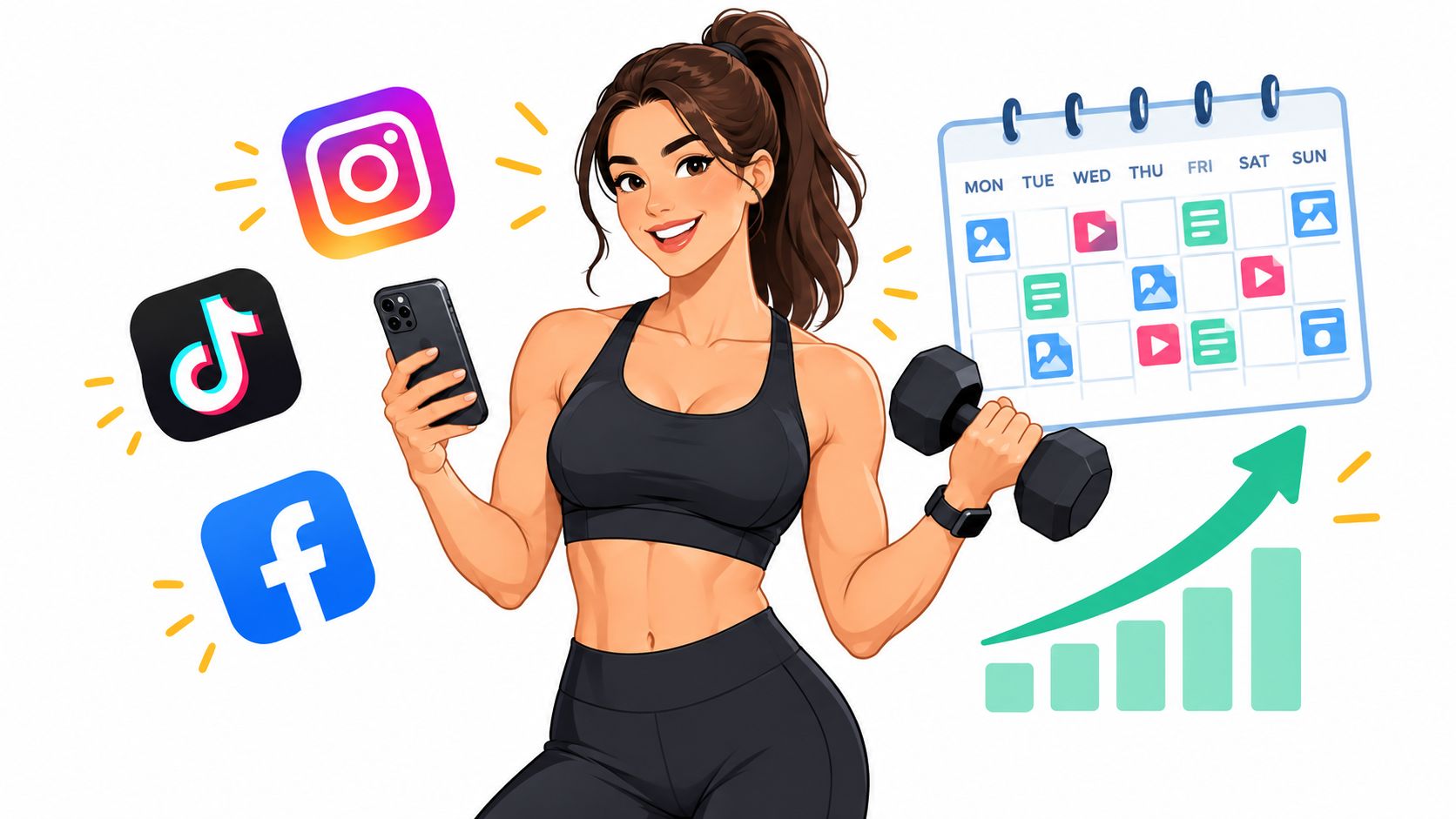
Most personal trainers don't need more followers. They need more of the right people finding them, trusting their coaching, and booking a conversation. A viral workout clip can produce applause without producing a single qualified enquiry, while a simple post answering a local beginner's question can bring in someone ready to buy.
That distinction changes the entire approach to social media marketing for personal trainers. The objective isn't to become a full-time content creator. It's to build a searchable, locally relevant content funnel that moves prospects from discovery to direct message, consultation, and paid coaching, while protecting client privacy and measuring commercial results.
Rethinking Follower Counts and Social Search
A large follower count looks impressive, but it doesn't tell you whether those followers live near your facility, understand your offer, or have any intention of hiring you. A smaller audience of local people searching for beginner strength coaching, postpartum training, or mobile senior fitness can be far more valuable than a global audience attracted by unrelated entertainment.
Social platforms increasingly behave like search engines. A 2026 industry analysis reports that 74% of Gen Z uses TikTok for search and 51% prefers it to Google for some searches, with discovery increasingly influenced by watch time, rewatches, pauses, saves, and shares rather than follower counts (Trainerize's social media trends analysis). That means your content should answer the questions a potential client is already typing, not just imitate the latest trend.

Make your profile easy to find
Your profile should state who you help, where you work, and what someone should do next. “Personal trainer” is broad. “Strength coach for beginners in Bristol” or “Online menopause fitness coach” gives both people and platforms a clearer match.
Use the same language in your name field, bio, captions, subtitles, and spoken introductions. Build posts around specific searches such as:
- Beginner questions: “Can beginners join small-group strength training in Bristol?”
- Problem-based searches: “How can I return to exercise after having a baby?”
- Service searches: “What happens in a personal training assessment?”
- Local searches: “Best personal trainer for back-friendly strength training in Leeds.”
Add descriptive alt text, captions that include the location and service, and a single booking path. A relevant guide to popular fitness hashtags can support discovery, but hashtags shouldn't replace clear search language.
Practical rule: Treat every Reel, carousel, and TikTok as a small landing page. Give it one audience, one problem, and one next action.
Track profile visits, direct messages, consultation bookings, and email sign-ups, not views alone. If a post reaches fewer people but produces qualified conversations, it deserves more attention than a high-reach post that attracts no buyers.
Choosing the Right Platforms for Client Acquisition
Trying to publish equally on every network usually creates shallow content and inconsistent follow-up. Choose the platform where your ideal client already looks for information, then repurpose intelligently rather than spreading yourself thin.
A 2025 survey of nearly 500 personal trainers found that 30.2% obtained the most clients from social media. In that survey, 42.2% identified Instagram as the best platform for promoting a personal-training business, followed by Facebook at 20.0% and YouTube at 15.6% (the survey summary from Axis Intelligence). These are reported preferences, not universal conversion rates, so use them as a starting point rather than a guarantee.
| Platform | Best For | Ideal Content Format |
|---|---|---|
| Visual coaching, movement demonstrations, local brand discovery | Reels, carousels, Stories, client-approved progress posts | |
| Local communities, referrals, group conversation, established audiences | Community posts, live sessions, event updates, longer explanations | |
| TikTok | Search-led discovery, practical answers, approachable education | Short demonstrations, question-led videos, technique explanations |
| YouTube | Authority, detailed education, online coaching nurture | Tutorials, full exercise breakdowns, training explanations |
| Messaging channels | Private support, referrals, consultation follow-up | Voice notes, FAQs, booking reminders, community updates |
Match the channel to the offer
Instagram suits trainers who can demonstrate coaching visually and consistently. A mobility coach might publish form corrections and short movement tests, while a strength coach can show setup, technique, and modifications. Instagram also supports direct messages and profile links, which makes it useful for moving interest toward a consultation.
Facebook often works better when the business depends on local trust and community participation. A trainer offering small-group classes can contribute useful answers in local groups, host an information session, or build a private client community. The content should feel like a helpful local presence, not a stream of advertisements.
TikTok can introduce your coaching to people who don't follow you yet, particularly when each video answers a clear question. YouTube requires more production time, but a detailed explanation can keep working as an authority asset long after publication.
Use Instagram and Facebook as your starting pair if your business is local and relationship-led. Explore channel-specific ideas in this guide to Instagram influencers in fitness, then select the channel you can maintain and support with prompt replies.
Building a High-Converting Content Calendar
A blank screen encourages random posting. A simple calendar gives you a repeatable system for demonstrating expertise, showing personality, and making offers without turning every post into a sales pitch.
An exploratory analysis of 226 fitness-brand posts found that trendiness and user-generated content produced the highest engagement, while direct remunerative content produced the lowest (the fitness-brand content analysis). The practical lesson isn't to avoid selling. It's to earn attention and trust before asking someone to book.

Use three content jobs
Educational posts answer technique questions, correct common mistakes, and explain how your service works. A short video showing three squat modifications can attract beginners who aren't ready to contact you yet, but who are actively evaluating your expertise.
Lifestyle and community posts make the business human. Share a behind-the-scenes coaching moment, a client-approved milestone, a local walk, or an honest explanation of how you adapt training for busy schedules. User-generated content can work particularly well when it reflects the client experience accurately.
Direct offers tell people what to do next. Invite them to book an assessment, request a programme outline, join a small-group intake, or send a message with a specific keyword. Keep the offer clear and make the booking process simple.
Run a focused content test
Use a 30-day test with three hypotheses:
- Technique trend: Adapt a relevant trend into a useful exercise explanation.
- Client voice: Publish an approved testimonial, progress note, or client question.
- Direct offer: Present a consultation, assessment, or trial with a clear reason to act.
Keep the format, audience, cadence, and call to action as comparable as possible. Review engagement per reach, saves, shares, profile visits, qualified messages, and bookings. Repeat the strongest themes, but improve the offer rather than just publishing more.
Batch filming around one coaching session. Record several exercise demonstrations, answer common questions while the setup is ready, and turn one idea into a Reel, carousel, Story, and email. A practical social media campaign template can help you organise the test without sacrificing coaching time.
Designing Funnels That Turn Scrollers Into Clients
Attention only becomes useful when the next step is obvious and measurable. Every post should lead somewhere, even if that destination is a helpful conversation rather than an immediate sale.
A study of fitness centres found that follower count was the strongest predictor of revenue in its regression model, with a standardized beta of 0.732 (the fitness-centre study). That finding doesn't mean every follower creates revenue. It reinforces the need to connect audience growth with relevant offers, qualified leads, and sales records.

Map the buyer's next action
Start by choosing one primary conversion event. That might be a consultation booking, paid trial, assessment, or application for online coaching. Avoid sending one post to a booking page, a social inbox, and several unrelated resources at the same time.
Build the path like this:
- Discovery: A searchable Reel or TikTok answers a specific training question.
- Interest: The profile explains the niche, location, coaching method, and result the service supports.
- Trust: A carousel, FAQ, email, or private conversation addresses objections.
- Conversion: A dedicated booking page or direct message moves the prospect into a consultation.
Use unique landing-page URLs, UTM parameters, or platform-specific booking codes. Record reach, profile visits, link clicks, booked consultations, attendance, and sales in a weekly funnel report. Then calculate cost per qualified lead and consultation-to-client conversion rate. If you aren't paying for ads, still track the time required to create and manage the content.
A resource such as this Trendy actionable growth guide can provide additional ideas for turning social attention into lead-generation activity.
Own the relationship
Social platforms can change distribution without warning. Offer a useful checklist, starter guide, or email series in exchange for permission to follow up. The lead magnet should solve a small, relevant problem and naturally lead to your paid service.
Don't use a generic “link in bio” with a crowded menu. Give visitors one clear choice. A beginner-focused trainer might offer a local assessment, while an online coach could invite prospects to complete a short coaching application. Review the numbers weekly by location, goal, age group, content theme, and source. Increase effort where qualified leads and sales improve, not where views merely rise.
Generating Social Proof While Respecting Privacy
A client can be delighted with their progress and still not want their body, health history, or training experience displayed publicly. Pressuring someone to appear in a transformation post weakens trust, even if the post performs well.
Consider a client who improves their strength and confidence over several months but works in a public-facing role. They may agree to a first-person written testimonial while declining photos and video. Another client might prefer an audio message shared only inside a private referral group. Both stories can help a prospective client understand the coaching experience without exposing information that belongs to the client.
A qualitative study of 34 professional fitness trainers identified four practical purposes for social media: building community, educating audiences, making social connections, and marketing services (the qualitative trainer study). That broader view supports a content strategy based on relationships, not only public transformation imagery.
Build proof with permission
Use a consent menu instead of a single release form that assumes every client wants public exposure. Offer choices such as:
- Anonymized case notes: Describe the starting problem, coaching approach, and observed progress without identifying the client.
- Text testimonials: Let clients write in their own words and approve the final edit.
- Audio feedback: Share a voice testimonial only where the client has agreed to the channel and audience.
- Client-written FAQs: Turn recurring questions into educational posts without attaching a name.
- Private referrals: Create an opt-in group where clients can invite friends who want discreet support.
- Email follow-ups: Send useful training guidance that keeps the relationship active away from public feeds.
Never imply guaranteed outcomes. Include context about the coaching process and avoid presenting an exceptional result as typical. Ask for fresh consent if the channel, purpose, or audience changes.
Measure private trust
Public likes are only one form of response. Track direct-message conversations, referral sources, consultation attendance, repeat enquiries, and retention. Private sharing can be difficult to attribute, so ask every new prospect how they heard about you and record the answer consistently.
A trainer who protects privacy can still demonstrate professionalism through thoughtful education, clear boundaries, and reliable follow-up. That often attracts clients who value discretion as much as visible results.
Elevating Your Brand Through Facility Hygiene
Your marketing creates the first expectation. Your training space confirms whether clients believe the promise. Clean equipment, visible routines, and clear communication can make the facility feel organised before a coach says a word.
Federal fitness-facility reopening guidance says disinfecting wipes may be used for individual wipe-downs between uses, recommends EPA-registered disinfectants for hand-contact surfaces, and requires surfaces to remain wet for the product label's required contact time (the federal fitness-facility guidance). Wiping once and immediately drying the surface may not meet that requirement.
Create a visible cleaning routine
Place a gym wipe dispenser near high-contact equipment, including free weights, bars, cardio-machine grips, benches, seats, fitness balls, and rope handles. Choose EPA registered disinfecting wipes that suit the surface, then check the product instructions and the equipment manufacturer's guidance before routine use.
A practical station routine looks like this:
- Remove visible dirt when needed.
- Apply wipes for gym equipment according to the product directions.
- Keep the surface visibly wet for the stated contact time.
- Allow the product to work, then remove residue if the label requires it.
- Check upholstery, rubber, screens, and metal for compatibility.
Stock commercial disinfecting wipes or fitness center wipes in suitable quantities so staff aren't forced to ration them during busy periods. Wipes.com disinfecting wipes can be one option to assess when comparing supply formats, dispenser compatibility, and product instructions.
Turn the routine into content
Show the dispenser locations, explain why contact time matters, and include the cleaning process in facility tours or Stories. Don't make unsupported promises about eliminating every risk. State what your team cleans, when they clean it, which surfaces clients should wipe between uses, and how staff handle scheduled deep-cleaning.
For additional equipment-care guidance, trainers can review these tips from Evermost LLC. Your hygiene content should support the actual routine, not replace it. If the camera shows a spotless station while clients can't find wipes during a session, the marketing creates distrust.
Finish every session by checking high-touch surfaces and replenishing supplies. A clean space supports retention because clients notice whether the business respects their time, comfort, and safety.
Choose one local audience, one primary platform, and one conversion event this week. Rewrite your profile around the problem you solve, publish three search-led posts, add a trackable consultation link, and ask every new enquiry how they found you. Then place accessible disinfecting wipes at each equipment station, follow the label's wet contact time, and show clients that your professional standards continue after they book.
Leave a Reply