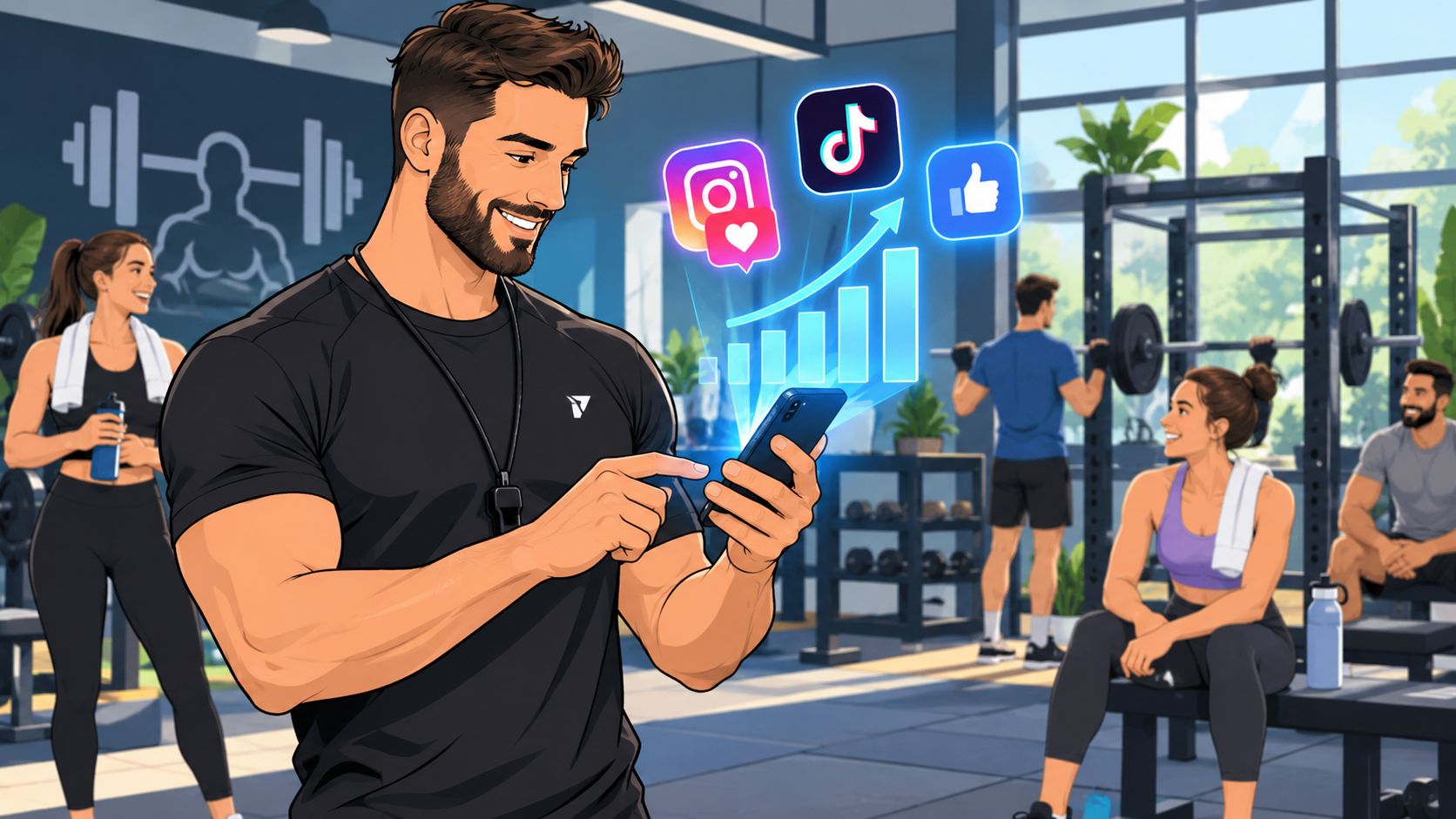
Social media has become a global mass-reach channel. DataReportal estimates 5.79 billion social media user identities worldwide at the start of April 2026, representing 69.9% of the global population, with social users outnumbering non-users by more than two to one (DataReportal's 2026 social media analysis). For a gym owner, the important question isn't whether everyone will see your content. It's whether nearby prospects will find enough evidence to trust your facility before they book.
A local prospect may discover your studio on Instagram, compare class clips on TikTok, check reviews and schedules on Facebook, then visit your website only after deciding that your coaching style and community feel right. Social media is important because it now sits inside that research process. It helps gyms create brand awareness, membership leads, community, retention, and measurable return on investment, but only when the content answers real buying questions.

A gym rarely closes a membership entirely inside a social feed. Social media usually opens the conversation, reduces uncertainty, and gives a prospect a reason to take the next step. A practical social media marketing strategy should therefore focus less on posting for visibility and more on making the path from discovery to trial obvious.
Consistency matters more than having the largest advertising budget. A smaller gym with clear positioning, regular proof, responsive DMs, and useful coaching content can look more trustworthy than a larger competitor whose account only publishes discounts.
The Reach and Reality of Social Media for Gyms
The global scale is substantial, but scale alone won't fill a local class. Your facility still competes for attention among nearby residents who want to know whether the gym is convenient, welcoming, clean, and suitable for their current fitness level.
That local research often happens before a prospect calls. They look for the atmosphere in member videos, the coaching standard in trainer demonstrations, and the practical details hidden in captions or comments. They may also check whether prices are explained clearly, whether beginners appear comfortable, and whether the gym shows real people rather than stock-style fitness imagery.
What prospects validate before visiting
Social media works as a research and trust layer, not merely a broadcasting channel. A facility walkthrough can answer questions that a billboard can't: how crowded the floor feels, where equipment sits, how bright the space is, and whether the environment suits someone who feels nervous about joining.
Trainer content handles another concern. A short clip showing a coach correcting a squat, explaining progression, or adapting an exercise demonstrates competence without making an unsupported promise. Member stories add social proof, especially when they show ordinary progress and retain the person's natural voice.
The five commercial outcomes are connected:
- Awareness: Local prospects recognize your gym and understand its position.
- Lead generation: Offers, DMs, forms, and booking links turn attention into conversations.
- Community: Members see themselves represented and feel part of something active.
- Retention: Challenges, milestones, and check-ins support participation after signup.
- ROI: Tracking connects content and campaigns to trials, memberships, reactivations, and referrals.
Practical rule: Treat every post as an answer to a question a prospect or member might ask.
The effort is real. Someone must film, edit, publish, respond, collect permissions, and review results. But consistency doesn't require cinematic production. A phone, a repeatable content calendar, and a team willing to appear on camera can create a stronger local impression than occasional polished campaigns.
Building Brand Awareness That Feels Like Your Gym
A billboard tells people that a gym exists. Social media lets them inspect the experience before they commit time, money, and personal vulnerability to a visit.
That difference changes the creative brief. Your account should help a prospect identify the gym's personality quickly. A 60-second facility walkthrough can show real equipment, lighting, traffic flow, and the spaces where classes happen. The value isn't production polish. It's reducing the gap between what the prospect expects and what they'll encounter at the front desk.
Show the details that advertisements hide
Trainer authority content gives awareness a useful foundation. Film coaches explaining a movement, demonstrating a regression, or discussing how they welcome beginners. Prospects don't need grand claims. They need visible evidence that your trainers can teach, observe, and communicate.
Member-of-the-month spotlights work for a similar reason. With permission, show a member's routine, milestone, or reason for joining in language that sounds like them. A scripted transformation claim can create distance, while an honest account of how someone fits training into work and family life can make the gym feel attainable.

Build recognition through repeatable proof
Traditional awareness forces people to imagine the experience. Social content supplies repeated, specific signals:
- The environment: Show the entrance, changing areas, equipment condition, and class setup.
- The coaching: Capture cueing, warmups, modifications, and trainer personality.
- The culture: Feature greetings, team moments, challenge recaps, and inclusive member participation.
- The offer: Explain who a trial suits, what it includes, and what happens next.
This layer often looks unglamorous in a monthly report because it may not produce an immediate booking. Its commercial value appears when a prospect arrives already familiar with the facility. They ask better questions, feel less uncertainty, and need less explanation from the sales team.
Awareness also compounds across other channels. Someone who sees your reel may later search your name, open an email, respond to a retargeting ad, or mention your gym to a friend. Social media gives those later touchpoints context, but only if the account consistently reflects the member experience.
Turning Followers Into Membership Leads
A follower count doesn't pay rent. A tracked conversation, booked intro, attended trial, or membership does. Social media becomes a lead-generation engine when you connect a relevant offer to a clear next action and record what happens afterward.
Fitness advertising can perform efficiently when targeting, creative, offer design, and tracking align. The 2026 benchmark cited by Webtonic places Fitness and Wellness Facebook Ads conversion at 14.29%, compared with roughly 8% to 10% across industries, while reported cost-per-lead ranges from $10 to $52 depending on audience and execution (fitness Facebook Ads benchmarks). Those figures aren't a promise for your gym. They're a reason to test the channel with disciplined measurement rather than dismissing it as vanity marketing.
Design the funnel before buying reach
Start with one useful entry offer:
- A free beginner program PDF can capture people who aren't ready to visit.
- A body-composition scan can create a reason for an in-person conversation.
- A class drop-in or short trial can move a warmer prospect toward the facility.
Then retarget people who watched a reel, visited the profile, opened a form, or engaged with the offer but didn't book. The next ad should address hesitation, such as what to bring, whether beginners are welcome, or how the first session works. Send traffic to a focused page with one promise, one form, and a calendar link.
Organic capture and paid capture serve different jobs. DMs and comments are useful when trainers can respond quickly and personally. Paid lead forms make more sense when you need predictable volume and can follow up promptly. A win every lead guide from Expressify AI can help teams tighten the follow-up process around those incoming inquiries.
The current benchmark data supports testing, but it doesn't remove operational costs. Creative fatigue means your team must keep producing fresh openings, demonstrations, member proof, and offer angles. Don't treat one filming day as a permanent acquisition system.
Social media lead generation works best when your sales process is ready for the attention it creates. A fast reply, clear qualification, and scheduled next step matter as much as the ad itself.
Fitness Ad Benchmarks by Objective 2026
| Campaign Objective | Avg. CTR | Avg. Cost per Lead | Notes for Gyms |
|---|---|---|---|
| Fitness and Wellness Facebook Ads | Not provided in verified data | $10 to $52 reported range | Test audience, creative, offer, and follow-up together |
| Trial or intro offer campaign | Not provided in verified data | Depends on segment and execution | Use a focused landing page and calendar |
| Retargeting campaign | Not provided in verified data | Depends on segment and execution | Address objections from warm viewers and visitors |
Community Building as Retention Strategy
Community posts aren't decoration around business. They can become retention infrastructure when they give members recognition, accountability, and a reason to return.
A member who sees a challenge recap remembers the next session. Someone featured in a milestone post gains an identity inside the group. A beginner who watches another member receive encouragement gets evidence that participation is noticed. These signals matter most when motivation drops, because attendance depends on more than a membership contract.
Three practical retention plays
Weekly challenge recaps should show participation, not just winners. Highlight different forms of progress, invite members to comment on the next goal, and make the following week visible. Track whether challenge participants attend again, engage with the next post, or respond to a coach.
Trainer DM check-ins can follow an attendance concern identified through your member systems, with social content reinforcing the personal tone. A coach might ask how a member's week is going, suggest a suitable class, or remind them that modifications are available. The post creates public belonging, while the DM creates private support.
Member-of-the-month spotlights reinforce identity. Ask what brought the member in, what they enjoy, and what helped them stay consistent. Then watch whether featured members refer friends, attend featured sessions, or participate in community activities.

A promotion-only account creates a very different member experience. It speaks whenever the gym needs a sale, but it doesn't give members much reason to interact between visits. A community-led account supports visit frequency, identifies disengagement earlier, and gives staff more natural reasons to reconnect.
The useful question isn't, “How many likes did this post receive?” Ask whether the post encouraged a visit, prompted a member reply, generated a referral, or helped a coach reopen a conversation. Those are retention signals. Social media's contribution to lifetime value may be indirect, but the operating behaviors are observable.
Cutting Through Skepticism and Misinformation
Gym owners are right to question vanity metrics. A large reach number doesn't prove that people trust your coaches or join your facility. Audiences are also more cautious about fitness and mental-health claims. APA polling reported that half of adults had reduced their social media use in 2025, while 54% said they encountered mental-health misinformation at least weekly and 31% considered mental-health information on platforms inaccurate (APA polling on social media use and misinformation).
That skepticism doesn't make social media irrelevant. It makes credibility more valuable.
Replace promotional noise with verifiable signals
Three generic discount posts can blur together. A raw coach tutorial may hold attention because it demonstrates something useful. An unfiltered member check-in may feel more believable than an aggressively edited transformation video. Transparent pricing, named trainers, visible credentials, realistic form cues, and clear boundaries around health advice reduce the amount of research a prospect must do independently.
Social media shouldn't position a gym as a medical authority. Coaches should stay within their qualifications, avoid guaranteed outcomes, and direct health concerns to appropriate professionals. That restraint is part of the trust signal.

Moderation matters as well. Establish who handles abusive comments, misleading claims, privacy concerns, and questions that require a qualified professional. These essential moderation tactics and tools can help your team respond consistently without turning every comment into an improvised policy decision.
The goal isn't to manufacture hype. It's to create a credibility layer that serious buyers can inspect. Good social content filters out some poor-fit prospects while giving suitable prospects enough confidence to book.
Picking the Right Platforms for Your Gym
Being everywhere is not a strategy if your team can't maintain quality. Choose platforms according to the job they perform, then build a workflow your staff can sustain.
Instagram is usually the visual and relationship hub. It suits facility tours, trainer demonstrations, member stories, Stories updates, and trial offers. TikTok and YouTube Shorts are useful discovery channels for concise coaching clips, approachable explanations, and member transformations that can reach people who don't yet know your gym.
Facebook serves a different role. It can support local community communication, events, schedule updates, announcements, and conversations with members who prefer a more established community space. The right choice depends on your local audience, not on whichever platform happens to be receiving the most industry attention.
Gym Marketing Jobs by Platform
| Platform | Best Gym Job | Content Type | Audience Fit |
|---|---|---|---|
| Vibe, trust, and trial consideration | Reels, Stories, walkthroughs, coach clips | Prospects comparing local gyms and members following daily activity | |
| TikTok | Cold-audience discovery | Short coaching videos and transformations | People browsing quick, personality-led fitness content |
| Community and event communication | Events, schedules, announcements, group posts | Local members and prospects who prefer community updates | |
| YouTube Shorts | Searchable discovery and education | Short tutorials, FAQs, and demonstrations | Prospects looking for practical guidance and coach credibility |
Use a simple allocation rule:
- Choose one primary platform that matches your members' habits and your team's strengths.
- Choose one discovery platform for reaching new local prospects.
- Keep the remaining accounts optional until the first two produce consistent content and measurable conversations.
A studio serving older adults may prioritize Facebook and Instagram. A strength gym targeting younger beginners may use Instagram as the operating hub and TikTok or Shorts for discovery. A family-oriented facility may need Facebook events and local updates more than daily trend participation.
Don't copy every post across four accounts without adapting the opening, format, and call to action. A strong tutorial published consistently in two suitable places will usually give your team more useful learning than weak, irregular activity everywhere.
Measuring the ROI of Social Media
Social media ROI starts with revenue, not applause. The basic commercial question is whether the value of memberships, reactivations, and referrals exceeds the cost of acquiring and serving those customers.
A practical formula is:
Social ROI = member lifetime value minus acquisition cost
You can apply it at campaign level, but you should also examine the supporting actions. A post may create the first touchpoint, a retargeting ad may generate the booking, and a staff member may close the membership during the visit. Credit the whole path instead of pretending one format did all the work.
Track the journey with simple identifiers
Use UTM tags on profile links and campaign landing pages. Give each offer a unique code or booking option. Ask every new lead how they heard about the gym, then compare the answer with your digital records. No tracking method is perfect, but several imperfect signals are more useful than a dashboard that only reports reach.
Reactivation deserves separate attention. Existing or lapsed members already know your facility, so a personal DM, relevant class invitation, or progress check can reopen a relationship without the same cold prospecting burden. The supplied scenario of 50 reactivation DMs yielding 8 memberships at $40 monthly, compared with a $150 cost per lead for cold ads, illustrates why operators should evaluate retention activity separately from acquisition. Those figures are an example for comparison, not a universal benchmark.
Email capture also changes the economics. A social post can introduce the gym, a lead form can collect permission, email can nurture the prospect, and a referral prompt can create another opportunity. That turns content into a multi-channel asset rather than a one-time conversion.
For additional context on how to measure social impact, use a calculation approach that includes campaign cost, staff time, offer cost, and realized revenue. The ROI calculation guide can also help organize the broader financial picture.
Social Media ROI Metrics for Gyms
| Metric | How to Track | Target Benchmark | Reporting Cadence |
|---|---|---|---|
| Qualified leads | CRM source, UTM, form fields, staff notes | Set from your current baseline | Weekly |
| Booked trials | Calendar source and unique offer code | Set by capacity and close process | Weekly |
| Membership sales | CRM attribution and onboarding records | Compare against acquisition cost | Weekly and monthly |
| Reactivations | DM log, member status, payment record | Compare with cold acquisition economics | Weekly |
| Referral conversations | Referral code or intake question | Establish a baseline before testing | Monthly |
| Content-assisted revenue | First-touch and assisted-touch notes | Review alongside total campaign cost | Monthly |
Review a small dashboard every week. Look at qualified leads, bookings, attendance, sales, reactivations, response time, and spend. Then review lifetime value and retention trends monthly, because those outcomes need enough time to become visible.
Your 30-Day Gym Social Media Action Plan
A short launch plan keeps social media from becoming an endless brainstorming exercise. Give each week a commercial purpose, assign ownership, and record what the team learns.
Week one builds the foundation
Audit your profile as if you were a nervous prospect. Check the location, opening hours, contact method, trainer information, class descriptions, pricing language, reviews, and profile link. Make the first screen answer three questions: who the gym serves, what makes the experience different, and how to book.
Record a baseline for inquiries, booked trials, attendance, memberships, reactivations, and referral conversations. You don't need a complicated reporting system. A spreadsheet connected to your CRM can show whether social conversations become sales.
Week two makes the facility recognizable
Film a facility walkthrough, several trainer authority clips, and member stories with written permission. Use a few dependable content buckets:
- Education: Form cues, beginner guidance, and exercise explanations.
- Experience: Equipment, class flow, coach introductions, and daily atmosphere.
- Proof: Member milestones, challenge recaps, and testimonials.
- Invitation: Trial details, FAQs, schedules, and booking prompts.
Publish consistently enough that the account looks active, but don't sacrifice clarity for volume. Respond to every genuine question and save recurring objections for future content.
Week three turns attention into action
Choose one trial or intro offer. Build a landing page or lead form with a direct call to action, install UTM tracking, and create a retargeting audience from engaged viewers or profile visitors. Prepare replies before launching so staff can answer questions about price, timing, equipment, and suitability without delay.
Check cost per lead, lead quality, response time, booked trials, and attended trials. A cheap inquiry that never schedules isn't a successful campaign.
Week four strengthens belonging
Run a weekly challenge, publish a member shout-out, recap participation, and ask members to refer someone who would enjoy the experience. Review which posts generated DMs, visits, comments from existing members, and reactivation conversations.
Cleanliness should appear in the actual facility and in the trust signals you publish. Keep equipment wiped down with disinfecting wipes between sets, make the process visible, and post a brief hygiene clip that shows staff and members protecting the shared environment. For high-use areas, operators can evaluate commercial disinfecting wipes and place a gym wipe dispenser where members can reach it without interrupting their workout.
A clean facility supports the promise your social content makes. If prospects see organized equipment, attentive coaches, and consistent hygiene, your credibility continues from the screen to the first visit.
If you're ready to make social media a membership system rather than a posting task, choose your primary platform today, film one facility walkthrough, and create a single tracked trial offer. Then assign one staff member to answer every inquiry and review the results at the end of the week. Go to the Gym Membership Tips resource library, select the social strategy that fits your facility, and put the first campaign live with a clear next step.
Leave a Reply