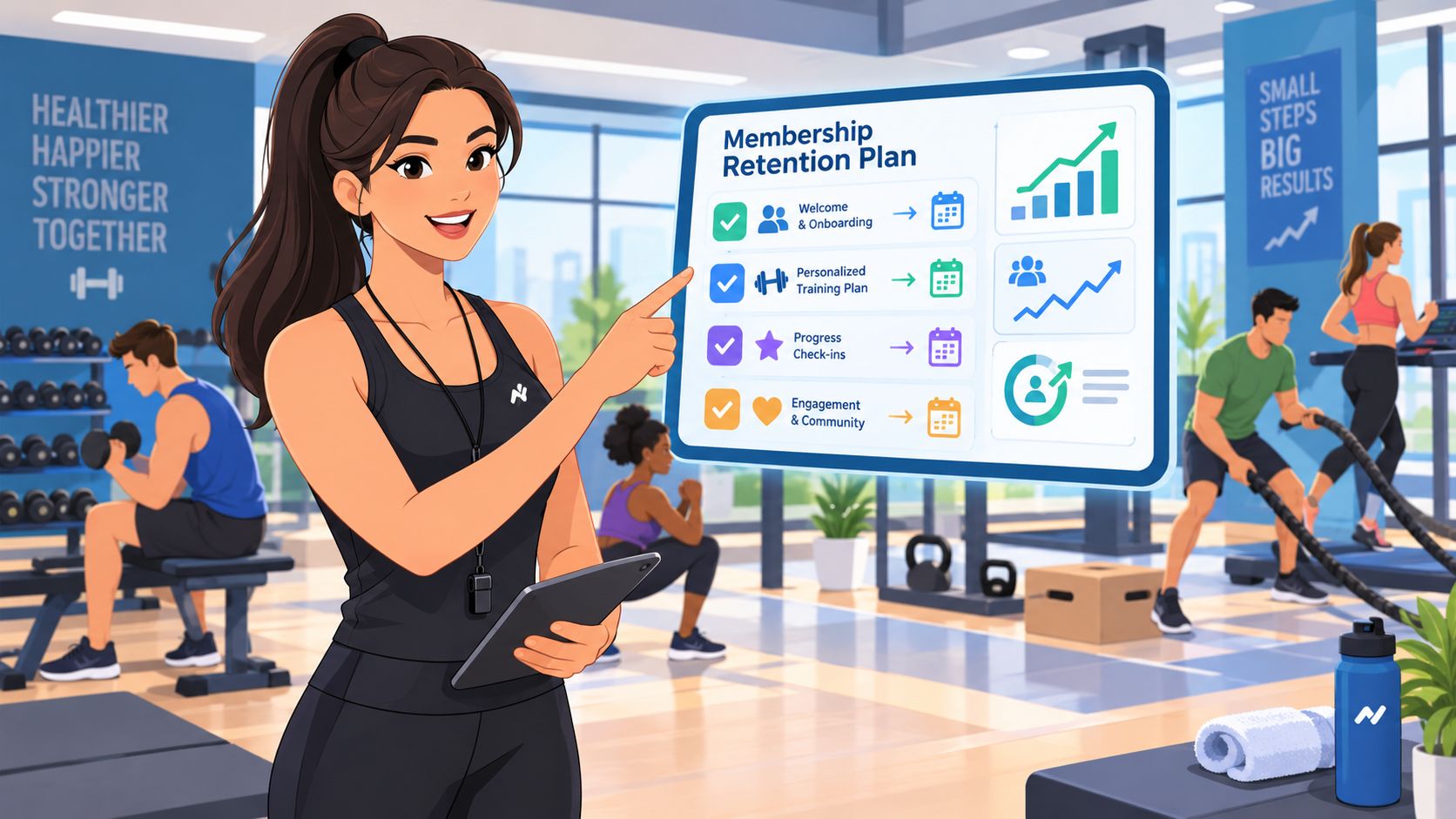
A gym can lose roughly one in three members every year while still believing its retention process is “working.” The fitness industry's annual retention benchmark is 66.4%, which implies 33.6% annual attrition. That figure comes from the Health & Fitness Association's 2025 benchmarking data, based on more than 175 companies and over 17,000 facilities across 27 countries, as summarized by Uptivo's gym member retention analysis.
That number should change how you build a membership retention plan template. Retention isn't mainly a messaging problem. It's an operating system for spotting disengagement early, assigning a person to act, and helping members build a routine before cancellation becomes the obvious choice.
Why Most Gyms Lose One in Three Members Every Year
The 66.4% annual retention rate is a floor, not a target. Strong boutique operators commonly report annual retention around 75% to 80%, according to PushPress's retention guide. The gap reflects operating discipline, not another newsletter or motivational poster. A retention plan must treat the first 90 days as a separate system, with milestones, triggers, and save flows.
A 2,000-member club retaining 67% instead of 75% would lose roughly 160 additional memberships in a year. At $55 in average monthly dues, that equals more than $100,000 in lost monthly recurring revenue before win-back spending. These figures are a worked example, not an industry benchmark, but they show why small retention gains deserve management attention.

The three failures behind the gap
First, the calendar is generic. A monthly check-in gives the same treatment to a new member, a regular attendee, and someone whose visits have collapsed. New members need structure. Established members with falling attendance need a defined intervention.
Second, nobody owns the save. An “at risk” CRM flag achieves nothing when no employee is responsible. Every alert needs an owner, deadline, message, and outcome code.
Third, onboarding ends too soon. An intro session can remove confusion, but it does not establish a durable routine. Historical fitness-sector findings identify the first six months as a critical period, with about 50% of new gym members quitting within six months and many disengaging within roughly 90 days, as summarized by Pilotium's 2026 retention overview.
Operating rule: If your plan waits for a cancellation request, it is a recovery process, not a retention system.
Staff capacity also affects member retention. Overworked teams with unclear responsibilities rarely deliver consistent personal follow-up. Guidance on building a workplace people love supports the operational point: give staff clear ownership, manageable workloads, and a defined save process.
The Core Sections of a Membership Retention Plan Template
A retention template earns its place when staff can answer four questions immediately: who needs contact, when it happens, why the member was flagged, and what happens next. Build the logic before launch. Staff should edit the record, not invent a process during a busy shift.
1. Member segmentation inputs
Capture tenure band, visit-frequency tier, contract type, and risk flag. Tenure routes members into first-90-day onboarding or longer-term loyalty work. Visit frequency reflects current behavior. Contract type shows renewal timing, and the risk flag selects the correct outreach branch.
Use clear labels such as new, developing habit, established, and lapsed. Set attendance tiers in advance. Personal judgment creates inconsistent treatment, so a frequent attendee and a member with sharply falling visits must not receive the same message.
2. Onboarding timeline
Pre-fill checkpoints for day 1, day 7, day 14, day 30, day 60, and day 90. Every checkpoint needs a channel, an owner, a purpose, and a completion field.
Make the timeline behavior-led. A member attending consistently receives progress reinforcement. A member falling below the early baseline moves into an intervention branch. The first 90 days therefore operate as a separate system, not as a generic monthly check-in calendar.
3. At-risk trigger matrix
Pair every signal with one defined action. Triggers can include two missed weeks, a broken class pattern, a falling weekly visit count, or a failed payment. Separate voluntary cancellations from involuntary churn, because payment recovery and engagement problems require different save flows. The broader principles in these gym member retention strategies can help refine the trigger logic.
4. Owner assignment roster
Assign each touchpoint to a named role. Front desk staff, coaches, assistant managers, and general managers should not share vague responsibility. “Team follows up” is not an assignment. Record the owner, deadline, contact method, and outcome code for every alert.
5. KPI dashboard
Separate weekly operating signals from monthly business outcomes. Weekly measures help the team spot missed visits, incomplete onboarding, and open saves while there is still time to act. Monthly measures show leaders whether retention is improving across the member base.
6. Monthly review agenda
Hold a recurring meeting with a fixed agenda: cohort retention, leading risk causes, unresolved saves, payment failures, completed onboarding, and process changes. Review the records, identify repeated failure points, and assign a correction before the next meeting.
| Template Section | What It Captures | Owning Role |
|---|---|---|
| Member segmentation inputs | Tenure, visits, contract, risk | Operations manager |
| Onboarding timeline | Milestones and completion | Front desk and coach |
| At-risk trigger matrix | Signal and save action | Retention owner |
| Owner assignment roster | Staff accountability | General manager |
| KPI dashboard | Weekly and monthly measures | Manager |
| Monthly review agenda | Decisions and corrections | Leadership team |
Mapping the First 90 Days Around Real Member Behavior
Riley is 34 and joins with strong initial enthusiasm. Riley attends nine times in week one, drops to three visits in week two, then records zero visits in week three. A generic monthly calendar might send a cheerful update after the problem has already become obvious. A behavior-led template reacts while there's still a relationship to recover.
On day 1, the coach who ran Riley's intro session sends a personal welcome text. It confirms the next appointment, reinforces the first goal, and gives Riley one clear action for the coming week. The message should sound like it came from someone who remembers the conversation, not from a bulk campaign.
On day 7, the system compares Riley's attendance with the week-one baseline. Because the plan uses behavior triggers, the personal check-in fires only when the attendance pattern dips. The coach asks what changed and offers a concrete booking option, rather than sending an empty “we miss you” message.

The intervention points
At day 30, Riley receives a milestone nudge inviting a goal-setting session with a trainer. The staff member reviews attendance, asks whether the original goal still fits, and makes the next visit easy to schedule. Many clubs fail here. They measure absence but don't create a realistic path back.
At day 90, Riley routes into one of two branches. Cumulative visits and recent behavior determine whether Riley receives a renewal save flow or a loyalist upgrade offer. The system doesn't reward high engagement with a desperate discount, and it doesn't send an upgrade pitch to someone who has barely returned.
This example is the reason a separate first-90-days system matters. Historical industry summaries connect early attendance and habit formation with retention risk, including the pattern that about half of new members quit within the first six months, as reported in Regulr's fitness retention statistics summary. For implementation detail, use a documented client onboarding process template and adapt the fields to your club's actual workflow.
Outreach Scripts and Cadence for Every Stage
Staff shouldn't improvise retention messages between check-ins and closing duties. Give them short scripts, fixed triggers, and reply rules.
Welcome sequence
Day 0, email
Subject: Welcome to [Gym Name], your first step
Hi [First Name],
Welcome to [Gym Name]. [Coach Name] is your assigned coach for the first phase of your membership. Your next step is [booked session or class]. Reply to this email if you need help choosing a time.
See you soon,
[Staff Name]
Day 0, SMS
Hi [First Name], it's [Coach Name] from [Gym Name]. You're all set. I'd like to help you lock in your first goal-setting session. Would [specific option] work?
Day 2, email
Subject: Your first goal at [Gym Name]
Hi [First Name],
You mentioned that you want to [member goal]. At your next visit, we'll make that goal practical by choosing a starting routine and one progress marker. Reply with “GOAL” and I'll reserve time with [Coach Name].
Day 5, SMS
Hi [First Name], checking in before your first week wraps up. Your next useful step is [class, appointment, or workout]. Reply “BOOK” and I'll help schedule it.
Nudge sequence
Trigger this sequence when a member misses two scheduled visits within seven days.
Day 7 accountability text: “Hi [First Name], I noticed you missed two planned visits. Is your schedule getting in the way, or do you need help adjusting the plan? Reply 1 for scheduling help or 2 for a coach call.”
Day 10 coach email
Subject: Let's reset your training week
Hi [First Name],
Your plan doesn't need to be perfect. Let's choose one realistic visit and get momentum back. I can help you book [specific class or appointment]. Reply with the best day.
Day 14 front desk handoff: “Hi [First Name], [Coach Name] asked me to help secure your next visit. I have [specific slot] available. Should I book it for you?”
Log every reply. BOOKED moves the member out of the active nudge queue. CALLBACK assigns a person and deadline. DECLINED records the reason. No reply triggers the next escalation.
Save and reactivation sequences
At day 14 of a risk flag, send: “Hi [First Name], we've noticed a gap in your visits. We'd like to help you restart with one month free and a quick plan reset. Reply RESET and [Manager Name] will call you.”
At day 21, the manager calls. The conversation should identify the barrier, offer a realistic rebooking option, and record whether the member wants to continue, pause, or exit.
For members lapsed 30 days, use the subject line “Your restart is ready” and offer $0 for the first month back. At 60 days, use “Want to rebuild your routine?” and offer a 50% discount. At 90 days, use “Should we close the loop?” and make the final reply easy: “Reply RETURN, PAUSE, or CLOSE.”
Don't keep sending offers after a clear decline. A clean exit protects the relationship and keeps your CRM accurate.
Retention Metrics That Actually Predict Churn
Your dashboard should separate leading indicators from lagging outcomes. Annual retention tells you what happened. Attendance behavior tells your team who needs help today.
Weekly tracking sheet
Track visits per week per member, no-show rate for booked classes, and the first-90-day attendance slope. A practical attendance rule is simple: two or more visits per week is the healthy target, fewer than one visit is a churn-risk signal, based on the operating benchmarks summarized by NexScale's 2026 fitness retention benchmarks.
A no-show rate of 30% or more belongs in the alert column. Any week-over-week downward attendance trajectory during the first 90 days should trigger outreach, even if the member hasn't complained.
Monthly dashboard
Review net retention, voluntary versus involuntary churn, revenue per retained member, and NPS by tenure cohort. Calculate retention on a trailing 12-month basis, keep the denominator tied to the full paying member base, and compare cohorts against your own history before using the industry benchmark.
| Metric | Green Healthy | Yellow Watch | Red At-Risk | Staff Action |
|---|---|---|---|---|
| Visits per week | 2 or more | 1 to under 2 | Under 1 | Yellow gets a nudge within 48 hours, red gets a call today |
| Class no-show rate | Under 30% | Near 30% | 30% or more | Confirm barriers and rebook |
| First-90-day slope | Stable or rising | One decline | Repeated decline | Coach outreach |
| Payment status | Current | Warning pending | Failed payment | Start dunning recovery |
| Risk Score | 70 to 100 | 40 to 69 | 0 to 39 | Sort CRM by score every Monday |
Use a 0 to 100 Risk Score with these weights: attendance 40%, tenure milestone completion 30%, engagement signals 20%, and payment status 10%. The score isn't a replacement for judgment. It's a sorting tool that tells staff where to begin.
Monday standard: Review the top 10 at-risk members in a 15-minute standup. Hold a monthly manager review by join-month cohort, not just by current membership total.
Training Your Front Desk and Coaches to Run the Plan
Retention fails at shift change. One employee assumes another employee followed up, the member receives nothing, and the CRM becomes unreliable. A general manager should publish a one-page playbook that makes ownership visible.
Front desk owns the day 0 welcome text, the day 14 handoff call, and CRM logging. Every interaction gets one of four tags: WELCOME, NUDGE, SAVE, or REACT.
Coaches own the day 7 accountability message, day 30 goal check-in, and day 90 milestone celebration. The final touch should lead to either a renewal offer or a referral ask, depending on the member's engagement and relationship.
Managers own escalation. If a save attempt doesn't produce a rebooked visit within seven days, the manager makes a 10-minute call. If a member stays red on the Risk Score for two consecutive weeks, the manager reviews the case and chooses among a rate freeze, waiving one month, or a graceful exit.
Daily handoff sheet
Print this at every shift change:
| Member | Reason for contact | Script | Owner | Outcome |
|---|---|---|---|---|
| [Name] | [Trigger] | WELCOME, NUDGE, SAVE, or REACT | [Staff] | BOOKED, CALLBACK, DECLINED, CANCELLED |
The sheet should list the five members to contact that day, not every possible task. Staff need a short, visible priority list.
Run a 30-minute training session covering the four sequences, role ownership, CRM tags, and a live Save Sequence role-play. Make one employee play the member who says they're too busy. Practice the response until staff can offer help without sounding scripted or defensive.
Your 30-Day Kickoff Checklist to Launch the Template
Boutique operators commonly target 75% to 80% annual retention, while the broader benchmark sits at 66.4%, as summarized by ABC Fitness's industry statistics overview. Don't try to fix every retention problem in one launch. Build the first version around the highest-risk behavior and make execution dependable.

Week 1, clean and segment
Import the full paying roster. Lock your retention definition, separate voluntary cancellations from payment failures, and segment members by tenure, attendance, contract type, and risk score. Don't use only active attendees, because that hides silent churn.
Week 2, configure the workflows
Load the welcome, nudge, save, and reactivation scripts into your gym management software or CRM. Assign every trigger to a role, define reply codes, and test the handoff from automated message to human call. A practical customer onboarding best-practices guide can help structure the early member journey.
Week 3, rehearse the team
Train the front desk and coaches on the playbook. Role-play the Save Sequence, especially the conversation around a missed rebooking, a pause request, and a cancellation decision. Managers should audit the CRM after the practice session.
Week 4, run a controlled launch
Start with the highest-risk 10% of members as a dry launch. Check whether messages fire correctly, owners complete tasks, and outcomes are recorded. Fix broken fields before opening the workflow to the full member base.
Use three launch-day guardrails:
- Log every touchpoint: Record each interaction within 24 hours.
- Review every Monday: Sort the dashboard by Risk Score and assign the top 10.
- Debrief every Friday: Hold a 15-minute review of stuck saves and unresolved replies.
Don't promise an automatic lift from any template. The defensible expectation is operational: a clear system gives your team a better chance to move toward the boutique benchmark because it addresses the behavior that precedes churn.
Cleaning the facility should sit beside retention work, not outside it. Members notice whether equipment feels cared for, and staff should wipe hard, non-porous surfaces according to the product label. EPA-registered disinfecting wipes are designed for these surfaces, and one product example states that it eliminates 99.9% of bacteria in 15 seconds and kills SARS-CoV-2 on hard, non-porous surfaces in 30 seconds, as described by Ardent Fitness's product information. Keep gym equipment cleaning wipes or a gym wipe dispenser near high-touch stations, add yoga mat wipes where appropriate, and train staff to clean handles, benches, screens, and shared accessories between uses.
Download this membership retention plan template structure, assign its owners in your CRM today, and schedule the first Monday risk review before the week ends. Then give your front desk the scripts, your coaches the milestones, and your managers the authority to act before a quiet attendance decline turns into a cancellation.
Leave a Reply