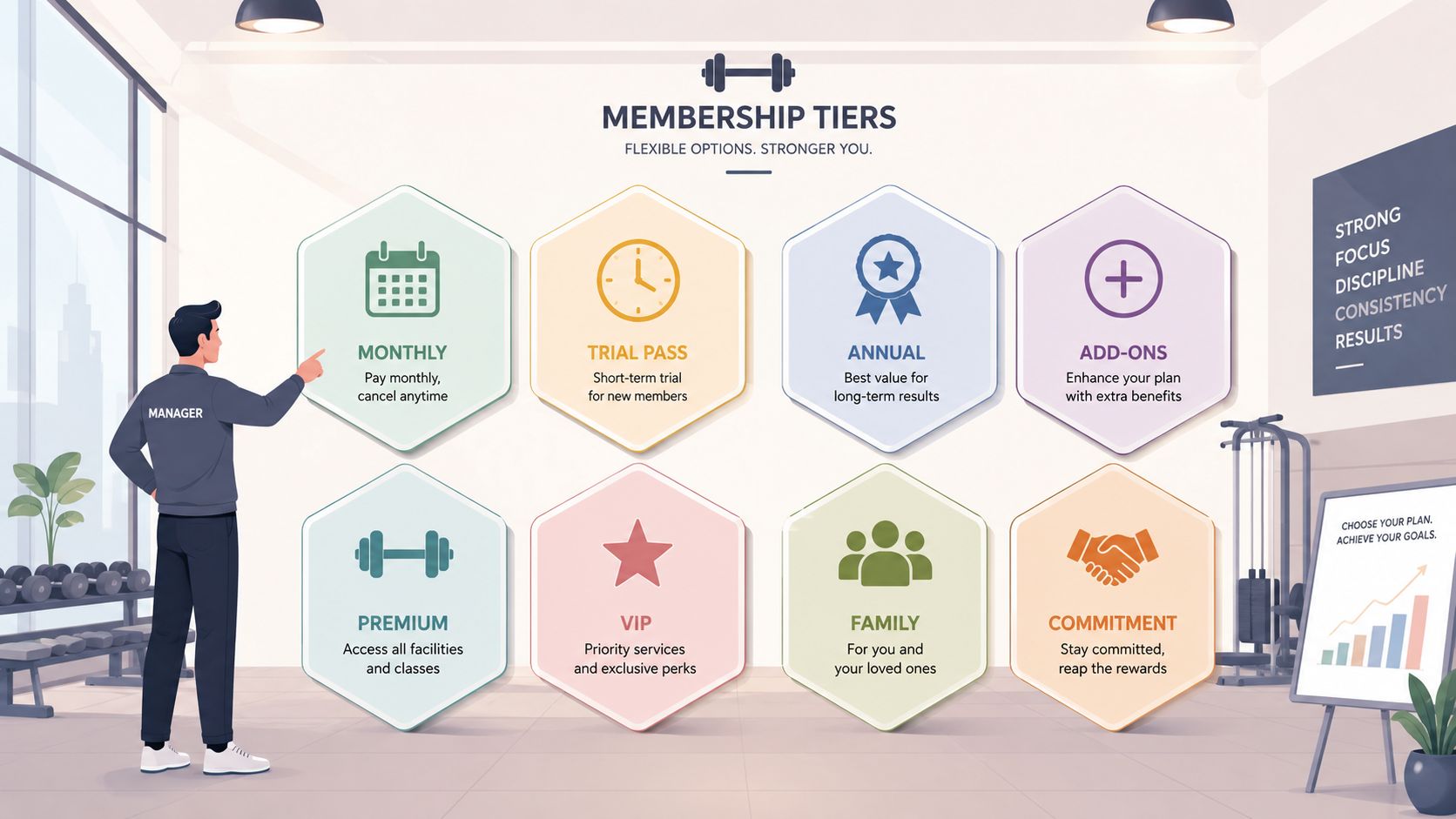
One membership price rarely serves every prospect well. A beginner may want simple access with minimal commitment, while a committed athlete may pay more for coaching, peak-time availability, or recovery amenities. The strongest subscription pricing examples treat the membership as a designed journey, matching payment cadence, access, commitment, and add-ons to distinct customer needs.
The eight models below include tiered memberships, flat-rate access, pay-per-class offers, annual prepayment, freemium upgrades, family plans, rolling-month billing, and usage-based pricing. Evaluate each through five practical lenses: acquisition friction, recurring revenue, retention, facility capacity, and perceived value. A model can look attractive on the pricing page yet create staffing pressure, billing confusion, or weak upgrade potential behind the scenes.
Test one clear offer at a time. Explain cancellation terms plainly, show exactly what each plan includes, and make visible cleaning standards part of the experience. A gym wipe or sanitizing wipe near shared equipment won't fix a weak membership offer, but it reinforces the care members expect after they buy.
1. Tiered Membership Pricing Model
Tiered pricing gives prospects a choice without forcing every member into the same package. A practical gym structure might use Basic, Premium, and Elite levels, with each tier adding a meaningful benefit such as broader class access, longer facility hours, personal training support, premium lockers, or recovery amenities.
Planet Fitness uses a standard membership alongside its Planet Black option, while LA Fitness presents choices that can include day access, monthly premium membership, and annual arrangements. Anytime Fitness also demonstrates how a gym can separate standard, premium, and elite-style benefits. These examples show the model's central advantage, but the labels matter less than the value progression.

Make the upgrade visible
A tier works when members can quickly answer, “Why would I move up?” Put the strongest upgrade trigger in the middle tier, such as preferred class booking, peak-hour access, or a monthly coaching review. Keep the Elite level aspirational but credible. A premium plan that adds vague “VIP benefits” won't create confidence.
For broader planning ideas, review these multiple gym membership structures.
Practical rule: Every upgrade should remove a specific restriction or add a benefit members can use often.
The main trade-off is complexity. More options can improve fit, but too many plans slow decisions and make staff explanations harder. Start with three tiers, track adoption by tier, and interview cancellations to learn whether the benefits feel distinct. Use class capacity and peak-hour access as differentiators only if your scheduling system can enforce them consistently.
2. Flat-Rate Unlimited Membership
Flat-rate unlimited pricing wins on clarity. Members pay one recurring fee and receive unlimited access to the facilities, equipment, and included classes. There are no credit calculations, usage thresholds, or difficult comparisons at checkout.
Anytime Fitness's standard membership approach, Crunch's basic plan, and independent gyms competing in crowded local markets all illustrate why simplicity can be persuasive. A prospect who feels overwhelmed by packages may respond better to one plain promise: pay the membership fee and use the gym whenever the plan allows.
The model has low acquisition friction and low billing complexity. It also creates predictable recurring revenue, but it can undercharge highly engaged members who would willingly pay for coaching, recovery, nutrition support, or priority access.
Protect the economics behind “unlimited”
Unlimited access isn't unlimited operational cost. Monitor attendance patterns, busy periods, equipment demand, and cleaning workload. If members cluster at the same times, a single flat plan may create congestion that damages perceived value.
Use add-ons instead of complicating the core membership:
- Personal training: Sell coaching separately so casual members don't subsidize intensive support.
- Recovery services: Package sauna, massage, mobility, or recovery sessions as optional upgrades where available.
- Retail and nutrition: Add supplements, merchandise, or consultations without changing the access promise.
- Loyalty engagement: Use digital fitness tracking and progress milestones to keep members connected between visits.
The test is straightforward. Keep the unlimited plan unchanged, introduce one relevant add-on, and compare attach rate, member feedback, and cancellation reasons. If members understand the base offer immediately, don't weaken that advantage with unnecessary plan variations.
3. Pay-Per-Class Model
Pay-per-class pricing removes the biggest barrier for casual users, travelers, and prospects who aren't ready to join. Someone can try a boutique studio, yoga class, or specialized training session without making a recurring commitment. That flexibility is valuable when the experience itself is the product.
SoulCycle, Barry's Bootcamp, independent yoga studios, and ClassPass all represent variations on class-based purchasing. Peloton Digital also shows how a customer can choose from a broad class library through a subscription experience, although the purchasing mechanics differ from a traditional drop-in studio.
A visitor paying for one class gives you more than immediate revenue. Their booking reveals preferred times, instructors, training goals, and willingness to return. Use that information to design the next offer rather than treating the transaction as complete.

Turn attendance into commitment
Offer class bundles for people who know they'll return, then create a clear path into membership. A first-visit offer can reduce hesitation, but the follow-up must explain the next logical step. Send a short email sequence after the class, recommend a relevant package, and use the attendee's actual class history rather than generic sales copy.
Track which sessions produce repeat purchases and which ones lead to memberships. If a popular instructor attracts many drop-ins but few conversions, the issue may be the handoff, not the class. Add a post-class consultation, a membership credit, or a guided tour and test the change separately.
The trade-off is revenue predictability. Pay-per-class protects flexibility but doesn't guarantee recurring income. It fits studios with strong experiences and spare capacity, especially when the operator can convert casual attendance into bundles, memberships, or coaching programs.
4. Annual Prepaid Membership With Discount
Annual prepayment is a cash-flow tool, not merely a discount. Members trade flexibility for a lower effective rate and a clear commitment, while the gym collects revenue upfront and manages fewer monthly billing events. That exchange makes the model strongest for goal-oriented members who already expect consistent attendance.
LA Fitness annual prepaid plans, Gold's Gym annual promotions, Equinox annual commitment tiers, and boutique studios offering annual passes follow this logic. Their real test is whether the upfront payment supports sustained use, not just whether it improves the initial sale.
Make the commitment feel usable
Attach practical value to the payment. An initial assessment, orientation, progress review, or appropriate merchandise benefit gives members a reason to act early. Flexible freeze terms can also reduce refund pressure when travel, injury, or scheduling problems interrupt attendance.
Time promotions around moments when prospects reassess routines, including New Year's campaigns and seasonal fitness pushes. Keep the conditions easy to understand. If prospects need several explanations to compare the annual offer with monthly billing, simplify the package before increasing the discount.
Run a retention experiment alongside the offer. Book the first orientation before the member leaves, then set progress checkpoints based on likely support needs rather than waiting for renewal. Invite referrals while the membership is active, and maintain visible standards with gym equipment wipes and sanitizing wipes. Those details reinforce that the facility is honoring the prepaid investment.
The trade-off is renewal risk. A member can remain committed for the term yet reach renewal with weak engagement and little perceived progress. Track attendance, checkpoint completion, and outreach by acquisition channel. Test whether a modest annual incentive produces stronger retention than a deeper discount, while comparing the operational work required to support each version. A monthly alternative may preserve flexibility, but the annual plan offers greater commitment and earlier cash when the studio can consistently deliver the promised experience.
5. Freemium Model With Premium Upgrades
Freemium reduces the first commitment to almost nothing. A gym might offer limited digital workouts, selected community events, basic app functionality, or restricted facility access for free, then charge for coaching, full class access, advanced tracking, or unrestricted use.
Digital examples include Spotify's free and premium experiences, YouTube's free access alongside YouTube Premium, MyFitnessPal's basic and premium features, and the Peloton app's free and premium paths. Apple Fitness+ also demonstrates how a trial-style entry can let people experience guided content before choosing a paid relationship.
The model only works when the free experience creates genuine value while leaving a clear reason to upgrade. If the free tier is useless, prospects leave. If it delivers everything members want, conversion stays weak.
Create a natural upgrade moment
Limit features, not trust. A free user might access selected workouts but need premium membership for personalized programming, progress analysis, live classes, or a coach's feedback. Put the upgrade invitation next to the feature that creates the strongest “I need that” moment.
Use the gyms that offer free trials as inspiration for designing a low-friction entry path, but don't copy a trial without defining the post-trial journey.
Measure the full funnel, including install-to-trial conversion, trial-to-paid conversion, cohort churn, refund rate, lifetime value, and payback period. These are practical subscription pricing metrics identified in a thesis-backed B2C framework (pricing metrics framework). The trade-off is operational attention. Freemium can expand your audience, but free users still require communication, support, and product maintenance.
6. Family or Group Membership Plans
Family and group plans sell commitment to a shared routine, not just a lower individual price. One account holder may bring in household members, training partners, or employees, while the gym gains more relationships from a single purchase decision. Planet Fitness family offers, YMCA family memberships, Equinox group and corporate plans, and local corporate wellness programs show how the structure can serve both consumers and employers.
For a studio, the offer could cover roommates, training partners, or a small company seeking a wellness benefit without a custom program. The pricing decision should match the audience. Household plans can strengthen accountability, while corporate plans may require clearer reporting and administrative support.
Test the rules before scaling
Set eligibility, payment responsibility, member additions, removals, freezes, and cancellations before launch. The account holder needs to understand what happens when a relative leaves or an employee changes jobs. Simple rules reduce staff intervention and protect the upgrade path from a small group to broader services, such as personal training or premium classes.
Use a short pilot and compare group members with individual members on attendance, peak-time bookings, retention, and upgrades. Offer shared challenges or family-friendly events, then test whether those benefits increase usage without adding costly staff hours. Corporate prospects may respond better to tiered packages for different group sizes than to one universal discount.
The trade-off is lower revenue per added member in exchange for stronger social commitment and fuller use of underused capacity. Protect peak sessions with booking limits or priority rules when demand is high. Keep one payer's account view clear, and maintain visibly clean shared equipment with commercial disinfecting wipes to support member confidence. If the pilot fills already-crowded classes without improving retention, narrow eligibility or reserve the discount for off-peak access.
7. Rolling-Month Auto-Renewal Model
Rolling-month auto-renewal sits between an annual contract and one-off attendance. Members pay monthly, renew automatically, and can cancel under stated terms. Commercial gyms such as Planet Fitness, LA Fitness, and 24 Hour Fitness use versions of this structure. Peloton and Apple Fitness+ apply the same recurring logic to digital services.
The trade-off is practical: the gym gains recurring revenue without requiring a large upfront payment, while members keep more flexibility. That flexibility raises the bar for trust. Hidden renewal terms or a difficult cancellation process can erase the convenience and damage future retention.
Use this model when your audience values low commitment, but design it around active engagement rather than passive billing. A month-to-month gym membership approach should give members clear control and give staff defined recovery actions.
- Clear billing language: Display the renewal date, cancellation process, and notice period before payment.
- Easy cancellation: One-click or low-friction cancellation builds more trust than requiring a phone call.
- Payment recovery: Send reminders before a failed charge becomes an involuntary cancellation.
- Exit feedback: Group responses into pricing, service, access, cleanliness, and scheduling themes.
- Win-back timing: Contact former members with a relevant reason to return, rather than a generic discount.
The operational test is whether flexibility produces healthy retention or merely delays visible churn. Connect attendance signals to a message, coach check-in, class recommendation, or pause option. A member who continues paying while inactive may cancel sharply after noticing the pattern, so re-engagement needs a defined owner and response window.
Track monthly churn alongside attendance, pause use, cancellation reasons, and upgrades. A 2026 gym-fitness analysis reports 6% to 10% monthly churn for traditional chains such as LA Fitness, Crunch, and EOS (gym subscription churn analysis). Its model uses $40 monthly ACV with 8% monthly churn, representing $3.20 in monthly recurring revenue lost per subscriber, or about $128 from a 40-member base at that churn level. Treat the calculation as exposure analysis, not a reason to restrict cancellation.
8. Usage-Based Dynamic Pricing Model
Usage-based pricing links the bill to facility demand or service consumption. A gym might charge a base access fee and vary the member's options by peak-hour access, class credits, personal training use, or recovery sessions. A boutique studio could test different credit requirements for high-demand classes, while a corporate wellness platform could offer usage tiers.
The attraction is alignment. Light users aren't paying for the same intensity of service as heavy users, and high-demand access can carry more value. The risk is complexity, especially when members can't predict what they'll owe.
Start with access, not surprise charges
Don't begin by charging for every visit. Test one controlled variable, such as off-peak and peak booking access, while keeping the base membership easy to understand. Show usage in the mobile app, explain credits before purchase, and provide a clear refund policy for canceled classes.
This model demands stronger technology than flat-rate billing. The system must record attendance or bookings accurately, apply the correct entitlement, and show members how their activity affects the bill. Staff also need a simple explanation they can repeat consistently.
Usage-based pricing should make value easier to understand, not make the invoice harder to trust.
Run the first pilot with a small segment. Compare attendance distribution, revenue per member, class fill, cancellations, and support requests. Preserve existing terms for legacy members when appropriate, then use what you learn to refine the offer. The operational lift is higher, but the model can improve capacity management when demand varies sharply across the day.
8 Subscription Pricing Models Compared
| Pricing Model | Implementation complexity | Resource requirements | Expected outcomes | Ideal use cases | Key advantages |
|---|---|---|---|---|---|
| Tiered Membership Pricing Model | Medium–High (design tiers, manage benefits) | Moderate (membership systems, staff training, marketing) | Higher ARPU, segmented revenue, upgrade opportunities | Mid-to-large gyms with diverse customer segments | Captures multiple segments; clear upsell paths; value differentiation |
| Flat-Rate Unlimited Membership | Low (single product offering) | Low–Moderate (capacity management, simple billing) | Predictable revenue, high acquisition, limited upsell | Competitive markets and price-sensitive audiences | Simplicity; fast sales; predictable billing |
| Pay-Per-Class Model | Low–Medium (scheduling and ticketing) | Moderate (class ops, booking/payment systems) | Variable month-to-month revenue, attracts casual users | Boutique studios, yoga/cycle studios, travelers | Low entry barrier; flexible access; trial-to-member conversion |
| Annual Prepaid Membership with Discount | Medium (contracts, refund/freeze policies) | Moderate (cash flow handling, onboarding perks) | Improved cash flow, reduced churn, stronger commitment | Seasonal promotions; goal-oriented members | Upfront revenue; lower churn; member commitment |
| Freemium Model with Premium Upgrades | High (product segmentation, conversion funnels) | High (scalable infrastructure, support, marketing) | Large user acquisition; low initial revenue; conversion-dependent profitability | Digital fitness platforms and content-heavy apps | Rapid user growth; data for targeting; natural upgrade funnel |
| Family or Group Membership Plans | Medium (shared billing, account management) | Moderate (billing complexity, member management tools) | Higher household penetration, social retention, referral lift | Family-focused facilities; corporate wellness programs | Increased household LTV; social accountability; B2B opportunities |
| Rolling-Month Auto-Renewal Model | Low–Medium (billing automation, cancellation handling) | Low–Moderate (payment processing, retention ops) | Stable recurring revenue; inertia-driven retention | Most commercial gyms and subscription services | Predictable MRR; flexible for members; easy upgrades/downgrades |
| Usage-Based Dynamic Pricing Model | High (real-time tracking, pricing engine) | High (analytics, app UX, customer service) | Revenue optimization, demand smoothing, potential customer confusion | Premium gyms, data-enabled platforms, peak-demand venues | Aligns price to usage; maximizes revenue from heavy users; incentivizes off-peak use |
Turn These Models Into Your Next Pricing Test
Choose a pricing model based on four realities: audience, capacity, cash-flow needs, and operational readiness. A boutique studio built around instructor-led experiences may start with pay-per-class and move repeat visitors into memberships. A large gym with predictable demand may favor flat-rate or rolling-month access, then add tiers for coaching and peak-time benefits. A facility seeking upfront cash flow can test annual prepayment, while a gym with uneven demand may explore controlled usage-based access.
Don't change the price, benefits, billing cadence, and sales message at the same time. Define one primary metric and one guardrail before the test begins. For example, you might measure paid conversion while protecting class capacity, or measure annual-plan uptake while monitoring refund requests. The exact metric depends on the decision, but the rule stays constant: know what success means before the offer goes live.
Useful tests include:
- Monthly versus annual commitment: Keep benefits consistent and compare conversion, early engagement, and renewal intent.
- Trial versus paid entry: Test whether a free or low-friction introduction produces better qualified members than a paid first visit.
- Access versus add-ons: Compare a simple membership with optional personal training, recovery services, or class credits.
- Tiered versus flat-rate packaging: Measure whether clearer choice increases upgrades or slows decisions.
- Peak access experiments: Test booking privileges before introducing variable charges.
Review performance by cohort, not only by total membership count. A new plan can increase signups while attracting members who cancel quickly, overwhelm peak capacity, or require more staff support than the revenue justifies. Pair conversion data with churn, attendance, payment failures, add-on attachment, and member feedback.
Your pricing promise also includes the physical condition of the facility. Place a gym wipe dispenser near high-touch equipment, stock suitable gym equipment cleaning wipes for shared surfaces, and make the cleaning routine visible without interrupting workouts. Use product labels correctly. The EPA explains that disinfectant wipe contact time means keeping the surface visibly wet for the full stated period, and a 10-minute label time requires reapplication if the surface dries after five minutes (EPA disinfectant guidance). Wipe instructions can differ from liquid disinfectant instructions, so staff should follow the registered label rather than assume every product works the same way (wipe and liquid treatment guidance). Some non-food-contact wipes may require four minutes of wetness, and hands should still be washed after use even when gloves are worn (Arizona Cooperative Extension wipe guidance).
Add simple retention infrastructure to the experiment. A gym loyalty software with QR codes can support check-ins, rewards, and engagement prompts when it fits your operating workflow. Choose one model, define the test, communicate it plainly, and give members a facility experience that makes the recurring payment feel justified.
Leave a Reply