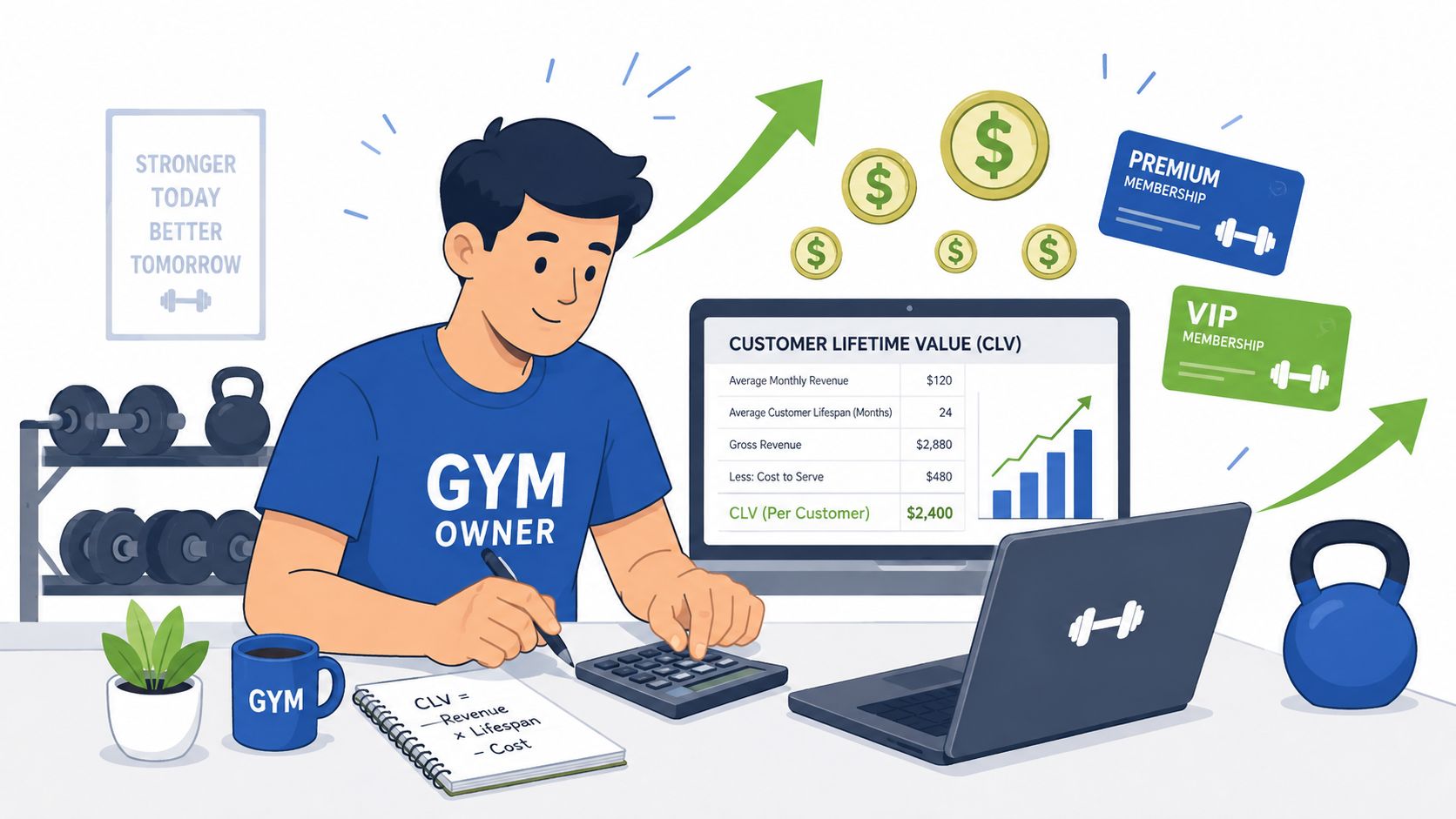
You've got a healthy-looking membership count, deposits arrive every month, and yet the profit line refuses to move. The problem usually isn't a lack of data. It's that dues, personal training, retail, freezes, acquisition costs, and cancellations sit in separate reports. You can see activity, but you can't see the economic value of each member relationship.
Customer lifetime value, or CLV, brings those pieces together. It shows what a member is likely to contribute over the relationship, preferably after accounting for gross margin. Once you know how to calculate customer lifetime value for your gym, you can judge marketing channels, prioritize retention work, and identify whether an upgrade offer is creating profit or just more administrative work.
Why CLV Is the Metric Your Gym Cannot Afford to Ignore
A gym can have 200 active members, steady monthly revenue, and a flat profit margin while its economics deteriorate. New sign-ups may cancel quickly, discounted memberships may consume staff time, and only a small portion of members may purchase personal training. The member count stays stable, but the value of each relationship changes.
The better operating question is not just, “Are we growing?” Ask which members produce a positive margin, which revenue streams they use, and how long they remain active.

CLV connects the variables that membership count hides:
- Acquisition cost: What the gym spends to generate and close a new member.
- Recurring dues: The predictable monthly contribution from the membership.
- Expansion revenue: Personal training, small-group coaching, supplements, apparel, and other purchases.
- Retention and churn: How long the member remains active, pauses, upgrades, or leaves.
- Margin: What remains after the direct costs of delivering the service.
Average revenue per user shows what members paid during a period. It does not show whether a low-paying member stays longer than a premium member, whether a paid social campaign brings short-lived accounts, or whether PT revenue improves the economics of a cohort. Membership count has the same limitation. It measures volume, not value.
Practical rule: A sign-up is an acquisition event. A retained, margin-positive member is a business asset.
The history of CLV in modern direct marketing reaches back to the 1988 book Database Marketing, which included worked examples of the concept, as documented in the customer lifetime value overview. Its use matters even more for recurring-revenue gyms, where each month of retention affects dues, PT upgrades, retail purchases, and freeze behavior. Bain & Company research found that a 5% increase in retention can raise profits by 25% to 95% (Bain & Company retention research). The effect depends on the gym's cost structure, but the operating lesson is direct: retention changes recalculate the value of the member base as conditions shift.
Recalculate CLV when monthly churn moves, not only during an annual planning exercise. A retention improvement can raise the value of existing acquisition channels, while shorter stays can make a previously acceptable lead cost unprofitable. Gyms that track those changes can shift budget toward offers, channels, and member behaviors that produce durable, margin-positive relationships.
The Core CLV Formulas Every Gym Owner Should Know
Start with the formula that fits the revenue model. For a recurring gym membership, use:
CLV = average monthly revenue per member × gross margin ÷ monthly churn rate
For a revenue-only view, remove gross margin. Keep both figures, but use margin-adjusted CLV for acquisition and budget decisions. Dues can look strong while staffing, facilities, payment processing, coaching delivery, and member support reduce the actual contribution.
Define the inputs before calculating
Average monthly revenue per member should cover revenue reasonably tied to the relationship, including membership dues, PT upgrades, retail, and paid services. Choose either actual member-level averages or a cohort average, then apply that definition consistently each month. Separating dues, PT, retail, and freeze-related effects makes the result more useful than one blended total.
Gross margin is the share left after direct delivery costs. Use a margin that matches the service measured. A basic membership and a PT package can carry different labor economics, so one blended margin may hide where value is created or lost.
Monthly churn rate is the proportion of members lost during a month, measured against the relevant starting base. Retention rate is the share that remains active. Pull both from the membership system and recalculate CLV as retention changes month to month. A static annual assumption can miss the effect of a recent freeze wave, upgrade pattern, or weaker renewal period.
For recurring purchases, use:
CLV = average purchase value × purchase frequency × customer lifespan
That foundational structure is documented in CLV strategies for e-commerce. A gym can translate it into average monthly spend, monthly purchase activity, and expected active months. Customer lifetime value guidance for e-commerce offers another explanation of the same structure.
Choose the right level of complexity
| Formula Version | Equation | Best Used When | Gym-Specific Input |
|---|---|---|---|
| Revenue CLV | Average monthly revenue ÷ monthly churn | Quick revenue snapshot | Dues and add-ons |
| Margin CLV | Average monthly revenue × gross margin ÷ monthly churn | Acquisition and profitability decisions | Direct service costs |
| Expanded CLV | Discounted future margin by period | Uneven revenue and longer forecasts | PT timing, freezes, upgrades |
| Historical CLV | Accumulated member revenue or profit | Existing member reporting | Actual transactions to date |
A discounted model assigns lower present value to money received later. Use it when PT starts after enrollment, seasonal retention shifts, freezes interrupt billing, or multi-year projections change the forecast. For stable monthly behavior, the margin-based formula remains easier to audit.
Track CAC beside CLV in a separate acquisition report. Use this gym customer acquisition cost calculation to keep campaign costs consistent. The comparison only works when both metrics use the same period, member definition, and margin logic.
A Real-World CLV Calculation for a Gym Membership
Consider a single-location gym member on a basic plan paying $59 per month. The member also spends an average of $15 per month on retail, then starts personal training in month four at $120 per month. The model uses a 70% gross margin, intended to account for staffing, facilities, and payment processing.
The membership and retail revenue before PT equals $74 per month. Once PT begins, monthly revenue rises to $194. For the simple model, use a 20% monthly churn assumption, because that's the assumption specified for the initial profile. The margin-adjusted monthly value is:
$194 × 70% = $135.80
Using the subscription formula:
$135.80 ÷ 20% = $679
That is a simplified margin CLV, not a promise that every member will produce exactly $679. It treats monthly revenue and churn as stable, while the PT upgrade begins later. A member-level forecast should preserve the timing of each revenue stream.
Model the cash flows by month
| Month | Membership Dues | PT Revenue | Retail Spend | Total Revenue | Cumulative CLV |
|---|---|---|---|---|---|
| 1 | $59 | $0 | $15 | $74 | $51.80 |
| 2 | $59 | $0 | $15 | $74 | $103.60 |
| 3 | $59 | $0 | $15 | $74 | $155.40 |
| 4 | $59 | $120 | $15 | $194 | $291.20 |
| 5 | $59 | $120 | $15 | $194 | $427.00 |
| 6 | $59 | $120 | $15 | $194 | $562.80 |
The cumulative CLV column applies the 70% margin to each month's total revenue. It shows why acquisition analysis based on the first month alone can misclassify a member who later purchases PT.
A discounted version applies a 10% annual discount rate to future cash flows. Convert that annual assumption into a monthly rate before discounting each month, then calculate:
Discounted CLV = sum of each month's margin-adjusted revenue ÷ (1 + monthly discount rate)^month
The exact result depends on whether you discount at the start or end of each period and how you model churn. Document that convention in the spreadsheet.
The retention sensitivity is more important than false precision. If churn improves from 5% to 3%, the stable-value model changes from monthly margin ÷ 5% to monthly margin ÷ 3%. With the same $135.80 monthly margin, that means $2,716.00 versus $4,526.67, before discounting and acquisition cost. The scenario shows how strongly retention compounds value.
Compare this member with your gym's average by acquisition source, plan, PT attachment, and cancellation risk. High-CLV members deserve a different retention and upgrade strategy from accounts already approaching churn.
Building a Simple CLV Spreadsheet for Your Gym
A useful spreadsheet doesn't need to resemble a finance department's forecasting model. It needs consistent fields, clear definitions, and a monthly refresh that staff can repeat without rebuilding the workbook.
Create one member-level sheet with these columns:
- Member ID: A stable identifier from your PMS or CRM.
- Join Date: The date used for cohort grouping.
- Monthly Dues: Current recurring membership revenue.
- PT Attach Rate: PT revenue or a binary indicator that can be converted into revenue.
- Retail Average Spend: The member's trailing average retail purchase value.
- Retention Rate: The applicable cohort or segment retention input.
- Gross Margin: The margin assumption for the revenue mix.
- Cumulative Revenue: Actual revenue collected to date.
- Projected CLV: Future margin-adjusted value.
- CAC: Fully loaded acquisition cost for the member's channel.
- CAC Flag: A warning when projected value falls below CAC.
Add formulas that answer operating questions
If monthly dues are in column C, PT revenue in D, retail in E, and margin in G, a simple projected monthly margin can use:
=(C2+D2+E2)*G2
If churn is stored in H, a recurring estimate can use:
=IFERROR(((C2+D2+E2)*G2)/H2,0)
For weighted monthly revenue across a member list, use SUMPRODUCT:
=SUMPRODUCT(C2:C201+D2:D201+E2:E201,G2:G201)
For cohort analysis by join month, AVERAGEIFS can isolate revenue for members within matching date boundaries:
=AVERAGEIFS($I:$I,$B:$B,">="&K2,$B:$B,"<"&EDATE(K2,1))
Set the warning column to:
=IF(I2<J2,"Below CAC","Within target")
The exact range will vary by workbook layout, but the logic should remain visible to the manager reviewing it.

Refresh the sheet after each CRM export. Recalculate active members, cancellations, freezes, upgrades, and actual collections. Use conditional formatting for high-, mid-, and low-value cohorts, but set thresholds from your own CAC and operating targets rather than copying another gym's colors.
For a related profitability framework, review how to calculate return on investment. Use it alongside CLV, not as a substitute. CLV forecasts member value, while ROI evaluates a specific investment.
Where Most Gyms Get CLV Wrong
The most damaging error is treating churn as a permanent flat percentage. Member behavior changes by acquisition cohort, season, plan, attendance pattern, and sales promise. A January joiner may behave differently from an October renewal, while PT attachment can rise during a strong enrollment period and fade later.
A single annual CLV calculation smooths away those differences. It can make a weak cohort look acceptable because mature members compensate for recent cancellations.
Common errors in the membership book
| Common Mistake | Distorted Result | Corrected Approach |
|---|---|---|
| Using one annual churn rate | Overstates or understates future value | Recalculate by month and cohort |
| Counting dues only | Misses PT and retail contribution | Attribute revenue by member |
| Ignoring freezes | Treats paused relationships as lost | Track freeze duration, fees, and reactivation |
| Using revenue CLV for spending decisions | Makes low-margin accounts look attractive | Use margin-adjusted CLV |
| Relying on industry averages | Hides local member behavior | Use PMS and CRM records |
| Calculating only once a year | Delays operational response | Refresh the forecast monthly |
Freezes deserve special attention. A freeze can reduce immediate dues while preserving the relationship, creating a different economic outcome from cancellation. If your model records every freeze as churn, it understates value during predictable slow periods and makes retention work look less effective than it is.
The cleanest model is not the most complicated one. It's the one your team updates consistently and can explain member by member.
Historical CLV tells you what a member has already spent. Predictive CLV estimates future value from current behavior, retention, add-ons, and upgrades. Keep those views separate. Mixing them produces a number that sounds precise but answers neither reporting nor planning well.
Recalculate whenever promotions change the entry price, when a freeze policy changes, or when PT delivery costs move. A model should respond to the business, not preserve an outdated assumption for the sake of consistency.
Turning CLV Into Better Acquisition and Retention Decisions
CLV becomes useful when it changes what the gym does tomorrow. Start by setting a maximum allowable CAC ceiling against 12-month CLV, using a conservative margin-based forecast rather than total projected revenue. The ceiling should leave room for service costs, forecast error, and the fact that predicted value isn't guaranteed.

Turn member value into staff priorities
A three-tier model works well when it stays operational:
- High-value members: Review for PT conversations, referral opportunities, and proactive service recovery.
- Middle-value members: Use onboarding, attendance prompts, and relevant add-on offers to increase engagement.
- At-risk members: Trigger personal outreach, a schedule conversation, or a suitable freeze alternative before cancellation.
Don't give every tier the same message. A premium member may need a coach check-in, while a low-engagement basic member may need help finding a class that fits their schedule. The point is not to make high-value members feel managed. It's to match staff time with likely economic return and member need.
Build a monthly decision tree
If a cohort's CLV falls for two consecutive months, audit onboarding, review front-desk scripts, inspect the class schedule, and examine the acquisition source. If predicted churn rises, trigger outreach for members within 60 days of predicted churn, then record whether the intervention changed attendance, payment status, or cancellation intent.
Use structured touchpoints at 30, 60, and 90 days, followed by birthday outreach and win-back campaigns. These aren't magic dates. They're useful operating checkpoints that prevent the team from waiting until a cancellation request arrives.
The customer lifetime value improvement guide can sit alongside your CRM workflow as a reference for retention and expansion ideas. For acquisition reporting, compare CLV by channel, offer, and cohort. A channel that produces more leads isn't automatically the channel that produces better members.
Spend more where the member relationship proves durable, not where the lead dashboard looks busiest.
Your facility experience also affects retention economics. Keep high-touch areas visibly clean with gym equipment cleaning wipes, and place a gym wipe dispenser near equipment exits so members can sanitize without searching for supplies. For studios, use yoga mat wipes that match the surface and follow the product label's contact-time instructions. Cleaning habits won't replace a retention program, but they support the everyday experience members judge before deciding whether to renew.
Calculate CLV from your last several CRM or PMS exports this week. Separate dues, PT, retail, freezes, and CAC, then compare historical value with a conservative predictive estimate by cohort. After that, schedule a monthly review and stock clearly labeled disinfecting wipes or wipes to disinfect gym equipment at every high-use zone, so your financial retention work is reinforced by a facility members trust.
Leave a Reply