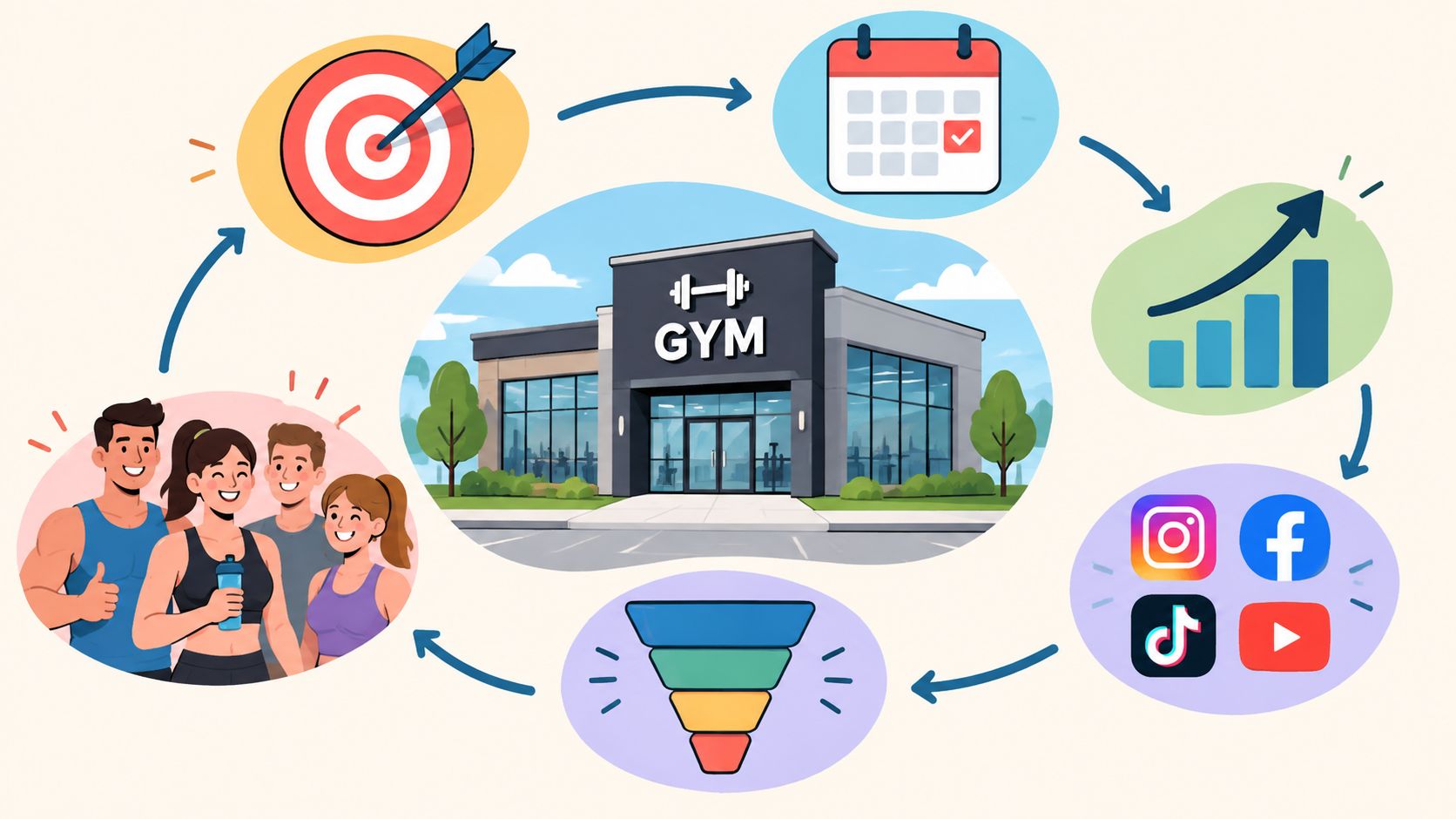
You open the gym with a strong launch offer, a busy social feed, and more tour requests than your front desk can handle. Then the opening buzz fades. Classes have empty spaces, leads stop replying, and some of the people who joined barely make it through their first few months.
That pattern doesn't mean your facility lacks potential. It usually means your marketing stops at acquisition. A durable fitness center marketing plan treats the member journey as one connected system, from local discovery and trial booking to onboarding, community participation, reactivation, and referrals.
Why Your Fitness Center Needs a Real Marketing Plan
A promotion can create attention. A plan creates repeatable behavior.
Without a coordinated system, gym owners often launch disconnected activities. Someone boosts an Instagram post, a trainer uploads a workout video, the sales team calls a few leads, and the front desk announces a referral offer. Each action may be useful, but nobody knows which audience it serves, what happens next, or whether the new member receives enough support to build a routine.
Retention makes that gap expensive. The industry average annual retention rate is about 66.4%, which means roughly one in three members cancels each year. Close to half of new members quit within their first six months, according to benchmark reporting covering 175 companies and more than 17,000 facilities across 27 countries (gym member retention benchmarks). The first 90 to 180 days deserve special attention because many members disengage before exercise becomes a habit.

Acquisition is only the first handoff
Suppose a prospect sees your video, books a tour, joins, and then receives no personal welcome. They don't know which class suits them, how to use unfamiliar equipment, or who to ask for help. Your ad did its job, but the business still loses the member.
A useful plan assigns a job to every stage:
- Attract: Help nearby prospects discover a relevant reason to visit.
- Convert: Make the tour, trial, and membership decision simple.
- Activate: Give new members a clear first workout and personal contact.
- Retain: Use progress checks, challenges, and community moments to sustain attendance.
- Reactivate: Reach out when attendance or engagement begins to fall.
- Refer: Make it easy for satisfied members to invite people they trust.
The global fitness market was estimated at $131.31 billion in 2025 and projected to reach $244.70 billion by 2032, with a 9.3% CAGR, according to ABC Fitness industry data. A larger market brings opportunity, but it also gives prospects more choices. Your plan needs a clear position, dependable follow-up, and an experience that supports the promises in your advertising.
For a plain-language overview of how strategy connects goals, audiences, channels, and measurement, the Silva Marketing strategy guide is a useful reference. Your practical version should answer one question at every step: what should this person do next, and why would they want to stay?
Understanding Your Market and Ideal Members
A local fitness market isn't one audience. It's a group of people with different schedules, motivations, anxieties, and definitions of progress. Treating everyone as “people who want to get fit” produces vague ads and generic offers.
Start with a simple local scan. Search for gyms, studios, personal trainers, boutique programs, and community recreation options within the area people are realistically willing to travel. Read their websites, reviews, class descriptions, social profiles, and introductory offers. Record what they emphasize, then look for what they don't explain well.
Map competitors before choosing your message
Create three columns:
- Direct competitors: Facilities offering similar equipment, classes, or coaching.
- Adjacent alternatives: Home workouts, outdoor groups, sports clubs, and digital coaching.
- Unserved needs: Problems people mention in reviews or local conversations that no provider addresses clearly.
Look for practical gaps. One facility may have excellent equipment but no beginner pathway. Another may offer personal training but no flexible digital support. A third may create a friendly atmosphere but lack early-morning access. Your opportunity often sits between what competitors promote and what members need.

Build personas like training programs
A trainer wouldn't give a beginner and an experienced athlete the same program. Your marketing shouldn't give them the same message either. Create two or three useful personas, each based on behavior and obstacles rather than only age or income.
For each persona, write:
- Goal: What outcome are they pursuing?
- Barrier: What keeps them from joining or attending?
- Routine: When and how do they prefer to exercise?
- Proof needed: What would make the gym feel safe and credible?
- Best first step: Which tour, class, challenge, or consultation fits them?
“The Busy Professional” may value efficiency, early access, short sessions, and app support. “The Social Butterfly” may respond to group classes, community events, and a welcoming introduction. A beginner may need equipment orientation and reassurance more than a discount.
Use those profiles to shape landing pages, email language, staff scripts, and content topics. For additional examples of narrowly defined audiences, explore these fitness business niche examples.
Practical rule: If a message could describe every gym in town, it hasn't identified a real member need yet.
Positioning Pricing and Offers That Sell Memberships
Your offer isn't just a price. It's the answer to the prospect's question, “What kind of progress and experience will I get here?”
A low-cost membership can work when the audience wants straightforward access and minimal extras. A community-focused tier can justify more value through classes, social connection, and accountability. A premium tier can combine coaching, personal attention, and convenience. The important point is alignment. Each tier should attract a person you can serve well and retain, not just create more choices.

Create an offer ladder
A clear ladder might include:
- Budget Basic: Core equipment and simple access for members who want independence.
- Community Core: Group classes, social events, and structured accountability.
- Premium Performance: Personal training, progress reviews, and enhanced amenities.
Don't lead every prospect with the cheapest option. Show the middle tier as the natural fit for members who want support, then make the premium offer specific enough to feel purposeful. A coach-led bundle might include an assessment, an onboarding session, and scheduled progress conversations. A hybrid membership might combine club access with app-based workouts for travel or home days.
Limited-time challenges can also make the first decision easier. The challenge should have a clear start, a defined activity, and a next step into membership. Avoid creating urgency that feels artificial. A genuine cohort, scheduled event, or limited coaching intake gives prospects a reason to act without training them to wait for discounts.
Retention economics should guide the structure. Acquiring a new member typically costs five to seven times more than retaining an existing one, while newer operators often allocate 12% to 15% of revenue to marketing, according to gym acquisition and retention cost guidance. That makes onboarding, engagement, and reactivation part of the offer's financial design, not optional extras.
For pricing mechanics and package structure, review this membership pricing strategy guide. Then ask your sales team to describe every tier by outcome, experience, and next step, not by features alone.
Choosing Channels That Fill Classes and Drive Tours
Each channel has a different job. Local search captures existing intent, social content creates discovery, SMS and email support follow-up, and partnerships lend local trust. Problems begin when a gym expects one channel to perform all four roles.
Paid social deserves careful testing rather than automatic expansion. Independent coverage reports that paid social CPMs increased roughly 30% to 50% over 24 months, while SMS and hyperlocal partnerships have outperformed broad-reach tactics in 2026 (fitness marketing channel trends). Smaller gyms can compete by being more relevant locally, not by trying to buy the largest audience.
Match the channel to the moment
| Channel | Primary Job | Budget Note | Best For |
|---|---|---|---|
| Google Business Profile and local SEO | Capture high-intent searches | Invest in accurate details, reviews, pages, and ongoing updates | Prospects already looking for a nearby gym or class |
| Instagram and short-form video | Build discovery and familiarity | Prioritize consistent, useful content before increasing paid spend | Showing coaches, classes, member stories, and atmosphere |
| SMS and email | Nurture and reactivate | Automate routine reminders, but keep sensitive conversations human | Tour confirmations, trial follow-up, onboarding, and attendance recovery |
| Local partnerships | Borrow trust and reach adjacent audiences | Trade value with complementary businesses and organizations | Referral traffic, events, and neighborhood credibility |
| Community events | Turn attention into relationships | Measure attendance, conversations, tours, and follow-up | Prospects who need social proof before joining |
Fitness-specific reporting places local search at the center of acquisition, with SEO driving 38% to 48% of website traffic and local search accounting for 62% of that volume (fitness marketing data and channel allocation). Because the source provides those figures, treat them as directional benchmarks rather than a promise for your facility.
Let automation handle speed, not empathy
AI-assisted nurture can respond quickly, classify leads, suggest follow-up timing, and reduce missed conversations. It shouldn't replace a coach who notices fear, a manager handling a complaint, or a sales advisor answering a complicated membership question. Recent reporting estimates U.S. gym AI marketing use at 31% in 2026, up from 12% in 2025, but the practical test is whether the system helps close tours, reduce no-shows, or improve retention (AI and local fitness marketing trends).
For a broader framework on local business digital marketing, focus on the same principle: own the local relationship, then use paid channels to amplify what already works.
Campaign Examples That Convert Trials to Members
A campaign works best when every message answers the next question. The hook earns attention, the offer reduces uncertainty, and the follow-up helps the prospect experience progress before asking for a longer commitment.

Campaign one, the challenge funnel
Offer a defined challenge for people who need structure. The landing page should explain who it's for, what participants will do, and what support they'll receive. On registration, collect the smallest amount of information needed for a useful welcome.
The conversion sequence can look like this:
- Registration message: Confirm the start details and ask the participant to choose a preferred session.
- First-visit welcome: Have a coach greet them, provide orientation, and recommend a suitable class or workout.
- Progress check: Ask what felt easy, confusing, or difficult, then adjust the next visit.
- Membership conversation: Present the tier that matches the behavior they've already shown.
The mechanism works because the prospect isn't buying abstract access. They're testing a guided experience with a visible path.
Campaign two, the community invitation
Ask current members to bring a friend to a community class, social workout, or wellness event. The invitation should feel like a shared activity, not a sales ambush. Give guests a named host and a simple follow-up appointment before they leave.
Campaign three, the trainer-led series
Choose a coach with a clear specialty and build a short video series around one local audience's problem, such as fitting strength training into a busy schedule. Each video should direct viewers to one practical next step, such as a consultation or introductory class.
The follow-up should include personal context. “You mentioned that evening sessions are difficult, so I reserved the morning option we discussed” is stronger than a generic reminder because it proves someone listened.
For more direct-response structures, see these direct-response marketing examples. The strongest campaign isn't necessarily the one with the biggest giveaway. It's the one that makes attendance, coaching, and belonging tangible before the prospect must decide.
Your 90 Day Launch and Retention Calendar
A launch calendar should continue after the opening event. The first 90 to 180 days are especially important because early disengagement creates a major retention risk (fitness analytics and retention benchmarks). Schedule the member journey before you spend heavily on promotion.
Days one to thirty
Use the opening phase to create clarity and personal contact.
- Before the first visit: Send directions, arrival expectations, clothing guidance, and a named contact.
- At the first visit: Complete orientation, identify the member's goal, and book the next session.
- During the first week: Check attendance, answer questions, and introduce one relevant coach or class.
- By the end of the first month: Hold a progress conversation, celebrate consistency, and recommend a realistic routine.
Don't overload new members with every service. Give them one achievable action, then reinforce it.
Days thirty-one to sixty
This is the point where novelty can fade. Invite members into a challenge, small group, or community ritual that gives them a reason to return beyond willpower. Use attendance data to trigger a personal message when someone misses the pattern they established.
A useful message is direct and warm: “We haven't seen you at your usual sessions, and we want to help. Would a different class time or a short coach check-in make returning easier?” Let the member choose the solution.
Days sixty-one to ninety
Review progress, participation, and satisfaction. Members who attend consistently may be ready for a coaching upgrade, referral invitation, or advanced class. Members who remain uncertain need a conversation about barriers, not an automatic promotion.
Set reactivation workflows for people who stop engaging. Automation can send the first reminder, while staff should take over when the member mentions pain, frustration, finances, or a poor experience. Record the reason for disengagement so your next campaign fixes the underlying issue.
Keep the calendar alive
Repeat community moments, progress reviews, referral prompts, and reactivation checks as operating habits. A membership plan becomes more valuable when the gym delivers support predictably, even during quiet periods.
Measuring Success With KPIs and Smart Budgeting
A dashboard should help you decide what to do next, not merely report activity. Track the path from first contact to long-term participation, then identify the stage where people disappear.
Start with these measures:
- Lead-to-tour rate: Shows whether your message and booking process create enough intent.
- Tour attendance: Reveals confirmation, scheduling, and no-show problems.
- Trial-to-member conversion: Shows whether the trial delivers a convincing experience.
- First-90-days engagement: Indicates whether onboarding creates a routine.
- Annual retention and monthly churn: Shows whether the business keeps the value it paid to acquire.
- Reactivation rate: Helps assess whether dormant members can be brought back.
- Member lifetime value: Connects pricing, attendance, retention, and upgrades.
Broader benchmarks place annual retention around 66.4%, while strong operators may reach 75% to 80% with monthly churn under 3%, according to fitness analytics benchmarks. These figures can frame a conversation, but your own baseline matters more than copying someone else's target. Segment the dashboard by location, membership tier, acquisition source, and tenure so an acceptable average doesn't hide a weak early-member experience.
Spend where the leak is
If tours are plentiful but conversions are weak, improve the tour and offer before buying more traffic. If new members join but disappear quickly, direct budget toward onboarding, coaching touchpoints, community programming, and reactivation. If local search produces qualified inquiries, protect the pages and profile that support it before expanding broad paid campaigns.
Keep a simple weekly review:
- Which source produced qualified conversations?
- Where did prospects stop responding?
- Which new members missed their expected routine?
- What action will the team test next?
A reporting workflow can reduce manual work. For teams comparing tools, a revenue SEO report automation guide can help clarify how recurring search reports fit into a broader measurement process. Use automation to surface signals, then let a manager interpret them in context.
Keeping Members Coming Back With a Clean Trusted Experience
A clean facility supports the promise your marketing makes. Place accessible gym equipment cleaning wipes or disinfecting wipes near high-touch areas, and remind users to follow the label's wet contact time. EPA guidance defines contact time as the period a surface must remain visibly wet, with examples ranging from 10 seconds to 10 minutes depending on the product and claim (EPA contact-time guidance for fitness facilities).
For larger equipment, wipes for gym equipment may require more than one wipe to maintain coverage, and commercial formulas can require about 30 seconds to 4 minutes of wet contact (fitness equipment disinfection guidance). Keep a visible gym wipe dispenser, train staff to check high-touch surfaces, and use EPA registered disinfecting wipes exactly as labeled. For operators comparing bulk gym wipes, Wipes.com offers a relevant commercial purchasing option. If using the CDC-recommended chlorine bleach method at 1,000 ppm, maintain a 1-minute wet contact time, then wipe surfaces with clean water to remove residuals (fitness facility sanitizing guidance).
Build your plan this week by choosing two member personas, writing one offer for each, assigning every channel a specific job, and scheduling the first 90 days of onboarding before launching another ad. Then have your team review the dashboard and cleaning checklist together, so every new member receives the same clear, welcoming experience from first click to long-term membership.
Leave a Reply