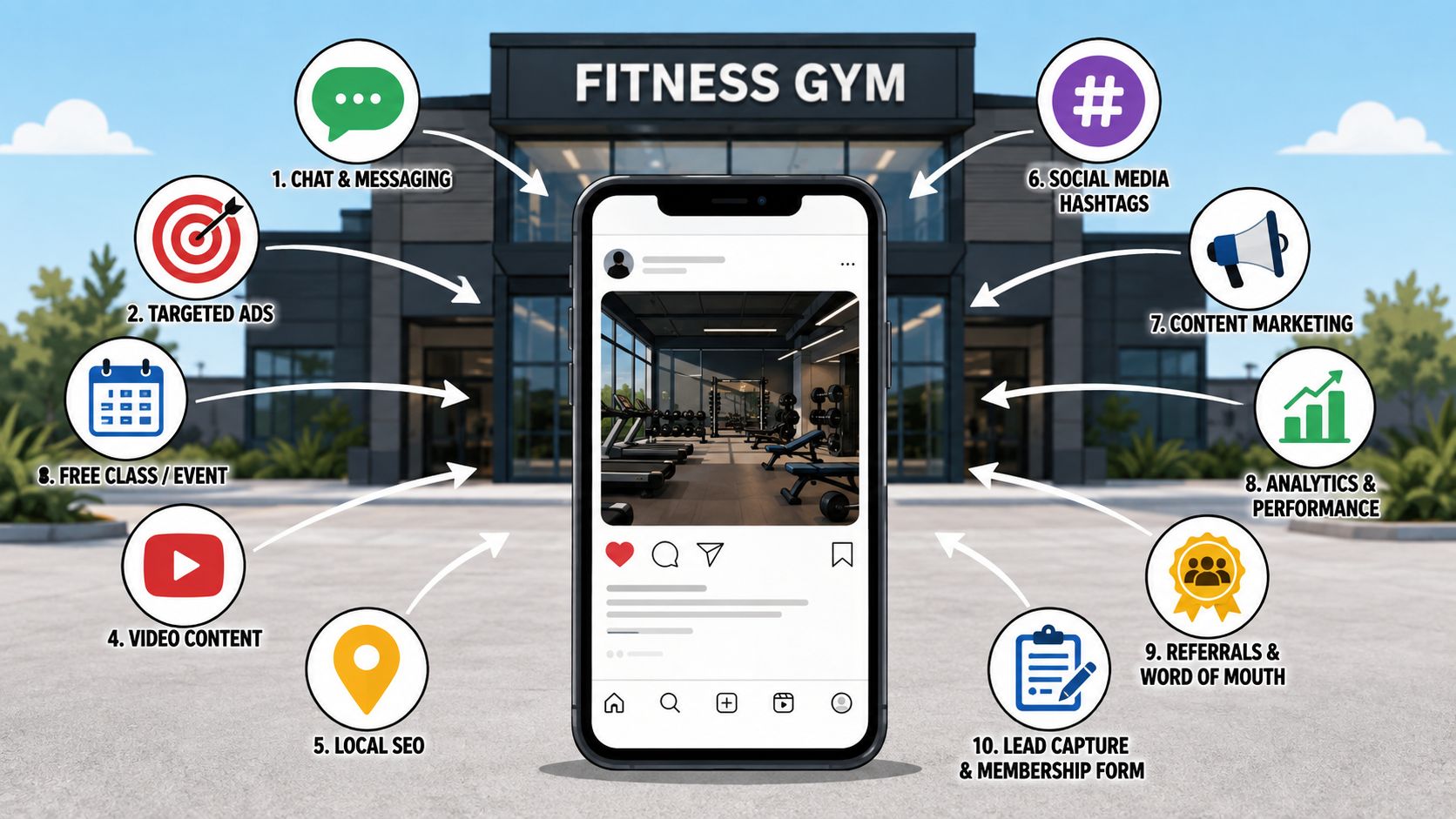
A local gym can post every day, collect plenty of likes, and still struggle to fill trial sessions. The problem usually isn't a lack of effort. It's that a workout video, a membership offer, and a direct message are being treated as separate marketing activities instead of steps in one member journey.
Effective social media lead generation matches each platform and message to a specific funnel stage. Instagram and TikTok can create discovery. Facebook can capture contact details. Email can build confidence. Retargeting can bring back someone who checked pricing but didn't book. A member group can turn a successful trial into a referral.
The ten tactics below connect those stages into a practical gym funnel. Each one includes the best-fit audience, CTA examples, targeting considerations, implementation cost, likely time to useful signals, and a measurement checkpoint. Some tactics need ad spend or software. Others require consistent staff time and disciplined follow-up. None should exist only to increase reach.
Every post, ad, partnership, and conversation should lead to a trackable action, such as a form submission, DM, landing-page visit, trial booking, referral, or consultation. A gym that measures those actions can see which attention becomes pipeline, which leads need nurturing, and which campaigns attract people who are ready to join.
1. Facebook Lead Generation Ads with Instant Forms
A gym can turn a local Facebook impression into a trial request without sending the prospect to a separate website. Instant forms let people tap an ad in the feed, Stories, or Messenger, review pre-filled contact details, and submit quickly. The format fits a free class, membership consultation, personal training assessment, or limited local offer.
Match the offer to the audience. A CrossFit box might promote a beginner trial class to nearby residents. A boutique studio could advertise a seasonal class pass, while a personal training studio could invite prospects to request a consultation. Lead with a clear benefit rather than asking people to “learn more.”
Separate audience segments make follow-up and budget decisions easier. Test neighborhood residents, relevant interests, and warm audiences independently, then compare the conversations and bookings each group produces. Facebook Ads for B2B leads also shows how the format can support more specialized business campaigns.

Make the form qualify interest
Keep the form short, then add one useful qualifier. Ask whether the prospect wants a class trial, membership information, or personal training. Send that answer to the CRM with the campaign source and offer attached. The response determines who receives a booking prompt first and helps staff avoid treating every inquiry identically.
- Use benefit-led copy: Lead with a free trial, consultation, or class pass.
- Show the experience: Use class footage, trainer demonstrations, or member testimonials before the form appears.
- Automate the first response: Send an email and staff alert promptly, then offer a specific booking time.
- Review lead quality weekly: Track form completion, response rates, conversations, trial bookings, and eventual memberships.
Budget includes creative and follow-up time, paid media, and possible CRM integration. Early form activity can appear quickly, while membership quality depends on the speed and relevance of post-submission contact.
Practical rule: An instant form isn't the conversion. The booked conversation is.
For campaign setup, use this guide to run fitness ads on Facebook. Judge the campaign by cost per lead, qualified-lead rate, contact rate, and trial bookings, not cheap form fills alone.
2. Instagram Reels and Short-Form Video Content Strategy
A prospect scrolling during lunch can decide whether a gym feels approachable before reading its membership page. Instagram Reels lets the gym show coaching, atmosphere, progress, and personality in seconds. A trainer correcting a squat, a member entering a first class, or a quick facility tour answers questions that polished copy cannot.
Build each video around one problem and one next action. Open with movement, a text hook, or a recognizable concern. “Your knees cave in during squats” gives viewers a clearer reason to continue than “Fitness tip.” Show the correction, then direct the viewer to DM for a beginner session or use the link in bio to book a trial. Match the format to the message with this format-fit framework for Instagram.

Turn discovery into a conversation
Reach creates awareness, not a qualified membership inquiry. Add the gym's location, name the class or program, and make the mobile CTA simple. A local yoga studio can offer a first-class booking. A personal trainer can ask viewers to DM their goal. A boutique gym can use member footage to show the first week from a real customer's perspective.
Use trending audio only when it supports the offer. Fast cuts and text overlays may improve comprehension, while excessive editing can make a welcoming gym feel intimidating. Authentic member content often suits higher-consideration services because prospects see real people in the actual environment.
Review Reels Insights weekly. Track profile visits, DMs, link clicks, and trial bookings, then repeat the underlying idea with a new opening, exercise, member story, or trainer. This creates a practical path from discovery to inquiry. Keep publishing consistently, because one ambitious video followed by silence will not sustain that path.
Staff can capture footage during existing classes, keeping production costs modest, but someone still needs to edit, approve, and publish it. Discovery may come quickly; conversion depends on a clear profile path and timely follow-up. Apply this Instagram Reels hashtag guidance to support local discovery, while keeping hooks and CTAs at the center.
3. LinkedIn Article Publishing and Thought Leadership
LinkedIn works best when a gym is selling beyond individual memberships. Corporate wellness partnerships, employee fitness programs, property-manager relationships, franchise discussions, and local business referrals all involve professional decision-makers who need evidence before starting a conversation.
B2B marketing teams widely use LinkedIn for lead generation, supporting a clear channel choice. Use it for manager-to-manager conversations rather than reposting a consumer Instagram feed. The LinkedIn lead generation data offers further context for that decision.
Publish useful operating knowledge
A gym owner can explain how to increase employee participation, schedule classes around working hours, retain workplace-program members, or remove the practical barriers that keep staff from using wellness benefits. A multi-location operator might share methods for maintaining service consistency across sites. A corporate wellness manager could describe how to gain support from HR and company leadership.
Teach before asking for a meeting. Use clear headings, short paragraphs, operating examples, and a soft CTA such as “Connect to discuss a workplace program.” A specific lesson carries more weight than a generic motivational post because a buyer can judge whether the gym understands workplace constraints.
Publish through the owner's profile and company page, then share it with relevant professional connections. Reply while comments are active. Turn the strongest idea into shorter posts or a newsletter, giving one article more opportunities to support discovery and follow-up.
The main investment is subject-matter time, editing, and distribution. Results usually take longer than a direct consumer ad because professional trust develops through repeated, useful expertise. Track connection acceptance, relevant comments, profile visits, direct messages, consultation requests, and partnership opportunities. These measures show whether attention is progressing toward a qualified business conversation.
Generic quotes rarely give a business buyer a reason to respond. An article explaining how a gym gets busy employees into consistent classes, handles attendance barriers, or structures a workplace trial gives that buyer a practical reason to make contact.
4. TikTok Fitness Trends and Viral Challenge Participation
A trainer posts a quick form correction, viewers ask follow-up questions, and local beginners discover the gym before they ever visit. TikTok can bring younger nearby audiences into that path through personality, humor, and fast-moving formats. The gym does not need to copy every trend. Choose formats that carry a useful fitness message and still sound like the brand.
A trainer might answer a form-correction comment with a short demonstration. A CrossFit box could show the experience of a workout of the day. A yoga studio could join a flexibility challenge while emphasizing safe progression. Humor about gym culture can attract attention when the joke reflects a genuine member experience.
Turn discovery into a trial opportunity
The opening must give viewers a reason to stay. Start with the surprising movement, common mistake, reaction, or visible result. Then connect that moment to a local next step. “Try this at our beginner strength class” gives a clearer path than a general request to follow.
Use location tags and fitness discovery terms so local viewers understand where the experience takes place. Invite members to create user-generated content, set clear privacy expectations, and obtain permission before reposting identifiable footage. Video replies to comments can extend a useful conversation, qualify interest, and reveal questions for future posts.
TikTok requires quick decisions. A gym with an energetic trainer who enjoys filming may act while a format still feels current. A facility with no content owner, slow approvals, or an audience that prefers detailed information may get better results elsewhere. That trade-off should shape the posting plan.
Equipment costs can stay low, but staff time remains a real investment. Track profile visits, link clicks, DMs, trial inquiries, and bookings tied to the campaign. A viral clip with no local action creates awareness rather than leads. Use a clear landing-page link or message keyword to separate trend-driven prospects from ordinary inquiries, then follow up with the relevant trial offer.
5. Email Lead Nurturing Sequences and Segmentation
A social lead often needs more reassurance before booking. They may want to know whether the gym welcomes beginners, which classes fit their schedule, what coaching feels like, or whether the environment matches their goal. Email gives the gym a controlled way to answer those questions after the initial social interaction.
Start with a useful exchange. Offer a beginner workout plan, nutrition guide, trial code, or class selector, then ask the prospect to identify an interest such as strength, weight loss, yoga, personal training, or workplace fitness. That answer should determine the sequence they receive.
Build a path toward the first visit
A trial-class sequence can introduce the coach, explain what to bring, show the class environment, answer common concerns, and invite a booking. A personal training sequence can focus on assessment, goal setting, and the first consultation. A corporate sequence should address scheduling, participation, and the practical needs of the employer.
You don't need every lead to receive the same message. Segment by stated goal, program interest, engagement level, and whether the person booked. A lead who opened several emails but hasn't booked needs a different message from someone who never interacted after downloading a guide.
The first message should arrive promptly, with later emails spaced around useful information rather than pressure. Keep CTAs clear and limited. “Choose your trial time” is easier to act on than several competing buttons.

The implementation cost includes email software, copy, segmentation, and CRM connections. The first engagement signal can appear soon after sign-up, but membership decisions often require sustained follow-up. Measure delivery, clicks, replies, trial bookings, attendance, and membership conversion by original social source. Don't judge the sequence by open rates alone.
6. Pinterest Visual Content Strategy for Fitness
Pinterest functions more like visual search than a rapid social feed. Someone searching for a beginner yoga routine, meal ideas, or a structured fitness challenge often has a specific problem to solve. Gyms can meet that intent with evergreen content, then guide visitors toward a relevant trial, consultation, or membership offer.
Start with the destination, not the graphic. A yoga studio can connect a beginner sequence to a trial page. A Pilates studio can explain class formats visually and invite visitors to choose a session. A women's fitness facility can offer nutrition and wellness pins that lead to a guide before presenting a consultation.
Build assets that keep working
Use vertical designs with readable text, one clear benefit, and a destination that delivers the promised next step. A pin titled “Beginner strength plan” should lead to a page where visitors can download the plan, choose a class, or request help, rather than a generic homepage.
Build several creative treatments for one offer. Change the headline, image, or framing, then compare outbound clicks with sign-ups and trial bookings. Organize pins around genuine search topics, including beginner yoga, home-to-gym transitions, mobility, and class preparation. Descriptions should use the language prospective members recognize, while remaining natural and useful.
Pinterest requires patience. Useful content can keep attracting search-driven visitors after publication, although it may not produce an immediate spike in inquiries. Plan for design time, keyword research, landing-page creation, and consistent publishing. Use Pinterest autocomplete to identify familiar search wording, then write for people instead of filling descriptions with repeated terms.
Measure Pinterest's role in the funnel. Track outbound clicks, email sign-ups, trial bookings, and assisted conversions. Saves without relevant visits usually signal a mismatch between the pin and its destination, or a weak CTA. Keep Pinterest focused on discovery and consideration, then use email and retargeting to support the booking decision.
7. Community Building Through Facebook Groups and Member Engagement
A trialist who receives a useful answer in the gym's Facebook group has a reason to return. A well-managed member group turns early interest into attendance, conversation, and referrals. It supports retention by making members feel recognized, while giving prospects a clearer view of the gym's daily experience.
Use the group for conversations that fit the facility. A CrossFit box can share workout previews and member spotlights. A yoga studio can post meditation prompts, class updates, and instructor guidance. A personal training studio can answer form questions and discuss nutrition. Larger gyms may need separate spaces for programs, locations, or member goals so useful posts do not disappear in a crowded feed.
Give members reasons to return
Plan a weekly mix of education, community interaction, and selective promotion. Share progress stories with permission, run polls about scheduling or class needs, and host challenges that reward participation without embarrassing anyone who misses a session. Staff responses matter most when a member asks about technique, attendance, or choosing the right class.
- Recognize progress: Celebrate consistency, first classes, personal milestones, and helpful community behavior.
- Create useful prompts: Ask what members need help with this week instead of posting announcements only.
- Invite referrals naturally: Give members a simple way to bring a friend to a suitable class or event.
- Measure business value: Track active participation, trialist engagement, referral conversations, and referral conversions.
Assign an owner and response expectations before inviting members. Set privacy rules for photos, testimonials, and member discussions. Staff time and moderation are the trade-off. A neglected group signals weak attention, while constant offers make members stop trusting the space.
“Community isn't a broadcast list. It's a place where members should get a useful response.”
Review engagement each month and connect referral enquiries to the member or campaign that generated them. Share external testimonials only with permission. Keep the route from a group conversation to a trial booking short, with one clear contact method and a prompt that tells the prospect what to do next.
8. Influencer Partnerships and Micro-Influencer Collaborations
A local creator can turn a follower's curiosity into a gym visit when the audience lives nearby and trusts the recommendation. A regional fitness personality with a smaller, local following may outperform a larger account whose audience is scattered across areas the facility cannot serve.
Match the creator to the funnel stage and offer. A yoga creator can document a first class, explain who it suits, and link to a trial. A nutrition coach can show the facility through a practical story series. A wellness creator can host a live workout and answer questions that often delay booking. Each collaboration should make the experience tangible and give followers one clear next action.
Buy evidence, not just exposure
Check audience location, engagement quality, previous partnerships, and comment tone. Follower volume alone does not show whether a creator can generate local visits. Confirm deliverables, posting dates, usage rights, disclosure expectations, and tracking before work begins.
Give every creator a unique promo code or landing-page link. Record the creator, campaign, and offer in the CRM source field. Compare clicks, trial bookings, attendance, and memberships. Reach screenshots cannot show whether a partnership produced qualified prospects.
Compensation may include gym access, commission, or a flat fee, based on the creator and agreed deliverables. Run a small test with different audience types, then renew partnerships that produce qualified actions. Give creators useful boundaries and key facts, while allowing natural delivery. Overly polished scripts can weaken trust with local followers.
Staff coordination, complimentary access, paid production, and creator fees all affect the implementation cost. Results may come quickly from a responsive local audience, but the gym still needs prompt follow-up and a strong first-visit experience. The creator opens the conversation. Staff convert that interest into attendance and membership.
9. Retargeting and Lookalike Audiences Through Pixel-Based Advertising
A prospect may watch a Reel, visit the membership page, compare class types, and leave without booking. Retargeting gives the gym another opportunity to address the question that interrupted the journey, then move that person toward a trial or membership.
Set up tracking tools, website events, consent management, and CRM connections before increasing ad spend. Group visitors by behavior and recency. A pricing-page visitor needs different creative from someone who watched a video or downloaded a beginner guide. Build a sequence that introduces the trial, provides proof, and ends with a direct booking option. This supports a gym marketing funnel plan rather than treating each ad as an isolated impression.
Protect relevance and budget
Repeated exposure can irritate prospects and waste budget. Exclude people who already booked, cap frequency, and update the message as intent changes. Someone who visited yesterday might receive a class invitation. A visitor who disappeared weeks ago may respond better to a seasonal offer or a clear explanation of the first session.
Sequential creative can also turn cheap meme impressions to conversions when the first touch creates awareness and later ads provide a relevant next step.
Lookalike audiences extend reach from existing members or qualified leads, but results depend on the source list. Build audiences from people who attended, joined, or showed strong intent, rather than every low-quality form submission. Compare lookalike traffic with cold audiences using qualified leads and bookings as the decision criteria.
Budget for ad spend, analytics setup, creative production, consent management, and CRM integration. Allow data to accumulate before judging a segment. Track cost per qualified lead, trial bookings, membership conversion, exclusions, and frequency. Retargeting amplifies a clear offer and reliable follow-up process. It cannot repair either one.
10. Integrated Multi-Channel Fitness Marketing Campaign
The strongest gym campaigns assign each channel a job. Short-form video creates discovery. Facebook forms or DMs capture intent. Email answers questions. Retargeting brings back undecided visitors. A member group supports retention and referrals. LinkedIn and Pinterest can serve distinct professional or search-driven audiences.
Start with one offer that a prospect can understand immediately. It might be a beginner class, a consultation, a short pass, or a program assessment. Give that offer one primary CTA and use consistent naming across ads, landing pages, emails, and CRM fields.

Connect the handoffs
A prospect might discover the gym through an Instagram Reel, click to a trial page, submit a Facebook form later, receive an email, and return through a retargeting ad. Without UTMs, pixels, promo codes, and CRM source fields, the gym may credit only the final click and misunderstand what created demand.
Keep the first campaign manageable. Choose two high-impact channels, define the audience and offer, and give staff responsibility for responses. Review performance weekly, then make a monthly cross-channel decision about creative, audience, follow-up, and budget.
The cost depends on the mix of advertising, content production, software, and staff time. Time to results also varies by channel, so don't compare an evergreen Pinterest asset with a paid retargeting campaign using the same short window.
Measure the full path:
- Discovery: Reach, video completion, profile visits, and local engagement.
- Capture: Form submissions, DMs, landing-page conversions, and consultation requests.
- Qualification: Contact rate, stated goal, availability, and program fit.
- Conversion: Trial bookings, attendance, membership starts, and revenue source.
- Retention: Repeat attendance, referrals, group participation, and reactivation.
A campaign is integrated only when those stages share a clear offer, tracking system, and follow-up standard.
10-Point Social Media Lead Generation Comparison
| Strategy | Implementation complexity | Resource requirements | Expected outcomes | Ideal use cases | Key advantages |
|---|---|---|---|---|---|
| Facebook Lead Generation Ads with Instant Forms | Low–Moderate, ad and form setup, CRM hookup | Ad budget, creatives, CRM/automation | Fast lead volume; quick lead delivery; variable lead intent | Local membership signups, trial/class bookings, PT consultations | High conversion; pre-filled mobile forms; direct CRM integration |
| Instagram Reels and Short‑Form Video Content Strategy | Low–Moderate, regular content production & editing | Time, basic video gear, editing tools; optional influencer spend | Growing organic reach and profile visits; gradual lead growth | Awareness, brand building, driving link‑in‑bio conversions | High organic reach; emotional storytelling; low paid dependence |
| LinkedIn Article Publishing and Thought Leadership | Moderate, long‑form writing and consistent cadence | Time, subject‑matter expertise; minimal ad spend | High‑quality B2B leads, credibility, long‑term traffic | Corporate wellness sales, partnerships, franchise or B2B leads | Positions as expert; attracts high‑intent professional prospects |
| TikTok Fitness Trends and Viral Challenge Participation | Low–Moderate, trend monitoring and fast posting cadence | Time, creative capacity; minimal production cost | Potential viral spikes, rapid awareness among younger audiences | Gen Z/millennial awareness, viral campaign testing | Exceptional viral potential; low production barrier; trend templates |
| Email Lead Nurturing Sequences and Segmentation | Moderate, build automations, scoring, and tests | ESP subscription, CRM integration, copywriting resources | High ROI; increased conversion during decision window; higher LTV | Converting social leads, trial-to-member flows, segmented offers | Personalization at scale; measurable ROI; retains leads over time |
| Pinterest Visual Content Strategy for Fitness | Low–Moderate, design and SEO optimization for pins | Graphic design tools, keyword research, time investment | Steady long‑term organic traffic and warmer leads | Visual content (workouts, meal plans), women‑focused audiences | Long content lifespan; high search intent; low competition niches |
| Community Building Through Facebook Groups and Member Engagement | Moderate, ongoing moderation and content planning | Community manager time, content calendar, incentives | Improved retention, referrals, UGC and member engagement | Retention-focused programs, referral amplification, member support | Builds loyalty and referrals; generates authentic UGC; low monetary cost |
| Influencer Partnerships and Micro‑Influencer Collaborations | Moderate, vetting, contracts, and coordination | Partnership fees ($200–$2k+), briefing, tracking codes/links | Local reach lift, increased trial bookings, social proof | Local promotions, event activations, targeted audience segments | High trust and authenticity; targeted local reach; scalable partnerships |
| Retargeting and Lookalike Audiences Through Pixel‑Based Advertising | Moderate–High, pixel setup, audience build and optimization | Ad spend, developer/analytics time, conversion tracking tools | Higher conversion efficiency, lower CPL, scalable lookalikes | Converting site visitors, recapturing interest, scaling similar users | High‑intent targeting; efficient ROAS; dynamic, sequential messaging |
| Integrated Multi‑Channel Fitness Marketing Campaign | High, cross‑channel coordination and attribution setup | Higher budget, multi‑team resources, attribution & automation tools | Balanced funnel performance, improved conversion & retention | Brands seeking scalable acquisition and reduced channel risk | Leverages strengths of each channel; better attribution; diversified risk |
Keep the Funnel Clean, Fast, and Trustworthy
A practical thirty-day plan starts with restraint. Select two high-impact channels that match your audience and staff capacity. Define one offer, one primary CTA, and one destination. Then connect the form, landing page, CRM, email sequence, tracking parameters, and staff notification before pushing more traffic into the system.
Review lead quality instead of celebrating vanity metrics. A video can earn attention without generating a local inquiry. A cheap form can produce contacts who never respond. A smaller campaign that creates attended trials and relevant consultations may be more valuable than a larger campaign with impressive reach.
Audit every lead path for clear consent, prompt responses, and relevant nurturing. The prospect should know what they submitted, what happens next, and how to contact the gym. Staff should see the source, offer, goal, and preferred program before making contact. If the first response is generic, delayed, or disconnected from the ad, the gym wastes the trust created by the campaign.
Keep conversations human. A short DM can ask what the prospect wants to improve, whether they've trained before, and which class or consultation suits them. Email can provide preparation advice and social proof. Retargeting can reinforce the next action, but it shouldn't pressure people who have already booked.
The physical experience also supports the marketing promise. A clean, well-maintained gym makes a stronger impression when a social lead arrives for a first visit. Use gym wipes or fitness wipes for routine touch-ups on high-touch areas, and place a stocked gym wipe dispenser near equipment where members can use it easily. For broader cleaning needs, choose disinfecting wipes or sanitizing wipes according to the surface and the product directions.
Use targeted products for targeted jobs. Keep wipes for gym equipment available for benches, handles, and machine contact points. Use yoga mat wipes where the product is suitable for the mat material. If the gym needs an EPA registered disinfecting wipes product, follow the label, including the required wet contact time. Gym-cleaning guidance commonly cites labeled wet contact times of about 2 to 10 minutes against MRSA for many wipe products, so don't promise disinfection based only on a quick pass. Check the product label and the applicable gym cleaning standards guidance.
The same discipline applies to attribution. Record the first meaningful source, the offer, every booked action, and the final membership outcome. Review the numbers with the person responsible for follow-up, not only with the person who published the content. That conversation reveals whether the problem is creative, targeting, qualification, scheduling, or the sales process.
If your team needs a practical place to organize membership offers, funnel ideas, and social campaigns, Gym Membership Tips is one relevant resource. Use it alongside your own CRM data and member feedback, because no external playbook knows your local audience as well as your staff does.
Choose your two channels this week, create one trackable offer, and assign an owner for every new lead. Then launch the first campaign, respond quickly, inspect lead quality after the initial conversations, and improve the path before increasing spend.
Leave a Reply