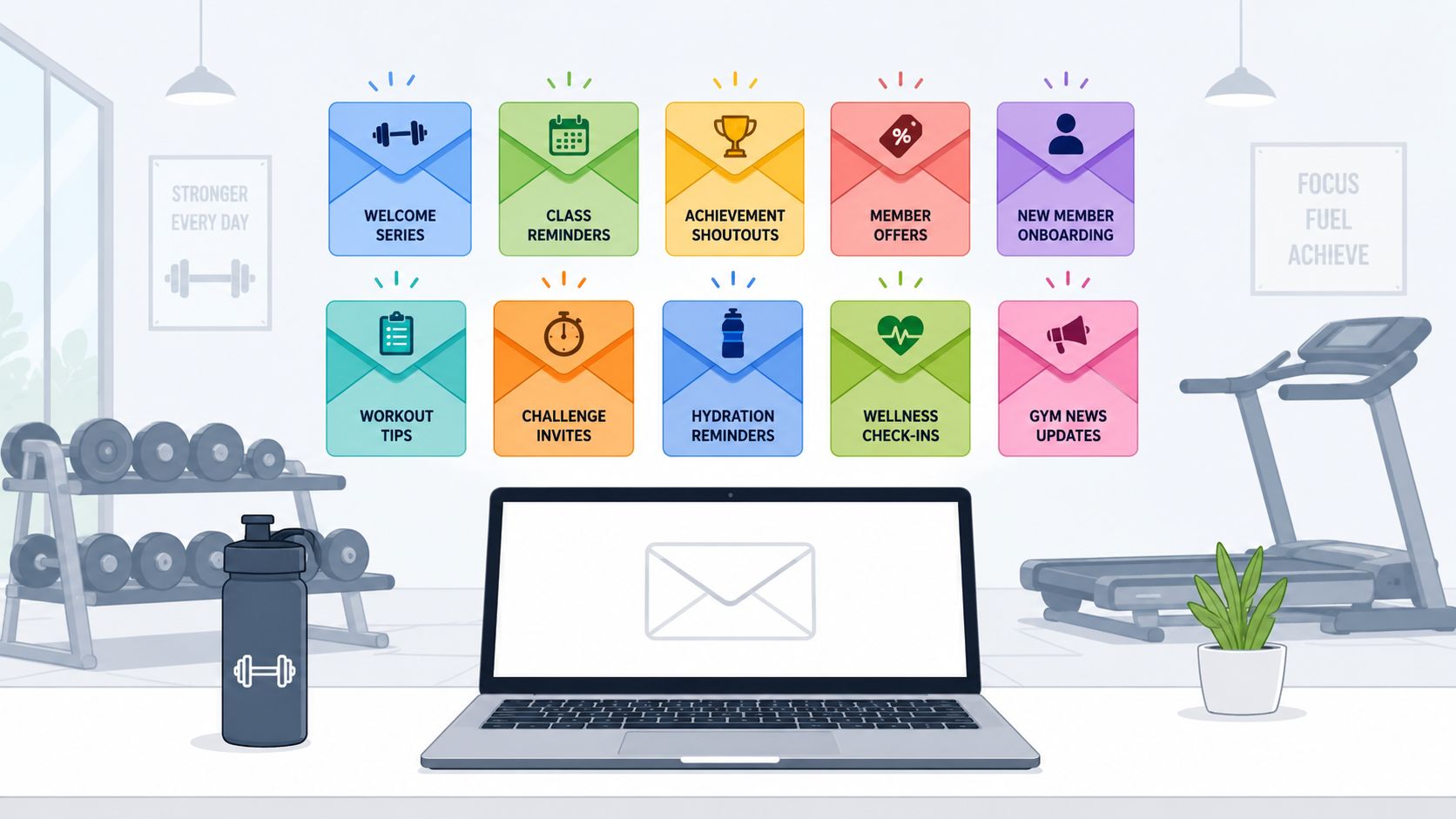
Your sales inbox rarely contains one clean type of conversation. On the same morning, you might have a brand-new lead asking about membership, a trial visitor who hasn't booked a second session, a recently joined member wondering where to start, and someone preparing to cancel. Sending all four people the same promotion wastes the context your team already has.
The strongest email template examples match the recipient's lifecycle stage, motivation, and next action. They give sales staff a reliable structure without forcing every member into robotic copy. The templates below move from prospecting through onboarding, engagement, upgrades, referrals, and cancellation, with subject-line options, personalization prompts, implementation guidance, trade-offs, and practical gym-floor follow-through.
Use the copy as a starting point, then adapt it to the member's actual behavior and goal. If your team is building a broader sequence, this guide on how to create an email sequence that sells can help connect individual messages into a coherent follow-up journey. The in-person promise matters too. Gym wipes, sanitizing wipes, and wipes for gym equipment help support the clean, ready-to-use experience your emails describe.
1. Welcome Series Email Template for New Members
A new member's first email should remove uncertainty, not dump every facility detail into one crowded message. Send a short welcome note within the first day of signup, then use follow-ups to introduce the equipment floor, classes, trainers, and practical support.
Subject-line options
- Welcome to [Gym Name], [First Name]
- Your first week at [Gym Name]
- Ready for your first workout?
- Start here, [First Name]
Copy-ready template
Hi [First Name],
Welcome to [Gym Name]. You joined because you want to [member goal], and we're here to make your first steps simple.
Start with [recommended first action], then take a look at [class or facility feature]. [Trainer Name] is available to answer questions about [relevant specialty], and you can reach us at [contact details].
Would you like us to help you book your first [orientation, class, or consultation]?
See you soon,
[Staff Name]
Personalize the first paragraph with the goal captured during the sale, such as strength training, improved mobility, or building a consistent routine. Add a direct booking link, a trainer contact, and one useful facility image. Keep each email mobile-friendly, because members often read messages between work, commuting, and training.
A welcome series can introduce one idea at a time across the early membership experience. The trade-off is workload. Too many emails can feel like homework, while one generic message leaves new members unsure what to do next.

Before promising a spotless, welcoming facility, make sure the floor team delivers it. Keep gym equipment wipes available near high-touch machines and confirm that shared areas are checked during the member's first visits.
2. Class Schedule Update and New Offering Announcement
Schedule emails earn attention when members can immediately see what changed and what they need to do. A subject line that hides the update behind clever promotional language creates avoidable confusion, particularly when a popular class has moved or a trainer has changed.
Subject-line options
- Schedule update for [Gym Name]
- New [Class Name] sessions are now open
- [Class Name] is moving to [Day and Time]
- Meet your new [Trainer Type]
Copy-ready template
Hi [First Name],
We've updated the [Gym Name] schedule to give members more access to [benefit, such as evening training or beginner support].
Starting [effective date], [specific change]. We're also adding [new class, trainer, or service], led by [Trainer Name]. You can reserve your place here: [booking link].
If your usual session is affected, these alternatives may suit you: [option one] and [option two]. Reply to this email if you need help choosing.
[Staff Name]
Use a simple calendar image or short schedule summary, but don't make the graphic the only place where the important information appears. Segment the send when possible. A beginner may care about an introductory class, while a regular attendee needs a direct notice about a time change.
Send reminders before the change takes effect, and write a separate message for members already registered for an affected session. The limitation is obvious: no email can repair a schedule that changes without accurate front-desk communication. Update booking pages, signage, and staff talking points at the same time.
When a new class launches, have the room ready before promoting it. If mats, benches, or cardio consoles are shared, place suitable disinfecting wipes where members can use them according to the product label.
3. Member Retention and Re-Engagement Winback Campaign
A member who hasn't visited may need a convenient time, a confidence boost, help with payment, or a better program match. Treating every inactive member as unmotivated leads to tone-deaf campaigns. Segment by the signal you have, then make the first return step easy.
Subject-line options
- We saved a simple next step for you
- Want help getting back into your routine?
- Your [Gym Name] plan can fit your schedule
- Which support would help most?
Copy-ready template
Hi [First Name],
We noticed you haven't booked a session recently, so we're checking in rather than assuming what you need. If time has been the issue, we can help you find a shorter session. If motivation has dropped, [Trainer Name] can help you build a manageable restart plan.
Choose your easiest next step:
- Book a class: [link]
- Request a quick check-in: [link]
- Tell us what got in the way: [survey link]
We'd like to help you return in a way that feels realistic.
[Staff Name]
Use a success story only when it resembles the recipient's situation, and don't turn a check-in into an immediate discount pitch. A free class, consultation, or simple reply can be more useful than a price offer when the barrier is uncertainty.
For members with payment issues, separate the operational reminder from the emotional win-back message. For members who have stopped booking classes, show the most relevant alternatives rather than the full timetable. Your team can refine the sequence with the practical guidance in gym member retention strategies.
Practical rule: Ask why the member disappeared before deciding what to sell them.
The facility experience has to support the invitation. Clean high-touch equipment before peak periods and make fitness wipes visible without making the gym feel clinical.
4. Personal Training Upsell and Premium Service Promotion
An upsell works best when it answers a goal the member has already shared. “Buy personal training” is weak copy. “You mentioned wanting to improve your squat technique, and [Trainer Name] specializes in that” gives the member a reason to continue reading.
Subject-line options
- A more focused plan for [Goal]
- Meet the trainer who can help with [Goal]
- Want a plan built around your schedule?
- Your next step at [Gym Name]
Copy-ready template
Hi [First Name],
You told us that your priority is [specific goal]. Based on that, [Trainer Name] may be a good fit. [He, she, or they] works with members who want to [relevant outcome or training focus].
Start with a [free assessment, consultation, or introductory session] so you can discuss your schedule, experience, and expectations before choosing a package. Reserve a time here: [booking link].
If you'd rather begin with small-group training or nutrition support, reply and I'll point you toward the right option.
[Staff Name]
Include the trainer's real photograph, credentials, coaching style, and availability. Match the offer to fitness level. A new member may need an orientation, while an experienced lifter may respond to technique coaching or a focused program.
The trade-off is revenue versus trust. A premium service email can perform well, but aggressive follow-up after a clear “not now” makes the core membership feel like a sales trap. Set a sensible follow-up limit and let the member choose the next conversation.
For a broader explanation of how related services can be positioned, see what is upselling and cross-selling. After the appointment, keep the promised environment ready with commercial disinfecting wipes for shared training surfaces.
5. Member Milestone and Achievement Recognition Template
Recognition messages should celebrate a real behavior, not manufacture enthusiasm from thin data. A class streak, membership anniversary, completed assessment, personal record, or birthday can give your team a natural reason to reach out without asking for a purchase first.
Subject-line options
- You reached a milestone, [First Name]
- [Number or achievement] worth celebrating
- Your progress deserves recognition
- Happy birthday from [Gym Name]
Copy-ready template
Hi [First Name],
You've just reached [specific milestone], and our team wanted to recognize the work behind it. Your consistency with [class, training habit, or goal] is a meaningful step toward [member's stated objective].
If you'd like to keep the momentum going, your next option is [relevant class, assessment, or challenge]. You can book it here: [link].
Congratulations,
[Staff Name]
The personalization should be specific enough to prove someone checked the record. Avoid exposing sensitive health information or displaying progress publicly without permission. If you include a referral invitation, keep it secondary. The member should feel appreciated before being asked to bring in a friend.
A visual badge can work for a digital community, but don't let design distract from the achievement. Some members prefer a personal note from a coach, while others enjoy a shareable graphic. Test the format by audience, not just by department preference.

A clean celebration matters too. Wipe benches, handles, and shared accessories before the next session, using antibacterial wipes only where the product is appropriate and following its directions.
6. Promotional Campaign and Limited-Time Offer Email
Promotional email is useful when the offer is clear, the audience is eligible, and the deadline is real. It fails when the member has to hunt for the price, terms, expiry, or action button. Urgency should clarify a decision, not pressure someone with a fabricated countdown.
Subject-line options
- Your [Gym Name] offer ends [date]
- Join with [specific benefit] by [date]
- A limited offer for [audience segment]
- Last day to claim [offer]
Copy-ready template
Hi [First Name],
For [audience or occasion], we're offering [specific offer] through [date and time]. This applies to [eligible membership or service] and includes [key benefit].
If it fits your plan, claim it here: [CTA link]. Before you join, review the membership terms, cancellation policy, and any freeze conditions here: [terms link].
Questions? Reply to this email or call [phone number].
[Staff Name]
Use one primary CTA. Email template guidance places the typical open-rate benchmark around 21%, CTR around 2.6%, click-to-open rate around 10% to 15%, unsubscribe rate near 0.1%, and conversion rate around 1% to 3%, while stronger performance is commonly described as open rates above 30%, CTR above 5%, and conversion rates above 5% in the email marketing reporting template guidance. Treat those figures as directional benchmarks, not promises.
A promotional email should be easy to read on a phone and easy for staff to explain at the desk. Make sure the advertised class times, joining process, and facility cleanliness match the offer before the first recipient arrives.

7. Event Invitation and Workshop Promotion Email
An event invitation should sell the experience, not just announce a date. Members need to know who it's for, what they'll do, where to go, what to bring, and how to reserve a spot. That information makes the event feel organized before anyone enters the building.
Subject-line options
- Reserve your place at [Event Name]
- Learn [topic] with [Trainer or Speaker]
- Members' [Workshop or Challenge] starts [date]
- You're invited to [Event Name]
Copy-ready template
Hi [First Name],
Join us for [Event Name] on [date] at [time]. [Trainer or Speaker Name] will cover [specific topic], with practical guidance for members working toward [relevant goal].
You'll need [what to bring]. Parking and arrival details are here: [information link]. Places are limited, so reserve yours here: [registration link].
After the event, we'll send a short recap and photos to registered attendees. If you have an accessibility or scheduling question, reply directly to this message.
[Staff Name]
Send the first invitation with enough planning time for the audience, then remind registrants with the exact arrival details. A trainer biography and photograph can increase confidence, but keep the focus on what attendees will gain. For a charity event, explain where participation supports the cause and avoid turning the message into a standard membership pitch.
The limitation is attendance quality. A large registration list doesn't guarantee a full room, so make confirmation and reminder emails useful rather than repetitive. Afterward, send resources, photos with appropriate permission, and a clear next action.
Before a workshop, clean chairs, mats, door handles, and shared equipment. If the event uses mats, keep yoga mat wipes nearby and verify the surface is compatible with the selected product.
8. Referral Program Incentive and Ambassador Email
Members refer friends when the recommendation feels natural and the sharing process takes little effort. The email should explain who makes a good referral, what both people receive, how to share, and when the reward becomes available.
Subject-line options
- Bring a training partner to [Gym Name]
- Share your [Gym Name] experience
- A reward for introducing a friend
- Who would enjoy your next workout?
Copy-ready template
Hi [First Name],
Know someone who'd enjoy [class type, coaching style, or facility benefit]? Invite them to [specific trial or introductory action] using your personal referral link: [referral link].
When [clear qualifying action] happens, you receive [member reward], and your friend receives [friend benefit]. You can share the invitation by email or social media here: [sharing link].
If you've already recommended someone, check your progress here: [status link]. Thanks for helping us build the community.
[Staff Name]
Make the reward worthwhile without eroding the economics of the membership. Spell out eligibility, timing, and exclusions in plain language. A public leaderboard may motivate some members, but private recognition is better for people who don't want their activity displayed.
Use separate messages for active participants, long-term members, and members who have recently praised a class or trainer. The strongest referral prompt follows a positive experience. You can refine the program mechanics with how to create a referral program.
Don't invite a friend to a visibly neglected facility. Place bulk gym wipes or a suitable gym wipe dispenser near shared stations so the experience supports the recommendation.
9. Membership Upgrade and Tier Expansion Email
An upgrade email should reflect a change in usage or goals. Heavy class attendance, repeated day-pass purchases, demand for premium access, or a growing interest in coaching can indicate that the current tier no longer fits. Lead with the benefit that removes friction, not with an unexplained price increase.
Subject-line options
- More flexibility for your training routine
- You've outgrown your current access
- Access [specific upgrade benefit]
- A membership option built around [behavior]
Copy-ready template
Hi [First Name],
You've been using [current service or class type] regularly, so I wanted to show you an option that may fit your routine better. [Upgrade name] includes [specific benefits], which means you can [member-centered advantage].
Your upgrade would start on [date] and cost [accurate price or price difference]. Review the details here: [upgrade link]. If you'd like to compare options first, reply and I'll walk you through them.
You can also review the downgrade and cancellation terms before deciding.
[Staff Name]
Segment from real activity data, but don't make members feel watched. “You attended several evening sessions” is more respectful than implying the gym has been monitoring every visit. A temporary price lock can create a reason to act, but disclose exactly when the regular terms begin.
The trade-off is average revenue versus member trust. An upgrade that improves access can deepen the relationship. An upgrade that adds features the member won't use creates regret and future cancellation risk.
10. Post-Cancellation and Win-Back Exit Email
Cancellation is a sensitive moment. The first message should acknowledge the request, explain the process, and ask for useful feedback without making the member defend the decision. A save offer can follow only when it matches the stated reason.
Subject-line options
- We received your cancellation request
- Can we make your membership work better?
- Before your membership ends
- A flexible option for your next chapter
Copy-ready template
Hi [First Name],
We've received your cancellation request and will process it according to your membership terms. Before the membership ends, would you tell us what influenced your decision? You can reply directly or complete this short survey: [survey link].
If the issue is schedule, we can discuss [pause or flexible option]. If the issue is progress, [trainer or support option] may be more relevant. There's no pressure to choose either.
If you leave, we'd still be glad to welcome you back when the timing is right.
[Staff Name]
Send the acknowledgment promptly, then use the response to choose one relevant retention path. Don't hide the cancellation button, impose unnecessary obstacles, or promise a pause that your system can't deliver. If the save attempt fails, move the member into a respectful win-back sequence instead of continuing to argue.
A later return message can invite the former member to review new classes, changed hours, or a suitable re-entry option. Before encouraging a return, make cleanliness easy to verify. Facilities using commercial disinfecting wipes and yoga mat wipes should communicate cleaning schedules accurately and maintain the stated process. Guidance for health clubs recommends EPA-registered disinfectants on equipment and tools, keeping high-use surfaces wet for the full instructed contact time, then allowing them to air-dry or wiping with a clean cloth after that time, as described in fitness-facility cleaning guidance.
Comparison of 10 Membership Email Templates
| Template | Core features | Target audience | Primary value proposition | Best use & timing |
|---|---|---|---|---|
| Welcome Series Email Template for New Members | Automated 5–7 email drip; personalization by name/tier; progressive feature discovery; CTAs to book classes/trainers; mobile-responsive | New members; all gym types | Rapid onboarding that increases 30‑day attendance and early retention | Send first email within 24 hrs; run over 2–4 weeks; CTA: book class/consult |
| Class Schedule Update & New Offering Announcement | Before/after schedule; visual calendar; trainer bios; registration links; FAQ | All members; seasonal/holiday audiences | Prevents confusion, promotes new classes and fills underused slots | Send 1–2 weeks prior; reminders 1 week & 1 day before changes |
| Member Retention & Re-engagement Winback Campaign | Activity tracking; personalized messaging; testimonials; limited-time incentives; simple re-engage actions | Lapsed or declining-attendance members (30+ days) | Reduces churn with targeted incentives and social proof (high ROI) | Trigger at 30+ days inactivity; offer free class/consult; A/B test incentives |
| Personal Training Upsell & Premium Service Promotion | Trainer credentials; transformation stories; tiered programs; free consultation lead magnet; social proof | Engaged members ready to advance; high‑LTV segments | Converts existing members into high-margin services to boost revenue | Target after usage signals (~3+ months); CTA: book assessment/consult |
| Member Milestone & Achievement Recognition Template | Personalized milestone badges; progress visuals; reward offers; referral CTA | Long-term and engaged members | Strengthens emotional loyalty, increases referrals and word‑of‑mouth | Send on exact milestone date; include shareable badge and referral link |
| Promotional Campaign & Limited-Time Offer Email | Countdown timer; urgency copy; multiple CTAs; social proof; clear terms | Prospects and price-sensitive segments; seasonal buyers | Drives rapid conversions and predictable revenue spikes | Use for seasonal/flash sales; genuine deadlines; follow-up last-chance email |
| Event Invitation & Workshop Promotion Email | Event details (date/time/location); hero image; reg link; presenter bio; RSVP incentives | Community-focused members and prospects | Builds community, increases foot traffic, and showcases expertise | Send 3–4 weeks ahead; early-bird incentives; follow up post-event with photos |
| Referral Program Incentive & Ambassador Email | Easy share links/codes; tiered incentives; tracking dashboard; social templates | Satisfied members and potential ambassadors | Lowest CAC channel; drives qualified leads with higher retention | Evergreen program; promote quarterly; publicly recognize top referrers |
| Membership Upgrade & Tier Expansion Email | Benefit comparison chart; personalized upgrade suggestions; limited-time incentives; testimonials | Heavy users and members who've outgrown current tier | Captures higher-margin revenue by matching evolving member needs | Target heavy users (activity-based); offer temporary price lock to convert |
| Post-Cancellation & Win-Back Exit Email | Exit survey; targeted retention offer; pause option; win-back incentive; follow-up sequence | Members initiating cancellation | Recovers ~10–20% of cancels, gathers feedback for retention improvements | Send immediately on cancellation; follow up at 30–90 days with return offer |
Make the Follow-Up Feel Like the Gym
A template is useful only when it helps a staff member send a more relevant message faster. Start with the lifecycle stage, not the promotion. A new member needs orientation, an inactive member may need a low-friction return, and a cancellation request requires clarity and respect. Choose the template that matches the situation before changing the copy.
Then personalize the subject line and opening paragraph. Use the member's real goal, recent class, question, or stated barrier. Don't add details just because your CRM has them. Personalization should make the message feel understood, not monitored.
Give every email one clear action. That might be booking an orientation, reserving a class, replying with a barrier, scheduling a consultation, claiming an eligible offer, or completing an exit survey. Email-template guidance reports that messages with one clear call to action receive 371% more clicks than messages with multiple competing asks, according to single-CTA email template guidance. The practical lesson is simple. Decide what the recipient should do next, then remove competing buttons and links.
Test the message on a phone before activating it. Also validate the layout across Gmail, Outlook 2019 and later, Apple Mail, Yahoo Mail, and Samsung Email, as recommended by this email template design guide. Check the booking link, reply address, merge fields, images, terms, and cancellation details. A polished design can't compensate for a broken schedule or an incorrect member name.
Measure the action closest to revenue and retention. Opens can be distorted by privacy changes, so clicks, click-to-open rate, replies, booked tours, attended consultations, and downstream conversions provide more useful signals for gym sales teams. Automated lifecycle messages deserve special attention. In 2026 benchmark data, automated emails generated $3.41 per email sent, compared with $0.155 for campaign emails, and flows generated nearly 41% of total email revenue from 5.3% of sends, according to Klaviyo's email marketing benchmarks. Use that evidence to prioritize timely behavior-based follow-up over endless batch promotions.
The operational promise matters just as much as the copy. Clean high-touch equipment and shared surfaces with appropriate gym equipment cleaning wipes, disinfecting wipes, or other suitable products. EPA-registered disinfecting wipes are identified for high-touch gym equipment and cardio consoles, but staff must follow the product label and stated contact time, as explained by EPA-registered disinfecting wipe guidance for gym surfaces. Keep a gym wipe dispenser accessible where members and staff can use it responsibly, and document the cleaning routine so the front desk can answer questions accurately.
Before expanding an automation, send a small test, review replies, inspect conversions, and ask staff what members said in person. Use genuine deadlines, supported claims, and real member details. Put the most relevant template into your CRM today, assign one owner for follow-up, test the complete journey on mobile, and verify that the facility delivers every promise before the next send.
Leave a Reply