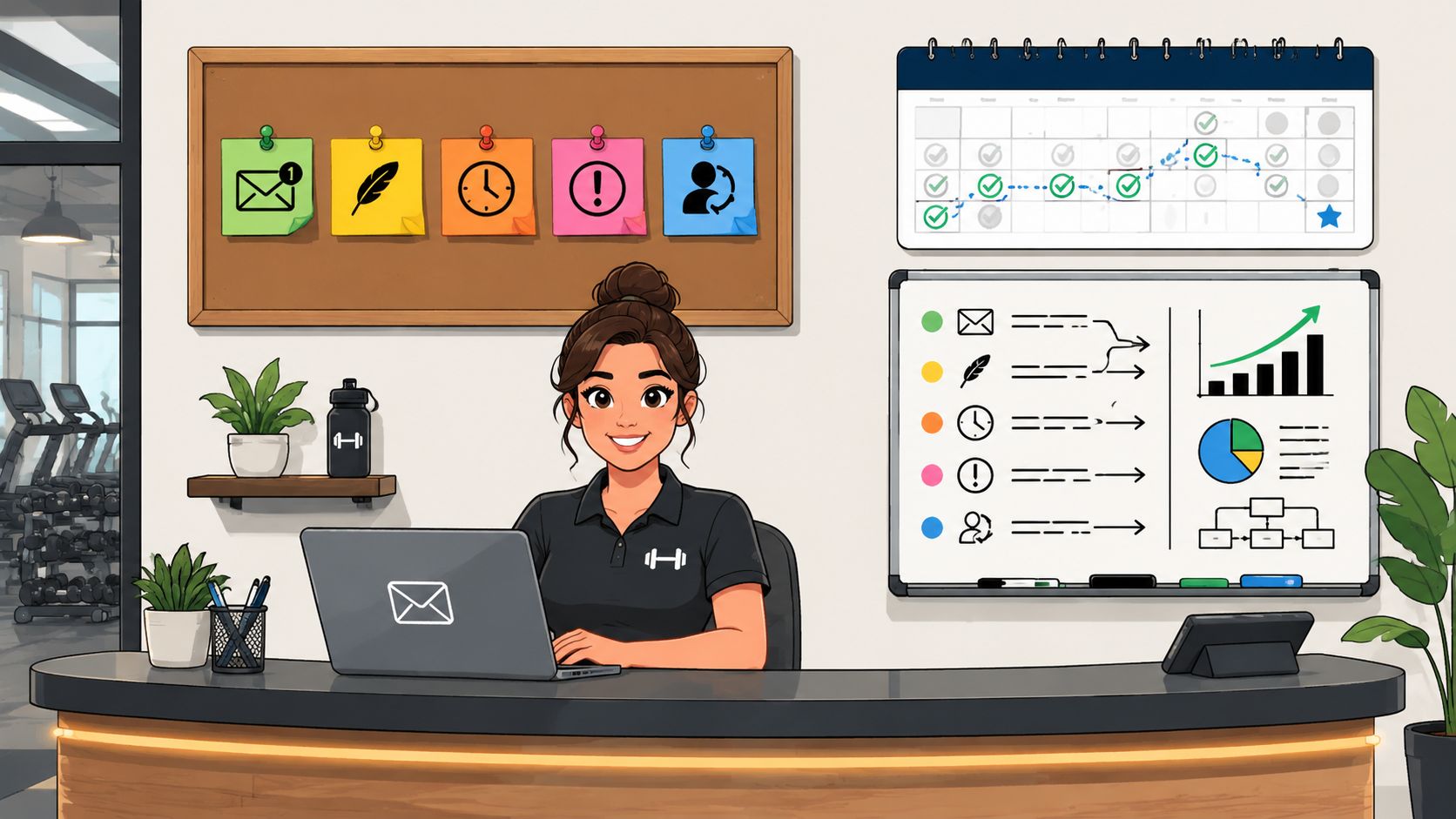
A payment reminder email can protect retention as effectively as it protects cash flow. Email remains the dominant reminder channel in major markets, with 93.8% of businesses using it to follow up on overdue invoices, while adding SMS to email increased the chance of payment within a week of the due date by 56% in a 2022 survey (Chaser's late-payments report). For a gym, that means the message has to recover revenue without making committed members feel punished.
The strongest approach is a 14-day automated cadence that adapts to the member and the account stage. The seven templates below cover the first reminder, a supportive check-in, flexible payment options, staged escalation, value reinforcement, concern-based problem solving, and a respectful final notice. Each approach includes timing, target segment, tone, subject-line ideas, customization guidance, testing opportunities, and an operational tie-in where cleaning communication can reinforce the member experience.
Keep account details verified, avoid threats, explain payment and support paths clearly, honor applicable cancellation and pause policies, protect privacy, and keep every message recognizably on-brand. If you also use text messages, apply the same discipline as you would when reviewing SMS tactics for Shopify stores, with consent and local privacy requirements in mind.
1. Simple Past-Due Payment Reminder
A first past-due email should recover payment without turning a routine card failure into a retention problem. Send it within 24 hours of a failed transaction or missed renewal, when the account shows no obvious service issue. Keep the message direct, calm, and professional.
Subject-line options
- Payment update needed for your membership
- A quick update to your gym payment
- Please review your membership payment
State the verified details: the member's name, membership type, payment date, amount due, and, where your system and privacy policy permit, the last four digits of the stored card. Use one prominent button, such as Update payment details, then offer a reply path for members who believe the charge is incorrect.
Practical rule: The next step should be clear without searching an old invoice, logging in twice, or calling the front desk.
A concise message can read: “Your recent membership payment didn't go through. Please update your payment method to keep your access active. If you've already resolved this, disregard this email or reply so our team can confirm your account.”
The first reminder deserves careful testing. Trove's reminder analysis found that 58% of eventually paid invoices were recovered after one reminder, while a second reminder recovered another 21% (Trove's reminder analysis). Use that pattern to prioritize a clear first request over elaborate copy.
Test one variable at a time. Compare “Update payment details” with “Keep my membership active,” while holding the segment and send window constant. Connect the billing trigger to the member record to streamline your coaching systems, then review recurring payment setup so successful payments automatically suppress later reminders. This operational link prevents members from receiving an escalation after fixing the issue.

2. Personalized Member Check-In Reminder
A personalized reminder can protect the member relationship while still asking for payment action. Use it for engaged members who attend regularly, train with a coach, or prefer a specific class. A technical or temporary payment problem should not make a loyal member feel treated like an account number.
Open with one accurate detail from the member record. Mention a recent class, assigned trainer, recorded goal, or completed milestone. Keep the payment request close to that recognition so the member understands what to do.
Subject-line options
- How's your training going, Alex?
- A quick check-in about your membership
- Let's keep your training on track
A coach might write: “Hi Alex, we've noticed you've been enjoying the early strength sessions with Maya. Your recent membership payment needs an update, so we wanted to check in before access is affected. You can update your payment details below, or reply if something has changed.”
The tone recognizes commitment without turning attendance into pressure. Never suggest that frequent visits create a special payment obligation. Avoid health, injury, or other sensitive details unless the member has expressly agreed to receive them in gym communications.
Make personalization operational
Use the same member system for billing triggers and approved profile details. If staff must investigate every account manually, reminders become slow and inconsistent. Limit personalization to fields the gym can keep accurate, such as preferred name, favorite class, assigned coach, and recent achievement.
Set a clear human follow-up path for exceptions. Accounts with replies, repeated failures, or unclear profile data should enter an escalation queue rather than receive increasingly personal automated messages.
A randomized reminder study found that adding a simple, timely payment reminder lifted the overall response rate from 78.1% to 88.0%, with first-reminder response rising from 26.6% to 40.8% (Saldetto's analysis of the payment-reminder experiment). For gym operators, the practical lesson is narrower: make the request timely, specific, and easy to answer. Personalization should support clarity, not replace it.
Test a warm opening against a neutral one while keeping the member segment and send window consistent. Track replies separately from completed payments. A member explaining a billing issue has shown engagement, even before the balance is settled.

3. Flexible Payment Plan Reminder
A failed payment does not always mean a member intends to leave. It may reflect a short-term budget problem, an annual renewal at an awkward time, or a membership structure that no longer fits. Use this reminder for members who mention hardship, have requested pauses before, or show a payment pattern consistent with a temporary issue. Send it before suspension, while the member still has a clear path to continue.
Lead with practical choices. Put the option that best protects both the relationship and gym revenue first. In many cases, that means updating the payment method, reviewing a lower-access tier, then requesting an eligible pause. Include only options your team, billing platform, and membership agreement can support.
Subject-line options
- Options to keep your membership active
- Let's find the right membership option
- Need a little flexibility with your account?
Explain the decision point in plain language. State what each option changes, when the member must choose, and which team or reply address handles questions. Do not promise fee waivers, credits, or special treatment unless staff approval and billing controls are already in place.
Give staff a clear handoff
Automation can present the choices, but complex eligibility questions need a trained staff member. Route replies to someone who can explain pause rules, confirm available membership changes, and record the outcome. Sync the account status between the front desk and billing platform. Otherwise, a member may agree to a plan and still receive an overdue notice.
A practical message could say:
“If your current membership no longer fits your budget, we can help you review available options. You may update your payment method, ask about an eligible membership change, or request support before access is paused. Reply to this email and our team will help you choose the next step.”
Review option order before testing discount language. For the right segment, compare a payment-first layout with a pause-first layout, then track completed payments, pauses, cancellations, and replies separately. A reply can signal continued engagement even when payment is not resolved yet.
The strongest result is not always immediate collection. A sustainable arrangement can preserve future attendance without teaching members to delay payment until a discount appears. Pair each automated send with a clear staff queue, approved response times, and a suppression rule once a plan, payment, pause, or cancellation is recorded.
4. Sequential Escalation Series
A failed membership payment needs a staged response, not repeated copies of the same email. Build one sequence that matches the member segment, escalation stage, emotional context, and operational follow-through. Each message should make resolution easier while keeping the tone appropriate for a gym relationship.
Start with a neutral notice and a direct payment option. If the issue remains open, follow up with a question that gives the member room to explain. Later, state the account consequence, such as restricted access, only when the membership agreement and local requirements support it. The final message should include a clear deadline and a staffed route for questions.
Suggested progression
- First touch: Neutral notice with a payment button.
- Second touch: Friendly check-in about a billing question.
- Third touch: Specific account-status notice with approved options.
- Final touch: Respectful notice before suspension or another authorized action.
Set the messages within your approved 14-day workflow, adjusting timing when a member replies or resolves the balance. Suppress the next email after payment, dispute, cancellation, or pause activity is recorded. Vary subject lines as the stage changes, since repeating one subject can make a legitimate reminder look like a system error.
Escalation should increase precision before it increases pressure.
Test email alongside SMS only after confirming consent, phone availability, time zones, and privacy requirements for each market. Mixed-channel follow-up can support faster payment timing, but adding a second channel also increases coordination work and the risk of conflicting instructions. Keep the account status synchronized so staff can see which message was sent and what action remains.

Use distinct subject-line angles, such as “Payment update needed,” “Can we help with your account?” and “Your membership access needs attention.” Review the broader email marketing approach for gyms to prevent transactional reminders from colliding with promotional sends. Track payment completion, replies, access changes, and cancellations by stage so the cadence improves retention rather than increasing pressure.
5. Value-Reinforcement Payment Reminder
This approach suits active members who use the facility and may need a timely renewal prompt. Instead of leading with the failed transaction, show the value the member has received, then connect that value to the next payment step. The message should celebrate usage, never shame someone for not using the gym enough.
Pull accurate activity information before sending. You might mention attended classes, booked sessions, trainer interactions, or amenities included in the member's plan. Don't invent a value calculation or display a monetary figure unless your records support it and the comparison is transparent.
Subject-line options
- Keep your training momentum going
- Your membership progress is waiting
- Let's keep your routine moving
A useful email might say: “You've been building a strong routine with the Tuesday mobility class and your recent coaching sessions. Your membership payment needs attention, and updating your payment details will help keep that routine uninterrupted.”
Use value without creating guilt
The difference between reinforcement and pressure is control. Reinforcement gives the member a clear reminder of benefits they chose. Pressure suggests that failing to pay makes them ungrateful or wastes their past effort. Keep the call to action simple and place support language nearby.
Test a usage-led opening against a service-led opening. Measure payment completion, clicks, pauses, and cancellations by engagement segment. Members with high recent activity may respond well to continuity language, while inactive members may need the concern-based approach in the next section.
A visual progress panel can work, but it must be accessible on mobile and understandable without images. Include text alternatives, avoid exposing sensitive information in preview text, and make sure the payment button remains the most obvious action.
For teams building polished transactional messages, an HTML email template can help with rendering checks. The design should support trust, not distract from the account details.

6. Concern-Based Problem-Solving Reminder
Use this message when a failed payment may signal dissatisfaction, confusion, or a technical problem. It's especially useful for premium studios, members who recently complained, and accounts showing a sudden change in attendance. The email should make it easy for the member to explain what happened without turning the message into a defensive survey.
Open with recognition: “We noticed there may be an issue with your membership account, and we'd like to help resolve it.” Then give the payment path, but offer alternatives for members who believe the charge is wrong or who want to discuss their membership.
Keep any feedback form short. Ask only what the team can act on, such as whether the issue is billing, access, classes, facilities, or account changes. A long questionnaire makes a payment problem feel like unpaid customer service work.
Subject-line options
- Can we help with your membership account?
- Is something not working as expected?
- We'd like to resolve your account issue
Provide several contact choices, including reply email, phone, and an in-person option at reception. Assign ownership to a named team or inbox, and set an internal response expectation so members don't receive an empathetic message followed by silence.
Connect the reply to a real remedy
Train staff to investigate the account before responding. They should check payment status, recent changes, cancellation requests, access notes, and any open complaint. If the problem is service-related, the remedy might involve a correction, explanation, class credit, facility tour, or manager conversation, depending on your policy.
A concern-first email can recover an account that a harder message would lose, but it shouldn't replace accurate billing controls. Suppress automated dunning when a dispute is open, and document every agreed action. Test whether the feedback link improves resolution or merely diverts members away from payment. The right metric is not form completion alone. Look at resolved issues, recovered memberships, cancellations, and complaint volume.
7. Retention-Focused Final Notice with Cancellation Alternative
The final notice should be firm about the account status and generous about member choice. Send it before suspension, after earlier messages have failed to produce payment or a conversation. Present three clear paths with equal dignity: pay now, pause for 30 days, or cancel through a straightforward process.
Subject-line options
- Choose what works for your membership
- Final account update before membership action
- Payment, pause, or cancel your membership
Make the pause option prominent, but explain its terms accurately. State whether access stops during the pause, whether billing resumes automatically, how the member extends the pause, and how account history and settings are handled. Don't create a confusing maze where cancellation is hidden behind a support request.
A concise structure is:
- Pay now: Update the payment method and keep access active.
- Pause: Place the membership on a 30-day pause under the stated policy.
- Cancel: Complete the formal cancellation process without unnecessary friction.
Follow the member's selected path immediately. If they pause, suppress payment reminders and schedule a re-engagement message near the end of the pause. If they cancel, record the reason where permitted and invite future contact without sending aggressive win-back messages.
Preserve the relationship after the decision
Test a three-button layout against a simpler email with one primary payment button and two text links. Track payment completion, pause selection, cancellations, complaints, and later re-engagement. Don't judge the message only by collected revenue. A transparent cancellation path can protect trust and reduce avoidable disputes.
Review your cancellation policy template before publishing the message. The final notice must match the member agreement, internal procedures, and applicable consumer requirements.
7 Payment Reminder Email Strategy Comparison
| Strategy | Implementation Complexity | Resource Requirements | Expected Outcomes | Ideal Use Cases | Key Advantages |
|---|---|---|---|---|---|
| Simple Past-Due Payment Reminder | Low | Minimal: template, payment link | Quick recovery of failed payments; moderate success rate | First-touch after payment failure; high-volume gyms | Fast to deploy, high open rates, reduces manual follow-up |
| Personalized Member Check-In Reminder | Medium | Member data, personalization logic, copywriting | Higher engagement and retention; slower resolution | Long-term or highly engaged members; boutique studios | Strengthens relationships, encourages dialogue, lowers churn |
| Flexible Payment Plan Reminder | Medium–High | Manager approval, billing flexibility, trained CS | Prevents cancellations; may reduce short-term revenue recovery | Members with financial hardship; community-focused centers | Member-centric solutions, preserves loyalty, reduces negative reviews |
| Sequential Escalation Series (Multi-Email Campaign) | High | Automation platform, templates, compliance review | Maximizes recovery rates; creates documentation trail | Subscription-like memberships, large operators | Systematic recovery, fair escalation, high recovery potential |
| Value-Reinforcement Payment Reminder | Medium–High | Usage data integration, analytics, design assets | Boosts perceived value; re-engages undecided members | Data-driven or premium services; members with usage history | Increases perceived ROI, data-backed persuasion, positive tone |
| Concern-Based Problem-Solving Reminder | Medium | Responsive CS, feedback channels, trained staff | Uncovers service/billing issues; may delay payment but saves members | At-risk members; high-touch or premium offerings | Identifies root causes, prevents complaints, builds loyalty |
| Retention-Focused Final Notice with Cancellation Alternative | Medium | System support for pauses/cancellations, clear processes | Recovers some members, increases pauses, clearer cancellations | Final pre-suspension touchpoint | Respects member choice, offers pause option, reduces disputes |
Build a Cadence Members Can Trust
A reliable payment reminder email program starts with segmentation, not copy. Separate members by engagement, account history, open disputes, recent complaints, pause status, and payment behavior. A loyal, active member may need a warm check-in, while an inactive member with a prior billing dispute needs problem-solving before escalation.
Trigger the first message within 24 hours of payment failure. Add a gentle nudge around Days 4 to 5, invite problem-solving around Days 7 to 8, present flexible options around Days 10 to 12, and send a respectful final notice around Days 13 to 14. Suppress every future message as soon as payment, cancellation, pause, or a documented dispute changes the account state.
Channel choice deserves the same attention as wording. Email is the default operational channel for many businesses, but adding SMS can improve payment timing when members have consented and the channel fits local requirements. Use mixed sequences selectively. A text message may reach a member who misses inbox communication, but it also adds compliance, privacy, and customer-experience responsibilities.
Test one variable at a time
Start with the subject line, then test the personalized opening, payment-button wording, and pause-versus-pay layout. Keep the segment, timing, offer, and destination page stable so the result tells you something useful.
Track more than open rate. Monitor click-through rate, payment completion, replies, unsubscribes, pauses, cancellations, complaints, and re-engagement. Review results by member segment, because an approach that helps active members may frustrate members who have already disengaged.
The physical gym should support the same promise as the email. Visible cleaning stations, gym wipes, disinfecting wipes, and wipes for gym equipment show members that the facility is cared for beyond the billing experience. Stock suitable commercial cleaning supplies through Wipes.com and place dispensers where members can use them without interrupting workouts. For mats and shared surfaces, choose products appropriate to the manufacturer's instructions, provide clear signage, and train staff on safe handling.
A payment reminder email works best when it combines clarity, empathy, automation, and a frictionless next step. Build the cadence, connect every trigger to a real operational action, and invite members toward a solution rather than treating every failed payment as a confrontation.
Set up your gym's 14-day payment reminder cadence this week. Audit your billing triggers, segment active and at-risk members, approve the seven message paths, and add a clear support route before switching the automation on. Then review your cleaning stations and order the appropriate gym equipment cleaning wipes so the member experience consistently reflects the professional, cared-for environment your emails promise.
Leave a Reply