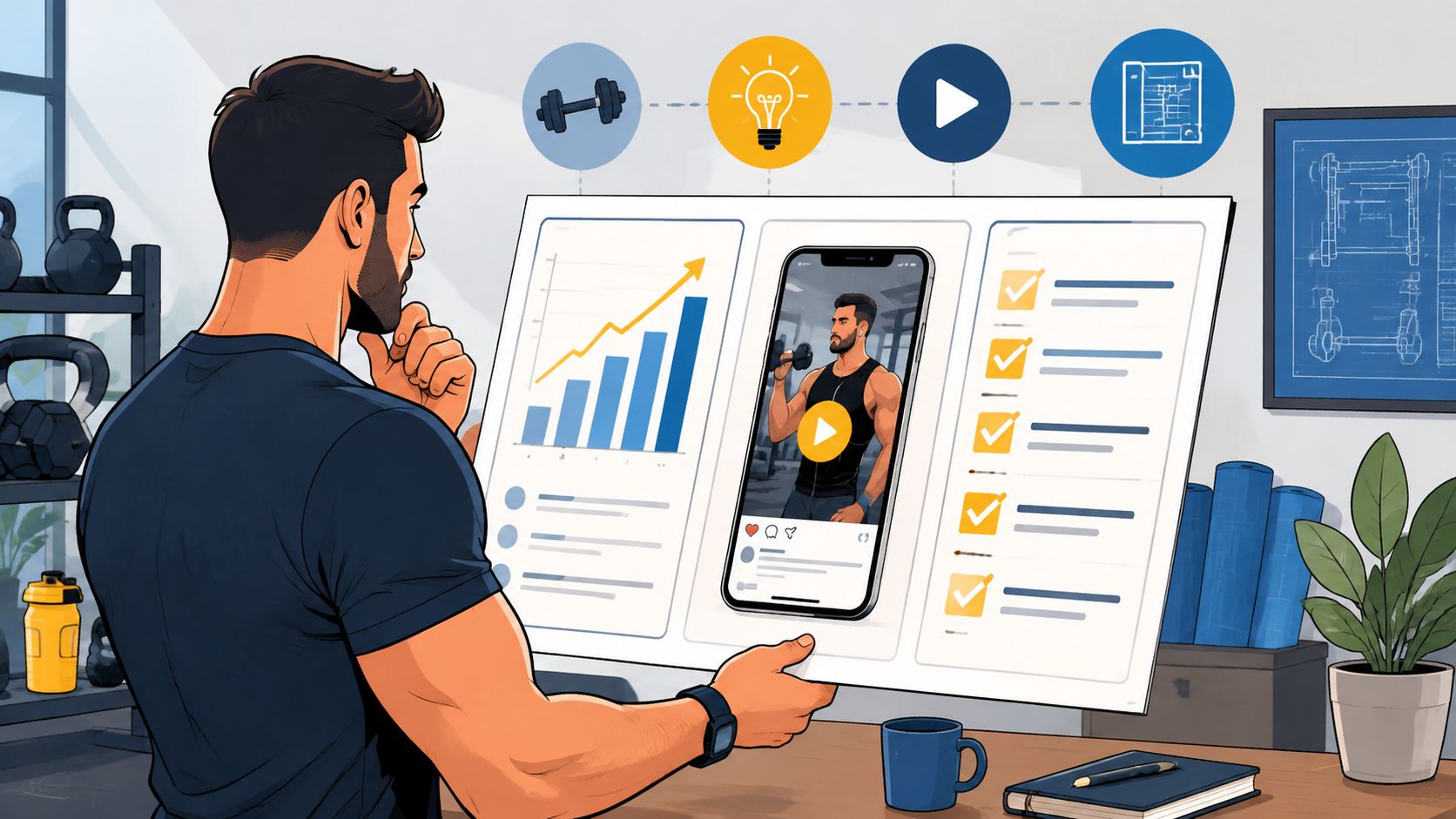
The strongest fitness campaigns don't sell access to treadmills, weights, or studio space. They sell a new identity, visible progress, confidence, convenience, belonging, or a safer-feeling routine. That distinction matters in a market projected to surpass $134 billion in 2026, with connected devices, apps, and data-driven engagement expanding the audience gyms can reach (fitness market projections).
The best fitness marketing campaigns turn that promise into a system. Peloton builds community, Orangetheory makes progress visible, F45 makes training fit busy lives, and Apple Fitness+ links exercise to an existing technology ecosystem. Beachbody uses challenges and advocacy, Lululemon creates lifestyle experiences, ClassPass removes commitment barriers, Planet Fitness reduces intimidation, Nike Training Club builds authority, and Barry's Bootcamp justifies premium positioning through experience.
Each example below examines the audience problem, campaign objective, creative execution, available performance signals, limitations, and a practical gym adaptation. Treat reported outcomes as evidence tied to specific campaigns, not as guarantees. The recurring framework is simple: promise, proof, participation, conversion, retention, and hygiene trust. Visible routines involving gym wipes and sanitizing wipes won't replace a strong offer, but they can reinforce the promise that members are entering a cared-for facility. For video-led creative execution, Sovran fitness video solutions provides a relevant production reference.
1. Peloton's Community-Driven Digital Fitness Revolution
Peloton's most transferable product isn't its hardware. It's the feeling that an individual workout connects to a larger group. Inspirational instructors, leaderboard competition, member milestones, transformation stories, and social sharing turn exercise into a public identity rather than a private chore.
An Instagram Story celebrating a member's first sustained attendance streak can perform the same psychological job at a smaller gym. TikTok challenges built around a coach's dance warm-up, testimonial videos featuring everyday members, and instructor-led clips give prospects a reason to participate before they buy. The objective is to make membership feel like entry into a culture.
The model has limits. A connected-device business can invest in proprietary content, data, and gamification in ways a local gym may not be able to copy. Hardware dependence, acquisition-cost pressure, market saturation, and controversy risks also make direct imitation unwise.
The replicable community loop
A gym can build a lighter version through four actions:
- Create shareable moments: Prompt members to celebrate attendance streaks, completed programs, or personal milestones.
- Recruit credible ambassadors: Choose members who use the facility and can explain their experience without scripted hype.
- Publish instructor content: Let coaches demonstrate workouts, answer beginner questions, and celebrate member progress.
- Close the referral loop: Give ambassadors a clear referral offer, a simple tracking method, and timely follow-up.
Track participation, member-generated posts, referral leads, trial-to-membership conversion, and retention. For a deeper community model, review this guide to an online fitness community.
Practical rule: Ask members to document progress they already feel proud of. Don't manufacture a transformation narrative they can't own.
After a class, a short message can remind members to use fitness wipes on shared surfaces and explain where supplies are located. That operational detail supports the same sense of collective responsibility that the campaign is trying to create.

2. Orangetheory Fitness's Data-Driven Performance Marketing
Orangetheory turns abstract motivation into visible training zones by anchoring the workout to heart-rate feedback members can interpret. Monitoring, real-time signals, interval language, performance emails, and retention messages connect each visit to evidence of progress.
The audience is specific: prospects who distrust vague encouragement and want a baseline, scorecard, and clear reason to return. Corporate wellness campaigns, health-insurance partnerships, and local studio promotions extend that performance promise beyond individual consumers.
The replicable growth mechanism is measurable outcomes. A small gym does not need proprietary heart-rate technology. It can offer an initial assessment, record agreed measures, send a progress update, and trigger a reactivation message when attendance declines. Staff must explain the data in plain language. Otherwise, technology adds friction instead of proof. Costs, inconsistent execution, and the work required to keep members engaged remain trade-offs.
A practical performance scorecard
Build the campaign around four stages:
- Establish a baseline: Record assessment measures suited to the program and obtain member consent for communications.
- Send useful updates: Translate progress into plain-language emails that connect a change in performance with the member's stated goal.
- Celebrate milestones: Recognize improvements such as stronger consistency, movement, or class participation.
- Trigger support: Send a personal check-in when visits or class participation fall.
Measure assessment bookings, report opens, repeat visits, retention, and business-to-business wellness leads. Use this fitness marketing ROI guide to organize the measurement layer and compare campaign costs with member actions.
Practical rule: Every metric needs an interpretation. Tell the member what changed, why it matters to their goal, and what action comes next.
A treadmill display can attract attention, but a progress message creates the stronger retention cue. The gym-ready template is simple: baseline, scheduled update, goal-linked milestone, and personal follow-up. Track each stage separately so owners can identify whether the constraint is assessment demand, communication engagement, repeat attendance, or retention.

After assessments and peak periods, staff should explain how to use wipes to disinfect gym equipment according to the product label and the facility's protocol. A measurable member experience also depends on predictable care standards.
3. F45's Franchise Growth Through Micro-Community Marketing
F45 turns functional fitness into a clear time-efficiency promise for professionals who want structured training without an open-ended gym routine. Its franchise model adds local penetration: operators can use a recognizable format while building neighborhood relationships.
The growth mechanism is micro-community marketing. Neighborhood Facebook groups, nearby retailers, grand-opening events, and inclusive creative give residents a social reason to try a new studio before it has a large member base. Local partners also transfer trust, but the trade-off is consistency. Staff, coaches, and partners must explain the offer in compatible language, or the repeatable franchise format loses force.
Build the launch around local participation
A gym-ready version can follow this sequence:
- Position the session: “A focused functional workout designed for a busy schedule.”
- Approach partners: Exchange useful offers, promote the launch, and host a shared event with nearby businesses.
- Create participation: Run a beginner-friendly community workout or movement session.
- Capture leads: Use one short form with a clear trial or introductory offer.
- Align the team: Brief coaches and front-desk employees on the welcome process, offer language, and follow-up timing.
The campaign should produce more than opening-day attendance. Track local reach, partner referrals, trial attendance, conversion, and attendance after the first month. A fitness brand ambassador strategy can support the relationship layer by giving trusted local voices a defined role in invitations and follow-up.
Practical rule: Treat launch week as a coordinated member journey. Assign each partner a referral path, each lead a next action, and each staff member the same explanation of the offer.
This template transfers well to independent gyms because it separates local acquisition from franchise branding. Owners can test one neighborhood, compare partner-sourced leads with event leads, and keep the channels that generate repeat attendance. Consistent staff language during launch week matters as much as the event calendar.
4. Apple Fitness+ Integration and Technology-Enabled Lifestyle Marketing
Apple Fitness+ makes exercise part of a connected routine. Device continuity, Apple Watch integration, curated music, premium instructors, health data, and design-led storytelling link workouts to tools an established audience already uses.
A gym can apply the same growth mechanism without copying Apple's ecosystem. Connect the booking platform, member app, email, and wearable data around one clear next action. The goal is to turn technology from an administrative system into a reason to return.
For example, a member who books yoga via the app could receive a push notification 24 hours before class with a map of the studio and a suggested warm-up sequence. After attendance, the app could recommend a related recovery session or coaching option. Track notification opens, booking completion, cross-service usage, completed classes, and retention.
Remove the extra steps
Map the member journey from discovery to the next visit. Check for duplicated logins, unclear booking instructions, and reminders that arrive without useful context. Then connect each behavior to a practical follow-up, such as a completed class leading to a recommended session or a missed booking prompting an easy reschedule.
Gym-ready template: Book, remind, guide, recommend, rebook. Assign one message to each stage, then compare return visits from members who received the sequence with those who received only a booking confirmation.
Apple's model depends on Apple Watch ownership, premium content production, and ecosystem exclusivity. A local gym should adopt continuity and convenience without claiming equivalent technology.
One-click rebooking after a completed class reduces friction more than any new feature ever would. Measure rebooking rate, time between visits, repeat attendance, and retention to determine whether the connected journey supports membership value.
5. Beachbody's Direct-to-Consumer Transformation Through Social Selling
Beachbody's 21-Day Fix converts participants into distributors through time-bound accountability, not product quality alone. The challenge, coach support, Facebook groups, transformation stories, and streaming workouts create repeated reasons to discuss progress.
Accountability drives the model. Participants join a defined experience, interact with a coach, and receive prompts that make progress visible to peers. That social structure can reduce the emotional barrier to starting and turn participation into referrals.
The risks require clear boundaries. Scrutiny of the MLM structure, inconsistent coach quality, market saturation, and misleading health claims can weaken trust. A gym can adapt the challenge format while rejecting exaggerated outcomes and unclear ambassador incentives.
Build an ethical challenge
Set a defined start and end date, explain eligibility, train coaches, obtain consent for testimonials, and use realistic language. Add daily prompts, member discussion, progress check-ins, and a straightforward membership offer after participants have experienced the service.
Gym-ready template: Set the goal, schedule the check-ins, assign a coach, invite peer discussion, and offer the next membership step. Track enrollment, completion, referrals, content participation, attendance, and conversion.
A large group is not proof of commercial success if few participants attend or join. Compare completion and conversion by acquisition source to identify whether community participation or coach contact produces stronger results.
A studio or home-based challenge can publish clear cleaning expectations as part of the participant experience. That operational detail supports confidence, but it should remain separate from the social-selling message and never imply that promotional language guarantees a healthy environment.

6. Lululemon's Brand Lifestyle Marketing Beyond Apparel
Lululemon sells participation before apparel. Stores, parks, classes, ambassadors, and wellness events let people experience the brand through community and routine, while free yoga sessions, local instructors, and pop-ups position the company as an active neighborhood participant.
Gym owners can adapt that lifestyle marketing mechanism without copying the apparel category or premium pricing. A recurring mobility class with a local instructor, or a wellness workshop with a neighborhood partner, gives prospects a reason to visit before they receive a membership offer. The transferable growth mechanism is local community access, supported by an experience people may discuss and revisit.
The economics need discipline. Events require staff time, partner coordination, space, promotion, and follow-up. Exclusivity can also narrow reach when each experience serves only existing enthusiasts or feels difficult for new visitors to enter.
Turn one event into a repeat-visit path
Write a partner brief covering the audience, value exchange, responsibilities, and promotion plan. Use a simple registration page, send a post-event thank-you message, request referrals after delivering value, and present one clear next visit.
Track registrations, attendance, partner referrals, follow-up engagement, repeat visits, and membership conversions. A crowded class is only an acquisition signal. The event's long-term value depends on the follow-up cadence, not the registration count.
Gym-ready template: Pair one local partner with one accessible class, define the next visit before registration opens, and measure attendance, repeat visits, referrals, and conversion by source.
The strongest test compares event attendees with their later usage and membership behavior. That reveals whether the experience creates durable participation or only temporary attention.
7. ClassPass's Platform Aggregation and Access Marketing
ClassPass addresses a common objection, “I don't want to commit before I know what fits.” Its marketplace combines variety, flexible discovery, recommendations, email campaigns, a credits system, and a network of gyms and studios. Members receive choice, while partners gain access to a broader acquisition channel.
The same structure can work at a smaller local scale. A gym might bundle strength sessions, yoga classes, recovery services, and nearby wellness partners into a discovery pass. The value depends on clear economics. Each partner needs to understand what it receives, what it contributes, and how bookings are handled.
Create a partner-ready network
Use preference data to recommend the next class, publish a shared promotion calendar, and track discovery clicks, bookings, partner referrals, repeat usage, contribution margin, and conversion. Don't assume more variety automatically produces loyalty. Too many choices can make the next action harder.
Partner standards also need to include the physical experience. If multiple facilities participate, agree on where wipes for gym equipment are placed, how staff communicate cleaning expectations, and how supplies are replenished. Wipes.com is a relevant vendor resource when a network needs a consistent equipment-wipe standard.
The growth mechanism is marketplace access, but the retention mechanism is useful recommendation. Members return when the network helps them choose, not merely when it gives them more options.
8. Planet Fitness's Value-Based Accessibility Marketing
Planet Fitness builds growth by removing two barriers at once: price and intimidation. Its stated $10 per month base price signals affordability, while the “Judgment Free Zone” addresses the fear of being watched, criticized, or unsure what to do (Planet Fitness campaign context). This pairing gives the brand a clear position for beginners rather than asking them to identify as athletes first.
Humorous social content, relatable fitness struggles, local grand-opening promotions, consistent national messaging, and PF+ app support repeat that promise across channels. The creative makes entry feel ordinary and manageable.
A smaller gym can apply the mechanism without matching Planet Fitness's scale. Identify the hesitation that blocks a first visit, show how the experience works, and make the commercial terms easy to understand. Staff language, onboarding, and follow-up must support the same promise.
Turn accessibility into a testable offer
Build the campaign around four prospect questions:
- “Will I fit in?” Show a first-visit walkthrough and introduce the coach.
- “What should I do?” Offer guided orientation instead of an undefined free pass.
- “Will it cost more than expected?” Explain the offer, limits, and terms clearly.
- “What happens after I visit?” Send one simple next step through a low-pressure follow-up sequence.
Measure first-time visits, cost per lead, tour-to-join conversion, and early retention. The trade-off is financial: value pricing can compress margins and require volume, while boutique competitors may win through specialization.
A first-visit walkthrough paired with a clear pricing sheet does more to reduce intimidation than another creative adjustment. The growth mechanism is barrier removal, and the transferable asset is a consistent path from uncertainty to action.
9. Nike Training Club's Brand Authority and Performance Marketing
Nike Training Club converts free users into deeper engagement by keeping core training content credible while reserving personalized programming and advanced support for paid access. Professional athletes, qualified coaches, structured programs, performance tracking, personalization, wearable integration, and achievement sharing give users reasons to return.
The replicable mechanism is authority-led conversion. A gym can publish useful sessions, explain trainer qualifications, offer a sample program, and place advanced coaching, assessments, or individualized plans inside membership. The campaign builds trust first, then gives that trust a clear commercial path.
Free access can increase activation while weakening purchase urgency. High-quality content also requires ongoing investment, and completing a workout does not guarantee retention. Measure free-user activation, membership conversion, workout completion, milestone shares, and churn to separate audience attention from business progress.
Separate trust from the paid offer
Give free users a practical win, then show what membership adds: coach correction, progression planning, equipment access, accountability, or a structured next phase. Achievement messages can re-engage inactive users, but content views should not be treated as conversion evidence.
Authority must hold beyond the campaign. Staff need consistent answers about programming, progress, and member support, while the facility and coaching experience must reinforce the same performance promise. A credible brand weakens when daily delivery feels less disciplined than its marketing.
10. Barry's Bootcamp's Luxury Boutique Studio Positioning
Barry's Bootcamp sells a coordinated premium experience: HIIT programming, luxury studio design, heart-rate monitoring, exclusive community, instructor quality, celebrity social proof, and influencer partnerships. Its supplied $38 or more per class price signals premium positioning, but the price works only when the full experience supports it (Barry's class information).
The replicable growth mechanism is premium consistency. A gym can combine distinctive sensory details, clear coaching standards, progress reporting, member recognition, credible testimonials, and high-touch follow-up. This approach does not require Barry's locations or celebrity access. It requires disciplined delivery at every member touchpoint.
Premium positioning also narrows the addressable audience. Price and geography restrict access, while a polished environment increases operating demands. One inconsistent class, weak follow-up, or neglected station can quickly undermine the promise.
Build the premium experience deliberately
Define the offer before promoting it. Set the instructor standard, arrival experience, performance feedback, recognition moments, testimonial permissions, and follow-up cadence. Track premium lead quality, class utilization, average revenue per visit, repeat purchase, referral rate, and retention. These measures show whether positioning produces profitable behavior rather than attention alone.
A gym-ready campaign template is straightforward: publish the training promise, show the studio ritual, introduce the coaching standard, invite prospects to a defined trial, then follow up with progress feedback and a membership path. Measure each stage from inquiry to first visit, repeat purchase, referral, and retention.
Facility care must support the message. Clean equipment daily, make sanitation visible at high-touch stations, and maintain consistent access to appropriate supplies, including EPA-registered gym disinfecting wipes where facility protocols call for them. Follow product labels and established cleaning procedures rather than making broader claims.
The premium principle is simple. Meticulous maintenance must be observable, repeatable, and aligned with the advertised experience.
Top 10 Fitness Marketing Campaigns Comparison
| Program / Brand | Implementation complexity | Resource requirements | Expected outcomes | Ideal use cases | Key advantages |
|---|---|---|---|---|---|
| Peloton's Community-Driven Digital Fitness Revolution | High, builds platform, live content and community features | High, production, celebrity instructors, marketing spend, tech stack | Strong brand loyalty, subscription revenue, viral member stories | Studios wanting to create a lifestyle community and digital engagement | Authentic community, UGC-driven growth, gamified retention |
| Orangetheory Fitness's Data-Driven Performance Marketing | Medium–High, integrates wearables, reporting and personalized messaging | Medium–High, heart-rate tech, analytics, trained staff | Measurable member progress, improved retention and B2B leads | Performance-focused studios and corporate wellness programs | Data-driven motivation, measurable outcomes, B2B revenue |
| F45's Franchise Growth Through Micro-Community Marketing | Medium, repeatable local playbook with franchise coordination | Medium, franchise support, local marketing, staff training | Rapid local expansion, strong neighborhood retention when consistent | Franchise models and neighborhood studios targeting busy professionals | Scalable local acquisition, time-efficient value proposition |
| Apple Fitness+ Integration: Technology-Enabled Lifestyle Marketing | Medium, ecosystem integration and content curation | Low–Medium for adaptation, leverage existing device ecosystems; higher if building own integrations | Smooth activation for existing device users, higher perceived value | Tech-savvy membership bases and studios that can integrate wearables | Seamless device continuity, premium positioning, low friction for users in the same ecosystem |
| BeachBody's Direct-to-Consumer Transformation Through Social Selling | Medium, coach network and challenge infrastructure | Low–Medium, social groups, coach training, digital content | High advocacy and viral challenge engagement; variable quality risk | Home-fitness initiatives and challenge-based community programs | Coach-led accountability, low entry barriers, strong social sharing |
| Lululemon's Brand Lifestyle Marketing Beyond Apparel | Medium, recurring events and ambassador programs | Medium, events, ambassador management, content | Strong lifestyle association and repeat local engagement | Retail-adjacent studios and community event strategies | Experiential community-building, ambassador authenticity |
| ClassPass's Platform Aggregation and Access Marketing | High, two-sided marketplace engineering and partner economics | High, app/platform, partner onboarding, marketplace management | Increased discovery and flexible bookings; partner revenue trade-offs | Aggregators or networks bundling multiple local providers | Variety and flexibility, network effects, data-driven recommendations |
| Planet Fitness's Value-Based Accessibility Marketing | Low, clear positioning and simple execution | Low–Medium, scaled ops, local promotions, consistent branding | High member volume, low price-driven acquisition; margin pressure | Mass-market gyms prioritizing affordability and low intimidation | Broad accessibility, relatable creative, strong franchise consistency |
| Nike Training Club's Brand Authority and Performance Marketing | Medium, high-quality content and athlete partnerships | Medium–High, content production, talent, personalization tech | Authority-led trials, free-to-premium funnel with variable conversion | Brands leveraging existing credibility to distribute free content | Brand credibility, aspirational athlete content, personalization |
| Barry's Bootcamp's Luxury Boutique Studio Positioning and Premium Pricing Strategy | High, premium design, performance systems, high-touch service | High, luxury studio buildouts, staff standards, hygiene systems | High ARPU, loyal premium community; limited reach due to price | Boutique studios seeking premium margins and exclusivity | Luxury experience, performance credibility, strong premium positioning |
Turn Campaign Inspiration Into Your Next Member Growth Test
The ten campaigns share a useful lesson, but they don't solve the same business problem. Community campaigns are strongest when the objective is advocacy and belonging. Data-led campaigns fit retention and measurable progress. Local campaigns are valuable during a launch or expansion period. Authority campaigns help a newer operator earn trust, while premium campaigns differentiate through experience rather than price.
Choose one barrier before choosing a channel. The barrier might be intimidation, uncertainty about results, lack of time, weak local awareness, commitment anxiety, or doubt about quality. Then define one distinctive promise, one proof format, one participation mechanic, one conversion path, and three success metrics.
A useful campaign brief can fit on one page:
- Audience barrier: What stops the prospect from acting?
- Promise: What specific change or experience does the gym offer?
- Proof: Will prospects see a member story, progress report, coach demonstration, review, or facility walkthrough?
- Participation: What can they do before becoming a member?
- Conversion: Is the next step a trial, assessment, introductory package, class booking, or tour?
- Retention: What happens after the first visit?
- Hygiene trust: How will the facility communicate and demonstrate its cleaning routine?
A 30-day adaptation plan
During the planning week, interview staff and recent members, choose the audience barrier, write the offer, prepare the landing page, assign follow-up ownership, and define the three metrics. Don't copy a national brand's reach or production budget. Document your assumptions and trade-offs, including what the campaign won't attempt.
Use the launch window to publish the creative, activate partners or ambassadors, deliver the participation experience, and contact every lead promptly. At the optimization checkpoint, review lead quality, attendance, conversion behavior, and member feedback. Change one variable at a time, such as the promise, audience, proof format, or booking path.
During the post-campaign review, compare the original assumptions with what happened. A paid social benchmark reported Facebook fitness-ad conversion at 14.29%, average CPC between $0.46 and $1.10, average cost per lead between $10 and $52, and ROAS of 2.87 to 1, with top campaigns reaching 3.8 to 1 or higher (fitness Facebook advertising benchmarks). These figures are benchmarks, not a promise for every gym. Your own lead quality, attendance, conversion, and retention data should decide whether the campaign deserves more budget.
Search deserves separate consideration when prospects show local intent. Reported gym search benchmarks include CTRs of 5.81% to 7.2%, conversion rates of 4.10% to 6.94%, trial-to-member rates of 5% to 15%, and local single-location CPLs around $25 to $55 (fitness Google Ads benchmarks). Use that evidence to test search, Local Services, and social video according to lead quality, not reach alone.
Sanitation belongs in the review because it reinforces the member promise. Keep gym equipment wipes or fitness center wipes available at high-touch areas, explain how members should clean shared equipment, and use a consistent visible protocol. Commercial disinfecting wipes or a gym wipe dispenser may support operational consistency where appropriate. For campaign scripting and short-form creative, AI-generated fitness scripts can help your team produce variations, but every claim should still match the actual service.
Choose one campaign mechanism this week, write the one-page brief, assign an owner, and launch a controlled 30-day test. Document the result in your marketing dashboard, then use the evidence to decide whether to scale, revise, or stop.
Leave a Reply