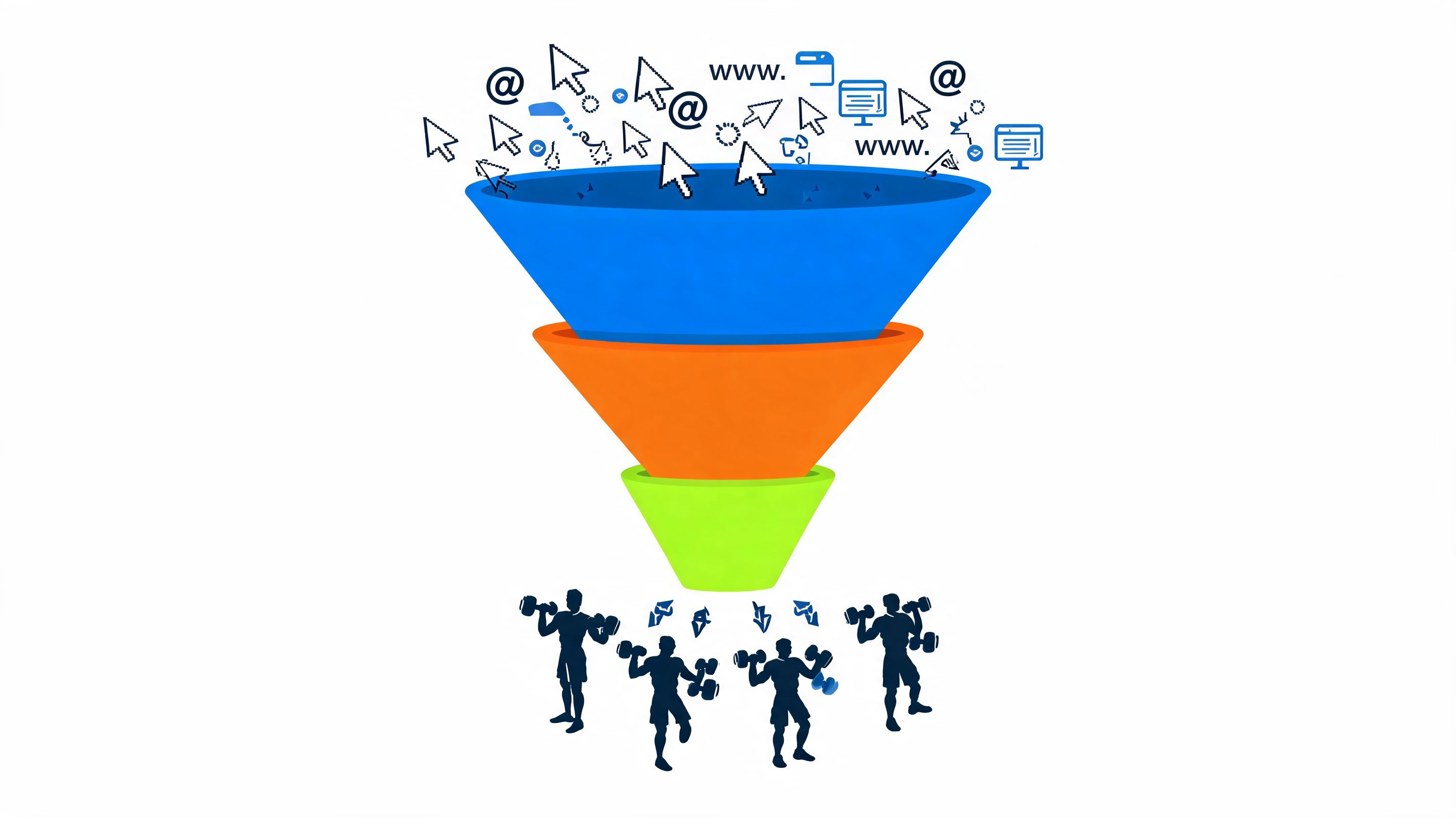
Most gym owners start funnel work at the wrong end. They launch ads, boost a few Instagram posts, maybe build a trial page, then wonder why leads come in soft, tours no-show, and memberships stall at the front desk.
A gym funnel isn't a fancy marketing diagram. It's a local sales system that moves someone from mild interest to an in-person visit, then into a paid membership and, ideally, long-term retention. If you're learning how to build a funnel for a physical gym, the game is not just clicks. It's getting the right local person to trust you enough to book, show up, join, and stay.
That means your funnel has to match how people buy gym memberships. They don't usually wake up ready to sign a contract on the first touch. They notice your gym, compare you against other options, ask themselves whether they'll feel comfortable there, and decide whether the offer feels worth acting on now.
Done right, this becomes predictable. Done poorly, it turns into random lead flow and constant guesswork.
Define Your Goals and Ideal Member
A profitable funnel starts with clarity. Not “I want more members.” That goal is too vague to drive decisions.
You need two things before you build anything. First, a specific business outcome. Second, a clear picture of the exact member you want to attract.

Set a goal that changes how you market
A gym offering low-cost general access needs a different funnel from a studio selling semi-private training. Same word, very different economics.
Ask yourself which outcome matters most right now:
- Fill classes: You need a funnel that creates steady trial volume for group fitness.
- Sell premium coaching: You need stronger qualification and more trust-building before the close.
- Increase recurring memberships: You need a cleaner handoff from lead to consult to signed agreement.
- Improve retention quality: You may need fewer leads, but better-fit leads.
If you don't define this upfront, you'll build a messy system that attracts everyone and converts almost no one well.
Practical rule: Build one funnel for one offer aimed at one type of member. General funnels usually create general results.
Measurement discipline matters at this stage. Good operators get comfortable with turning raw data into clear decisions, because a funnel only helps if you can tell which stage is working and which stage is leaking.
Build an ideal member profile you can actually use
Most gym owner avatars are too shallow. Age, gender, and income aren't enough.
You need the details that shape action:
- Primary pain point: They feel intimidated in large gyms. They've started and quit before. They don't know what to do once they walk in.
- Immediate goal: Lose weight for an event, rebuild strength after time off, get accountability, find a gym close to work.
- Buying friction: Price anxiety, schedule conflicts, childcare, commute, fear of judgment.
- Decision trigger: A free intro session, a coach-led tour, a beginner program, a women-only class, a trial that feels low pressure.
For a practical framework, study these customer segmentation methods for fitness businesses. Segmentation keeps you from writing generic ads and generic emails to completely different buyers.
Map the member journey before creating assets
One of the smartest ways to build a funnel is to map every marketing and sales activity to a defined stage, then audit the gaps. Outreach recommends this stage-mapping approach because it exposes where teams have plenty of top-of-funnel activity but weak decision-stage support like proof, comparisons, or buying guidance in the later steps of the journey, as explained in its breakdown of how to build and audit a sales funnel.
For a gym, that usually means separating these actions clearly:
- Lead capture through a free pass, class booking, or website inquiry
- Qualification through goals, budget, location, training preferences, and timing
- Purchase triggers through a completed tour, completed trial, offer discussion, and signed agreement
A lot of gyms skip the separation and call every form fill a lead. That's how staff waste time chasing people who were only mildly curious.
Use this quick gut-check:
| Question | If the answer is no | What it means |
|---|---|---|
| Do you know your primary offer? | Your funnel will feel scattered | Prospects won't know what to do next |
| Do you know your best-fit member? | Your messaging will stay broad | Low-quality leads increase |
| Do you know your handoff stages? | Sales follow-up gets inconsistent | Staff rely on memory instead of process |
If you want to know how to build a funnel that holds up under real-world gym operations, start here. Strategy first. Pages and ads second.
Build Your Gym's Funnel Stages and Assets
Once the foundation is clear, turn it into a member journey people can move through. For most physical gyms, the cleanest version uses Awareness, Consideration, and Decision.
That keeps the funnel simple for your team and intuitive for the prospect.

Awareness stage
At the top of the funnel, people aren't ready for a hard sell. They're deciding whether you seem relevant, credible, and approachable.
Your best assets here are educational and local:
- Beginner guides: “First Week Back in the Gym” or “How to Start Strength Training Without Feeling Lost”
- Lead magnets: a meal plan, mobility checklist, or simple workout guide
- Short-form video: coach tips, member spotlights, gym walk-throughs
- Local content: posts aimed at people in your area with specific problems you solve
Monday's funnel guidance, referenced in Xero's overview, supports this broad idea that early stages should lean educational rather than sales-heavy. Xero also recommends tracking conversion rates at each stage and fixing the weakest point instead of trying to improve the whole pipeline at once in its guide to how the sales funnel works.
If you want paid traffic here, keep the creative problem-focused. Don't lead with “join now.” Lead with “feel confident starting again” or “find a gym where beginners aren't ignored.” For gyms leaning hard into social acquisition, this guide on how to scale your Facebook ads and Instagram is useful because it pushes you to think in campaign systems instead of random boosted posts.
Consideration stage
In this stage, strangers become appointments.
Your job here is not to dump information on them. Your job is to reduce friction and make the next step easy.
A gym consideration-stage setup usually includes:
- A landing page for a free trial, consultation, or facility tour
- A short form that asks only what sales staff truly need
- A thank-you page that tells them exactly what happens next
- An email and SMS sequence that confirms the booking and lowers anxiety
- Staff follow-up for anyone who starts but doesn't complete the booking
A lot of gyms lose people here by asking for too much too soon. If the form feels like paperwork, prospects leave.
Keep the offer specific. “Come see the gym” is weaker than “Book a coach-led tour and get a personalized membership recommendation.”
Decision stage
Bottom-of-funnel assets help someone say yes without feeling pressured.
This is where you use:
- Membership comparison pages
- Trial follow-up texts
- Objection-handling email copy
- Simple offers tied to the consult or trial outcome
- Staff scripts for same-day close and next-day follow-up
The point isn't fake urgency. It's clarity. Tell them what plan fits their goal, what support they get, what onboarding looks like, and what to do next.
Statsig's funnel analytics guidance is useful here because it frames funnel building around clearly defined stage transitions and the simple conversion formula (later stage ÷ earlier stage) × 100. It also notes that gyms can structure funnels around practical stages like inquiry, tour booked, trial attended, and membership sold, then measure where people drop off using stage-by-stage funnel conversion tracking.
Gym Membership Funnel Stages and Assets
| Funnel Stage | Goal | Example Assets | Primary CTA |
|---|---|---|---|
| Awareness | Attract local prospects and earn attention | Beginner guide, meal plan PDF, local social posts, coach tip videos, lead ad | Download the guide or learn more |
| Consideration | Turn interest into a booked action | Trial landing page, tour booking page, automated confirmation emails, SMS reminders | Book a trial or tour |
| Decision | Convert visits into memberships | Offer page, membership comparison sheet, follow-up texts, staff scripts, onboarding email | Join now or choose your membership |
Most funnel problems aren't traffic problems. They're asset mismatch problems. Gyms often have decent awareness content, a decent offer, and almost nothing in the middle to carry someone from curiosity to commitment.
Fix the middle, and your close rate usually gets a lot easier to improve.
Drive Targeted Traffic into Your New Funnel
A clean funnel still needs fuel. For gyms, the best traffic strategy usually comes from three lanes working together: organic visibility, paid local reach, and partnership-based referrals.
Rely on one lane only, and the funnel gets fragile fast.

Organic traffic that attracts local buyers
Organic works best when it answers local intent, not when it tries to “go viral.”
Focus on these:
- Google Business Profile: keep hours, photos, categories, and offers current
- Location-based content: trainer intros, community events, before-and-after journey stories
- Social proof posts: screenshots of kind messages, class atmosphere, beginner wins
- Search-friendly website pages: class pages, personal training pages, “gym near me” style local relevance
If your gym serves multiple audiences, split content by segment. A parent looking for early-morning classes needs different messaging than a young professional looking for strength coaching. This article on direct response ads for gyms pairs nicely with that approach because it forces your offer and audience targeting to line up.
Paid traffic that feeds booked tours
Paid ads work when they promote a clear next step. They fail when they send cold prospects to your homepage and expect them to figure it out.
For gyms, good local paid campaigns often promote:
- A free class pass
- A coach-led tour
- A foundations program
- A consult for personal training
- A seasonal challenge with a real onboarding path
Keep geography tight. Use creative that shows the actual facility, real staff, and the kind of person you want to attract. Polished stock imagery usually underperforms authentic gym visuals because local trust matters more than slick branding.
Your ad doesn't need to impress everyone in town. It needs to feel relevant to the right person within driving distance.
Partnership traffic that converts better than cold clicks
This lane gets ignored, which is a mistake. Local partnerships often send warmer prospects because trust transfers.
Strong gym partnerships include:
- Apartment complexes: offer resident-only trial access
- Physical therapists or chiropractors: create a post-rehab intro path
- Coffee shops or smoothie bars: run bounce-back cards or co-promos
- Corporate offices: offer on-site mobility workshops with a follow-up gym invitation
- Schools and youth programs: connect parents to adult fitness offers
The key is alignment. Don't chase any business with foot traffic. Partner with businesses that already serve the type of member you want.
Traffic quality beats traffic volume in local fitness. A smaller flow of relevant prospects who live nearby, can afford the offer, and want your style of coaching is worth far more than a larger pile of low-intent leads.
Select and Automate Your Funnel Tech Stack
Most gym owners don't need more software. They need fewer tools connected in the right order.
A practical gym funnel stack has four core jobs. It needs to capture leads, store lead data, automate follow-up, and book the next action. If one of those jobs breaks, the funnel slows down and staff start patching holes manually.

Pick the essential tools first
Start with the minimum system that supports the member journey.
You'll usually need:
| Tool type | What it does in a gym funnel | What to look for |
|---|---|---|
| CRM | Tracks inquiries, status, notes, and staff follow-up | Pipeline views, task assignment, lead source tracking |
| Landing page builder | Captures trial and tour requests | Fast-loading pages, mobile forms, easy editing |
| Email and SMS platform | Sends reminders, nurture messages, and reactivation follow-up | Automation, segmentation, consent handling |
| Booking tool | Lets prospects choose a tour, intro session, or call | Simple scheduling, reminders, calendar sync |
For many gyms, the right move is one gym-focused system plus one communication layer. If your current setup is clunky, review options for CRM software for gyms with an eye toward staff usability, not feature bloat. A powerful CRM that nobody updates is worse than a simpler one your team utilizes.
Build a clean handoff between marketing and sales
Most funnels wobble at this point. Marketing captures the lead, then nobody defines what happens next.
Your automation should trigger a sequence like this:
- Lead submits form
- CRM creates contact and tags source
- Prospect gets instant email or text confirmation
- Booking page opens or staff receives a follow-up task
- Reminder sequence runs before the appointment
- Post-visit follow-up changes based on attended, missed, or joined
That structure matters more than fancy design. A gym can win with a plain landing page and sharp follow-up. It can lose with beautiful branding and slow response times.
If a staff member has to remember every follow-up manually, the funnel isn't built yet. It's still a hope-based process.
Use first-party data and AI the practical way
TrainerFu highlights a major shift in modern funnel design. Gyms need to rely more on first-party data gathered through owned channels like email and SMS because privacy changes have made third-party signals less dependable. The same piece also points out that AI can help with drafting personalized messages and summarizing lead notes, which makes a more compliant and useful system when used thoughtfully in fitness funnel design built around owned data.
That's the right mindset.
Use AI for tasks like:
- Drafting a follow-up message after a missed tour
- Summarizing intake notes for sales staff
- Creating message variants for different lead segments
- Cleaning up coach-written copy so it sounds clear and consistent
Don't use AI to sound robotic. A local gym wins when communication feels human, timely, and specific.
Your tech stack should also support reputation growth. If you're putting real effort into tours and onboarding, review generation should be part of the system too. Tools that boost visibility on Google with HearBack can fit well here because local search trust often influences whether a prospect books in the first place.
Keep the stack simple enough that a front-desk manager can explain it in two minutes. If they can't, it's probably too complicated.
Measure KPIs and Optimize for Perpetual Growth
Most gyms don't have a funnel problem. They have a measurement problem.
They know leads came in. They know a few people joined. They don't know which offer brought the best prospects, which landing page leaked attention, which sales rep struggled with follow-up, or whether the funnel effectively produced profitable memberships.
That's why measurement has to be built in before you spend hard on traffic.
Make the funnel measurement-ready
Trainerize makes an important point here. Many funnel guides skip the setup required to prove whether the funnel works. A stronger approach starts with one clear acquisition path and stage-specific KPIs like landing-page opt-in rate, booked-tour rate, show rate, and close rate. That gap matters because 74% of organizations say they struggle to connect marketing efforts to revenue outcomes, according to Trainerize's discussion of a measurement-ready funnel for fitness businesses.
For a gym, that means choosing one path such as:
Local ad or organic post → landing page → booked tour → attended tour → membership sale
Track that path before building five more.
Focus on stage KPIs, not vanity metrics
The most useful gym KPIs are the ones that match real movement through the funnel.
Track these consistently:
- Landing-page opt-in rate: Are visitors taking the first step?
- Booked-tour rate: Are leads committing to an appointment?
- Show rate: Do booked prospects arrive?
- Close rate: How many attending prospects become members?
- Retention checkpoints: Are new members still engaged at 30/60/90-day retention, as recommended in Xero's funnel guidance discussed earlier
You can also monitor cost per lead and lifetime value internally, but stage movement usually tells you where operational fixes are needed first.
Use the conversion formula where it matters
A lot of owners overcomplicate analysis. Start simple.
Use the stage conversion formula:
(number in later stage ÷ number in earlier stage) × 100
Examples inside a gym funnel:
- Tour booked ÷ inquiry
- Trial attended ÷ trial booked
- Membership sold ÷ tour attended
This works because funnel reporting is supposed to reveal where prospects drop off, not just show traffic volume. Good funnel design combines both raw counts and proportions so you can see scale and efficiency, a principle highlighted by Atlassian in its explanation of how funnel charts show volume and drop-off together.
Don't ask “Is marketing working?” Ask “Which stage loses the most people, and why?”
That question leads to action.
Run small tests instead of big guesses
Once you know the weakest stage, improve that stage first.
Good tests for gyms include:
Landing page headline test
Try a benefit-led promise against a beginner-comfort message.Form reduction test
Remove fields that staff don't need before first contact.Reminder sequence test
Compare a plain confirmation against a confirmation plus coach-intro message.Follow-up timing test
Test immediate outreach versus delayed follow-up after form submission.Offer framing test
Compare a free trial against a guided intro session if your audience needs more structure.
Xero specifically recommends targeted fixes like simplifying forms, segmenting audiences, and A/B testing landing page copy or email subject lines in the funnel optimization process noted earlier. That's the right operating model. Don't try to “improve marketing” as a vague project. Improve one friction point.
A final note that matters more than many owners realize. Retention starts with the in-person experience, and cleanliness is part of that experience. Sanitize high-touch equipment like dumbbells, benches, treadmill rails, locker handles, and front-desk surfaces on a consistent schedule. For an easy gym-friendly option, consider Wipes.com Disinfectant Wipes so members walk into a space that feels cared for, safe, and professionally run.
If you're serious about building a gym funnel that sells memberships, keep it simple. Define one offer, map the member journey, install the minimum tech, and measure every handoff. For more gym sales tactics and membership growth ideas, visit Gym Membership Tips.
Leave a Reply