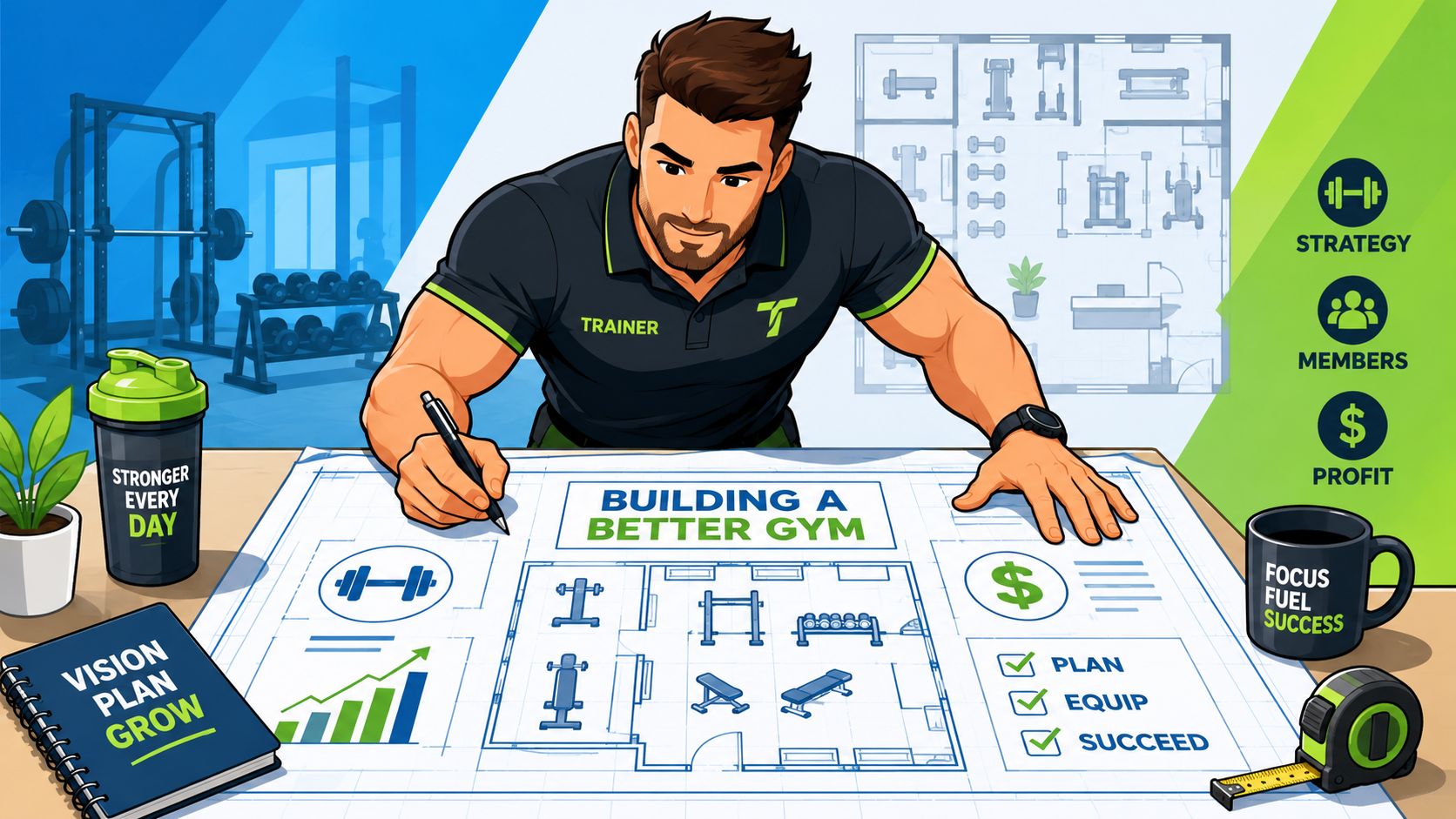
A lot of trainers hit the same wall. They're excellent on the gym floor, clients trust them, results are real, and referrals start to trickle in. Then the business side shows up. Pricing feels guessy. Revenue swings from one month to the next. Growth depends too much on your own calendar, energy, and availability.
That's usually the moment a personal training business plan stops sounding corporate and starts sounding useful.
A good plan isn't paperwork for paperwork's sake. It's the operating system for your business. It tells you who you serve, what you sell, what it costs to deliver, how you get clients, how you keep them, and whether the numbers hold up before you commit more time and money. If you want a business that can scale beyond a solo hustle, your plan has to do more than list services and hope demand appears.
From Passion to Profit Your Roadmap to Success
At 6 a.m., the day can look promising. Three clients before 9, a few messages from leads, and a full evening block. By 8 p.m., the picture is different. One client rescheduled, another asked for a discount, travel time ate two unpaid hours, and the week still depends on you being physically available for every session.
That is the gap between coaching skill and business design.
A personal training business plan closes that gap by forcing clear decisions before small problems turn into expensive habits. It shows whether you are building a job with decent income or a brand that can scale past your own calendar. That distinction matters. A solo trainer can survive with rough systems for a while. A business with growth goals cannot.
The strongest plans answer four questions fast:
- Who you serve: A specific client group with a clear problem, schedule, and budget
- What you sell: Sessions, packages, memberships, hybrid coaching, small group training, or a mobile model with defined service zones
- How delivery works: Consult, assessment, onboarding, programming, check-ins, renewals, and referrals
- What the numbers need to do: Revenue per client, retention length, lead volume, delivery costs, and break-even
For personal trainers, the hidden part is usually cost structure. Gym-based coaches often underestimate rent splits, floor fees, software, payment processing, and dead time between sessions. Mobile trainers usually miss fuel, vehicle wear, travel gaps, equipment replacement, and the income ceiling created by geography. Those details decide margin. Margin decides whether you can hire, market consistently, and build a real brand instead of staying self-employed forever.
I prefer a short working plan over a polished document no one uses. One page for the model. One page for the numbers. One page for acquisition and operations. That is enough to expose bad pricing, weak positioning, and unrealistic schedules early.
If you want a useful reference point for shaping the bigger document, this business plan for fitness guide focused on operational decisions is a solid complement.
Treat the plan the same way you would treat a client program. Start with the baseline. Set performance targets. Review what is happening, not what you hoped would happen.
If the model only works when every week is full, every client stays, and nothing goes wrong, it is not a plan. It is wishful thinking.
Laying the Foundation Executive Summary and Market Analysis
A trainer opens a new business with a full calendar in mind. Six months later, the week has holes in it, travel time is eating the day, and the pricing looked better on paper than it does in the bank account. That gap usually starts here, in the summary and market analysis, where vague ideas survive longer than they should.

Write the executive summary like an operator
The executive summary should let a lender, landlord, future hire, or business partner understand the model in a minute or two. If it takes a full page to explain what you sell and who it is for, the business is still too blurry.
Keep it focused on decisions:
- Business identity: Business name, service model, and location or coverage area.
- Target client: The buyer with the clearest problem and strongest reason to pay.
- Primary offer: The core service that drives revenue, not a long menu of options.
- Positioning: Why this business wins in its market. Convenience, specialization, coaching standard, accountability, or brand experience.
- Commercial model: How the business gets clients, keeps them, and produces margin after overhead is paid.
For a useful benchmark, this business plan for fitness guide focused on operational decisions is a good reference because it stays grounded in execution rather than generic planning language.
A strong summary also makes the long-term model clear. A solo trainer can survive on hustle. A scalable brand needs repeatable delivery, pricing that supports staff, and positioning that still makes sense when other coaches are serving clients under the same name.
Market analysis should expose the real opportunity
A weak market analysis says, "people who want to get fit." That gives you nothing to build on.
A useful market analysis answers three questions. Who buys fastest. What they are buying now. Where competitors leave money on the table.
Start with the buyer. Busy professionals often pay for time efficiency and reliability. Parents often pay for structure, scheduling flexibility, and a coach who reduces friction. Older adults often care less about aesthetics and more about pain-free movement, confidence, and consistency. The point is not to choose a trendy niche. The point is to choose a group whose problem is expensive enough to solve.
Then study local competition with a business lens, not a fan lens. Review their offers, pricing presentation, reviews, schedule availability, and service format. A gym-floor trainer competing on single sessions is solving a different problem from a mobile coach selling convenience and accountability at home.
Look for the service gap that supports scale. Sometimes the gap is time of day. Sometimes it is poor follow-up, inconsistent client experience, or weak brand trust. In other markets, the gap is business model design. Plenty of trainers offer mobile sessions, but their radius is too wide, their travel kills capacity, and their pricing does not cover the hidden cost. That creates an opening for a tighter territory, better packaging, and a brand clients can refer with confidence.
Clear positioning lowers waste. It cuts bad leads, shortens the sales conversation, and makes pricing easier to defend.
What to assess in your market
| Focus area | What to look for |
|---|---|
| Client profile | Schedule, motivation, budget level, urgency, and preferred format |
| Competitors | Core offer, pricing model, service area, review patterns, and brand strength |
| Service gap | Convenience, specialization, accountability, staff quality, or consistency |
| Delivery model | Gym-based, mobile, studio, hybrid, and whether the model can expand beyond one coach |
The goal is not to prove there is demand in a broad market. The goal is to find a lane where the economics work, the message is clear, and the business can grow past one person's calendar.
Defining Your Offer Services Pricing and Brand Identity
Most personal trainers either build an asset or trap themselves in a job at this stage.
If your clients are attached only to you as an individual, growth gets hard fast. You become the bottleneck for sales, delivery, scheduling, and retention. If you ever want to hire, expand, or reduce your own hours, that model starts fighting you.

Build a brand people can stay with
This matters more than many trainers think. Two Brain Business's perspective on personal training business plans makes the point clearly: brand the business over the individual so staff turnover has less impact on retention and the company becomes a more resilient, scalable asset.
That changes how you name, package, and communicate your service.
Instead of selling “sessions with Jake,” sell a defined coaching system under a business brand. Clients should feel they're buying a process, a standard, and an experience. Not just access to one person.
Owner mindset: If your business disappears when you take a week off, you don't own a business yet. You own a demanding role.
Package the offer so revenue can repeat
Single-session pricing is easy to start with and hard to scale with. It trains clients to think transactionally. Better models anchor value around outcomes, structure, and continuity.
Consider a menu like this:
- Foundational membership: Recurring monthly coaching with a set number of sessions and accountability check-ins.
- Premium hybrid coaching: In-person training plus program design, messaging support, and regular reviews.
- Mobile training package: A higher-touch service for convenience-focused clients who want home-based coaching.
This online personal training packages guide is a solid reference if you want to think in terms of package design instead of hourly selling.
Price for delivery, not just session time
Gym-based trainers often underprice because they count only coaching time. Mobile trainers underprice even more often because hidden overhead stacks up unnoticed. Travel time, transport, setup, vehicle costs, and equipment wear all eat margin.
The challenge is real. Gymbile's note on mobile trainer business planning highlights that many business plan guides don't properly answer how mobile or home-based trainers should price to cover travel time, vehicle costs, and equipment depreciation without drifting into unsustainable underpricing.
A practical way to think about pricing is to establish a rate floor. That's the minimum price that covers:
- Travel burden: Time between clients and dead time that can't be sold elsewhere
- Vehicle and logistics: Fuel, maintenance, and carrying equipment
- Programming and follow-up: Work that happens outside the session
- Payment and software costs: Processing fees and operating tools
Once you know your floor, you can decide whether the market supports the service. If it doesn't, the answer isn't “work harder.” The answer is usually to narrow the area you serve, increase package value, or change the offer.
Acquiring Clients Your Marketing and Sales Engine
Most training businesses don't fail because the coach can't coach. They fail because client flow is inconsistent and retention is weak.
That's why marketing and sales shouldn't be treated as side tasks. They are part of delivery. The consult, onboarding experience, first month, progress reviews, and referral asks all influence revenue.

Focus on two engines, not ten tactics
Most trainers spread themselves too thin. They post everywhere, dabble in ads, network inconsistently, and follow up poorly. A better model is to pick one primary acquisition channel and one secondary support channel.
A common mix that works well:
- Primary channel: Referral system or local relationship marketing
- Secondary channel: Instagram or local content that supports credibility
Referrals deserve special attention. Dojo Business's business plan guidance for trainers notes that referral leads convert 3 to 5 times better than cold leads. That's a big reason smart operators build a referral-first system into the client journey instead of hoping referrals happen on their own.
Retention is where profit lives
The same source also notes that acquiring a new client costs 5 to 25 times more than retaining an existing one, and that client renewal rates above 70% mark high performance. That's not a soft metric. It's a profit metric.
Retention improves when the business does ordinary things consistently well:
- Progress reviews: Clients stay longer when they can see progress clearly
- Regular communication: Short check-ins matter between sessions
- Milestone recognition: Celebrating adherence, not just aesthetics, strengthens buy-in
- Clear next-step offers: Don't wait until the final session to talk renewal
Clients rarely leave only because of programming. They leave when communication gets thin, progress feels invisible, or the service loses structure.
A simple sales view
| Stage | What needs to happen |
|---|---|
| Inquiry | Fast response and clear next step |
| Consultation | Diagnose the problem, don't just sell sessions |
| Onboarding | Remove friction and build early confidence |
| Delivery | Keep standards tight and communication steady |
| Renewal and referral | Ask with timing, not desperation |
Branding helps here too, but only if the service experience backs it up. Every DM, consult, intake form, and follow-up message teaches the client what your business stands for.
Building the Machine Your Operations and Staffing Plan
A trainer can be fully booked on paper and still run a weak business. Sessions happen, money comes in, but the back end is sloppy. Clients reschedule by text, invoices get chased manually, notes live in three apps, and every missed admin task lands back on the owner. That model works until volume picks up. Then it breaks.
Operations decides whether you are building a job for yourself or a business that can scale into a real brand.
Build systems that remove owner dependence
The goal is simple. A new lead, an active client, and a part-time coach should all move through a clear process without you reinventing it every week.
At minimum, define these operating systems:
- Scheduling: One booking method, one reschedule policy, one confirmation flow
- Billing: Recurring payments, failed-payment follow-up, and a written cancellation policy
- Client records: Goals, health history, attendance, program notes, and review dates in one system
- Onboarding: Consultation, waiver, assessment, payment setup, and first-week plan handled the same way every time
- Session delivery: Standard session length, coaching expectations, and progress-tracking checkpoints
- Reporting: Weekly visibility into sessions delivered, revenue collected, renewals due, and client adherence
That sounds basic. It is. Basic systems done consistently protect margin.
Gym-based trainers usually underestimate split fees, floor rent, travel between sites, and unpaid admin time. Mobile trainers often miss fuel, parking, equipment replacement, and dead time between appointments. Those costs shape your staffing plan because they determine how much revenue one coach can produce before payroll starts squeezing the business. The PEO Metrics guide to fitness studio costs is a useful reference for mapping the cost structure that shows up once you move beyond a solo setup.
Map the client journey in writing
Do not trust memory. Write the workflow down and train from it.
A practical client journey looks like this:
Inquiry received
Reply with a scripted response, basic qualification questions, and a booking link.Consult completed
Record goals, injury history, schedule constraints, and purchase intent.Client launched
Send forms, collect payment details, deliver the first plan, and set communication rules.Coaching active
Track attendance, adjust programming, log wins and issues, and schedule review points in advance.Renewal triggered
Review results before the package ends, present the next plan, and confirm the next billing cycle.
Good operations create consistency. Consistency is what allows a business to add coaches without lowering the standard.
Staff for the model you want, not the one you have today
If the long-term plan is a scalable brand, hiring cannot be an afterthought. A second coach should plug into documented systems, defined service standards, and a clear client handoff process.
The trade-off is real. A solo model keeps quality control tight and overhead lower. A team model gives you more delivery capacity, broader time coverage, and a business that is less tied to your personal calendar. It also adds payroll pressure, supervision time, and the risk of inconsistent coaching if your systems are weak.
Start with role clarity:
- Owner-coach: Sales, programming oversight, high-value clients, and KPI review
- Assistant coach or contractor: Session delivery, check-ins, and basic client reporting
- Admin support, even part-time: Scheduling issues, billing follow-up, and intake paperwork
Do not hire because you feel busy. Hire when the numbers support it. Use a simple return on investment calculator for new hires and operating spend before adding payroll, software, or admin help. If a coach cannot cover their compensation, overhead, and a profit buffer within a reasonable ramp period, the role is too early.
One more point matters here. Brand standards have to be teachable. If the service only works when you deliver it personally, you do not have a scalable operation yet. You have a strong personal practice. Those are different businesses.
The Bottom Line Crafting Your Financial Projections
A trainer can book 30 sessions a week and still run a weak business. The usual reason is simple. Revenue looks healthy on the calendar, but the numbers underneath were never modeled properly.
Your financial projections need to answer three questions: how money comes in, where it leaks out, and how many clients the business needs before it starts producing real profit. If those answers are vague, the plan is not ready.

Start with revenue you can actually deliver
One of the more useful frameworks comes from Coachway's personal trainer business plan article: coaching income equals price per client multiplied by retention duration and client count, minus software and payment processing fees.
That formula works because it ties your forecast to operational reality. Price matters. Retention matters just as much. A business with moderate pricing and strong retention usually outperforms one with premium pricing and constant churn.
Keep the first model tight. Use your actual weekly session capacity, your realistic close rate, and your average monthly client value. If you plan to build a brand instead of staying a one-person practice, model revenue by delivery type too. One-to-one coaching, semi-private training, online coaching, and recurring memberships do not carry the same margins.
Build the three core projections
Every serious plan should include these:
- Profit and loss projection: Revenue, direct costs, fixed overhead, and operating profit
- Cash flow projection: The timing gap between money collected and money spent
- Break-even analysis: The client volume required to cover monthly costs
Break-even is where many trainers fool themselves. Rent is obvious. Merchant fees, software, insurance, certification renewals, chargebacks, towels, fuel, parking, replacement bands, and unpaid admin time are where margin gets squeezed. The PEO Metrics guide to fitness studio costs is a useful reference for pressure-testing those expense assumptions before you lock them into the plan.
If you want a cleaner way to judge whether a new expense earns its keep, use this ROI calculator for hires, marketing, and equipment decisions. It helps separate growth investments from costs that just make the business feel busier.
Separate gym-based and mobile models
Do not use one projection for both.
A gym-based trainer usually deals with rent, floor fees, revenue share, or session splits. Travel is lower, but dependence on facility traffic and schedule access can limit capacity. A mobile trainer avoids some facility costs but picks up fuel, drive time, setup time, equipment wear, parking, and the dead space between appointments. Those hours still cost money even when no session is being delivered.
That difference changes pricing. It also changes how fast the business can scale.
A gym-based brand may improve margin faster through semi-private sessions or a small team inside one location. A mobile brand often needs tighter territory planning, higher minimum package values, and stricter scheduling windows to protect profit. Full calendars do not create scale by themselves. Standardized offers, controlled delivery costs, and predictable retention do.
Finalizing Your Plan and Maintaining a Safe Space
Once the plan is written, put it to work. Review it quarterly. Compare projected client growth to actuals. Check whether retention is holding. Tighten pricing if the model is too thin. Cut offers that sound good but create operational drag.
The final piece is professionalism in the training environment. Cleanliness affects trust, retention, and risk management. Whether you coach in a studio, commercial facility, or a client's home, equipment should be cleaned consistently and correctly.
A few standards matter:
- Use EPA-registered products: Zogics' gym cleaning guidance notes that EPA-registered disinfectant wipes or sprays should be used after each use on high-touch points and left wet for the recommended dwell time.
- Follow the right sequence: Janitors Supply's gym cleaning overview lays out the three-step protocol: clean, sanitize, then disinfect. It also recommends applying product to a cloth first rather than spraying directly onto machines, especially around electronics.
- Match wipes to the setting: Keep gym wipes or sanitizing wipes available for quick turnarounds, use disinfectant wipes on high-touch surfaces, and stock yoga mat wipes or other wipes for gym equipment where members and staff can use them easily.
- Buy for scale: If you're serving a steady volume of clients, ordering bulk gym wipes and setting up a gym wipe dispenser saves time and keeps standards visible. A practical place to compare EPA registered disinfecting wipes and other gym cleaning options is Wipes.com.
For the risk side of the business, especially if you train in regulated or higher-liability environments, PIA's guide to Florida professional liability is a useful reference when you're reviewing your coverage needs.
Your brand isn't just your logo, pricing, or marketing. It's the experience clients get every time they train with you, including how safe and well-run the environment feels.
If you want more practical guidance on building, pricing, and selling fitness services, visit Gym Membership Tips.
Leave a Reply