The software layer behind online personal training packages is already a USD 13.9 billion market in 2025, and it is projected to reach USD 43.3 billion by 2035, with a 12% CAGR and nearly 3.1X growth over the decade, according to Future Market Insights on the personal fitness training software market. That is not a side trend. It is a business model shift.
For gym owners, studio operators, and coaches, the implication is simple. If your offers still depend mainly on sessions sold one hour at a time, you are building around your calendar instead of around a scalable client experience.
The strongest online personal training packages do not win because they look polished on Instagram. They win because the package, the delivery method, the client journey, and the sales message all support each other. When one piece is weak, margins shrink, retention drops, and fulfillment becomes messy fast.
Most advice stops at “offer a few tiers.” That is not enough. A package only becomes profitable when the promise matches the systems behind it. Your starter offer needs a low-friction delivery model. Your premium offer needs real accountability. Your tech stack has to fit the service level you sold. Your onboarding must make clients feel guided from day one.
The Multi-Billion Dollar Shift to Online Fitness
USD 13.9 billion in 2025. Projected USD 43.3 billion by 2035. That is the software market supporting personal fitness training, as noted earlier. For operators selling online personal training packages, that scale matters because it confirms a permanent shift in how coaching is bought, delivered, and retained.

The practical takeaway is straightforward. Revenue no longer has to stop when the floor schedule fills up. Coaches can serve clients outside their zip code, gyms can keep members engaged between visits, and studios can package support in ways that are not tied to a single appointment slot.
That opportunity also exposes weak business design fast.
A common challenge for fitness businesses is building the online offer backwards. They pick an app first, upload a few workouts, add check-in messages, and call it a package. Then retention slips, fulfillment feels messy, and pricing starts to look too low for the amount of support being delivered.
I have seen the same pattern across independent coaches, multi-trainer gyms, and boutique studios. The problem usually is not demand. The problem is that the offer, the delivery system, and the sales promise were never designed to work together.
Three failure points show up again and again:
- Confusing package structure: prospects cannot tell the difference between entry-level support, hybrid accountability, and premium coaching
- Service mismatch: the sales page promises access and personalization that the actual workflow cannot support
- Disconnected operations: onboarding, messaging cadence, tracking, and renewals live in separate tools with no clear owner
This shift to online fitness is bigger than content delivery. It changes staffing decisions, margins, onboarding speed, and the lifetime value of each client. A package that looks profitable on a sales page can become a drain if your coach touchpoints are too manual, your tech stack is bloated, or your follow-up process is inconsistent.
Strong operators treat the package as an operating model. The offer defines what gets delivered, the tech stack supports that promise, the onboarding sequence creates momentum in week one, and the retention workflow keeps clients progressing after the initial excitement wears off. That is the difference between an online add-on and a real revenue channel.
For teams building offers across coaching, nutrition, and accountability, this is the same logic behind well-structured health and fitness programs that scale without losing clarity.
The upside is real, but so is the trade-off. More flexibility for the client means more systems required on the business side. Operators who accept that early build cleaner packages, protect margins, and create an online service that clients stay with.
Architecting Your Signature Training Packages
Online personal training packages sell best when clients can quickly understand which level fits them. Complexity kills conversions. A clean offer ladder makes the buying decision easier and the delivery model easier to manage.
A strong structure starts with three package types: one-on-one coaching, group sessions, and subscription models. Hybrid delivery also matters because roughly 50% of trainers now report hybrid as their primary delivery method, and it allows them to handle 20-50+ clients without a proportional increase in time, as noted by Trainerize’s guide to online personal training.
Build the offer ladder first
Do not begin with features. Begin with client intent.
Some clients want affordability and momentum. Others want guidance with flexibility. A smaller group wants direct coaching, fast feedback, and a premium relationship. Those are different buyers, and they should not all see the same package.
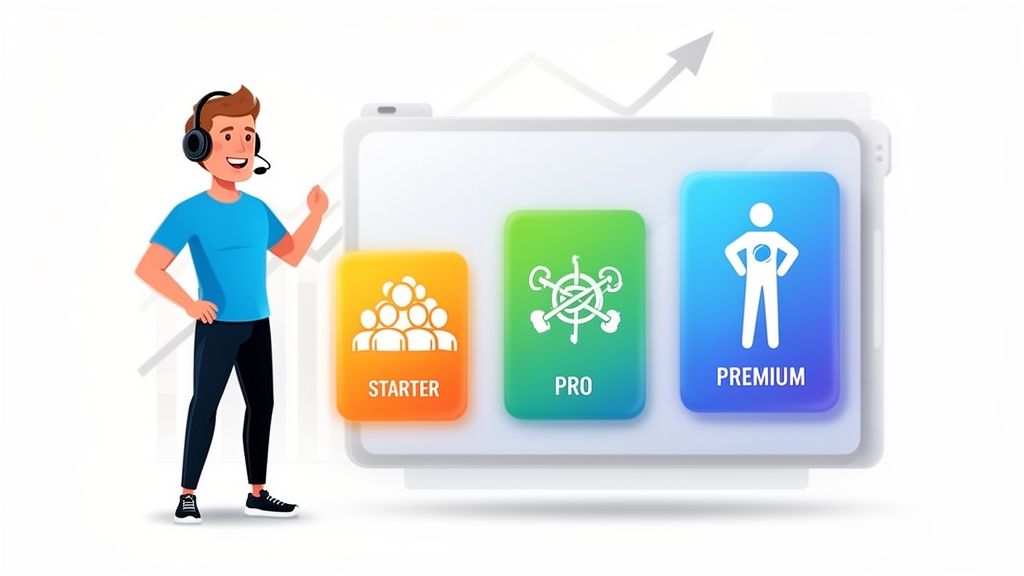
I recommend three clear tiers:
- Starter for clients who want structure at a lower price point
- Pro for clients who want personalization without full concierge support
- Premium for clients who want a coach in the loop at every key moment
That model supports both lead generation and upsell paths. It also gives your team a cleaner way to fulfill services.
Online Personal Training Package Tiers
| Feature | Tier 1: Starter (Group/DIY) | Tier 2: Pro (Hybrid) | Tier 3: Premium (1-on-1) |
|---|---|---|---|
| Best fit | Budget-conscious clients, self-starters | Busy clients who want accountability and flexibility | Clients who want high-touch coaching |
| Delivery style | Subscription model with group support and on-demand programming | Hybrid model with app delivery plus scheduled coaching touchpoints | Fully personalized one-on-one coaching |
| Programming | Templated by goal or training level | Customized from a template base | Fully bespoke |
| Check-ins | Automated reminders and scheduled group touchpoints | Regular personal check-ins | Direct coach-led review and adjustment |
| Communication | Group chat or limited support windows | Direct messaging with response boundaries | Priority communication |
| Coaching focus | Consistency and habit building | Progress with guidance and accountability | Precision, adaptation, and relationship |
| Best use for operator | Entry point and scalable volume | Core profit driver | High-margin premium service |
What to include in each tier
Starter package
This is the package many businesses skip or undervalue. That is a mistake.
Starter is where you capture people who are curious but not ready for premium coaching. It should feel useful, not stripped down. Give clients a training path, access to your exercise library, a simple onboarding questionnaire, and a defined communication policy.
Good starter deliverables often include:
- Goal-based programming: Fat loss, strength foundation, return-to-fitness, or general conditioning
- App access: Workouts, habit tracking, and basic progress logging
- Community support: Group accountability or challenge-based engagement
- Simple education: Short videos, FAQs, and form demos
This is also where strong packaging matters. If you present it as “cheap coaching,” it will attract price shoppers. If you present it as a guided starting system, it will attract clients who may grow into bigger offers.
For operators building broader membership ecosystems, there are useful ideas in this breakdown of health and fitness programs.
Pro package
This is the package most businesses should expect to sell most often.
The Pro tier combines scale with personalization. It works well for hybrid clients, former in-person clients moving partly online, and remote clients who want coaching without paying for full one-on-one access. Here, your client experience needs discipline. Not every touchpoint should be live, but every touchpoint should feel intentional.
Use Pro when you want to offer:
- more customized programming
- regular coach review
- direct messaging during business hours
- scheduled form checks or progress calls
- lifestyle and habit coaching layered into the plan
If your Starter offer gets clients moving, Pro gets them staying.
The middle tier should feel like the obvious choice. It needs enough support to feel personal and enough boundaries to remain profitable.
Premium package
Premium is not “more messages.” It is a tighter coaching loop.
This package should include individualized programming, direct review of progress, faster feedback, and a more hands-on decision-making process around training, recovery, and schedule changes. Premium clients pay for confidence, responsiveness, and precise judgment.
The biggest operational mistake here is selling premium and delivering reactive support instead of proactive coaching. Set fixed review points. Build a coach dashboard. Decide how and when adjustments happen. Premium clients should never feel like they are chasing you.
Strategic Pricing for Maximum Profit and Value
Most coaches underprice online personal training packages because they still think in terms of session replacement. That creates weak positioning.
Online coaching is not just a cheaper version of in-person training. It is a different service model. The value comes from program design, accountability, feedback, convenience, and continuity between sessions. Clients are buying access to a system, not only your live time.

One useful benchmark makes the margin logic clear. Trainers can use apps like TrueCoach to manage up to 50 clients for around $129/month, while the broader personal training market is expected to grow from $32.63 billion in 2021 to $42.34 billion by the end of 2025, driven largely by scalable virtual coaching, according to Accio’s personal training market trends summary. The exact app matters less than the lesson. Software cost is rarely the fundamental barrier. Weak packaging is.
Stop charging for hours
If you price your online offer by asking, “How much is my time worth per hour?” you will keep shrinking your own ceiling.
A better question is, “What level of transformation support does this package provide, and how much operator effort does it require to fulfill well?” That shifts your pricing model from labor-only thinking to service design thinking.
Three principles matter here:
- Scope before price: Define what the client gets, how often, and with what level of access.
- Boundaries protect margin: Unlimited support sounds attractive in sales calls and becomes a problem in delivery.
- Mid-tier usually drives profit: Entry offers generate volume, premium offers raise perceived value, and the middle often carries the healthiest balance of access and scalability.
How to frame the value
Clients do not compare your package to your internal workload. They compare it to the result they want, the convenience they need, and the confidence your offer creates.
That means your pricing page should emphasize outcomes and support mechanisms such as:
- custom or semi-custom programming
- regular feedback cadence
- progress adjustments
- simple communication pathways
- education that helps the client train well even when you are not live with them
A weak pricing page lists features. A strong pricing page explains why those features matter in daily life.
Weak pricing language
“Four workouts per week, app access, weekly check-in, nutrition guidance.”
Stronger pricing language
“Know exactly what to do each week, get your plan adjusted when progress stalls, and stay accountable without needing to book constant sessions.”
Use anchors carefully
Your premium tier gives context to your Pro tier. That is one of the most useful pricing mechanics in online coaching.
If the Premium package is fully bespoke and visibly high-touch, your Pro package starts to look efficient and attractive instead of expensive. The mistake is making the gap between tiers feel arbitrary. Every step up should answer a real client need.
Here is the structure I prefer:
- Starter feels accessible and clear
- Pro feels like the smartest value
- Premium feels customized and decisive
Price should communicate service depth. If your top tier and middle tier look too similar, the client defaults to the cheaper one.
What not to do
A few pricing habits damage both sales and fulfillment:
- Do not hide support limits. If messaging is business-hours only, say so.
- Do not pile on bonuses to avoid conviction. More files and PDFs do not fix weak core value.
- Do not discount your best package first. Tighten the offer before cutting price.
- Do not let every prospect customize the package. Too much customization in the sales process destroys operational consistency.
The healthiest online personal training packages feel clean. The client understands what they are buying. Your team understands how to deliver it. The margin survives after the sale.
Choosing Your Technology and Delivery Platform
The right tech stack should support your packages, not dictate them.
Too many operators buy software because it looks impressive in a demo. Then they discover they are paying for features their clients never use, while still patching together basic communication and fulfillment tasks manually. Good tech decisions start with one question: what does this package need in order to feel excellent to the client?

A critical delivery clue comes from a 2022 study on remote training modalities. Supervised live-streamed packages had a 93.3% adherence rate, compared with 86% for video-recorded and 74% for written-program formats, according to the PMC study on online training modalities. If you sell premium support, real-time interaction is not a luxury feature. It is part of the service quality.
Match the stack to the offer
Your technology should map directly to your package ladder.
Starter usually needs reliable app-based delivery, easy content access, habit tracking, and lightweight communication. Pro needs stronger check-in systems, direct messaging, and better visibility into adherence. Premium needs live coaching, quick review workflows, and a cleaner way to centralize client decisions.
Think in functions, not brand names:
- Core coaching platform: Program delivery, exercise library, progress tracking
- Communication layer: Messaging and live calls
- Content system: Video hosting, resource organization, education assets
- Payments and admin: Billing, contracts, waivers, and recurring subscriptions
If you want a more tool-specific look at platform choices, this guide on the best personal training software is a useful companion.
Lean starter stack
A lean stack works well when you are validating demand or serving a smaller client base.
Use this approach if you need simplicity and control costs:
- All-in-one coaching app: A platform such as Trainerize or TrueCoach for programming, exercise delivery, and client tracking
- Video tool: Zoom for live form checks, consultations, or group sessions
- Messaging rule set: Keep support inside the coaching app or one designated business channel
- Payment processor: Stripe or a comparable recurring billing tool
- Document workflow: Digital waivers and coaching agreements sent electronically
The advantage is speed. You can launch quickly and keep your operations clear. The downside is that some experiences may feel less branded or less automated.
Pro-level integrated stack
This setup fits operators with established offers, multiple coaches, or a serious retention focus.
A stronger integrated stack usually includes:
- a central coaching platform for delivery and tracking
- a dedicated video workflow for premium clients and hybrid sessions
- an organized content library with modules for training education, nutrition support, and onboarding
- automated billing and renewal handling
- digital forms and internal workflows so no client falls through the cracks
The benefit is consistency. Your team can repeat the same fulfillment standard across many clients. The risk is overbuilding too early. If your offer is still changing every week, more software will not fix it.
Buy software after you define service standards. Operators who reverse that sequence usually overspend and still miss key client touchpoints.
Key Factors in Delivery
The best platform is not necessarily the one with the longest feature list. It is the one that helps your coaches respond, review, adjust, and communicate without friction.
For premium online personal training packages, I prioritize:
- Live interaction capability
- Fast program updates
- Clear client progress visibility
- Simple messaging workflows
- Reliable billing and admin
Those five matter more than flashy dashboards. Clients stay when the experience feels supported and easy to follow.
The Client Onboarding and Retention Engine
Most online personal training packages are sold with more care than they are delivered.
That is where retention problems begin. The client was excited on payment day, then enters a fuzzy process with slow communication, generic setup, and no clear sense of what happens next. A strong onboarding engine removes uncertainty fast and replaces it with momentum.

Day zero matters more than week four
When a client signs up, the first goal is not motivation. It is clarity.
They should immediately know:
- what happens next
- where to access their plan
- how communication works
- what you need from them before training starts
- when they will hear from you again
This can be automated without feeling cold. A welcome email, intake form, app invite, and next-step checklist should go out right away. The personalization comes in how you use what they submit.
A basic intake should cover fitness level, goals, schedule constraints, equipment access, and obstacles that could affect adherence. Then the coach builds or assigns the right starting path.
The first-week workflow
The first week should feel guided, not overloaded.
Here is the sequence I use for operators building a retention-friendly model:
Welcome and access
Send the app invitation, onboarding email, and a brief orientation video. Keep the message short. The client should know where everything lives and what to do first.
Initial assessment
Use a questionnaire, video call, or both. Gather training history, current routine, preferences, and any constraints. Personalization starts here.
Program assignment
Deliver the initial training plan with notes that explain the structure. Do not assume the client understands why the plan starts where it starts.
Expectation setting
Define messaging windows, check-in cadence, update timelines, and what counts as a successful first week.
First coach touchpoint
Reach out before the client has to ask for help. A simple check-in after the first sessions can prevent confusion from turning into disengagement.
The weekly rhythm that keeps clients
Retention comes from cadence.
Clients stay when they feel seen, when progress gets interpreted for them, and when the plan evolves at the right moments. That does not mean constant contact. It means reliable contact.
A practical weekly retention workflow often includes:
- Adherence review: Did the client complete the planned work?
- Response check: How did the body feel, and how was recovery?
- Behavior insight: What made execution easier or harder this week?
- Coach feedback: Short, clear notes that guide the next block
- Adjustment decision: Keep, progress, regress, or modify
At this point, many businesses either overcoach or undercoach. Too much messaging creates noise. Too little review makes the package feel generic.
A good check-in is not a casual “How did the week go?” It is a structured review that helps the client understand what to keep doing next.
Automation should support attention, not replace it
Automation is useful for reminders, forms, recurring emails, payment prompts, and scheduled nudges. It is not a substitute for coaching.
The right balance looks like this:
- automate welcome sequences
- automate check-in reminders
- automate billing and access
- personalize feedback
- personalize program changes
- personalize milestone recognition
Clients can tell the difference between a system that helps the coach stay organized and a system that is pretending to coach them.
The retention moments most operators miss
A few touchpoints have outsized impact:
Stalled progress conversations
When a client feels stuck, silence is expensive. Coaches need a script and a process for reframing plateaus, checking adherence, and adjusting variables calmly.
Milestone reinforcement
Clients often underappreciate their own progress. If you do not point it out, they may feel they are not moving.
Renewal framing
Do not wait until the end of a package to mention continuation. Progress reviews should naturally lead into the next phase of support.
Some clients need a stronger challenge. Others need a simpler plan they can sustain. Retention improves when the package keeps fitting the client’s real life, not the fantasy version they described on day one.
Marketing Copy and Sales Funnels That Convert
Many coaches build a solid offer and then describe it in forgettable language.
That is why good online personal training packages can still struggle to sell. The issue is not always the package. The issue is often how the package is framed. Buyers do not act on features alone. They act when they believe your system solves a problem they already feel.
Stop leading with features
Feature-led copy sounds professional and converts poorly.
“Custom workouts, weekly check-ins, app support, and nutrition guidance” tells the reader what exists. It does not tell them why they should care now.
Benefit-led copy creates movement.
“Follow a training plan built for your schedule, get feedback before small mistakes become setbacks, and stay consistent even when work gets chaotic.”
That language speaks to lived friction. It also makes the offer feel usable, not abstract.
Before and after examples
Website headline
Before:
“Online personal training packages for all fitness levels”
After:
“Get a coaching plan that fits your schedule, keeps you accountable, and helps you train with direction instead of guessing”
Social post
Before:
“Now accepting clients for online coaching. Includes app access and customized workouts.”
After:
“If your workouts keep changing with your mood, your schedule, or whatever machine is open, this is for you. My online coaching gives you a clear plan, built-in accountability, and a coaching process you can stick with.”
Email subject line
Before:
New online training offer
After:
Stop starting over every Monday
That shift matters because people do not buy deliverables. They buy relief, momentum, confidence, and structure.
A simple funnel that fits this model
The cleanest funnel for most operators looks like this:
- Top of funnel: Content that identifies a painful pattern
- Middle: A clear explanation of who the package is for and how it works
- Bottom: A low-friction call to action such as an application, consultation, or direct purchase
The content itself should sort people. Not everyone should enter the same path.
For example:
- a Starter lead may respond to consistency, affordability, and ease
- a Pro lead may respond to flexibility plus accountability
- a Premium lead may respond to customization, direct review, and high-touch support
If you need examples of how fitness offers move from message to sale, this guide on how to sell fitness programs online is worth reviewing.
Copy that helps clients choose
The best sales pages reduce decision fatigue. They do not bury the reader in details.
Use these prompts when writing package copy:
- Who is this for? Name the situation, not just the demographic.
- What problem does it fix? Speak to inconsistency, confusion, lack of accountability, or stalled progress.
- How does support work? Clarify feedback, messaging, and review cadence.
- Why this tier? Help the client self-select quickly.
Strong copy makes the package feel tangible. The buyer should be able to picture how coaching fits into their week before they ever book a call.
A good funnel does not rely on hype. It removes ambiguity. That is usually enough to improve conversion quality.
Your Blueprint for Sustainable Growth
Sustainable growth starts with the next 30 days, not a bigger annual plan.
Coaches who scale online training packages profitably usually win on execution. They launch one clear offer, set up the delivery system behind it, and fix friction fast. That matters more than adding new tiers, posting more often, or stacking extra software before the first package is working consistently.
Use this 30-day rollout sequence.
Days 1 to 7: Choose one package to lead with. Build the minimum delivery system around it, including payment, intake form, training app, check-in schedule, and client communication rules. If a client buys today, every step after purchase should already be defined.
Days 8 to 14: Run your onboarding yourself and document every touchpoint. Note where clients hesitate, what questions repeat, and how long setup takes. Those notes become your standard operating procedure and later save coaching hours.
Days 15 to 21: Review client completion data. Look at log-ins, workout adherence, check-in response rates, and where support requests cluster. If clients stall in week two, the problem is rarely motivation alone. It is usually unclear expectations, too much complexity, or slow feedback.
Days 22 to 30: Tighten the offer based on real use. Rewrite weak sales copy, simplify onboarding, remove unnecessary features, and adjust pricing if the service load is heavier than expected. Then decide whether the package is ready to scale with ads, partnerships, or a second tier.
One package that delivers cleanly will teach more than three packages launched at once.
That is also where many fitness businesses lose margin. They sell a promise the tech stack cannot support, or they price a service that requires custom work for every client without acknowledging it. Profitability comes from fit. The offer, software, coach workflow, and sales message need to match the actual service being delivered.
Brand trust still shows up in small details. If you record demo videos, coach hybrid clients, or work from a studio, keep the environment organized and client-ready. Clean equipment, tablets, tripods, and shared touchpoints on a set schedule. For teams that need a simple supply option, keep Wipes.com Disinfectant Wipes available for benches, handles, touchscreens, and front-desk surfaces.
The goal is not to build a flashy online coaching business. The goal is to build one that delivers results consistently, retains clients longer, and gets easier to operate as volume grows.
Leave a Reply