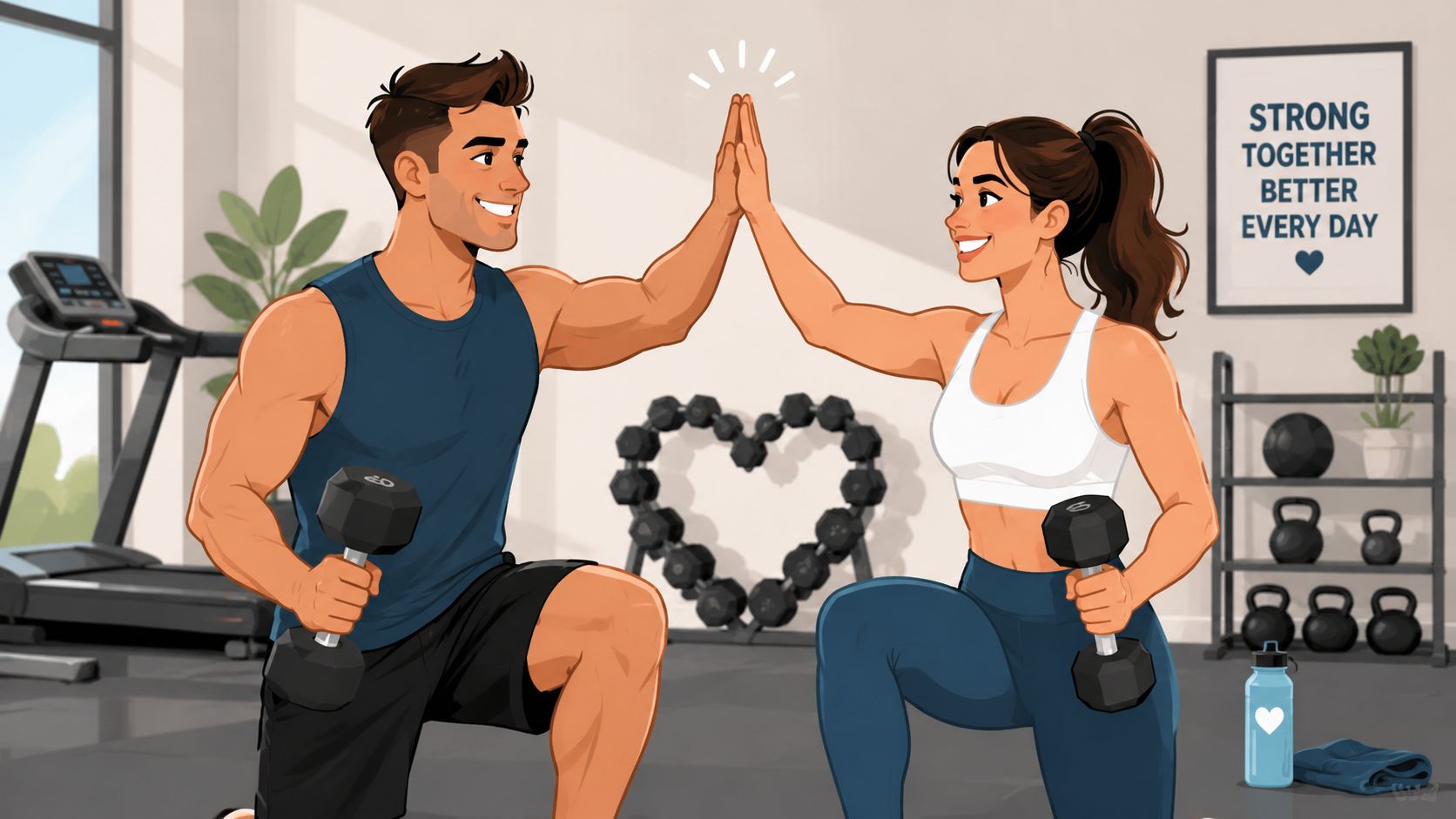
January looks great on the sales board. March tells the truth.
That's when new members start skipping sessions, front desk staff stop hearing from the couples who joined together, and cancellation requests pick up. If your gym membership for couples is just “two people, slightly lower price,” you're leaving retention to chance.
A strong couples offer works because it solves an operational problem. It gives members built-in accountability, gives staff a clearer follow-up path, and gives the business a more stable household account instead of two fragile solo decisions. I've seen the difference again and again. The profitable programs aren't the cheapest. They're the ones with clear rules, visible value, and a structured first 90 days.
Why a Couples Plan Is Your Retention Powerhouse
The usual pattern is familiar. A gym acquires a wave of new members, momentum fades, and motivation drops before habits stick. That's exactly where a couples plan can outperform a generic membership.
Approximately 44% of gym members in the US prefer working out with a partner, and 50% of new gym members quit within the first six months due to lack of motivation according to Gym Marketing Solutions. That single pairing of facts explains why gym membership for couples isn't just a discount category. It's a retention tool.

Accountability beats good intentions
When one partner loses motivation, the other often pulls them back into the routine. That doesn't happen with most single memberships. A solo member can disappear unnoticed. A couple usually creates friction against that drop-off because someone notices the missed workout.
That changes how staff should think about the sale. Don't frame the plan as a price concession. Frame it as a structure that makes consistency easier.
Three things tend to work in practice:
- Shared start dates: Put both partners into the same onboarding flow so neither starts cold.
- Joint habits: Encourage one or two fixed weekly visit windows they both can protect.
- Visible progress: Give staff a reason to ask both people about the same goal, not two disconnected check-ins.
Practical rule: If your couples plan doesn't create more visits, more staff touchpoints, or more social connection, it's just a discount with extra admin.
Couples plans stabilize the member base
A household account is usually more durable than two separate accounts because the decision to stay isn't made in isolation. One person might feel flat about training for a week. Two people are more likely to keep the plan because the membership serves the relationship as well as the workout.
That's also why I like pairing the offer with a retention system instead of a seasonal promo. If you want more ideas beyond pricing, this guide on how to discover retention marketing tactics is a useful outside perspective on keeping members engaged after the first sale.
For gym operators building that system internally, it also helps to review practical member retention strategies for gyms and map your couples plan directly into that workflow.
Designing Your Irresistible Couples Package
A couples package should feel like a better experience, not just a lower bill. If it looks identical to two standard memberships with a small reduction, prospects compare only on price. That's a weak position.
The better model is a tiered offer with one simple promise per tier. Keep the structure easy for sales staff to explain and easy for members to understand.

Couples or family-based gym memberships account for 39% of all enrollments in the U.S. fitness industry, compared with 35% for single-person memberships, according to Mirrors Delivered. That tells you bundled plans aren't a side offer. They're a core enrollment lane.
Use a three-tier structure
I prefer three options because two can feel binary and four creates hesitation. Here's a practical template.
Bronze Lovebirds
This is your entry offer. It should remove friction without adding much operational load.
Include:
- Shared gym access: Standard access for both partners during normal hours.
- Consolidated billing: One account, one payment method, one renewal date.
- Starter orientation: A short joint walkthrough and equipment intro.
Silver Synergy
This is usually the best seller because it introduces guided engagement.
Add:
- Priority class booking: Helpful for busy couples who train around work.
- Partner training session: One joint session at signup or within the first month.
- Monthly guest privilege: A flexible perk that feels generous without being costly.
Golden Duo
This should target higher-value members who want support and convenience.
Add:
- Programming support: Personalized plans that let each partner pursue different goals.
- Premium workshop access: Nutrition, recovery, mobility, or habit coaching.
- Reserved check-ins: Scheduled staff touchpoints instead of passive support.
A low-cost perk with high perceived value is a monthly shared guest pass. Members feel they're getting flexibility, and your team gets a natural excuse to restart conversations around attendance and referrals.
Build value around joint behavior
The mistake most operators make is loading the package with isolated perks. Don't add features that each person uses alone. Add value that encourages the pair to return together.
That means:
- booking access that helps them coordinate,
- one or two partner sessions to reduce first-month uncertainty,
- invitations into classes or events where they can build familiarity with the gym.
If you're comparing bundled structures against other membership models, this guide to a multiple gym membership approach is useful for seeing where couples plans fit in a wider offer stack.
What doesn't work
Some ideas sound attractive but underperform:
- Unlimited freebies: They create confusion, abuse, and weak margins.
- Complicated perk menus: Front desk staff won't explain them consistently.
- Forced identical programming: Couples don't always share the same fitness level or goals.
A good couples package lets partners join together without forcing them into the same training identity. Shared membership. Individual goals. That's the balance.
Smart Pricing Strategies and Contract Terms
Pricing has to feel like a win for the customer while still protecting revenue per household. If the discount is too shallow, the offer feels fake. If it's too aggressive, you train people to buy only when you cut margin.
The benchmark is straightforward. Gym membership for couples typically costs between $90 and $150 per month, compared with two individual memberships averaging $54 for males and $50 for females in the US, which means couples save about $18 to $24 monthly by joining together, according to Iron Lair Gym.
Price for clarity, not cleverness
The cleanest positioning is to show the math plainly. Staff shouldn't need a calculator at the desk.
Here's a practical pricing table format you can adapt.
| Membership Tier | 2x Individual Price | Couples Plan Price | Couple's Monthly Savings | Gym Revenue per Household |
|---|---|---|---|---|
| Basic Partner | $104 | $90 | $14 | $90 |
| Standard Couple | $108 | $96 | $12 | $96 |
| Premium Couple | $108 | $102 | $6 | $102 |
The exact numbers above are sample formatting, not market claims. The structure matters more than the labels. Show the household value, not just the discount.
Use contract language that solves the obvious problem
Every manager knows the awkward scenario. Two people join together. Later, one wants out and the other wants to stay. If your agreement is vague, your team improvises. That creates billing disputes and inconsistent exceptions.
Use a clause like this in plain English:
Sample membership clause: If one member on a couples plan chooses to cancel, relocate, freeze, or transfer eligibility, the remaining member may continue under the gym's current individual membership rate or any applicable replacement bundled plan. The gym may update billing and account ownership accordingly. Early termination rights, freeze terms, and notice periods apply as stated elsewhere in this agreement.
That clause does three things well:
- Protects continuity: One breakup doesn't automatically kill the entire account.
- Protects staff: The front desk has a script, not a judgment call.
- Protects revenue: The surviving membership converts cleanly to a single plan if needed.
For operators tightening legal language and cancellation handling, this resource on gym membership contracts is worth keeping nearby during setup.
Terms that reduce headaches
A couples contract should also answer these points before anyone asks:
- Billing ownership: Name one primary payer and one secondary member.
- Access rights: State whether one member can use the plan independently.
- Freeze policy: Clarify whether one or both members must freeze together.
- Upgrade path: Allow movement to PT-supported or premium plans without rewriting the whole agreement.
Don't hide this stuff in legal clutter. Clear terms close deals faster because prospects can see you've already thought through real life.
The Sales and Marketing Playbook for Couples
Selling gym membership for couples takes different language than selling an individual plan. Price matters, but it usually isn't the deciding factor. Couples buy around convenience, accountability, and shared time.
That means your campaigns should sound relational, not transactional.

When gym staff engages members with at least two interactions per month, members make one additional visit the following month, which reduces cancellation risk by 33%, according to Glofox. That matters for couples because the sale should launch a contact rhythm, not end it.
Campaigns that actually convert
Different seasons need different angles. Repeating “join together and save” all year gets stale.
Try a simple campaign calendar:
- January theme: New Year, New Us. Focus on habit-building and shared commitment.
- February theme: Stronger Together. Lead with quality time plus health, not romance clichés.
- Summer theme: Stay Consistent Through Travel and Schedule Chaos. Push flexible class booking and consolidated billing.
- Back-to-routine season: Reset as a pair after school, vacation, or work schedule changes.
In-gym signage should mirror the campaign language. Keep it short. Use images of real partner workouts, not stock-photo smiles and generic discount banners.
Staff script that sells the real benefit
Most sales teams default to this: “You'll save money if you join together.”
That line is true, but weak. A better desk script sounds like this:
“The best part of the couples plan isn't the bundled rate. It's that you won't be starting alone. We can set both of you up with the same first-week schedule, make your first visit easier, and give you a plan that works even if your goals are different.”
That script works because it removes friction. It also gives the prospect a picture of how the membership will fit into their week.
A few practical prompts for staff:
- Ask about routines: “When could both of you realistically train each week?”
- Ask about goal mismatch: “Are you looking for the same result, or different ones?”
- Ask about support preference: “Would you want a joint intro session or separate programming after sign-up?”
Marketing assets that pull their weight
The best-performing assets are usually simple:
- landing pages with clear package comparisons,
- short couple-focused testimonial clips,
- an email to current solo members offering an upgrade path,
- front desk cards with one clean explanation of how the plan works.
What tends to fail is broad, fluffy messaging. “Transform your life together” sounds nice, but it doesn't answer the buyer's question. Buyers want to know how this plan makes showing up easier next week.
Onboarding and Retaining Your Power Duos
The enrollment is only the opening move. Most couples don't cancel because they disliked the idea. They cancel because the gym didn't turn the idea into a routine fast enough.
That's why the first 90 days need a system. The average annual gym member retention rate is 66.4%, meaning roughly one in three members cancel each year, and half of new members quit within their first six months, according to Gymdesk. A couples program should be built to interrupt that pattern early.

Your 30 60 90 day checklist
Print this. Give it to membership, coaching, and front desk staff. If no one owns the sequence, it won't happen.
Days 1 to 30
- Book the joint orientation: Don't leave first use to chance.
- Set one shared goal and two individual goals: Shared goals create teamwork. Individual goals avoid forced alignment.
- Complete app and booking setup: Make class booking and account access frictionless.
- Schedule the next visit before they leave: Don't rely on intention.
Days 31 to 60
- Run a progress check-in: Ask what's working and what's getting in the way.
- Introduce one community touchpoint: Group class, challenge, workshop, or coached session.
- Flag attendance drift early: If one partner disappears, contact both with care and specificity.
Days 61 to 90
- Recognize consistency: Staff acknowledgment matters more than most operators think.
- Refresh the plan: Update programming if boredom or mismatch is creeping in.
- Ask for the next commitment: PT add-on, challenge entry, or class series.
Don't onboard couples as one person times two. Onboard them as a shared decision with two separate behavior patterns.
What keeps them past the honeymoon phase
Couples stay longer when the gym becomes part of their routine and part of their relationship rhythm. That usually comes from repeated, low-friction touchpoints.
Retention tactics that work well:
- Couples challenges: Friendly structure without overcomplicating the experience.
- Date-night training slots: A branded evening class or coached floor session.
- Referral prompts for other pairs: Social expansion often reinforces the original habit.
What doesn't work is assuming they'll motivate each other forever. Some pairs accelerate each other. Others drift together. Staff still need to monitor attendance, energy, and engagement instead of treating a joint account as automatically safe.
Cultivating a Clean and Welcoming Environment
Couples plans promise a better experience. Cleanliness is part of that promise.
Members notice the small things immediately. Sticky benches, empty wipe stations, and neglected mats signal that standards slip when the room gets busy. A clean club feels organized, professional, and worth staying with.
Cleanliness should be visible
Don't treat sanitation as a back-room task. Put a gym wipe dispenser at every major zone where members expect it: cardio, selectorized strength, free weights, group fitness, and stretching areas. Stock it with gym equipment wipes or fitness wipes that members can grab without asking.
If you manage a larger floor, order bulk gym wipes and assign refill checks to opening, peak-time, and closing routines. That's more reliable than waiting for staff to notice an empty canister during a rush.
For operators reviewing supply options, commercial disinfecting wipes at Wipes.com are worth a look because they fit the needs of high-traffic fitness facilities and help simplify reordering for teams that go through a lot of product.
Match the product to the use case
Different surfaces need different habits. Keep wipes for gym equipment near strength and cardio stations, and put yoga mat wipes near mobility and studio spaces. If your club promotes hygiene as part of the brand, choose EPA registered disinfecting wipes where that standard matters for member confidence.
Good cleaning habits are easier to maintain when the environment supports them:
- Place supplies where decisions happen: Members wipe down equipment when the wipes are within arm's reach.
- Use clear signage: “Please wipe equipment after use” works better when paired with a visible station.
- Train staff to model behavior: Members copy what they see trainers and attendants do.
- Refill before peak hours: Empty stations make your standards look performative.
Clean clubs retain trust. Dirty clubs force members to question everything else you promise.
Air quality also shapes the experience, especially in busy training rooms and enclosed studios. If you're evaluating ways to maintain healthier indoor environments, that's a useful operational consideration alongside sanitizing wipes, antibacterial wipes, and regular floor cleaning.
The final detail is consistency. If you want couples to stay, every visit has to feel like the gym is ready for them. Keep workout wipes stocked, check the locker rooms more often than you think you need to, and make sanitizing part of the visible culture, not an occasional deep-cleaning event.
A profitable gym membership for couples isn't built on a cute name and a discount. It's built on package design, clear contract terms, staff scripts, a 90-day system, and an environment that feels worth returning to.
If you want more practical templates for selling and retaining memberships, visit Gym Membership Tips.
Leave a Reply