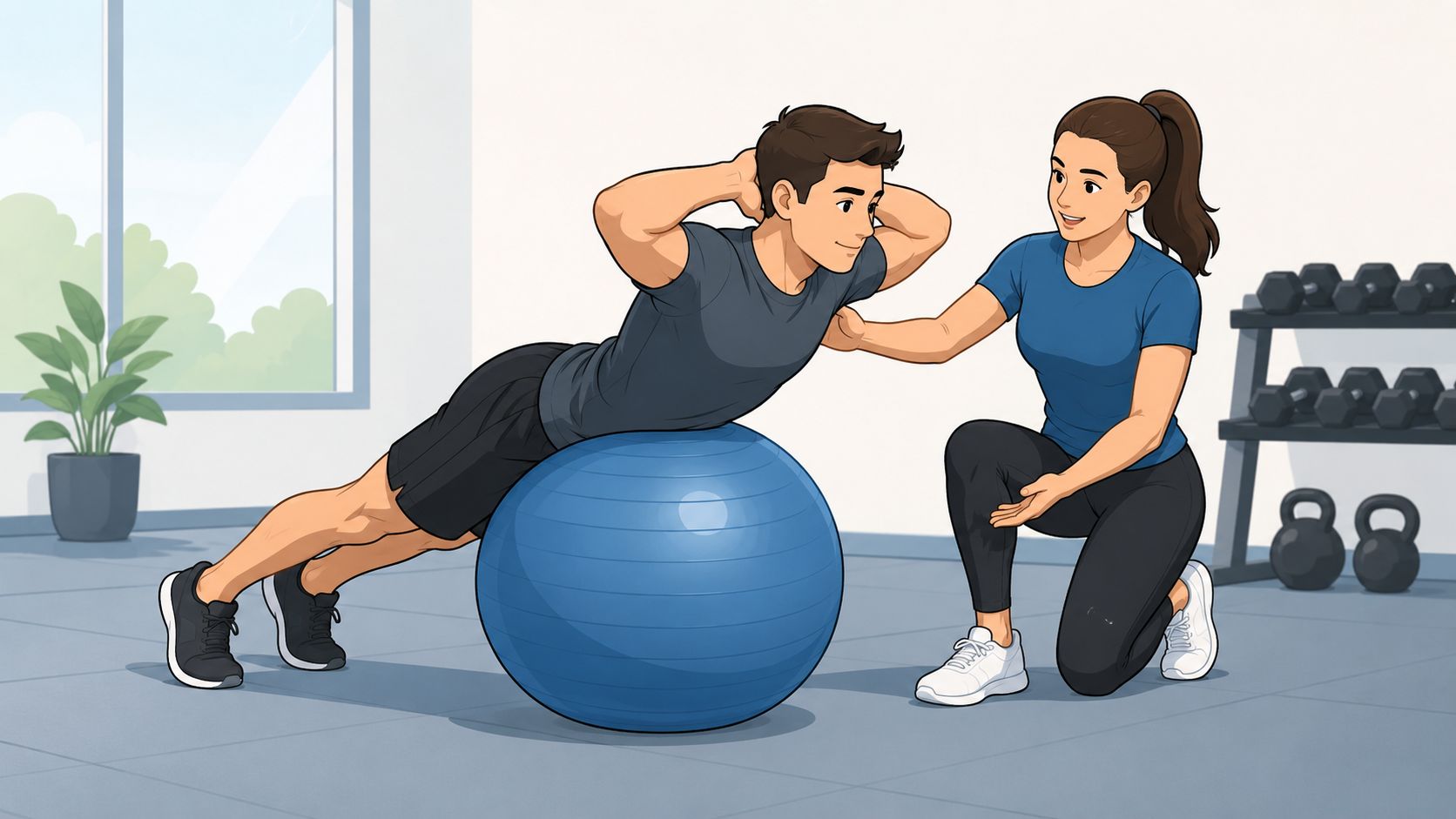
A trainer sees this every week. A member says their low back gets tight after work, they're tired of floor drills, and they want something that feels like real training instead of rehab homework. If the only answer is another round of generic crunches and mat work, that member often checks out mentally before they ever check out of the gym.
That's where the Swiss ball earns its place on the floor. Used well, it gives trainers a way to coach spinal control, build confidence, and make back training feel active instead of clinical. Used poorly, it becomes a balance circus that frustrates beginners and scares off the exact members who need support most.
The difference is coaching. Strong back exercises Swiss ball sessions aren't about novelty. They're about selecting the right setup, teaching control before range, and progressing members in a way that feels personal. When clients feel their back moving better and understand why they're doing each drill, they stay engaged longer.
For gym owners and fitness directors, that matters. A Swiss ball program can be more than a corner accessory. It can become a retention tool, a small-group offering, and a visible sign that your coaching staff knows how to meet members where they are.
Beyond Crunches The Untapped Potential for Back Health
Most facilities already own Swiss balls. Few use them as a complete back health system.
The common pattern is familiar. A member reports recurring stiffness, a trainer gives them a few floor-based core moves, and the member either gets bored or pushes too hard. Neither outcome builds trust. Members with back concerns usually want two things at once. They want relief, and they want to feel capable again.
A Swiss ball can bridge that gap because it changes how clients experience core work. The ball creates just enough instability to demand attention from the trunk without automatically turning every drill into a high-skill challenge. That makes it useful for teaching posture, breathing, balance, and controlled spinal movement in one station.
Why the ball works in a commercial gym
In a busy gym, simplicity wins. One piece of equipment can support warm-ups, foundational movement, targeted posterior-chain work, and low-intimidation coaching for newer members. Trainers can also scale it fast. One client may only need seated pelvic control. Another may be ready for loaded extension patterns later.
That versatility helps with retention because members notice when a program feels customized. They don't just remember the exercise. They remember that the trainer adjusted the drill, caught the wobble, and gave them something they could do well.
Practical rule: Members stay with programs that feel both safe and progressive. Swiss ball training can deliver both if coaches prioritize control over spectacle.
What separates good programming from random ball work
The ball doesn't fix anything by itself. Random reps on an unstable surface won't impress experienced clients or protect deconditioned ones. The value comes from a repeatable system:
- Assess first: Watch how the member sits, breathes, and controls the pelvis before assigning loaded movement.
- Coach the basics hard: Bracing, tempo, and alignment matter more than creative exercise selection.
- Progress by quality: Stop sets when control fades, not when the member is just willing to keep going.
- Tie it to function: Explain how each movement supports posture, walking, lifting, and day-to-day comfort.
That approach separates a professional coaching floor from a room full of equipment. It also gives trainers a service they can package, teach, and market with confidence.
Foundations for Success Ball Selection and Core Principles
A new member sits on the ball, feet too narrow, knees higher than the hips, shoulders already tense. Before the first rep, you can usually tell whether the session will build confidence or create a complaint.

Pick the ball like a coach, not like a buyer
Ball selection sets the tone for everything that follows. For most adults, that means starting in the 55 to 75 cm range, then confirming the fit on the floor instead of trusting the printed size alone. The quick check is simple. The member should be able to sit with feet flat, knees close to 90 degrees, pelvis neutral, and no toe gripping.
Poor sizing creates coaching problems that look like movement problems. A ball that is too small closes the hip angle and pushes the client into a slumped position. A ball that is too large makes it harder to create steady foot pressure, which usually shows up as wobbling, overbracing through the neck, or rushing through reps.
On a busy gym floor, that matters. The right setup gives newer trainers cleaner reps to coach and gives members an early win.
The required briefing before anyone rolls out
Give every client the same short setup talk before the first exercise. Consistency protects the member and protects your coaching standard.
- Brace before motion: Cue a gentle abdominal brace before the limb or spine moves.
- Slow the tempo: The ball exposes poor control quickly. Slower reps let you see it and fix it.
- Keep the neck relaxed: Clients who feel unstable often lead with the chin and tense the jaw. Cue a long neck and quiet shoulders.
- Drive the feet into the floor: Stable foot pressure improves balance and reduces panic in deconditioned members.
This is also where staff education affects retention. If personal trainers and class instructors use different language for the same positions, members get confused and confidence drops. I prefer one shared coaching standard across the facility, especially if your team teaches both one-on-one and small-group sessions. Reviewing group fitness instruction standards with new coaches helps keep those cues aligned.
Start with pelvic control before loaded extension
The first goal is not bigger movement. It is cleaner movement.
Seated pelvic tilts and small circles usually tell you whether a client can dissociate the hips from the rib cage, keep breathing, and stay off the neck. If they cannot do that on top of the ball, loaded extension drills are usually premature. You do not need a dramatic compensation pattern to create a bad experience. A few shaky reps are enough to make a newer member feel incapable.
Research on Swiss ball exercise for low back pain generally supports controlled, low-load trunk work as part of a broader program. In practice, I start with pelvic tilts for 10 to 15 reps per direction, coached slowly, with the upper body quiet and the feet fixed. That gives trainers a clear screen for motor control and gives clients a drill they can succeed with early.
Slow reps expose the real pattern. Fast reps hide it.
That principle carries business value too. A member who feels stable, understands the purpose of the drill, and leaves with less fear around back training is far more likely to book the next session.
The Core Four Essential Swiss Ball Back Exercises
A Swiss ball program earns trust when trainers coach the same four patterns the same way. Members feel the difference. Sessions look organized, progress is easier to explain, and back training stops feeling like random balance work. For gym owners, that consistency matters because clear progressions turn a low-cost tool into a service members will keep paying for.

I keep the exercise menu tight with new trainers. These four movements cover trunk extension, anti-rotation, posterior-chain endurance, and hip support for the low back. They also fit cleanly into broader back-friendly health and fitness programming instead of sitting off to the side as a novelty circuit.
Back extension
Back extension is the first big pattern to own because it exposes setup errors fast. If the ball position is off, the client either hangs on the lumbar spine or spends the whole set trying not to fall.
Setup and execution
- Place the ball under the hips or lower abdomen: Too high under the stomach limits the motion. Too low toward the thighs turns the set into a balance drill.
- Set a long neutral line: Feet stay planted wide enough to create stability. Hands can stay lightly behind the head or across the chest, depending on the client.
- Raise and lower under control: Lift until the torso matches the line of the legs, then return slowly. A brief top hold can work well if the client can keep the ribs down and the neck neutral, as shown in Rehab Hero's Swiss ball back extension guide.
Watch for
- Lumbar hinging: The movement should spread through the whole posterior chain, not jam into one spinal segment.
- Head lift first: Clients often lead with the chin when they do not trust their trunk.
- Loss of foot pressure: If the heels and forefoot stop gripping the floor, tension leaks out.
Common faults to correct
- Range chasing: Stopping at neutral is usually enough for general population clients.
- Fast lowering: The return phase tells you whether they own the rep.
- Hands pulling on the head: That turns a trunk drill into a neck problem.
Regressions and progressions
- Regression: Isometric hold in neutral for a short, clean set.
- Regression: Reduce the range and coach tempo.
- Progression: Add a pause at the top, increase time under tension, or move the hands from chest to head. Zing Coach's Swiss ball exercise library shows several clean variations.
A trainer who can coach this exercise well usually cleans up half the member's other extension patterns.
Bird-Dog
Swiss ball bird-dog is a coordination drill with very little room for fake stability. It works best when trainers treat it as an anti-rotation pattern, not a flexibility display.
Setup and execution
- Start from a stable base: Hands stay on the floor. The knees or shins contact the ball based on the version.
- Reach long through opposite limbs: The hand and foot move away from each other. Height is not the goal.
- Keep the torso quiet: The ball should stay relatively still while the limbs move.
Key cues for trainers
- Press the floor away: Active shoulders make the trunk easier to organize.
- Zip up the front of the body: Clients usually understand this faster than a long brace lecture.
- Exhale on the reach: Breathing helps prevent rib flare and overextension.
Common errors
- Leg lifted too high: That usually creates lumbar extension instead of hip motion.
- Hip twist: The pelvis rotates because the client cannot control load transfer.
- Rushed switching: Fast transitions hide poor balance.
Modification ideas
Teach the pattern on the floor first if needed. Good trainers do this without apologizing for it. Floor bird-dog often gives a newer member an early win, and that confidence carries over when the ball is reintroduced.
Prone Cobra Superman
This movement trains upper-back endurance and full-body extension tolerance. It also tells you quickly whether a member can create length without turning the drill into a neck and low-back strain contest.
Setup and execution
- Support the chest on the ball: The body should feel secure enough to move without gripping through the jaw and shoulders.
- Reach away from the center: Arms and legs lengthen out before they lift.
- Use modest sets: Quality drops quickly when breathing and head position break down.
Coach's eye
- Neck stays long: The gaze stays down, not forward.
- Shoulder blades move gently: Look for controlled retraction, not aggressive squeezing.
- Breathing stays visible: If the client braces so hard they stop breathing, the set is too hard.
What doesn't work
- Throwing the chest upward: Momentum hides weak control.
- Leading with the chin: Common and easy to miss on a busy floor.
- Ignoring symptom reports: Muscular effort is acceptable. Sharp pain is not.
This exercise has value, but it has a narrower coaching window than many trainers think. Keep it honest.
Hip bridge
Hip bridge on the ball often does more for back comfort than another round of spinal extension drills. Members learn that glutes and trunk positioning support the low back together, which is a useful message in both rehab-adjacent training and general fitness.
Setup and execution
- Place the feet on the ball: Heels press down and slightly back to create tension.
- Lift to a straight line from ribs to knees: The top position comes from hip extension, not a rib flare.
- Lower with control: Every rep should look the same.
Watch for
- Immediate hamstring cramping: That usually points to poor setup, poor tension strategy, or both.
- Ball drift: The ball rolling around the room tells you the client has lost even pressure.
- Hips dropping on one side: That exposes asymmetry quickly.
Useful variation
For clients who need a lower-threat starting point, the Bridge-1 setup can work well. The client lies supine with the ball under the upper back, brings one knee toward the chest, holds the position briefly, then repeats on the other side, following Chiro Trust's Swiss ball back pain exercise description.
If your staff can coach these four movements with consistent standards, the Swiss ball stops being accessory equipment and becomes a retention tool. Members feel progress, trainers sound credible, and the program has a clear place on the training floor.
Programming for Progress From Rehab to Performance
Exercise selection matters. Programming matters more.
Most Swiss ball guides stop at a static rep prescription. That's not enough for a real coaching floor. A trainer working with mixed ability levels needs a better standard for when to continue, when to stop, and when to progress. That's where fatigue-based progression comes in.
A practical industry gap exists here. Existing content often gives fixed rep counts but doesn't define how to stop a set when control fades. That gap around loss of control and spinal misalignment is highlighted in this discussion of fatigue-based progression in Swiss ball coaching.
Form failure beats muscle failure
On a Swiss ball, don't wait for classic gym-style muscle failure. Stop when the member loses the position you're trying to train.
That means the set ends when you see:
- Pelvic rotation: Hips twist or drop.
- Neck compensation: Chin juts forward or shoulders creep up.
- Tempo breakdown: The member speeds up to finish.
- Loss of alignment: The trunk can't stay organized on the ball.
That standard protects the client and gives the trainer a coaching language that sounds professional. It also creates clearer progressions inside broader health and fitness programs instead of leaving Swiss ball work as a random add-on.
Sample Swiss Ball Back Health Routines
| Level | Exercise | Sets x Reps/Duration | Focus |
|---|---|---|---|
| Beginner / Rehab | Seated pelvic tilts | Controlled sets of 10 to 15 reps per direction | Pelvic awareness and tempo |
| Beginner / Rehab | Isometric back extension hold | Short holds of 10 to 20 seconds | Neutral spine and low-threat endurance |
| Beginner / Rehab | Bridge-1 | 5 holds per leg, 10 seconds each | Hip control and trunk stability |
| Intermediate / Strength | Back extension | Sets of 10 to 12 reps | Lumbar support and posterior-chain strength |
| Intermediate / Strength | Bird-dog | Sets of 8 to 10 reps | Cross-body coordination |
| Intermediate / Strength | Hip bridge | Sets of 10 to 12 reps | Glutes, hamstrings, and core integration |
| Advanced / Performance | Back extension with pause | 6 to 10 reps | Extended time under control |
| Advanced / Performance | Superman variation | 8 to 10 reps | Posterior-chain endurance and balance |
| Advanced / Performance | Slower-eccentric bridge or extension work | Trainer-directed within clean form | Advanced control under instability |
How to progress without rushing
I like a simple progression rule. Keep the exercise the same until the member can own every rep with the same shape, same breath, and same speed. Then change one variable only.
You can progress by:
- Adding a pause
- Slowing the lowering phase
- Reducing support
- Increasing complexity
You don't need endless exercise variety. Members get better results when they feel mastery building session to session.
A member doesn't need a new drill every week. They need a drill they can feel themselves doing better.
Boost Your Business Marketing Your Swiss Ball Expertise
Most gyms market intensity. Fewer market competence.
That creates an opening. If your staff can coach Swiss ball back work with confidence, you can turn a common piece of equipment into a clear point of difference. Members with desk-related stiffness, previous flare-ups, or a fear of “hurting their back again” respond to programs that feel structured and approachable.

Offers that are easy to launch
You don't need a massive rollout. Start with one focused offer and teach your team to talk about outcomes in plain language.
- Bulletproof Back workshop: Run a short educational session on posture, bracing, and the core four movements. This works well for lead generation and reactivation.
- Small-group series: Create a recurring Swiss ball class for members who want guided support without one-on-one pricing.
- Intro package add-on: Include a back health screen and one ball-based session in your new member onboarding.
- Trainer content days: Film short coaching clips that show setup, common errors, and regressions.
What to emphasize in your messaging
Don't market the ball as trendy. Market what members care about.
Focus on:
- Approachability: The drills look manageable.
- Personalization: Members can start at a low barrier and progress.
- Visible coaching value: Trainers aren't just counting reps. They're correcting movement.
- Consistency: This can fit personal training, small-group training, and recovery-focused programming.
One of the better outside reads on turning expertise into visibility is Lake City Physical Therapy's marketing strategy. It's useful because it treats educational content as part of business growth instead of as an afterthought. That mindset carries over well in fitness.
What works and what doesn't
What works is packaging a clear problem and a clear solution. “Low back support for active adults” is understandable. “Integrated unstable-surface posterior-chain optimization” is not.
What doesn't work is burying your best coaching under generic social posts. If your trainers know how to fix setup errors, scale movement, and keep clients safe, show that. Expertise builds trust long before a sales conversation starts.
Equipment Care and Member Safety Protocols
Shared Swiss balls need the same professionalism as benches, mats, and handles. If members see dust, sweat residue, or no cleaning system nearby, they assume the rest of the facility is being managed the same way.
That's why hygiene has to be visible. Put a gym wipe dispenser near functional training and rehab areas, and stock it with gym equipment wipes that members can grab without asking. Good systems reduce friction. Great systems make cleanliness automatic.
A simple Swiss ball cleaning protocol
Use a repeatable process your team can enforce:
- Pre-session check: Staff should inspect each ball for surface wear, instability, and obvious contamination.
- Post-use wipe-down: Ask members to clean the ball immediately with disinfecting wipes or sanitizing wipes suitable for shared fitness surfaces.
- End-of-day reset: Staff should do a second pass on all high-touch equipment in the zone, including balls, mats, and racks.
- Storage standards: Keep Swiss balls off dirty walkways and away from sharp edges or rough storage points.
If you're setting up supplies, keep bulk gym wipes on hand so the station never sits empty during peak hours. For facilities that need a broader ordering solution, Wipes.com disinfecting wipes and gym cleaning products are a practical source for commercial disinfecting wipes, wipes for gym equipment, and other cleaning essentials.
Match the cleaning system to the member experience
Members shouldn't have to hunt for supplies. If they do, compliance drops. Put cleaning materials where the workout happens and label the expectation clearly. A few signs and a visible wipe station do more than a back-office policy nobody reads.
You can also extend the same standard to nearby accessories. Keep fitness wipes available for benches, and consider yoga mat wipes in studio zones so cleaning behavior becomes part of the culture, not a special rule for one tool.
For operations teams, this belongs inside your broader gym equipment maintenance process. Clean equipment protects members, protects the asset, and reinforces that your facility runs with discipline.
Clean equipment signals care. In a retention business, that signal matters.
A good Swiss ball program helps members move better. A clean Swiss ball tells them your staff pays attention. Both matter.
If you're building systems that improve coaching, retention, and daily operations, Gym Membership Tips is worth keeping on your radar. It's a useful resource for gym owners and fitness leaders who want sharper programming, stronger sales processes, and better member experiences.
Leave a Reply