At 6 PM on a Monday, nobody notices your maintenance plan. They notice the treadmill with printer paper taped to the console. They notice the cable machine that feels rough on the pull. They notice the bike that wobbles enough to make them choose a different gym next month.
That is why maintenance gym equipment work cannot sit at the bottom of a clipboard under “miscellaneous.” In a busy facility, maintenance is operations. It shapes member trust, staff confidence, sales conversations, and the number of avoidable headaches your team deals with every week.
The operators who run smooth clubs do not treat upkeep as a reaction to breakdowns. They build a repeatable system. They inspect before members complain. They clean before sweat and dust turn into corrosion and overheating. They log what was checked, what was adjusted, and what needs follow-up. That discipline protects revenue just as much as it protects machines.
Beyond the 'Out of Order' Sign
Rush hour failures are never just equipment failures. They are service failures.
A broken treadmill during peak traffic pulls staff away from the front desk, frustrates regulars, and creates doubt about what else in the club may be getting missed. If the same machine goes down more than once, members stop seeing it as bad luck. They see it as poor management.

I look at equipment in two ways. First, as a physical asset. Second, as a visible promise to members. If you promise convenience, safety, and quality, every machine on the floor either supports that promise or weakens it.
What members read from your equipment
Members rarely ask whether your team completed a maintenance log this morning. They read the room instead.
They notice things like:
- Cleanliness: Dried sweat on handles and dust under shrouds suggest neglect.
- Consistency: If one treadmill is down today and another is down next week, confidence drops fast.
- Feel: A centered belt, smooth guide rods, quiet bearings, and secure benches communicate professionalism.
- Response: When staff tag, isolate, and address issues quickly, members feel protected rather than inconvenienced.
That last point matters. A machine can fail even in a well-run gym. What separates strong operators from sloppy ones is the response. Good clubs already know who inspects it, who logs it, who decides whether it stays offline, and who calls service if needed.
Tip: Members forgive isolated problems. They do not forgive patterns that tell them the facility is drifting.
Maintenance as brand protection
A lot of owners still treat maintenance as a cost center that only matters when a machine stops working. That mindset creates reactive clubs. Reactive clubs spend more time apologizing.
A stronger approach is to treat maintenance as part of your retention strategy. The clubs that keep equipment reliable also make tours easier, online reviews stronger, and renewals less fragile. If you are evaluating whether older machines still fit your floor plan, it also helps to think carefully about commercial gym equipment used and whether your current maintenance capacity matches the equipment mix you are operating.
Maintenance is not glamorous. It is one of the clearest signals that the business is under control.
Your Gym's Maintenance Cadence
Random maintenance fails because busy gyms are noisy environments. Staff get interrupted. Priorities shift. Small tasks slide. The answer is cadence.
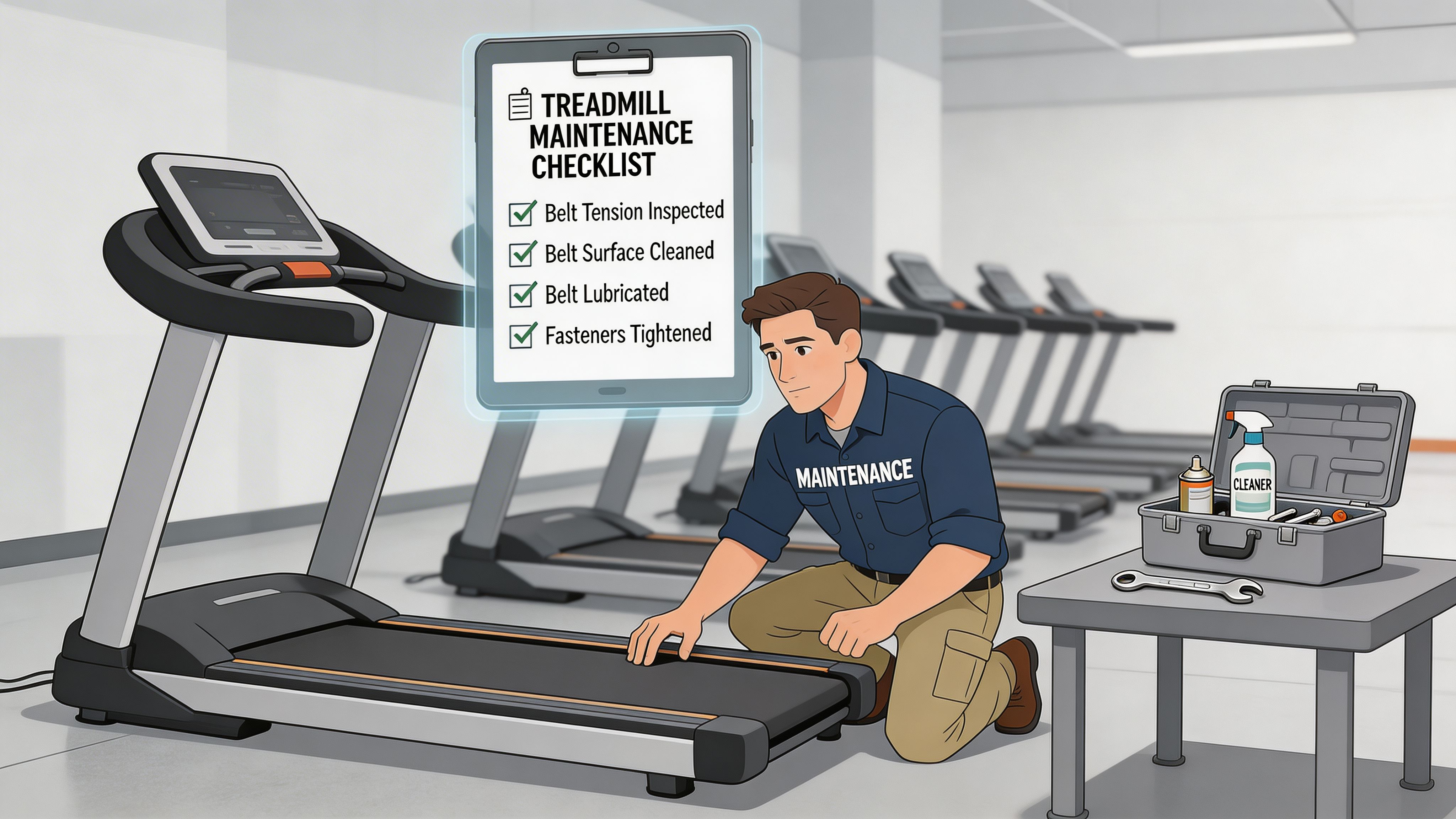
Professional maintenance programs use a tiered schedule with weekly, monthly, semi-annual, and annual cycles, and for treadmills that means weekly belt tension checks, monthly motor inspections for dust, and lubrication every 3 months, according to Xenia’s gym equipment maintenance management guide.

Daily rhythm
Daily work should be fast, visible, and impossible to skip.
Openers or closers should move the floor with a simple pattern. Start at one end of cardio, continue through selectorized strength, then free weight stations, benches, and accessory storage. The point is not a perfect engineering review. The point is to catch obvious faults early.
A practical daily routine includes:
- Wipe contact surfaces: Handles, seats, touchpoints, adjustment knobs, and consoles.
- Scan for visible wear: Frayed cables, loose bolts, damaged pedal straps, torn upholstery, and unstable benches.
- Check machine feel: Listen for unusual noise, feel for drag, sticking, or wobble during a brief function test.
- Tag and log immediately: If something is questionable, remove it from use and create a record before the issue gets forgotten.
Daily tasks should live on a short checklist. If your staff need ten minutes to understand the form, the form is too long.
Weekly control points
Weekly work is where maintenance gym equipment routines start preventing bigger failures.
For treadmills, belt tension and alignment deserve focused attention. The technical method matters. The treadmill should run at 6.0 mph, and rear roller screws should be adjusted in ½-turn increments with at least one minute between adjustments so the belt can equalize, as described in the same Xenia guide linked above.
Strength and cycling equipment need their own weekly attention:
- Universal machines: Check chains, guide rods, pulleys, and cable tracking.
- Exercise bikes: Inspect pedal straps, seat posts, and console stability.
- Stair simulators: Verify belt resistance and electronic response.
- Benches and racks: Tighten hardware and inspect high-stress contact points.
This is also the right frequency for checking whether your staff completed the daily basics. Most maintenance failures come from inconsistency, not ignorance.
Key takeaway: The schedule only works if tasks are assigned to names, not departments.
Monthly and quarterly actions
Monthly work goes deeper. At this stage, your team slows down, opens panels where appropriate, and checks hidden trouble spots.
Use monthly reviews for:
- Motor and ventilation inspection: Remove dust and debris from treadmill motor areas.
- Lubrication: Apply manufacturer-recommended products to treadmill belts, elliptical tracks, and moving strength components on the proper interval.
- Calibration checks: Verify displays, resistance changes, emergency stop response, and safety systems.
- Upholstery and frame review: Catch splits, rust, corrosion, or instability before members do.
For many clubs, belt lubrication lands on a roughly every-3-month rhythm, with more frequent attention during heavy use. That interval should not be guessed. It should be documented by machine type and tracked on a calendar or in software.
Semi-annual and annual work
Some work belongs with a technician, but even then, your team should prepare the visit and verify the result.
A simple way to think about annual tasks is in this table:
| Frequency | Main objective | Typical focus |
|---|---|---|
| Semi-annual | Catch wear before failure | Deep inspection of cables, bearings, fasteners, electronics |
| Annual | Reset equipment health baseline | Professional servicing, calibration, replacement planning |
Annual maintenance is also the right time to retire repeat offenders. If one machine keeps consuming staff attention, disrupts member flow, and never stays fixed for long, stop treating it like a one-off incident. It may be a replacement decision wearing a repair costume.
How to keep the cadence from collapsing
A schedule fails when it depends on memory or heroics.
Use a system with these basics:
- Assign ownership: Every zone needs a primary and backup staff member.
- Standardize checklists: One checklist per equipment category.
- Log exceptions: “Looked fine” is not enough when something was adjusted or tagged.
- Review weekly: Managers should scan logs, not just trust completion boxes.
- Train for warning signs: Loose bolts, unusual noise, belt drift, and cable wear should trigger action.
If your club gets these basics right, maintenance becomes routine instead of dramatic.
Building Your Maintenance Arsenal
A good maintenance system falls apart if the supply closet is a mess.
I want one station that any trained employee can walk up to and use without hunting for tools, guessing at chemicals, or borrowing half a kit from the spin studio. Speed matters. So does using the right product on the right surface.

Daily cleaning is not cosmetic. Sweat and moisture degrade materials, small debris gets into chains and gears and creates friction, moisture starts corrosion, and dust can clog ventilation in electronic equipment, leading to overheating, according to this guide on gym equipment maintenance and longevity.
What belongs in the closet
The core kit should cover cleaning, adjustment, and minor repair triage.
Keep these on hand:
- Microfiber cloths: Better on consoles, screens, and vinyl than rough shop rags.
- Non-abrasive cleaning solution: Safer for upholstery, painted surfaces, and display areas.
- Disinfectant wipes: Fast for high-touch points between deeper cleaning rounds.
- Allen wrench set: Essential for benches, bikes, selectorized machines, and accessory hardware.
- Socket set and screwdrivers: Useful for tightening and replacing common fasteners.
- Flashlight: Needed for underframes, shrouds, and dark motor compartments.
- Inspection mirror: Helpful for hard-to-see cable paths and rear hardware.
- Manufacturer-approved lubricants: Especially important for treadmills and elliptical tracks.
- Disposable gloves and labels: For safe handling and immediate out-of-service tagging.
Do not let staff improvise with household spray bottles and whatever lubricant happens to be on a shelf. Wrong products create new problems. Abrasive cleaners dull screens and break down finishes. The wrong lubricant attracts debris or interferes with parts that need a specific formulation.
Organize by task, not by item type
Most clubs organize supplies the wrong way. They group all tools together, all cleaning products together, and all labels somewhere else.
That slows people down.
A better setup is to create task bins:
- Daily floor care bin: Cloths, wipes, approved spray, gloves.
- Cardio adjustment bin: Hex keys, flashlight, labels, approved lubricant.
- Strength inspection bin: Wrenches, mirror, cloths, fastener kit, log sheets.
- Deep clean bin: Upholstery-safe products, brushes approved for specific surfaces, spare towels.
Tip: If a new employee cannot find what they need in under a minute, your maintenance station is organized for storage, not for use.
Match products to risk
Cardio equipment has two enemies. Heat and friction.
Strength equipment has a different profile. Wear tends to show up in cables, guide rods, pulleys, pop pins, and fasteners. That means your supplies should support inspection and controlled lubrication, not just surface cleaning.
The best maintenance gym equipment setups always reflect the floor mix. A boutique cycling studio does not need the same station as a full-service club with rows of treadmills, selectorized machines, plate-loaded equipment, and a free weight area. Build for your reality, then label everything clearly enough that nobody has to guess.
Mastering Safety Inspections and Troubleshooting
A member steps onto a treadmill at 6:10 a.m., the belt surges, and the front desk hears about it before the warm-up is over. That moment is not just a safety problem. It is a retention problem, a liability problem, and a signal that inspection discipline broke somewhere upstream.
Inspection work needs structure. A casual walk-through misses the same failure points again and again. Strong operators build a repeatable floor check that catches risk early, creates a clear paper trail, and keeps small defects from turning into injury claims or expensive downtime.

A floor inspection that catches problems
The best inspection route follows member risk, not convenience. Start with the equipment that can hurt someone fastest or fail under continuous use. In most clubs, that means cardio first, selectorized strength second, then benches, racks, and accessories.
Run the same sequence every time so staff know what “done” looks like. A useful pass checks:
- Cardio safety controls: Test emergency stop function, console response, side rail stability, and belt or pedal behavior during a short live run.
- Treadmill condition: Listen for scraping, slipping, drift, or uneven speed feel.
- Weight machine cables: Look for fraying, flat spots, cracked coating, and pulley misalignment.
- Weight stacks and pins: Confirm selector pin seating and smooth travel through the full range.
- Benches and racks: Check wobble, loose hardware, damaged pads, and visible weld concerns.
- Attachments and accessories: Inspect clips, straps, handles, and carabiners for wear, deformation, or cracked coatings.
Every inspection should end with a decision. Clear it for use. Tag it for close monitoring with a follow-up date. Remove it from service.
That last call matters. A machine that stays on the floor after a failed check can cost far more than a few hours of lost availability.
Troubleshooting without guessing
Troubleshooting starts with one question. Is this safe to test further, or does it need to come offline now?
Staff do not need to diagnose every fault. They need to recognize patterns, make the safe first move, and stop before a minor issue becomes a bad repair decision. That boundary protects members and keeps your insurance position stronger if an incident is ever reviewed.
Slipping treadmill belt
A member says the belt hesitates or feels unstable under load.
Check belt tracking and visible tension first. Do a short controlled test if your procedure allows it. If the belt still slips, if the speed feels inconsistent, or if the unit shows signs of overdue service, tag it out and escalate. For staff refreshers, I like pairing that review with the basics of the treadmills safety key, since emergency shutdown readiness should be checked alongside belt behavior.
Sticking weight stack
A member reports that the stack hangs, jerks, or does not return smoothly.
Inspect guide rods for grime, watch cable tracking, and confirm the selector pin is fully seated. If the stack binds through any part of the movement path, take it out of service. Dirt can be a simple fix. Misalignment, worn bushings, or cable problems are not jobs to guess through on a busy floor.
Dead or unresponsive cardio console
The screen freezes, flickers, or fails to boot.
Start with power. Check the plug, the outlet status if accessible, and any visible external connection points your team is allowed to inspect. If a restart does not solve it, or if wiring, heat, or intermittent shutdowns are involved, stop there and call for service. Staff should not open panels or troubleshoot boards beyond approved steps.
What a strong inspection culture looks like
Good clubs make reporting easy and expected. Staff log noise, friction, looseness, wobble, and unusual wear as soon as they see it. Managers review those notes before problems pile up across shifts.
The payoff is operational, not just mechanical.
Clear logs help prove that your team inspected, tagged, and responded on time. That record supports warranty claims, helps outside techs fix problems faster, and gives insurers and attorneys less room to argue that the club ignored a known hazard. It also protects member trust. People may never thank you for a cable you replaced early, but they notice when equipment feels safe, clean, and consistently available.
That is the standard. Catch problems early, document every decision, and never let a full floor outrank a safe one.
The Business Case for Maintenance
At 5:30 p.m., the cardio row is full, one treadmill is tagged out, another is making noise, and a prospect on a tour notices both. That moment is not a maintenance problem. It is an operations problem with revenue attached.
Owners usually agree that equipment needs to work. An important question is how much discipline, labor, and budget to assign before a breakdown forces the decision. The right answer is simpler than many operators make it. Maintenance protects usable inventory, keeps members on routine, supports retention, and reduces the odds that a preventable issue turns into a claim.
Reactive maintenance gets expensive fast
A reactive gym pays in several places at once. The repair invoice is only the visible part.
Downtime pulls staff off the floor, interrupts programming, frustrates members, weakens tours, and creates review language you cannot control. One broken machine may not change the month. Repeated equipment issues absolutely can.
Repairs are rising, treadmills account for a large share of service calls, and preventive service plans reduce emergency breakdowns meaningfully. That matters because every emergency call costs more than the labor line. It also creates schedule disruption, member irritation, and avoidable wear on the rest of the floor as traffic shifts to fewer available units.
Budget maintenance like a business function
A lot of clubs still use one vague maintenance number. That makes it hard to explain spending, harder to spot underfunding, and almost impossible to plan replacements on time.
I budget in layers:
| Budget layer | What belongs there | Why it matters |
|---|---|---|
| Routine labor | Daily, weekly, monthly in-house tasks | Keeps basic upkeep from slipping during busy periods |
| Consumables | Approved cleaners, wipes, lubricants, labels, small hardware | Prevents delays caused by missing low-cost supplies |
| Outside service | Diagnostics, calibration, motor work, electronics, major repairs | Covers work your team should not handle in-house |
| Replacement reserve | Aging units, repeat offenders, discontinued models | Prevents rushed purchases and long downtime |
That structure changes the conversation with owners, investors, and GMs. Instead of arguing that maintenance is expensive, you can point to the exact layer being cut and the consequence that follows. Ecofit Solutions makes a similar point in its discussion of the true cost of neglecting gym equipment maintenance. The cost is not only repair spend. It reaches replacement timing, member experience, and lost operating consistency.
Records support claims, coverage, and accountability
A clean logbook will not solve a mechanical failure. It does put the gym in a stronger position when something goes wrong.
Insurers, attorneys, manufacturers, and service vendors all care about the same basics. What was inspected. When it was inspected. Who saw the issue. What action followed. Whether the unit stayed live or was removed from service. If your team can answer those questions with records instead of memory, you reduce confusion and improve your position during warranty discussions, incident reviews, and insurance conversations.
Good documentation also makes internal management easier. Patterns become obvious. You can see which locations defer tasks, which units create repeat work orders, and which assets are costing more in downtime than they are worth.
Maintenance affects retention more than operators admit
Members rarely compliment preventive care directly. They do notice whether the club feels reliable.
That is where ROI shows up. A dependable floor keeps training plans on track. It reduces the little frustrations that push people to try another gym at renewal time. It also helps sales. A prospect who sees a clean, fully working floor reads that as competence.
This should also shape equipment decisions. Before adding another unit because it is popular online, compare demand, maintenance burden, part availability, and service history. A machine can be a member favorite and still be a poor operator choice if it fails often or sits too long waiting on parts. That is one reason I review high-demand categories against our service logs before buying, then compare them with what members use from lists like these best gym machines for different training goals.
Use maintenance to protect margin, not just equipment
The practical goal is not spotless logs or perfect checklists. The primary goal is a floor that stays available, safe, and worth paying for.
That requires ownership, simple systems, and clear replacement rules. It also requires humility about what should stay in-house and what should not. The same logic behind hiring a professional company for specialized facility work applies here. Expertise, tools, liability, and time all affect the actual cost of the job.
What works is consistent accountability, preventive service before visible failure, and replacement decisions based on repeat disruption. What fails is waiting for complaints, stretching tired machines past their useful life, and treating maintenance as a side task instead of a core business function.
Knowing When to Outsource Repairs
Every gym should handle basic upkeep in-house. Not every gym should handle every repair in-house.
The easiest rule is this. If the repair touches electrical systems, load-bearing structure, control boards, or anything your staff cannot diagnose confidently, outsource it. The risk of getting that wrong is too high.
Use three filters
When a machine goes down, I run the decision through three filters.
First is safety. If a bad repair could put a member at risk, the machine stays offline until a qualified technician handles it.
Second is complexity. A loose pedal strap or a missing fastener is different from a console fault, motor issue, or structural concern.
Third is cost-effectiveness. A DIY attempt is not cheaper if it burns staff time, extends downtime, or creates a second service call after the first attempt fails.
A useful comparison is the same one facility operators make in other parts of building maintenance. The logic behind hiring a professional company instead of forcing every specialized job in-house applies here too. This calculation includes tools, experience, liability, and the cost of doing the job twice.
Signs it is time to call service
Outsource when you see any of the following:
- Electrical uncertainty: Dead consoles, power irregularities, overheating, control board concerns.
- Structural concerns: Cracks, failed welds, unstable frames, compromised load-bearing parts.
- Persistent repeat failures: The same issue returns after your approved in-house fix.
- Specialized calibration needs: Advanced diagnostics, internal electronics, or manufacturer-specific procedures.
Build a service partner before you need one
Do not wait until Saturday morning with three dead treadmills to start searching.
Vet providers in advance. Ask about equipment brands, response communication, reporting detail, and whether they explain what failed versus swapping parts. The best repair partners help you improve your own process by showing you what they keep seeing on your floor.
Outsourcing is not a sign your team is weak. It is a sign your standards are strong.
Your Blueprint for a Flawless Facility
Monday at 5:30 p.m., the front door is busy, the cardio deck is full, and one loose bench pad or dead console can change the tone of the entire room. Members may not say much in the moment, but they notice. They notice what works, what looks neglected, and how quickly your team responds.
That is why equipment maintenance sits in operations, not just janitorial or repair. A clean, working floor protects revenue, keeps cancelation risk down, reduces incident exposure, and gives insurers fewer reasons to view your facility as careless. The gyms that run well treat maintenance as a business system with clear standards, visible follow-through, and accountability on every shift.
Quiet details drive member confidence. Solid benches, smooth cable action, responsive treadmills, clean touchpoints, and a floor that looks cared for all shape whether the club feels worth the monthly draft. Equipment and environment work together. If you are reviewing the full member experience, including durability, cleaning demands, and slip resistance, this guide to choosing the best commercial flooring fits that conversation.
Visible cleanliness matters because members use it as a proxy for everything else. If dust is collecting under bikes, they assume nobody is checking bolts either. If wipe stations are empty, they assume standards are loose across the board.
What works is a repeatable shift routine.
Each shift should confirm:
- Wipe and spray stations are stocked: Empty stations tell members the team is reacting instead of managing.
- High-touch surfaces are cleaned throughout the day: Handles, seats, screens, and pop pins need repeated attention during peak traffic.
- Floor areas around equipment stay clear: Dust, chalk, hair, and bottle caps create a poor impression and can affect moving parts.
- Cleaning tools stay presentable: Worn towels, broken dispensers, and dirty bottles make the facility look unmanaged.
For a visible, member-friendly option, consider placing dispensers of Wipes.com Disinfectant Wipes throughout your facility. It is a simple way to support cleaner equipment and reinforce that health and safety are not afterthoughts.
The payoff shows up in places owners care about. Fewer complaints at the desk. Less avoidable downtime. Better member reviews. Cleaner incident documentation. Stronger retention because members trust the room they train in.
A flawless facility is built shift by shift. Standards keep it that way.
Leave a Reply