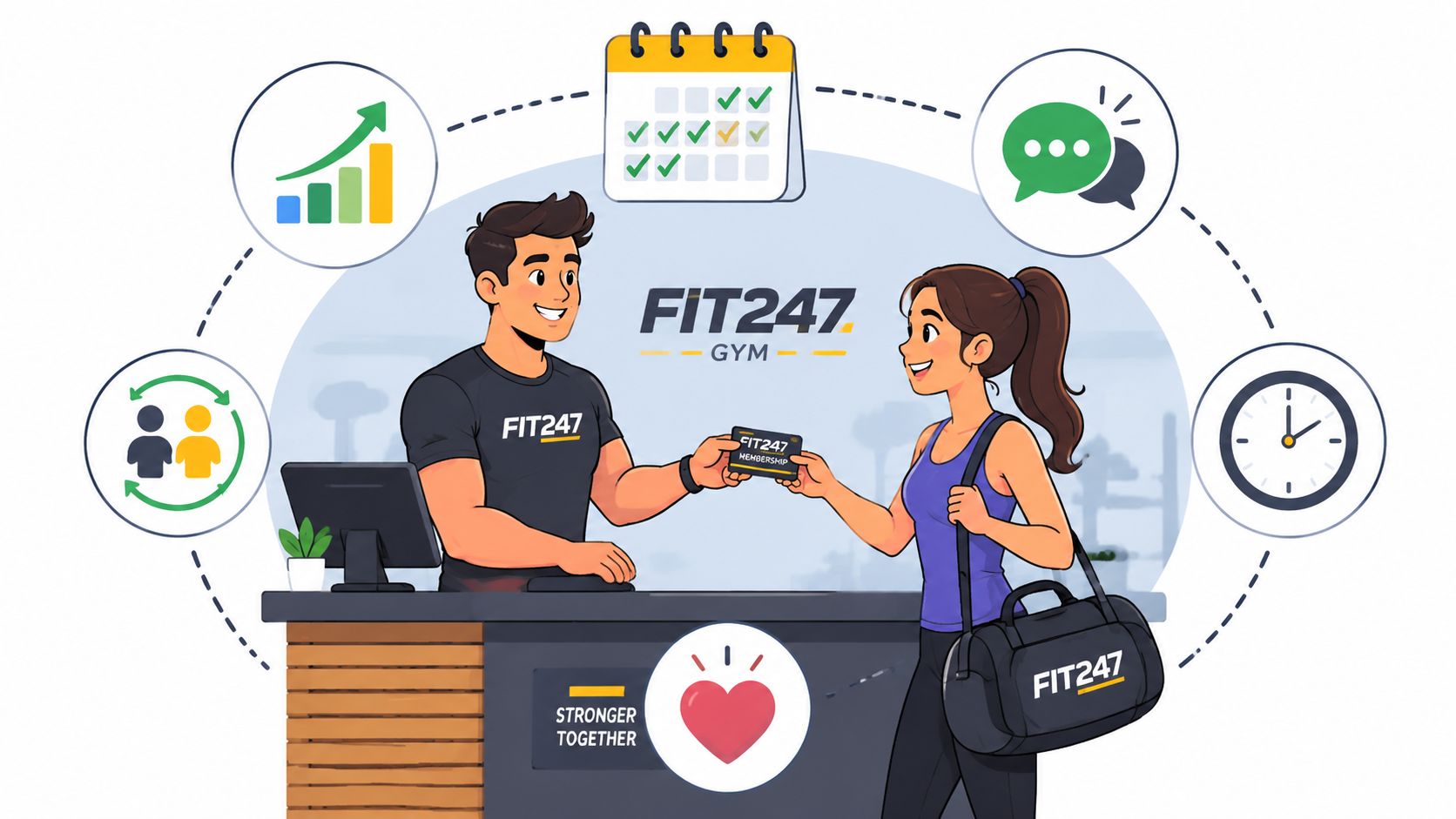
Why Member Retention Matters Now
Did you know retaining an existing gym member costs up to 80% less than acquiring a new one? In 2026, mastering membership retention strategies is your fastest path to boosting revenue, reducing churn, and building a thriving fitness community.
That headline number gets attention, but the operational reason is simpler. A member who stays is easier to serve, easier to upsell, more likely to refer friends, and far less likely to create the frantic month-end scramble that burns out your sales team. Retention gives you breathing room.
The strongest gyms don't treat retention as a rescue project. They build it into the daily floor routine, the front-desk script, the welcome flow, the class schedule, and even cleaning habits. Members notice when the club feels organized, personal, and consistently cared for.
One of the clearest early retention levers is speed. Club Retention Benchmarks 2026 says the first 7 days of membership are the primary onboarding window tied to retention gains, especially when clubs send a welcome email within 24 hours, make a personal call or video welcome, and invite the member to an event within the first 30 days. If you miss that window, you're often trying to recover a member who never really got started.
Below are 10 membership retention strategies that work in actual gyms and studios. They aren't theory. They're practical systems you can implement, train, measure, and improve.
1. Personalized Member Communication Programs
Generic blasts don't retain people. Relevant messages do.
A member who loves early-morning strength classes shouldn't get the same email as someone who only uses the yoga studio twice a week. Good communication starts with basic segmentation: visit pattern, class preference, stated goal, and inactivity signals.

What this looks like in practice
In a studio setting, I'd split members into simple groups first. New joiners, regulars, slipping regulars, class loyalists, open-gym users, and members who haven't visited in a while. That's enough to make your messages feel human without building a monster CRM project.
A practical mini case looks like this: a member who usually attends Tuesday and Thursday HIIT suddenly disappears for two weeks. Instead of sending a generic promo, the club sends a short note that references the missed routine and points to a class they normally enjoy.
We noticed you missed your usual Tuesday session. Want us to hold you a spot this week?
That kind of message works because it sounds like a coach, not a billing department.
Implementation, time, and KPI
Use this rollout:
- Week one setup: Export attendance data, define 4 to 6 segments, and write one template for each segment.
- Automation pass: Trigger messages from behavior, such as first visit, class milestone, or drop in attendance.
- Human layer: Have a coach or front-desk lead personalize replies for members who engage.
Sample SMS:
“Hey Sam, you were on a great streak last month. Want help picking two classes for this week so you can get back into rhythm?”
Track reply rate, booked visits after outreach, and the number of at-risk members contacted each week. What doesn't work is overdoing it. If every visit creates three texts and two emails, members mute you fast.
2. Community-Building Events and Member Challenges
People cancel memberships. They hesitate to leave communities.
The best gyms create reasons to show up that go beyond treadmill minutes. Team challenges, beginner-friendly events, member spotlights, charity workouts, and social mixers give people social roots inside the club. Once that happens, retention gets easier.

Where most gyms miss
They launch challenges that only appeal to top performers. That backfires. Newer members feel behind before they begin, and your so-called community event becomes a leaderboard for the same ten people.
A better version includes layered wins. Attendance streaks, team points, form-improvement badges, and partner check-ins give beginners and veterans a reason to join. If you want extra ideas, this roundup of fun gym games for engagement is useful for making challenges less repetitive.
Step by step on the floor
Run a four-week challenge with one staff owner and one simple scorecard. Keep the admin light.
- Pick a theme: Consistency, recovery, mobility, or partner accountability all work better than pure weight-loss framing.
- Build team options: Pair newer members with regulars so the event creates relationships.
- Add visible recognition: Whiteboard shout-outs, social posts, and in-club announcements keep momentum up.
Mini case: a neighborhood gym runs a “12 check-ins in 30 days” challenge with bonus points for attending one workshop and bringing a friend to community day. The strongest outcome isn't the prize. It's that members start seeing familiar faces at the same times each week.
Use challenge periods to reinforce hygiene too. Put a gym wipe dispenser near the check-in board, remind members to use wipes for gym equipment between rounds, and make cleanup part of the event culture rather than an afterthought.
3. Flexible Membership Tiers and Pause Options
Rigid memberships create unnecessary cancellations.
When life changes, members don't always want out. They often want a lighter option, a temporary break, or a way to stay connected without paying for a plan they can't use right now. If your only choices are “full rate” or “cancel,” you'll lose people you could've kept.
The smarter save conversation
High-retention studios use a specific cancellation save path. According to fitness member retention stats compiled by Regulr, the strongest win-back sequence starts with personal outreach by call or text within 24 hours of cancellation, then offers a pause instead of full cancellation, followed later by a return offer and seasonal re-engagement.
That sequence matters because it meets members where they are. A parent with a new work schedule may need a freeze, not a farewell. A member with a minor injury may want a lower-tier plan plus mobility classes.
Practical rule: Make pausing as easy as canceling. If the save option takes more effort than leaving, staff won't use it and members won't trust it.
Implementation and trade-offs
Offer a few clear pathways:
- Pause option: Best for travel, injury, schedule shifts, or short-term budget pressure.
- Downgrade tier: Good for members moving from unlimited access to fewer visits.
- Seasonal plan: Useful in college markets and vacation-heavy communities.
Mini case: a studio member says she can't justify unlimited classes during tax season. Instead of forcing a cancellation, staff moves her to a reduced-access plan and books her reactivation review for the following month. She stays attached to the brand and doesn't vanish from your system.
Measure saves from cancellation requests, paused members who return, and downgrade-to-upgrade recovery. What doesn't work is hiding the pause policy in fine print. Train staff to offer it early, not after the member has already emotionally checked out.
4. Proactive Member Engagement Metrics and Predictive Churn Prevention
Retention gets easier when you stop guessing who's about to leave.
Your floor team already sees the signs. A regular stops checking in. A class member drops from three visits a week to one. Someone who used to chat with coaches now slips in and out. Put those signals into a system.
The metric that deserves more attention
One of the most overlooked gym retention problems is the member who hasn't used the facility in 30 days but also hasn't canceled. YourMembership's retention guidance notes that 70% of inactive members who receive a personalized value-recall message within 30 days of inactivity renew their commitment, compared with 15% who only get generic renewal reminders.
That should change how your team works. Don't wait for the renewal notice. Reach out when the behavior changes.
Sample message:
“Hi Jenna, we noticed you haven't been in lately. You were building a strong routine on Tuesdays and Saturdays. If your schedule changed, we can help you find a new time that fits.”
A simple at-risk workflow
You don't need fancy software to start.
- Create a weekly report: Flag members with no check-in activity in the last 30 days.
- Send a personalized message first: Mention their usual class, trainer, or routine.
- Escalate to a human call: If there's no response, have a staff member follow up personally.
Mini case: a mid-market club reviews inactivity every Monday. One coach owns ten outreach calls before noon. Members often reveal ordinary problems such as travel, intimidation, boredom, or confusion about what to do next. Those are fixable.
Track reactivation after outreach, inactive-member count, and staff completion rate. What fails is sending generic “we miss you” emails to everyone. Members know the difference immediately.
5. Exceptional Onboarding and New Member Integration
Most retention problems start as onboarding problems.
If a new member doesn't know where to go, what to do, who to ask, or how to get an early win, they drift. Then they feel awkward. Then they stop coming. That's why this item deserves more attention than almost any clever promotion you'll run later.

The non-negotiables in the first month
Data tied to IHRSA, cited in this fitness industry trends summary, shows that 87% of members who experience a positive onboarding process remain active after 6 months. The same source also notes that two meaningful staff interactions per member per month can reduce cancellation rates by up to 33%.
That means onboarding isn't just a tour. It's a contact plan.
For a practical framework, use these customer onboarding best practices for gyms and then streamline follow-up email sequences so no new member falls through the cracks.
What to include
Your new-member flow should cover orientation, equipment basics, first-program recommendation, and one easy early success. It should also show members how your club stays clean. Point out sanitizing wipes near high-touch zones, explain when to use gym equipment wipes, and make wipe-down etiquette part of the welcome instead of an apology sign on the wall.
- Time estimate: About 20 to 30 minutes for the initial orientation, plus short follow-ups.
- Staff owner: One named coach or front-desk leader.
- KPIs: Onboarding completion, first-week visit, first-month event attendance, and coach follow-up completion.
Mini case: a new member joins because she wants accountability, not just access. The club books her first class before she leaves the desk, sends a same-day welcome email, and checks in after visit one. That's what integration looks like.
6. Personalized Goal-Setting and Progress Tracking Systems
People stay when they can see progress, even if the progress isn't dramatic.
The key is making goals personal and visible. “Get healthier” is too fuzzy. “Attend strength class twice a week for six weeks” gives the member and the coach something concrete to reinforce.
Better goals create better retention conversations
Most members don't need an elaborate performance lab. They need a baseline, a next target, and regular acknowledgment. That can be strength gains, improved mobility, better class consistency, or just feeling less intimidated in the gym.
A practical mini case: a deconditioned member says weight loss is the goal, but the coach sets an early marker around attendance consistency and confidence using free-weight stations. Within a few weeks, the member feels successful because progress is visible before body-composition changes become obvious.
Progress tracking should reduce anxiety, not create it.
A simple system your staff will actually use
Use a short review every 60 to 90 days. Keep the format consistent so staff doesn't skip it during busy weeks.
- Set one outcome goal: Such as completing a beginner lifting cycle or returning to exercise after time away.
- Set one behavior goal: For example, three visits per week or one coached class plus two solo sessions.
- Record one visible win: More energy, stronger lifts, better movement quality, improved class confidence.
Sample check-in message:
“Hey Chris, you hit your consistency target last month. Want to keep building on that with a simple upper-lower split and one recovery class each week?”
Track completed goal reviews, booked follow-up appointments, and class attendance after review conversations. What doesn't work is turning every check-in into a hard sell for personal training. Members need coaching first. Sales can follow when the trust is there.
7. Responsive Member Service Excellence and Staff Relationships
Members remember how your staff makes them feel.
They remember whether someone greeted them by name, whether a coach noticed their absence, and whether the front desk fixed a billing issue without attitude. In many clubs, that relationship layer matters more than the latest rower or lighting upgrade.
Service standards that actually retain people
Friendly culture isn't enough. Define the behaviors.
Use a standard such as greeting every entering member, acknowledging regulars by name, responding quickly to member issues, and handing off concerns to one accountable person. The clubs that do this well don't leave service quality to personality.
If you're refining that front-line approach, this guide to customer service excellence in gyms is worth reviewing with your team.
Real-world example and KPIs
Mini case: a member has a frustrating class-booking error. In a weak operation, the desk says, “You'll need to email support.” In a strong one, the desk resolves the booking, offers an alternative class if needed, and checks back later that day. Same problem. Very different retention outcome.
Use a short scorecard:
- Greeting consistency: Spot-check during peak hours.
- Issue resolution speed: Track how fast common complaints get closed.
- Member mentions: Note when members praise staff by name in reviews or surveys.
The member isn't comparing your club only to the gym across town. They're comparing you to every easy, well-run service they use each week.
What doesn't work is asking staff to “be more engaging” without training, scripts, or time. Retention behavior has to be coached just like sales behavior.
8. Strategic Pricing Psychology and Retention-Focused Rate Structures
Price matters. Surprise and confusion matter more.
A fair rate can still trigger cancellations if the billing feels sneaky, the upgrade path is muddy, or the member can't tell what they're paying for. Good pricing structure supports retention by reducing friction and protecting trust.
The danger zone sits in the middle of the year
A neglected retention window in gyms is months 4 through 8. Communal's retention guide highlights that 40% of gym members cancel between months 4 and 8 because of habit decay, and it points to proactive month-5 nudge interventions as a stronger move than waiting for renewal-time offers.
That should influence your pricing communication. If a member is losing habit momentum, a renewal discount six months later won't fix the underlying problem.
Smarter pricing moves
Use pricing as a retention tool, not just a revenue lever.
- Protect existing members: Give clear advance notice before rate changes and explain added value plainly.
- Reward commitment: Locked-in rates or loyalty perks help long-term members feel recognized.
- Offer a softer landing: If cost pressure appears, provide a lower tier or pause instead of forcing cancellation.
Mini case: a member starts questioning value around month five because attendance dropped. The club doesn't lead with a discount. Staff first reconnects the member to a fitting class schedule, then offers a lower-frequency tier if budget is part of the issue. That sequence respects both value and margin.
What doesn't work is relying on endless promotions. Cheap wins can attract the wrong expectations and train members to negotiate every renewal.
9. Exit Experience and Winback Campaign Strategy
A cancellation isn't the end of the relationship unless you make it one.
Some members leave because of money. Some because of schedule changes. Some because they lost momentum and feel embarrassed. If your exit process is cold or defensive, you erase any chance of a return.
Make the off-ramp useful
Train staff to ask calm, practical questions. Why now? Is this temporary? Would a pause help? Is there a class-time issue, a confidence issue, or a billing issue? The goal isn't to trap the member. It's to offer the right alternative before the account disappears.
A realistic mini case: a member cancels after inconsistent attendance. The desk thanks them, offers a pause, and sends a text the next day with one low-pressure option to stay connected. If they still leave, the club tags the reason and schedules a later follow-up.
A winback sequence that feels personal
Strong winback campaigns don't sound like blasts from marketing. They reference the member's history and remove re-entry friction.
Use a sequence like this:
- Right after cancellation: Personal call or text, not a generic email, while the reason is still fresh.
- After some time away: Offer a return path tied to the member's original behavior, such as a favorite class or coach.
- Seasonal re-engagement: Reach out when routines naturally reset, such as after holidays or back-to-school periods.
Sample text:
“Hi Alex, sorry to see you go. If your schedule was the issue, we can pause instead and restart when things settle. Happy to help if that would make things easier.”
Track cancellation saves, return rate from past members, and top exit reasons. What doesn't work is punishing departing members with friction or guilt. That might protect ego, but it destroys future revenue.
10. Enhanced Programming Variety and Regular Class Service Innovation
Stale programming prompts members to leave.
You don't need to reinvent the gym every month. You do need members to feel that the club is alive, improving, and paying attention to what keeps training interesting. Freshness matters, especially for members who already beat the onboarding phase and need a reason to stay engaged.
Innovation doesn't have to be expensive
The easiest wins usually come from format tweaks, themed training blocks, skills workshops, and limited-run class series. A studio can add a recovery clinic, foundations series, or hybrid strength-cardio block without buying a room full of new equipment.
Mini case: a club notices its regular schedule feels repetitive by late summer. It adds a six-week “learn the free weights” series, a mobility workshop on Saturdays, and a short seasonal partner challenge. The change gives existing members something new to talk about and lowers intimidation for newer ones.
Keep the core, rotate the edge
Members still want dependable favorites. Innovation should sit beside consistency, not replace it.
- Refresh quarterly: Review schedule gaps, instructor energy, and member requests.
- Pilot before expanding: Test one new format in a peak slot and one in an off-peak slot.
- Gather feedback fast: Front-desk comments and coach notes are often enough to tell if a format deserves another run.
Programming refreshes are also a good time to tighten cleanliness standards. Add yoga mat wipes in studio rooms, place workout wipes near functional training zones, and restock fitness center wipes before launching new classes so the space feels cared for from day one.
Top 10 Membership Retention Strategies Comparison
| Strategy | Implementation complexity | Resource requirements | Expected outcomes | Ideal use cases | Key advantages |
|---|---|---|---|---|---|
| Personalized Member Communication Programs | Medium–High (CRM + automation) | CRM/automation, data, content creation, staff time | Higher engagement; ~25–30% retention lift | Gyms with member data and segmentation needs | Targeted outreach; improved ROI; personalization |
| Community-Building Events and Member Challenges | Medium (event coordination) | Staff time, event budget, prizes, scheduling | Stronger loyalty; increased visits and referrals | Facilities seeking community differentiation | Emotional bonds; organic referrals; higher utilization |
| Flexible Membership Tiers and Pause Options | Medium (billing & policy changes) | Advanced billing, admin processes, policy design | Converts cancellations to pauses; high reactivation rates | Price-sensitive members; seasonal or transitional users | Reduces churn; preserves long-term relationships |
| Proactive Member Engagement Metrics & Predictive Churn Prevention | High (analytics & integrations) | Analytics platform, reliable check-ins, trained staff | Proactive interventions; 15–25% retention improvement | Data-driven, multi-location operators | Early risk detection; prioritized retention actions |
| Exceptional Onboarding & New Member Integration | Medium (process + staffing) | Staff time, onboarding materials, scheduling | Strong early retention; 30–50%+ improved early retention | New-member heavy gyms; high-touch models | Faster engagement; fewer injuries; lasting relationships |
| Personalized Goal-Setting & Progress Tracking Systems | Medium–High (tech + coaching) | Apps/wearables, coaching time, tracking systems | Higher motivation; 3–4x retention for goal-oriented members | Members focused on measurable results | Accountability; objective ROI; upsell pathways |
| Responsive Member Service Excellence & Staff Relationships | Medium (hiring & training) | Ongoing staff training, recognition systems, time | Lower churn; ~20–35% cancellation reduction | Premium or community-centric gyms | Hard-to-replicate advantage; stronger NPS/referrals |
| Strategic Pricing Psychology & Retention-Focused Rate Structures | Medium (pricing design & comms) | Pricing analytics, communication plans, policy tools | Improved loyalty; fewer surprise-driven cancellations | Markets sensitive to price and fees | Builds trust; rewards loyalty; stabilizes LTV |
| Exit Experience & Winback Campaign Strategy | Low–Medium (process + campaigns) | Email platform, staff training, incentives, analytics | Retains ~10–15% at exit; reactivates 15–30% lapsed | Gyms with notable cancellations or churn spikes | Recover lapsed members; gather actionable feedback |
| Enhanced Programming Variety & Regular Class/Service Innovation | Medium (planning & training) | Instructor education, scheduling, equipment/investment | Increased engagement; ~20%+ higher satisfaction | Facilities suffering stagnation or churn from boredom | Keeps experience fresh; drives upsells and excitement |
Next Steps to Lock In Your Members
Ready to put these membership retention strategies into action? Start with the one that's easiest to install this week, not the one that looks best in a strategy deck. In most gyms, that means fixing one daily habit first: a better welcome sequence, a 30-day inactivity report, a cancellation save script, or a cleaner follow-up system for coaches.
If your operation is leaking members, don't try to solve everything at once. Pick a narrow retention lane and own it for 30 days. For example, assign one staff member to call every new joiner within the first day, or require every coach to reconnect with inactive members before the week ends. Small systems beat big intentions.
A practical rollout might look like this. Week one, tighten onboarding. Week two, segment inactive members and send personalized value-recall outreach. Week three, formalize pause options and cancellation saves. Week four, review what happened and decide what to standardize.
Keep the trade-offs in view. More personalization means more staff time unless you automate the first touch. More flexibility in pricing can save members, but it can also create confusion if your plans multiply. More events can build community, but only if someone owns execution and follow-through. Retention work pays off when it's consistent, not when it's flashy.
Your KPIs should stay simple at first. Track onboarding completion, inactive-member outreach, saved cancellations, returned paused members, and attendance after a staff touchpoint. If your team can't explain the number and act on it quickly, it probably isn't helping yet.
Hygiene matters more than many operators admit. Members connect cleanliness with professionalism, safety, and care. When your club has stocked wipe stations, clean benches, and visible reset habits between users, it reinforces the same message as your retention systems: this place is well run. If you need to upgrade supplies, stock gym equipment wipes or commercial disinfecting wipes from Wipes.com where members use them, not just where purchasing finds shelf space easiest.
A few practical cleaning habits help retention more than operators think:
- Restock visible stations: Put bulk gym wipes near cardio, strength, and studio zones so members don't have to hunt for them.
- Match wipes to surfaces: Use wipes to disinfect gym equipment on high-touch handles and use yoga mat wipes where floor classes happen.
- Choose the right products: If your team needs compliance-focused products, look at EPA registered disinfecting wipes and train staff on proper use times.
- Support convenience: A wall-mounted gym wipe dispenser near exits and training areas drives better member participation than a single hidden container at the desk.
The clubs that keep members longest usually do ordinary things better than everyone else. They welcome fast, notice drop-off early, offer flexible saves, refresh programming, and keep the place clean. That's the formula. Not glamorous, but effective.
Leave a Reply