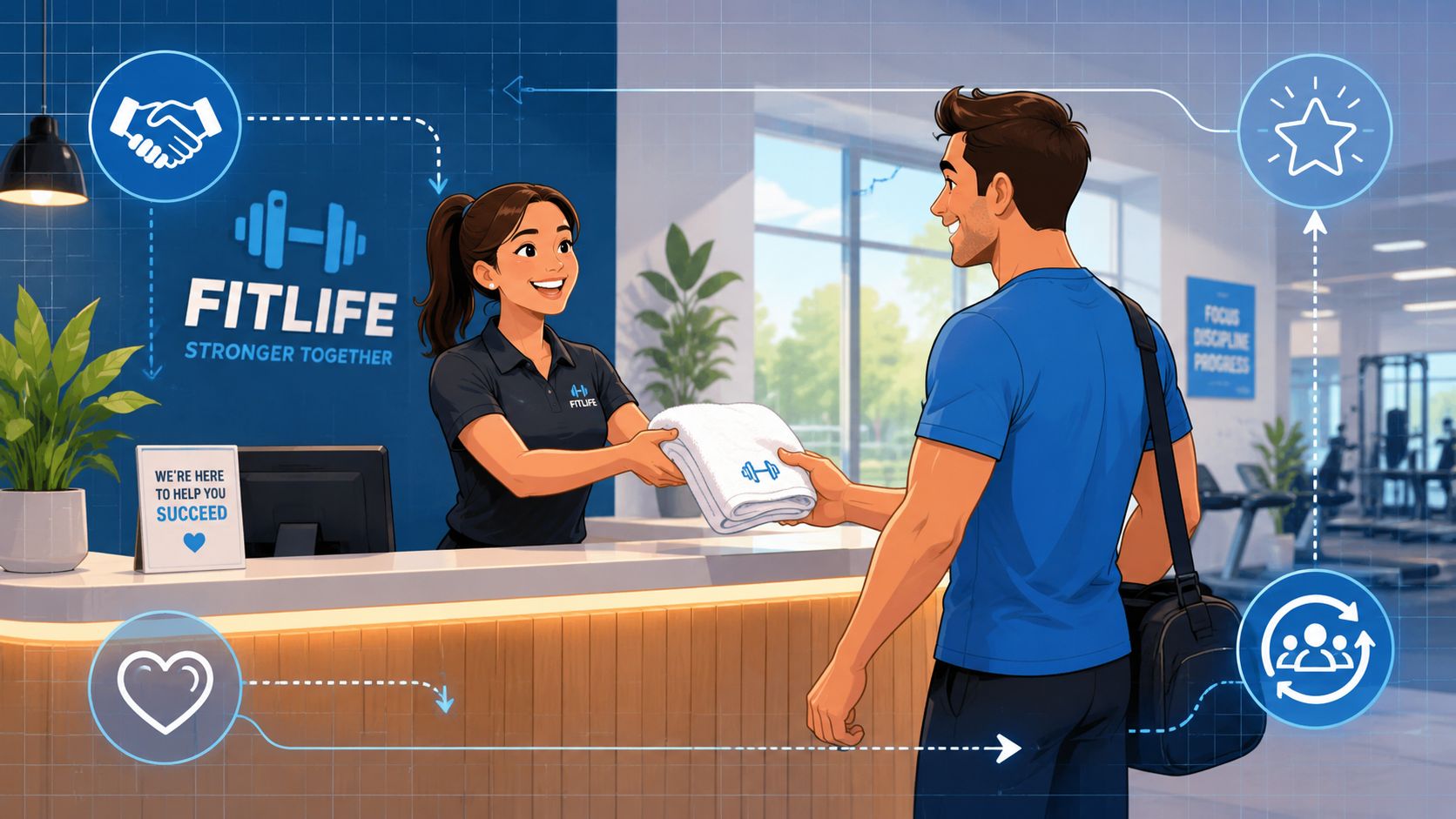
A lot of gym owners think they have a sales problem when they really have a service problem.
You've seen it. A prospect walks in, stands at the front desk while two staff members finish a side conversation, signs up anyway because the location is convenient, then disappears after a few weeks. On paper, you got the membership. In reality, you rented trust for a month.
The opposite happens just as often. A new member walks in nervous, gets greeted by name on the second visit, has a trainer point them to the right rack before they have to ask, sees the studio reset quickly between classes, and feels like they belong. That member stays longer, buys more, and talks about your gym like it matters.
That difference is customer service excellence in a gym. It isn't fluff. It's one of the clearest drivers of retention, referrals, and revenue you control inside your four walls.
The First Impression and The Lasting Impact
A member's judgment starts before the workout starts.
They notice whether the front desk looks up. They notice whether someone explains where to put their bag, how to book classes, and what to wipe down after use. They notice whether your team acts like they expected them or merely tolerated them.

I've worked with clubs that spent heavily on equipment upgrades while ignoring the welcome experience. The result was predictable. New join volume looked decent, but the mood on the floor felt cold, complaints stacked up around little things, and staff kept saying members were “just price sensitive.” They weren't. They were experience sensitive.
What members feel in the first five minutes
In a gym, first impressions come from small operational habits:
- Eye contact at entry: A quick acknowledgment beats a polished script delivered late.
- Clear direction: New members need to know where lockers, studios, restrooms, and sanitizer stations are.
- Visible floor support: If no one approaches a confused member, your service promise already feels weak.
- Order and cleanliness: A tidy check-in area signals discipline everywhere else.
If your onboarding is loose, tighten it fast. A simple, repeatable intake process makes a bigger difference than another discount campaign. This guide on customer onboarding best practices is worth reviewing with your front desk lead.
Why the welcome experience has hard-dollar value
Great service changes spending behavior. Customers with a positive service experience are likely to spend 140% more than those with a negative experience, according to customer experience statistics summarized by Wavetec. In a gym, that shows up in longer stays, stronger PT uptake, smoother renewals, and less resistance when you recommend the right add-on.
Practical rule: If the first visit feels awkward, every later upsell gets harder.
The gym owner's mistake is treating service as attitude instead of system. Smiling helps. Systems keep the smile from disappearing on a busy Tuesday at 6 p.m.
You don't need a luxury facility to create a premium first impression. You need fast greetings, clean zones, confident staff, and a handoff process that doesn't leave new members wandering around your club like they entered the wrong building.
What Gym Service Excellence Actually Means
In most gyms, service gets defined too loosely. Staff hear “be friendly” and interpret it ten different ways.
That's why weak clubs swing between two bad extremes. One team becomes passive and waits to be asked. Another team becomes pushy and mistakes pressure for attentiveness. Neither creates loyalty.
The gym isn't just a facility
For many members, your gym is a third place. It sits between home and work. They come there to improve themselves, regulate stress, rebuild confidence, or find routine. If your service model ignores that emotional context, you'll miss what members value.
Customer service excellence in a gym means your team consistently removes friction, builds familiarity, and solves problems before they become reasons to quit.
I break it into four practical pillars.
Proactive assistance
The best gym teams don't lurk behind the desk. They move.
A staff member sees a new member adjusting a bench incorrectly and steps in. A trainer notices someone searching for attachments and points them to the cable area. A group fitness instructor spots a first-timer before class starts and gives them a quick orientation.
Gym friction is often silent; members won't always complain. They'll just stop showing up.
Personalized recognition
People don't expect miracles. They expect to feel known.
Use names. Remember preferences. Note injuries, favorite class formats, or the fact that a member prefers morning sessions and quieter zones. This isn't overcomplication. It's memory supported by process.
A simple member note in your CRM can help staff avoid generic interactions like, “Can I help you?” and replace them with specific ones like, “Your mobility class starts in ten minutes. Want me to show you where the foam rollers were moved?”
A gym that remembers people feels safer than a gym that only remembers billing dates.
Consistent experience
Members shouldn't get one standard on Monday and another on Saturday.
Consistency means your opening shift, closing shift, part-time trainer, and weekend desk associate all follow the same basic service habits. The greeting is consistent. The floor checks are consistent. Equipment resets are consistent. Complaint handling is consistent.
Here's where many operators slip. They hire good people, then leave too much to personality. Personality helps. It doesn't replace standards.
Empowered problem-solving
Your staff has to be able to fix common issues without creating a chain of delays.
If a member has trouble with class booking, can the desk solve it immediately? If a locker issue comes up, does staff know the process? If a treadmill goes down mid-session, can someone respond with options instead of excuses?
A simple way to test your gym is to ask this question: when something goes wrong, does the member hear “let me take care of that” or “that's not my department”?
The first answer keeps members. The second trains them to disengage.
The Real ROI of Raving Fans and Member Loyalty
Retention isn't built by contracts. It's built by repeated proof that joining your gym was a smart decision.
That proof shows up in dozens of moments. A billing issue gets handled cleanly. A class waitlist is explained clearly. A trainer follows up after a tough first session. A member who had a bad interaction gets a fast reset instead of a defensive response.

The business case gets stronger when something goes wrong, because mistakes are unavoidable in a busy gym. Schedules change. Equipment fails. Staff miss details. What matters is your recovery speed and tone. If a company's customer service is excellent, 78% of consumers will do business with them again after a mistake, according to Help Scout's summary of Salesforce Research.
Why this matters more in a membership business
A gym doesn't win on one transaction. We win on months and years of continued attendance.
That changes the math. Every preventable cancellation hurts more than most owners admit because the loss isn't just next month's dues. It's lost personal training, lost referrals, lost secondary purchases, and the cost of replacing that member through marketing and sales effort.
When owners ask me where to put budget first, I usually look at these areas before another ad push:
- Front desk training: Poor check-in habits subtly increase churn.
- Complaint recovery: Fast, calm service saves memberships that would otherwise vanish.
- Follow-up discipline: Missed callbacks make your gym look disorganized.
- Member recognition: Familiarity turns routine attendance into belonging.
Service recovery protects revenue
A strong recovery process should be written down, trained, and reviewed. If it isn't, your team will improvise under pressure, and individuals often improvise poorly when a member is upset.
Use a simple progression:
- Acknowledge the issue
- Take ownership
- Offer the next step immediately
- Follow up after the fix
If your team needs a better reset process after service failures, review these service recovery strategies for gyms.
Members don't expect perfection. They expect professionalism when perfection fails.
The upside of getting this right is huge. Loyal members market the gym for you in ways paid ads can't match. They bring friends. They defend your reputation when someone posts a cheap complaint online. They stay through minor inconveniences because the overall relationship feels solid.
That's the ROI of service. It doesn't just reduce churn. It makes every other growth channel work better.
Building Your Service Frameworks Step by Step
Good intentions don't scale. Frameworks do.
When a gym says, “We want better service,” but has no standards, no map of the member experience, and no written response process, the team falls back on memory and mood. That creates uneven service fast.

Framework one: service standards
Start with core standards. Keep them short enough that staff can remember them on a busy floor.
For most gyms, that list should cover:
- Greeting standard: Every entering member gets acknowledged promptly.
- Floor standard: Staff circulates instead of staying rooted behind the desk.
- Cleanliness standard: Equipment resets and studio checks happen visibly.
- Problem ownership standard: The first employee who receives the complaint owns the handoff until it's resolved.
Write these in plain language. Don't bury them in a manual no one opens.
Framework two: the member journey map
Here, many operators get sharper fast.
Map the full member path from first inquiry to long-term renewal. Include the website lead, phone call, walk-in, tour, sign-up, first visit, first class, first billing cycle, first missed week, upgrade conversation, freeze request, and cancellation risk points.
You need this because satisfaction scores alone can mislead you. Emerging trends emphasize using customer journey analytics to assess service impact, as 68% of customers who report a “neutral” experience churn within six months, according to EHL Insights on service excellence benefits. In gym terms, “fine” isn't safe. “Fine” often means forgettable.
A practical journey map should answer three questions at each touchpoint:
| Touchpoint | What the member needs | What your team must do |
|---|---|---|
| Inquiry | Fast clarity | Respond clearly and invite the visit |
| First visit | Confidence | Welcome, orient, reduce intimidation |
| Early usage | Momentum | Follow up before habits fade |
| Service issue | Reassurance | Fix fast and communicate clearly |
Framework three: SOPs for repeat situations
Standard operating procedures sound corporate. In a gym, they save time and protect the brand.
Build SOPs for recurring scenarios such as:
- missed class bookings
- billing confusion
- broken equipment reports
- locker complaints
- first-time tour handoffs
- trainer no-shows
- member freeze requests
Each SOP should state who handles it, what gets said, what gets logged, and when follow-up happens. If you want a model for organizing support workflows and member help materials, Vanta Sports' user resources show the kind of structured support environment many gyms can learn from.
Field note: The best SOP is the one a tired employee can still follow correctly at closing time.
Don't overbuild this. One page per scenario is usually enough. The goal isn't bureaucracy. The goal is repeatable execution under pressure.
Training Your Team From Staff to Service Champions
A service standard that lives on paper dies on the floor unless your team practices it.
Training in gyms often focuses on compliance, sales scripts, and equipment basics. Those matter. But if staff doesn't know how to greet, guide, reassure, and recover in live member situations, your service quality will depend too much on who happened to be scheduled.
Role-play the moments that cost you members
Start with the front desk. They control the emotional tone of the building.
Use short scripts and repeat them until they sound natural.
New member arrival
- “Welcome in. Glad you're here.”
- “Is this your first workout with us?”
- “Let me show you the locker rooms, studio schedule, and where to find cleaning stations.”
Confused member on the floor
- “You look like you're trying to find something. What do you need?”
- “I can walk you there.”
Complaint about a class being full
- “I get why that's frustrating.”
- “Let's look at your options right now so you don't leave without a plan.”
Then train your coaches and trainers differently. They need service language that supports expertise without sounding salesy.
Trainer check-in before a session
- “How's your energy today, and is anything tight or bothering you before we start?”
Trainer supporting a newer member
- “You're in the right place. Let's make this simple and get you comfortable with the setup.”
Build a feedback loop from the floor up
Most gym owners ask members for feedback and forget the people who hear member frustrations all day.
That's a mistake. Research shows 76% of employees feel their ideas are ignored, according to Lime Technologies' article on customer excellence. In a gym, that's costly because front desk staff, trainers, and instructors spot the friction long before management sees it on a report.
Use a weekly routine:
- Ask one operational question: “What annoyed members most this week?”
- Ask one service question: “Where did we create unnecessary confusion?”
- Ask one improvement question: “What change would make your shift easier and member experience smoother?”
Log the answers. Then act on some of them fast. If staff keeps talking and nothing changes, the loop dies.
Coach for empathy without losing pace
Empathy matters in fitness because members often arrive stressed, embarrassed, injured, or intimidated. But empathy without action feels hollow.
That's why I like training that pairs tone with execution. This piece on Scaling empathy in customer service is useful for managers who want staff to sound human while still moving toward a solution.
Don't train your team to apologize beautifully and solve slowly. Train them to understand fast and act faster.
The best gyms build service champions by doing three things well: they practice common scenarios, they let employees surface patterns, and they praise specific service behaviors in public. Not vague praise like “great job today.” Specific praise like “you caught that new member before she got lost in the free weight area, and that's exactly the standard.”
That's how culture sticks.
Measuring What Matters KPIs for Service Excellence
A member walks to the desk after class with a billing question. Your staff member is polite, but the answer is unclear, the follow-up never happens, and by Friday that member is telling friends your gym is disorganized. You will see the cancellation later. The service failure happened earlier.
That is why service needs its own scoreboard inside a gym. If you only track joins, EFT, and cancels, you are reviewing lagging results. Good service metrics show where trust breaks before retention drops.
The KPIs that matter most
Start with three measures and review them every week.
Net Promoter Score (NPS) tracks loyalty and referral strength. It measures how willing members are to recommend your gym after enough time to judge the experience fairly. Customer Contact Week Digital's explanation of NPS covers the calculation and why promoters, passives, and detractors matter.
Customer Satisfaction (CSAT) tracks a specific interaction. In a gym, that could be a freeze request, a tour, a class booking problem, or a maintenance complaint. Zendesk's customer service metrics guide explains both CSAT and First Contact Resolution, with CSAT often used to judge whether a team handled an issue well and FCR used to judge whether they solved it on the first try.
First Contact Resolution (FCR) shows whether the member had to chase you. This matters more in gyms than many owners realize. A member who has to ask twice about billing, locker access, or a broken shower starts to assume every future issue will also take two tries.
Key Service Excellence KPIs for Gyms
| KPI | What It Measures | Gym Industry Target |
|---|---|---|
| NPS | Member loyalty and willingness to recommend | Strong upward trend and healthy promoter share |
| CSAT | Satisfaction with a specific service interaction | Consistently high scores after key interactions |
| FCR | Issues solved on first contact | Majority of issues resolved without repeat follow-up |
What good measurement looks like in a gym
Tie each metric to a real touchpoint in the club.
Use NPS after onboarding, at the sixty- or ninety-day mark, and periodically for long-term members. Use CSAT right after support moments, not in a giant monthly survey nobody wants to finish. Track FCR by issue type so you can see whether front desk questions, trainer handoffs, or class booking problems are getting resolved cleanly.
The setup matters. If your systems make staff bounce between email, paper notes, and a membership platform that does not log service history, your numbers will stay muddy. If you are cleaning that up, this guide to CRM software for gyms that supports service tracking is a practical place to start.
One more metric deserves a spot on the board. Backlog age. Doug Bryan's discussion of customer service metrics points to case closure speed as a service health signal. In a gym, old issues get expensive fast. A delayed refund, a membership hold that was never processed, or a maintenance complaint left sitting for days creates friction that staff then have to repair face to face.
Measurement rule: Track a small set of service KPIs, review them weekly, and assign each one to a named owner.
The goal is not prettier reporting. The goal is fewer unresolved issues, faster recovery when something goes wrong, and a member experience that feels organized from the front desk to the weight floor to the studio door.
Your Roadmap to Excellence and a Cleaner Gym
Most gyms don't need a total reinvention. They need a disciplined ninety-day reset.
Start with a simple sequence. In the first month, audit the current experience. Walk in as if you're a nervous first-time member. Call the front desk. Submit a website inquiry. Watch how long it takes someone to greet a person who looks lost on the floor. Ask staff where service breaks down most often.

A practical ninety-day rollout
In days 1 through 30, define the basics:
- Set standards: Greeting, floor coverage, issue ownership, and follow-up.
- Map friction: Identify where members get confused, delayed, or ignored.
- Choose KPIs: Keep it to NPS, CSAT, FCR, and backlog review.
In days 31 through 60, train and install:
- Practice scripts: Front desk, trainers, and class instructors should rehearse real situations.
- Launch SOPs: Start with complaints, tours, billing issues, and booking errors.
- Fix visible gaps: Broken signage, poor desk coverage, and unclear communication should be corrected fast.
In days 61 through 90, refine:
- Review weekly: Look at feedback, cancellations, and service bottlenecks.
- Reward behavior: Recognize staff who model the standard.
- Tighten the environment: Make cleanliness part of the service promise, not a side task.
Cleanliness is customer service
A clean gym tells members you respect their health, time, and training experience.
That means keeping wipes for gym equipment within easy reach, not hidden behind the desk. It means using reliable disinfecting wipes in a visible routine that members can trust. It means choosing gym wipes or fitness wipes that staff and members will readily use because they're accessible, durable, and stocked consistently.
For larger facilities, a well-placed gym wipe dispenser near high-touch zones can do more than improve hygiene. It can reduce excuses, speed up equipment resets, and reinforce standards without staff having to chase every member. If you're sourcing supplies, Wipes.com disinfecting wipes and gym cleaning products are worth reviewing, especially if you need bulk gym wipes, commercial disinfecting wipes, or EPA registered disinfecting wipes for a busier operation.
A few finishing details matter more than owners think:
- Stock gym equipment cleaning wipes near cardio, selectorized machines, and stretch zones.
- Offer yoga mat wipes in studio areas where shared surfaces can turn into a complaint source.
- Use sanitizing wipes and antibacterial wipes in staff-led reset routines between peak usage windows.
- Keep soft but durable gym towel wipes or workout wipes available where they fit your setup and member expectations.
The member who sees a clean bench, a stocked wipe station, and a staff team that notices details assumes the rest of your business is run with the same care.
That assumption helps retention.
If you're ready to tighten both sales and service systems, Gym Membership Tips has practical guides for gym owners who want stronger onboarding, better retention, and a smoother member experience without guesswork.
Leave a Reply