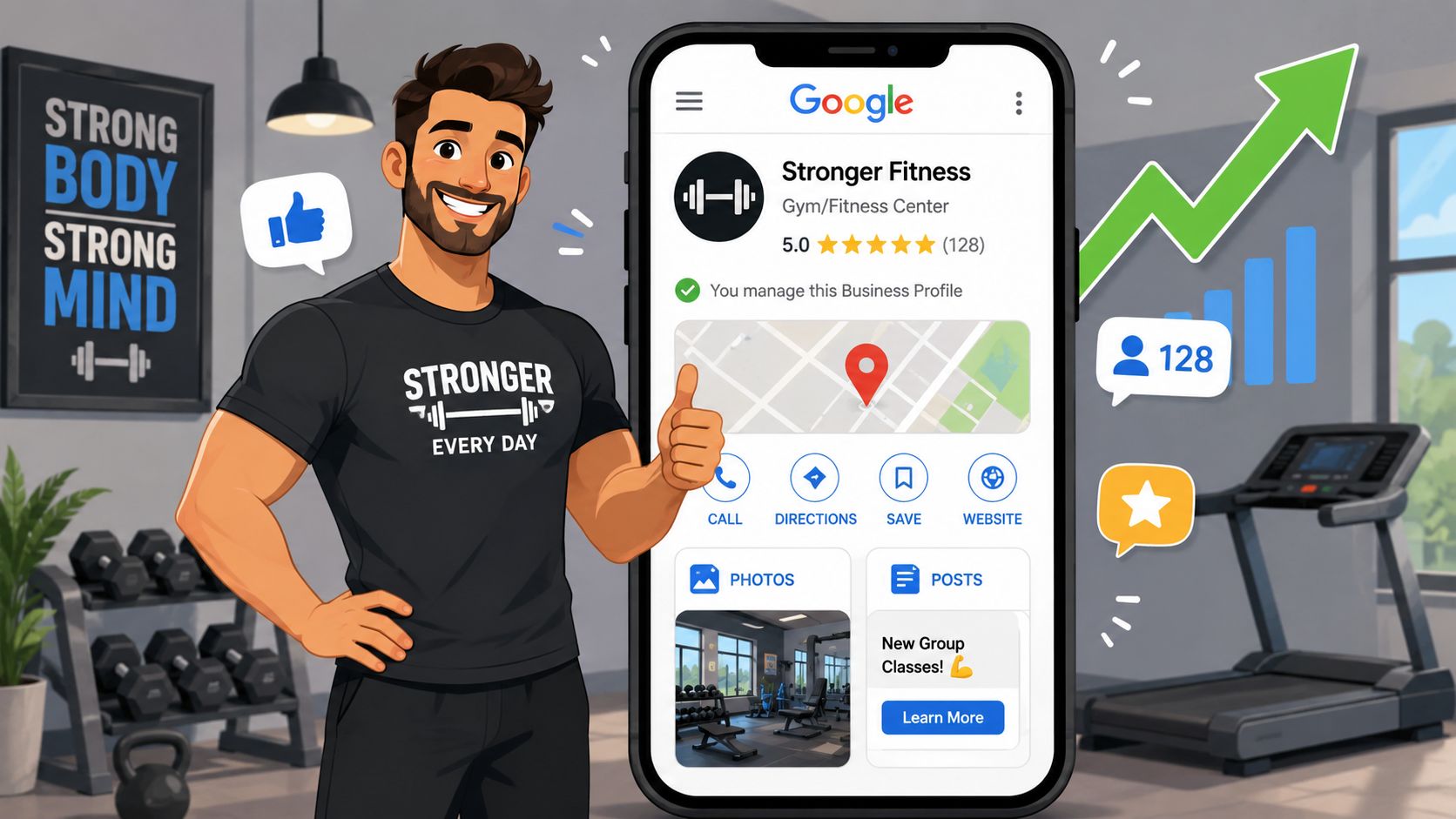
A lot of gym owners are in the same spot right now. The facility looks strong, the coaching is solid, the members who do join tend to stay, but local prospects still aren't finding the business fast enough. Search your gym category in your own city and you'll usually see the problem immediately. Competitors with a more active Google presence show up first, get the calls, and book the tours.
That's why Google Business Profile optimization deserves more attention than almost any other free marketing task you can do. This profile often becomes your first sales conversation with a prospect. Before they ever tour your space, they're judging your photos, hours, reviews, offers, and whether basic questions are answered.
For local businesses in 2026, a fully optimized profile is a meaningful traffic source. Verified Google Business profiles average about 200 monthly clicks according to Search Endurance's Google Business Profile statistics roundup. For a gym, those clicks can become calls, direction requests, trial passes, and membership appointments if the profile is built to convert, not just to exist.
From Empty Classes to a Full House
A new gym owner usually starts by focusing on the visible stuff. Flooring. Equipment. Branding. Staffing. Class schedules. Those things matter, but they don't solve a visibility problem by themselves. If someone nearby searches for a gym, yoga studio, or personal trainer and your profile looks incomplete, that prospect may never make it to your website.
I've seen this play out in a familiar pattern. A gym has great coaching, a clean space, and a real community, but the Google Business Profile has a vague category, a few old photos, no recent posts, and a Q&A section that's empty. Meanwhile, the gym across town looks active. It answers reviews, shows real members in classes, and makes it easy to understand pricing options and what to expect on day one.
That second gym wins the click more often because its profile reduces uncertainty.
Why this profile matters so much for gyms
Fitness is a local, trust-heavy sale. People aren't only comparing price. They're asking themselves whether they'll fit in, whether the gym is clean, whether the schedule works, and whether the joining process feels awkward or simple.
A strong Google Business Profile helps answer those questions before a staff member ever gets involved. It also catches people at the exact moment they're ready to act. Local search traffic is high intent. These aren't cold prospects scrolling for entertainment. They're looking for a place to train.
Practical rule: Treat your Google Business Profile like a front desk rep who works all day, every day. If it looks neglected, prospects assume the business feels neglected too.
What gym owners get wrong
The biggest mistake is treating the profile as a directory listing. It's not just a digital business card. It's a conversion asset.
What works:
- Clear positioning: Your category, description, and services reflect what you sell.
- Fresh activity: New photos, current offers, and visible engagement make the gym feel alive.
- Low-friction answers: People can quickly find details about price, policies, classes, and amenities.
What doesn't work:
- Set-it-and-forget-it management
- Stock images that could belong to any gym
- A profile that sends people to call for every small question
If your classes feel emptier than they should, start here. A sharper profile won't fix a weak business model, but it will remove a lot of avoidable leakage in the local buying journey.
Laying the Foundation for Local Dominance
The foundation is simple, but gym owners still get it wrong. If your core business information is inconsistent or vague, everything else gets harder. Google needs confidence in who you are, where you are, and what kind of gym you run.

Match your NAP exactly
Your Name, Address, and Phone number need to match your website exactly. Not mostly. Exactly.
PushPress notes that gyms should start by ensuring NAP matches the website, then choose the most specific primary category and add up to 9 secondary categories. It also reports that using secondary categories strategically can increase profile clicks by 25% compared to single-category profiles in its gym SEO guidance from PushPress.
That means if your website says “Suite 200” and your profile says “Ste 200,” or if your brand name appears differently across key places online, you're creating unnecessary confusion. Clean consistency beats creative formatting.
Choose categories like a buyer, not like an owner
A lot of gym operators default to broad labels because they think broader means more reach. Usually, it just means less relevance.
If you run a CrossFit facility, choose CrossFit Gym as the primary category instead of generic Gym. If your core offer is hot yoga, Yoga Studio is stronger than trying to look like everything to everyone. Google Business Profile allows one primary category and up to 9 relevant subcategories, and the primary category carries the most weight for local visibility, as outlined in Haley Marketing's Google Business Profile optimization guide.
Here's a practical way to approach this:
| Business model | Better primary category | Useful secondary categories |
|---|---|---|
| Strength facility | CrossFit Gym | Personal Trainer, Fitness Center |
| Boutique yoga brand | Yoga Studio | Fitness Center, Meditation Center |
| Personal training studio | Personal Trainer | Gym, Fitness Center |
| Full-service club | Gym | Personal Trainer, Fitness Center |
Fill service details with buyer intent in mind
Your services section should reflect how prospects search and evaluate. Don't write for yourself. Write for the person deciding between three nearby options.
Use service entries for things like:
- Personal training
- Small group training
- Youth training
- Open gym access
- Recovery or mobility sessions
Each one helps a prospect understand whether your gym fits their goals.
A complete local profile doesn't just improve discovery. It improves the quality of the click because the right prospect knows they're in the right place.
If you want the website side of this to support the profile properly, this guide on SEO for fitness businesses is worth reviewing alongside your profile setup.
Creating a Visual Showcase That Sells
Photos don't decorate your profile. They do sales work.
People join gyms they can picture themselves using. That's why polished but generic brand photography often underperforms authentic images from the actual facility. Prospects want proof, not perfection. They want to see what your front desk looks like, how crowded classes feel, whether your equipment is modern, and whether the environment looks clean and welcoming.

Show the experience, not just the machines
A rack of dumbbells doesn't explain your gym. A photo of a coach correcting form during a small group session says much more. The same goes for a smiling front-desk welcome, a beginner-friendly class moment, or a bright, organized locker area.
The strongest gym photo libraries usually include a mix of:
- Exterior shots so first-time visitors can find the building
- Interior walkthrough-style images that reduce first-visit anxiety
- Coaching moments that show guidance and professionalism
- Community shots that communicate energy and belonging
- Cleanliness cues like tidy training zones, fresh mats, and organized equipment
Fresh visuals signal an active business
When owners ask what to upload, I tell them to stop thinking in terms of one big photo session per year. Add new images on a regular basis. The profile should look maintained, not abandoned.
That means rotating in current photos of:
- a new class launch
- seasonal events
- updated equipment
- member milestones
- trainer spotlights
Authenticity matters more than overproduced editing. Good lighting and clear framing help, but the biggest win is relevance. If your gym looks today the way your profile looked a year ago, local prospects will feel that stagnation.
Borrow visual standards from other high-trust industries
Real estate marketers understand this well because buyers decide fast when the visuals are weak. Pinnacle's tips for quick property sales from Pinnacle Property Media are a useful reminder that strong photography reduces hesitation and helps people imagine themselves in the space. Gyms benefit from the same principle.
Your photo library should answer one quiet question for every prospect. “Will I feel comfortable walking in here?”
One more point that gym owners miss. Cleanliness shows up visually. If benches look smudged, mirrors are streaked, or mats look tired, that sends the wrong signal before a lead ever visits. Keep photos current, and make sure the room looks as sharp as your branding.
Engaging Your Community with Posts and Offers
An optimized profile still needs movement. That's where Google Posts come in.
A lot of gym owners either ignore posts completely or use them like a random social feed. Neither approach works well. Posts should support conversions. They should answer “why visit now?” and “what's happening here?” in a way that feels timely and useful.
There's good reason to keep this habit going. Gyms with weekly posts and active review management achieve a 35% higher conversion rate for in-person visits compared to inactive profiles, based on benchmark data shared in this local SEO discussion on Reddit.
What to post if you want memberships
Use your profile like a micro-campaign board. Keep the message local, direct, and tied to an action.
Good examples for gyms:
- Offer posts: Free first class, limited-time enrollment specials, personal training intro packages
- Event posts: Open house weekends, charity workouts, mobility workshops, member appreciation events
- What's new posts: New coach announcement, added class times, upgraded equipment, recovery services
A simple posting rhythm
You don't need complicated production. You need consistency and relevance.
Try a weekly rhythm like this:
- Week one: Promote a trial or offer
- Week two: Highlight a class, coach, or member success story
- Week three: Announce an event or challenge
- Week four: Answer a common joining concern through a post
That fourth one is underused. A post about “What your first session looks like” or “How our beginner onboarding works” can remove friction better than a flashy promotion.
What usually falls flat
Posts fail when they're too broad or too internal.
Avoid:
- generic motivational quotes
- announcements that mean nothing to prospects
- graphics with too much text
- stale promotions left up too long
Write like someone standing at the front desk talking to a hesitant lead. Keep the headline clear. Use one strong image. Give them one next step.
If a post doesn't help someone visit, call, or book, it's probably not worth publishing on your profile.
Building Trust Through Reviews and Q&A
Trust grows two ways on a Google Business Profile. First, prospects read what members say about you. Second, they check whether you answer the practical questions that affect joining. Most gyms spend too much time on the first and almost none on the second.

Reviews are public sales conversations
When someone leaves a positive review, thank them like a real person. Mention something specific if possible. That shows future prospects there's a human team behind the business.
For example:
- Strong response to a happy review: Thank them for trusting your coaching team, mention the program they joined, and say you're glad they feel supported.
- Strong response to a complaint: Acknowledge the issue, avoid defensiveness, state that you want to make it right, and move the detailed conversation offline.
Bad review responses usually fail in one of two ways. They're robotic, or they're argumentative. Neither helps. Even when a review feels unfair, your reply is mostly for future readers.
If you need practical outreach ideas, these actionable tips for local businesses from Polaris Marketing Solutions are useful for building a steady review habit without making it awkward.
The most overlooked conversion tool on the profile
The Q&A section is where gyms subtly lose prospects.
A 2026 analysis found that 68% of gym seekers abandon inquiries when FAQs about pricing tiers, cancellation policies, or child-care hours aren't explicitly addressed in the Q&A section before users ask, according to GymMark's article on why Google Business Profile posts matter.
That tracks with what happens in real sales conversations. People don't always want to call and ask sensitive questions. If they can't quickly find answers, they move on.
Seed the questions yourself
Don't wait for prospects to create the conversation. Add the common questions and answer them clearly.
Start with the questions that create hesitation:
- What do memberships include
- Do you offer month-to-month options
- What is your cancellation policy
- Do beginners train here
- Is childcare available
- What should I bring to my first class
Notice what's missing from many gym profiles. Pricing context. Policy clarity. Beginner reassurance. Those are often the exact issues stopping someone from booking.
A gym that answers uncomfortable questions openly usually earns more trust than a gym that tries to force every lead into a phone call.
For a deeper look at handling reputation signals around your club, review these gym review strategies and tighten your response process.
Tracking Performance and Avoiding Critical Mistakes
Most gym owners either obsess over the wrong metrics or never check the dashboard at all. The better approach is simple. Watch the signals that tell you whether your profile is generating intent, then fix the profile elements that create friction.
The opportunity is large because most businesses still haven't done the basics well. Only 11 percent of local businesses describe their Google Business Profile as fully optimized across every available field and feature, according to Neil Patel's Google Business Profile optimization analysis. That means a gym owner who keeps a profile complete and active is already doing what many competitors neglect.
What to watch inside your profile performance
You don't need a complicated reporting stack to improve results. Look for directional patterns.
Focus on:
- Search queries: What terms are bringing people to the profile
- Profile views: Whether visibility is rising or flattening
- Actions: Calls, website visits, direction requests, and bookings
If views are healthy but actions are weak, the issue usually isn't visibility alone. It's conversion friction. Your photos may be stale, your offer may be weak, or your Q&A may leave too much unanswered.
If actions are rising after you improve categories, visuals, and review responses, keep going. That's your signal that the profile is attracting the right traffic.
Mistakes that hurt gyms fast
Some errors create quiet drag. Others can create bigger problems.
Avoid these:
- Keyword stuffing in the business name: Use the actual business name, not a spammed version loaded with city and service terms.
- Outdated hours: Holiday schedules, class timing changes, and staffed-hour shifts need regular updates.
- Incomplete service menus: If a core offer isn't listed, some prospects won't dig for it.
- Neglected review replies: Silence looks careless.
- Weak attribution: Add tracking to your website link so you can separate profile traffic from other channels.
A monthly audit is enough for most gyms if someone owns the task. Check every field, compare it with the website, review recent questions, and confirm that your current offer is visible.
If you're trying to connect profile activity to broader business outcomes, this guide on how to measure marketing ROI can help you structure the numbers in a way that informs decisions.
Your Final Rep for a Fully Optimized Profile
The best way to think about Google Business Profile optimization is as a training habit. One workout won't change a body, and one profile update won't change a gym's local visibility. The gyms that win keep the basics tight. Accurate setup. Strong visuals. Current posts. Active review management. Clear Q&A.
That last point matters more than many owners realize. If your profile removes uncertainty, more local prospects will take the next step. They'll call, click, ask for directions, or walk in already feeling like they know what to expect.
Then the in-person experience has to match the digital promise.
A clean, well-run facility closes the loop. If your profile shows a bright, professional gym, the physical space needs to feel the same the second someone touches a bench, grabs a mat, or checks in at the desk. Keep wipes for gym equipment visible, use a reliable gym wipe dispenser in high-traffic areas, and stock commercial disinfecting wipes or sanitizing wipes that staff and members can use without friction. For many clubs, that means buying bulk gym wipes so the cleaning standard stays consistent throughout the day.
For yoga areas, keep yoga mat wipes nearby. For strength floors and cardio zones, use gym wipes or gym equipment cleaning wipes that are appropriate for shared surfaces. If your team prefers a regulated option, look at EPA registered disinfecting wipes for added peace of mind. A practical place to compare options is Wipes.com disinfecting wipes and gym cleaning supplies.
Cleanliness sells retention as much as it supports acquisition. Ask staff to wipe high-touch surfaces often, replace empty stations quickly, and make sure mirrors, mats, benches, and front-desk touchpoints never look neglected. That final rep matters.
If you want more practical ways to turn local visibility into real tours and sign-ups, visit Gym Membership Tips for membership sales and gym marketing guidance.
Leave a Reply