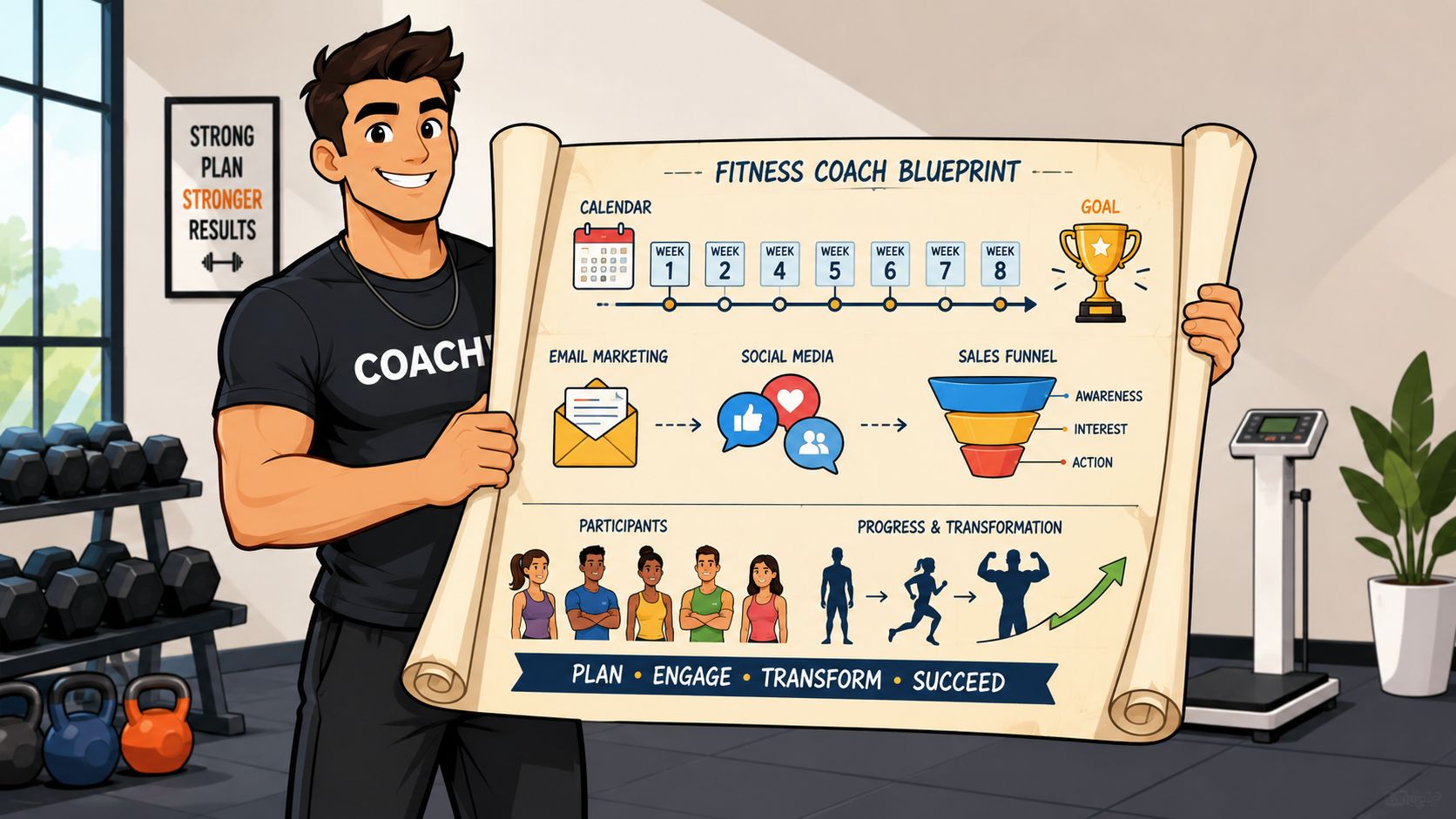
You've probably seen this play out already. A transformation challenge launches with energy, signups come in fast, coaches are fired up, and the gym feels alive for a few weeks. Then the cracks show. Check-ins slip, staff improvises, the winner gets a prize, and half the room disappears before the next billing cycle.
That isn't a challenge problem. It's a system problem.
A profitable transformation challenge has to do three jobs at once. It has to attract attention, create visible results, and convert short-term excitement into long-term member value. If it only does the first two, you ran an event. If it does all three, you built a growth engine.
Blueprinting Your Challenge Objectives and Timeline
Most gyms start with the wrong question. They ask, “What should the challenge include?” The better question is, “What business outcome is this challenge supposed to create?”
That distinction matters because vanity goals produce busywork. More Instagram comments. More selfies. More hype. None of that matters if the challenge doesn't improve lead flow, paid participation, upgrades, referrals, or retention.
A better starting point is simple. Decide what success means before you design workouts, prizes, or promos. That discipline matters in every change initiative. According to a 2021 BCG analysis, 65% of transformation initiatives fail to achieve their stated objectives, which is why planning has to come first instead of relying on enthusiasm alone, as noted in this BCG summary on transformation challenge statistics.

Start with business goals, not marketing slogans
A strong challenge objective is specific enough that your front desk, coaches, and sales staff all know what they're driving toward.
Use a simple filter:
- Revenue goal: Are you using the challenge to sell paid entries, premium coaching, nutrition support, or membership upgrades?
- Lead goal: Is the main purpose to bring in non-members for consultations and trials?
- Retention goal: Are you trying to reactivate drifting members and deepen habit formation?
- Brand goal: Are you trying to build social proof and local visibility so the next offer converts more easily?
Most gyms try to chase all four at once. That's where confusion starts. Pick one primary objective and one secondary objective. Everything else becomes support work.
Practical rule: If your staff can't explain the purpose of the challenge in one sentence, the campaign is still too vague.
Build a timeline that protects execution
An effective transformation challenge needs a master calendar. Not a rough idea. A real one. The easiest model for most facilities is a 4-week pre-launch, an 8-week challenge, and a 1-week follow-up and celebration window.
Here's a practical template:
| Phase | Focus | What must happen |
|---|---|---|
| Weeks 1 to 2 | Offer development | Set the goal, define audience, build pricing, choose scoring, write the rules |
| Weeks 3 to 4 | Pre-launch marketing | Record coach videos, build landing page, prep email and social assets, train staff on the pitch |
| Weeks 5 to 12 | Challenge delivery | Run onboarding, weekly check-ins, midpoint reviews, recognition, and sales conversations |
| Week 13 | Conversion and follow-up | Announce winners, hold celebration, present next-step offers, book goal reviews |
Define milestones before launch day
Good operators don't wait to “see how it goes.” They predefine checkpoints.
Use milestones such as:
- Registration checkpoint: Sales team reviews who joined, who didn't, and which audience responded.
- Week 2 adherence checkpoint: Coaches identify early drop-off signals and reach out fast.
- Midpoint checkpoint: Reframe goals, celebrate effort, and correct unrealistic expectations.
- Final-week conversion checkpoint: Staff shifts from challenge support to membership continuity conversations.
That's what keeps a transformation challenge from becoming a short burst of chaos. You don't need more motivation. You need a schedule your team can run.
Designing an Irresistible Challenge Structure
Once the objective is clear, the challenge has to feel worth joining. Members don't buy structure charts. They buy a believable path to progress, support, and recognition.
The biggest mistake here is making the offer too narrow. A challenge built only around fat loss will attract some people and implicitly exclude others who want strength, consistency, mobility, or general health. That's a costly mistake if your goal is broad participation.

Pick a scoring model your staff can explain in under a minute
I see three formats work in real gyms.
Metric-based scoring
This is the classic setup. Winners are determined by outcome measures such as body composition change or other physical benchmarks.
It's clean and easy to market. It also creates risk. Some members feel they've lost before they start, especially if their goal isn't primarily aesthetic.
Use this when your audience already expects performance or body-composition tracking.
Point-based scoring
This rewards behaviors instead of only outcomes. Check-ins, class attendance, habit tasks, meal logs, coach meetings, and community participation all count.
This format is stronger for retention because it reinforces repeat actions. It also creates more winners, which keeps morale higher across the room.
Hybrid scoring
This is usually the best commercial model. Part of the score comes from effort. Part comes from results.
That combination fixes two common problems. It keeps high performers engaged, and it gives newer or less confident members a reason to stay in the game.
Add tracks instead of forcing everyone into the same lane
Most transformation challenge offers falter. They assume every participant should train the same way, at the same pace, for the same purpose.
That doesn't match how members think. Some want fat loss. Some want muscle. Some want a routine they can sustain. Some are returning after time away and need a lower-friction starting point.
Recent 2026 data shows that adaptive programs that vary intensity or nutrition based on individual baselines improve adherence by 35% and reduce dropout rates by 28% compared to rigid, one-size-fits-all challenge models, based on this Purpose Brands fitness goals survey.
Don't sell one challenge with one path. Sell one challenge with multiple tracks and a shared finish line.
A practical setup looks like this:
- Fat Loss Track: Nutrition compliance, class consistency, recovery habits
- Strength Builder Track: Lifting benchmarks, session completion, protein habits
- Consistency Track: Weekly attendance, coaching touchpoints, movement goals
If you want to study how a challenge is framed publicly, browse a live example like this May 2026 fitness challenge and pay attention to how the offer is packaged, not just how the workouts are presented.
Build prize psychology the right way
A single grand prize sounds exciting. It also discourages a lot of people by week two.
Better prize design includes layers:
- Weekly recognition: Coach shoutouts, social highlights, member of the week
- Behavior rewards: Small prizes for consistency, referrals, and milestone completion
- Track-specific wins: Separate recognition by goal type so members don't compete across incompatible outcomes
- Finishers reward: Something every committed participant can claim
That structure keeps the room alive longer. The challenge feels fair, not just dramatic.
Creating a High-Conversion Marketing Funnel
A challenge doesn't fill because the idea is good. It fills because the path from attention to registration is obvious.
Most gyms leak signups in the middle. They post on social, get a few DMs, answer questions manually, and hope people remember to come back. That isn't a funnel. It's scattered follow-up.
The better model is linear. Someone sees the offer, clicks, understands the value, registers, gets confirmation, and receives next steps without friction.

Build the landing page before you start posting
If your staff is sending people to DMs or a vague homepage, conversions will suffer.
Your landing page should answer five questions fast:
- What is it: Name the transformation challenge clearly.
- Who it's for: Spell out whether it's for current members, non-members, beginners, or mixed levels.
- What's included: Coaching, workouts, check-ins, education, accountability, prizes.
- What happens next: Registration, consultation, onboarding session, start date.
- Why act now: Deadline, limited onboarding capacity, or launch timing.
Add an FAQ that handles the objections staff hears every day. Questions about experience level, schedule flexibility, nutrition expectations, and how winners are chosen should never require a private message to answer.
If you want a practical walkthrough of funnel structure, this guide on how to build a funnel is useful for mapping the steps from click to consult.
Use a four-part email sequence that does one job at a time
Too many campaigns send one launch email and then go quiet. You need repeated exposure with different angles.
A simple sequence works well:
Announcement email
Lead with the outcome and start date. Keep it direct. Explain who should join and why this challenge is different from generic gym promos.Education email
Break down what participants get. Coaching support, accountability, scoring, and what makes success realistic. This email reduces uncertainty.Urgency email
Focus on deadline and capacity. Remind people what they'll miss if they wait.Last chance email
Short subject line. Clear CTA. No extra teaching. Just decision pressure and registration link.
Make social content pull people into the funnel
Social shouldn't try to close the sale by itself. Its job is to trigger interest and move people to the page.
The best-performing content usually comes from three buckets:
| Content type | What it does |
|---|---|
| Coach intro videos | Builds trust and shows who will guide participants |
| Prize and milestone teasers | Creates excitement and gives the offer shape |
| Member story content | Makes the challenge feel attainable and human |
If Instagram is one of your main discovery channels, study audience quality as much as follower count. This real follower guide for gyms is useful because fake attention won't turn into booked consultations.
Your funnel is working when staff stops chasing “interested” people and starts talking mostly to applicants who already understand the offer.
The thank-you page matters too. Don't end with “you're registered.” Give the next instruction immediately. Tell them what to bring, when onboarding starts, and how they'll be contacted.
Fueling Motivation with Powerful Engagement Tactics
Week 3 is where enthusiasm usually drops. The soreness isn't new anymore, the novelty is gone, and life starts competing with the plan.
One participant type shows up in almost every challenge. She was excited at kickoff, checked in consistently during the first stretch, then missed two sessions and stopped posting in the group. She isn't quitting because she hates the program. She's drifting because nobody interrupted the drift.
Catch the dip before it becomes a dropout
The gyms that keep momentum high don't rely on mass motivation. They use small, specific interventions.
A coach sees the missed check-ins and sends a short text. Not a guilt message. A reset message. Something direct that says, “You're not behind. Show up today and we'll rebuild the week from here.”
That works because it removes shame. Most members don't need a lecture. They need permission to re-enter without feeling like they failed.
Turn the group into an accountability engine
A private challenge group works best when it has rhythm. Random posting creates noise. Structured posting creates culture.
Use recurring beats such as:
- Monday focus post: Weekly intention and attendance target
- Midweek coach check-in: Quick reminder, FAQ, or live answer session
- Friday win thread: Members share a small success, not just dramatic results
- Weekend prep post: Grocery, calendar, and recovery planning
If you need fresh formats, this roundup of fitness challenge ideas for groups can help you vary prompts without making the experience feel repetitive.
The member who stays isn't always the most motivated one. It's usually the one who gets noticed quickly when momentum slips.
Use public recognition and private rescue
Those are two different tools. Both matter.
Public recognition gives the community something to rally around. A coach shouting out attendance consistency or a member hitting a personal milestone tells everyone that effort gets seen.
Private rescue is quieter and more important. When someone goes missing, assign a staff owner. One person reaches out, books the check-in, and follows through. Diffused responsibility kills recoveries.
I've seen struggling participants bounce back from a rough week with one personal text, one class booking, and one public welcome-back comment. That kind of support keeps the transformation challenge feeling personal instead of transactional.
Converting Challengers into Lifelong Members
Most gyms treat the end of the challenge like a finish line, wasting the best opportunity in the entire campaign. It serves instead as a handoff point.
The hard truth is simple. The long-term retention paradox is real: less than 40% of participants maintain consistent gym attendance after the challenge, while studios with formal challenge-to-membership pathways retain 22% more attendees at the 6-month mark, according to this Orangetheory challenge retention reference.
If you don't build the next step before the final weigh-in, many participants will celebrate, exhale, and leave.
Why most post-challenge follow-up fails
The usual approach is weak. The gym announces winners, posts photos, maybe sends a generic “keep it going” email, and assumes results will carry people forward.
They won't.
Challenges create urgency through deadlines, visibility, and accountability. Remove all three at once and many participants lose structure immediately. That's why retention after a transformation challenge has to be engineered, not hoped for.
Use a three-step conversion pathway
The best systems make continuation feel obvious.
Step 1. Hold a finish-line review
Every participant should get a short review meeting. Go over progress, effort, obstacles, and what their next goal should be. This reframes the challenge as phase one, not the whole story.
Step 2. Present a continuation offer
Don't pitch a generic membership if they already had a guided experience. Offer a next-stage path with coaching logic behind it.
Examples include:
- A phase-two accountability program
- A small-group training upgrade
- A habit-maintenance package
- A coached strength or nutrition continuation track
The offer should feel like a bridge, not a reset.
Step 3. Enroll them before momentum cools
This part matters most. Don't wait a week. Present the next step during the final review window while motivation and identity are still high.
Here's the standard I use with operators: every finisher leaves with one of three outcomes. Continued membership, a booked decision appointment, or a documented follow-up owner on staff. No one exits into silence.
For operators refining this side of the business, this guide on how to boost gym member retention is worth reading alongside your own retention workflow.
A challenge creates proof. Your retention system decides whether that proof becomes a new habit or a short-lived memory.
The gyms that win long term don't just run better events. They package continuity better than everyone else.
Protecting Participants and Your Facility
A packed challenge calendar creates more traffic, more sweat, more equipment turnover, and more risk. If your operational standards stay the same while intensity rises, you're inviting preventable problems.
Start with the legal side. Your standard membership waiver usually isn't enough for a structured transformation challenge.
Tighten the paperwork before the first session
Use a challenge-specific addendum detailing the program itself.
It should address:
- Program intensity acknowledgment: Participants confirm they understand the challenge involves structured physical activity and coaching expectations.
- Photo and video release: If you plan to use before-and-after content, coach videos, or community recap posts, get explicit permission in writing.
- Progress tracking consent: If you're collecting measurements, body-composition data, or check-in records, document that process clearly.
- Emergency contact details: Keep current contact information easy for staff to access.
If you're reviewing your facility-wide procedures, these risk assessment examples for gyms can help you spot weak points before launch.

Raise cleaning standards during the challenge
More participants touching more surfaces means hygiene has to become visible, easy, and enforced.
That isn't paranoia. It's operations. A study found that typical workout equipment can harbor 362 times more bacteria than a toilet seat, which makes post-use cleaning with gym equipment wipes a practical requirement, not a courtesy.
Members need immediate access to fitness wipes or other disinfecting wipes at the point of use. If someone has to walk across the gym to find supplies, compliance drops. Place a gym wipe dispenser in high-traffic zones and near stations with the most touchpoints.
Use a cleaning protocol your team can repeat under pressure
A challenge environment moves fast, so your protocol has to be simple.
Member-facing protocol
Post the expectation clearly and coach it verbally during kickoff.
- Wipe after each use: Members should use wipes for gym equipment as soon as they finish a station.
- Cover high-touch points: Handles, benches, screens, pins, adjustment levers, and mats need attention.
- Include specialty zones: Don't forget yoga mat wipes if your challenge uses mobility or recovery sessions.
Staff-facing protocol
Your team needs a separate standard for true disinfection.
The CDC and EPA recommend using at least an approved low-level chemical disinfectant, and fitness facilities should preferably use an intermediate-level disinfectant to achieve equipment disinfection rather than simple sanitization, according to this NASM gym cleaning guidance.
For disinfectant solutions to work on gym surfaces, they require dwell times of 10 to 30 minutes, which is why a two-step process matters: one pass to keep the surface wet long enough, then a second wipe with friction to remove microbes, as explained in this gym equipment cleaning article.
In commercial gyms, staff should perform quick disinfecting throughout the day and deep clean at least once a week, based on this fitness equipment maintenance guide.
Here's the system I recommend:
| Area | Member action | Staff action |
|---|---|---|
| Cardio deck | Wipe contact points after use | Frequent walk-through disinfecting |
| Strength floor | Clean benches, handles, and attachments after sets | Spot checks plus scheduled deep cleaning |
| Group studio | Wipe mats and shared tools after class | Full reset after heavy-traffic sessions |
| Reception and common areas | Limited member role | Staff-owned recurring disinfection |
Cleanliness has to be frictionless. If supplies are hard to reach or procedures are vague, members won't follow through consistently.
For supply planning, keep bulk gym wipes or commercial disinfecting wipes stocked so your team never has to ration cleaning during peak usage. If you're reviewing options for EPA registered disinfecting wipes, dispensers, and other gym equipment cleaning wipes, browse the facility-focused selection at Wipes.com.
A strong finish to a transformation challenge includes a strong hygiene finish too. Remind members to wipe every station after use, train staff on proper dwell time, deep clean on schedule, and keep sanitizing supplies visible enough that no one has to ask where they are.
If you're building your next transformation challenge, treat it like a business system from day one. Set one primary objective, structure the experience around different member tracks, market it through a real funnel, and never leave post-challenge retention to chance. For more practical gym sales and retention playbooks, visit Gym Membership Tips.
Leave a Reply