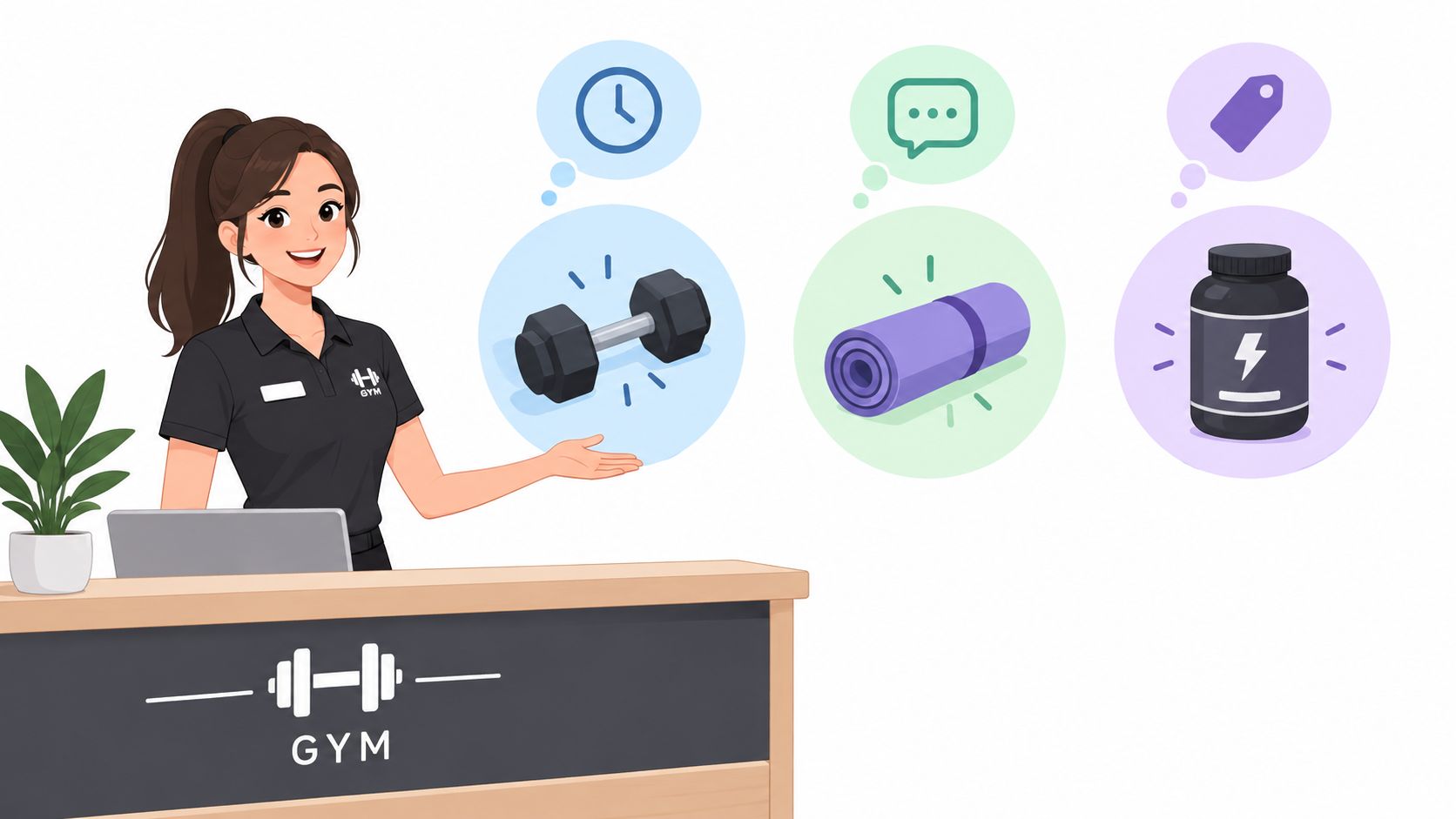
You've just watched a trial member finish her third workout in a week. She's smiling, she's asking about class times, and your front desk team has about thirty seconds to say the right thing before she heads for the door. That's the moment most upsell and cross sell examples either work or fall flat.
The difference isn't enthusiasm. It's relevance. An upsell moves a member to a more expensive version of what she's already buying, while a cross-sell adds a complementary service, a distinction laid out in the clear separation between upselling and cross-selling mechanics. One improves the core membership. The other expands the relationship.
Personalization decides whether either offer feels helpful. In McKinsey's research, 71% of consumers expected personalized interactions and 76% became frustrated when those interactions were absent, as detailed in McKinsey's Next in Personalization findings on consumer expectations. That same research linked personalization most commonly to a 10% to 15% revenue lift. For your gym, that means matching the next step to a visible signal, a finished trial, a milestone, consistent attendance, or a direct request for help.
Each example below ties the offer to that kind of moment. You'll get the timing, a usable price structure, short language your team can say, and the numbers to watch after the sale.
1. Membership Tier Upgrades (Planet Fitness Black Card Model)

Planet Fitness makes the upgrade decision easy. The Classic tier removes the price barrier, while the Black Card bundles massage chairs, guest privileges, and at some locations tanning into one higher monthly price. The member doesn't buy five separate perks. She picks a better version of membership.
That structure works because three clear tiers give people a comparison without overload. Pricing research summarized in the analysis identifying three tiers as a common optimum for subscription pricing supports a good, better, best layout, with the middle option as the comfortable default and premium as the anchor. If you're still sorting the mechanics, start with a plain-English breakdown of upselling and cross-selling for gyms before redesigning your tiers.
Make the Upgrade Trigger Specific
Don't pitch premium on day one to everyone. Trigger it after 30 to 60 days of consistent check-ins, when the member has felt the limits of basic access.
- Name tiers by benefit: Call it Recovery Plus or All Access, not Gold or Tier 2.
- Frame the gap daily: "It's less than a coffee a day to add recovery and guest access" beats reciting a monthly total.
- Use one sentence at check-in: "You've been in four times this week. Want me to show you what Recovery Plus adds for your routine?"
Track upgrade rate among eligible members, premium utilization, and downgrades within the first billing cycle. A mini test is simple, offer the upgrade only to frequent visitors for one month and compare their retention with frequent visitors who stayed basic. If premium buyers don't use the perks, you've sold price, not value.
2. Personal Training Session Packs
A member finishes a free assessment and says, "I just don't know if I'm doing this right." That's your opening, and it's stronger than any front desk pitch. Sell the pack as the plan that answers that exact worry.

Most gyms do better with packs of 10 to 20 sessions at a lower per-session price than with single sessions. The pack creates commitment, smooths revenue, and gives the trainer enough time to produce a visible result. Boutique studios often start smaller, with intro bundles of three or five sessions for first-timers who aren't ready for a bigger commitment.
The service lesson travels well from other industries. A US regional bank that trained agents to match offers to stated needs saw qualified leads rise by more than 60% and revenue per call rise 96% within six weeks, according to McKinsey's case on needs-based service to solutions selling. Your version is a trainer who listens first, then recommends.
Sell the Assessment, Not the Pack
Start with a complimentary 30-minute assessment. End it with a specific recommendation, "For your strength goal, I'd do two sessions a week for five weeks, then we retest." Trainers who want sharper programming and cueing skills behind that recommendation can use a solid coach's guide to training clients.
State expiration dates upfront, in writing, before payment. Then measure assessment-to-pack conversion, sessions used, and whether pack holders renew their memberships at higher rates than similar members without training. Don't assume every member needs coaching. The win comes from matching the pack to members who've named a goal they can't reach alone.
3. Nutrition Coaching and Meal Plan Add-Ons
Training creates the question. Nutrition coaching answers it. Members who've committed to workouts almost always ask what they should eat, and that curiosity is your cross-sell moment.
Structure it three ways so members can self-select. Offer a one-time meal plan for self-starters, a monthly coaching plan with check-ins for accountability, and a 12-week nutrition challenge with weekly group sessions for members who thrive on community. Partnering with a registered dietitian who offers member rates adds credibility without adding payroll.
Purchase history and behavior should drive who hears the offer. An online retailer that used purchase history to personalize recommendations saw email conversion rise 25% and on-site conversion rise 60% six months after pilot programs, as shown in McKinsey's online retailer personalization case. Your equivalent is simple, pitch nutrition to members who've just completed a body composition scan or finished a training block, not to your entire list.
Practical rule: Pitch food help right after a measurable fitness moment, when the member is already thinking about what comes next.
Keep the First Step Free and Safe
A free nutrition starter session demonstrates value without pressure. Your script can stay short, "Your scan shows great progress on muscle. Want a free session on the eating side so the training keeps paying off?" For programming ideas that pair training with nutrition support, see how fitness and nutrition coaching work together in practice.
Avoid medical claims entirely. Refer members with medical conditions to licensed professionals, and say so in your materials. Measure starter-to-paid conversion, check-in attendance, and retention among coaching clients versus matched members without it. If clients stop showing up to check-ins by week three, your format is wrong, not your price.
4. Recovery Service Add-Ons (Massage, Sauna, and Cold Plunge)
Friday at 6:40 p.m., a member finishes deadlifts, palms on knees, and asks if the sauna is “worth it.” That is the moment recovery stops being an amenity and becomes a sale.

Price the yes so she does not have to think. Keep a monthly sauna and cold plunge pass under the premium tier, sell single recovery visits at the desk, and let a vetted massage therapist rent a room on revenue share so you add a service without adding payroll.
| Offer | Best member moment | Front-desk line |
|---|---|---|
| Sauna/cold plunge pass | fourth visit in seven days | “You earned the easy finish. First plunge is on us after Saturday's workout.” |
| Massage session | post-race or heavy block | “Want twenty minutes on the calves while the flush is still working?” |
| Recovery bundle | new program start | “Training days plus two recovery sessions, one card charge.” |
Before you buy equipment or give up a corner, compare add-on services before you commit floor space. Start with the option that can be sanitized fast, booked inside the app, and staffed at peak hours.
Run the room like equipment. Clean benches, plunge rims, and shared surfaces after every use, log water checks and session counts by hour, and treat repeat queues as a capacity problem rather than a marketing problem.
Test demand with a simple split: fifty frequent trainers get a free session, fifty only see signage. Track trial-to-pass conversion, visits per pass holder, off-peak fill, and whether recovery buyers train more often. The booked experience usually outsells the poster.
5. Annual Prepay Upgrades
Monthly billing is easy to start and easy to quit. Annual prepay trades a visible discount for commitment, improves your cash flow, and gives the member a locked-in rate. Everybody knows what they got.
The clearest framing is "save two months." Show the savings in dollars on the same screen or sheet as the monthly price, because percentages make people do math they'll postpone. Some studios sweeten it with a free month of personal training, which adds experience value without cutting the headline price further.
Timing matters more than the discount size. One analysis recommends sending post-purchase cross-sell messages 7 to 14 days after the customer has received and used the original purchase rather than immediately, a timing point covered in the guidance on choosing between upsell and cross-sell timing. For memberships, stretch that logic, let the member train for about a month first. The same source notes personalized offers can convert at up to 2.8 times the rate of generic recommendations, so reference her actual attendance in the pitch.
A Script That Respects the Decision
Try this at the 30-day check-in. "You've been in twelve times this month, so you're clearly using this. The annual plan saves you two months and locks your rate for the year. Want me to show you the exact difference?"
Put cancellation and freeze terms in writing before the sale closes. Surprises here destroy trust and generate chargebacks. Then track prepay uptake among members past their first month, freeze requests, and renewal at month twelve. If annual members stop attending by month four, the discount bought you cash but not loyalty, and they'll vanish at renewal.
6. Boutique Class Packs and Specialty Program Bundles
Some members will never buy unlimited. That doesn't make them bad members. Class packs of 5 or 10 fit occasional attendees, while unlimited suits your regulars, and selling both side by side, the way Orangetheory and similar studios do, captures revenue you'd otherwise lose.
Specialty bundles push the cross-sell further. Pair spin with strength, or yoga with Pilates, and price the bundle below buying both separately. An intro first five classes pack priced under your regular rate gives newcomers a low-risk way to find their favorite format.
The bigger shift is that members increasingly want fitness beyond your four walls. Recent industry reporting notes that 40% of gym-goers want access to fitness experiences outside their club, highlighted in ABC Fitness year-end reporting on member expectations. That makes a hybrid bundle, in-studio classes plus app-based programming and community events, a legitimate cross-sell rather than a gimmick.
The best bundle doesn't add more stuff. It removes the gaps where members quietly drift away.
Build Bundles From Booking Data
Look at what members already attend, then recommend the adjacent format. A spin regular gets the strength add-on, not a generic everything pack. Recommendations based on real behavior, similar to how shoppers respond to personalized supplement bundle picks built around their own choices, feel curated instead of pushed.
Set expirations at 60 to 90 days, long enough to feel fair and short enough to create momentum. Sell packs against classes with open capacity so you're filling empty bikes, not crowding full ones. Measure pack completion rate, second-pack purchases, and upgrades from packs to unlimited. Members who finish a pack quickly are your warmest unlimited prospects.
7. Childcare and Family Membership Add-Ons
A parent arrives for a 5:30 p.m. workout, but the after-school pickup plan falls through. A supervised kids' area can turn that missed session into a regular training slot, provided its hours and staffing match when parents come in.
Price the offer around how families use it. For example, a club could charge a monthly fee for two adults and up to two children, with childcare access limited to staffed hours. A parent considering the add-on might hear: “You usually train after work. We have childcare from 5 to 7 p.m. Would you like to see the room and check the pickup process?”
Before setting a price, calculate staffing, insurance, licensing, and cleaning costs. Check local requirements for staff-to-child ratios, background checks, sign-in procedures, and authorized pickups. If demand is concentrated in a short evening window, limited booking slots may work better than promising all-day availability.
Childcare addresses a reported reason members cancel: lack of time or motivation, cited by 31% of respondents in the gym membership market report on cancellation drivers. Cost concerns were also cited by 38%, so a family rate needs to show clear value without underpricing the labor involved.
Track family add-on uptake, childcare bookings by hour, no-shows, and cancellations among family accounts. For example, if a club has more available slots than bookings during its advertised hours, it could test a different time window before adding staff. Compare retention over time with similar individual accounts, and review parent feedback alongside the revenue. A full childcare room is not a win if supervision or cleanliness slips. Keep a visible cleaning log for toys, mats, and high-touch surfaces, and make the room part of the membership tour.
8. Guest Passes and Household Add-Ons
Your happiest member is your cheapest marketing channel. Guest passes give her a reason to prove it. Sell a pack of five passes at a discount, or bundle a set number into premium tiers, and every redemption becomes a warm lead standing in your lobby.
Household add-ons work on the same principle. Adding a partner or adult child to an existing account at a reduced rate is easier than selling a stranger a full membership, because the trust conversation already happened at the kitchen table.
Behavior-based invitations have a long track record. Amazon's early growth leaned on personalized recommendations and repeat customer behavior, and the company reported that repeat customer orders accounted for more than 60% of orders in its fiscal year ending December 31, 1998, documented in Amazon's 1998 annual report on customer orders. Your version is simpler, invite the member who's already attending consistently to bring someone, because she's your credible recommender.
Protect the Experience While You Grow
- Limit passes per month: Scarcity keeps the floor comfortable and makes passes feel valuable.
- Follow up within 48 hours: A guest who trained yesterday is warm. A guest from last month is a cold call.
- Require waivers and hygiene rules: Guests sign, guests wipe down equipment, no exceptions for friends of members.
The script is one line at a milestone moment. "You've hit twenty workouts. Want a few passes so a friend can try your Saturday class with you?" Measure pass redemption rate, guest-to-member conversion, and the acquisition cost comparison against your paid ads. A referral reward, like a free month when a guest joins, usually costs less than the ad spend it replaces.
9. Pro Shop, Apparel, and Supplement Cross-Sells
A member finishes a workout and realizes their lifting straps have frayed. That moment is a better retail prompt than a generic sales pitch: keep replacement straps, wraps, and bottles near the front desk, with prices clearly marked. Stock a few useful items first, then expand based on what members request.
For example, offer a branded bottle for $15 or a bottle-and-towel bundle for $25. At check-in, staff can say, “You mentioned you keep forgetting your bottle. We have one here for $15 if you want it.” Keep the choice optional, and avoid pushing supplements without asking about allergies, dietary needs, or the member's preferences.
Make the Shelf Earn Its Space
Protein bars can suit members heading straight from work to training. Trial one case before committing to regular orders; Gym Snack's wholesale protein bar guide can help you compare sourcing options. Perishable products tie up cash and require expiry checks, so begin with a small range and reorder only when sales justify it.
Track sales by item, retail revenue per active member, and stock that has not moved in 60 days. A simple test is to feature one product at the desk for a month, record how often staff mention it and how many units sell, then decide whether to keep it. If staff cannot explain who the product helps or when to use it, it probably does not belong on the shelf.
A small shop works best when it solves immediate needs: a member forgot a bottle, needs fresh wraps, or wants a quick snack after class. Keep the display clean, make prices easy to see, and review slow stock before reordering.
10. Member Starter Kits and Equipment-Care Bundles
A new member's first week is full of small friction. She forgot a towel, she doesn't own a mat, and she's not sure which gym wipes to grab after using the bench. A starter kit removes all three problems in one purchase.

Bundle the practical basics, a yoga mat, a gym towel, a water bottle, and disinfecting wipes for personal equipment. Price the kit below the cost of buying items separately, and offer it at sign-up and again at the first-week check-in. Studios with floor-based classes can add yoga mat wipes, and members who train at home appreciate wipes for gym equipment they own. The script stays helpful, "Most new members grab the starter kit so they have everything for class. Want me to add it to your account?"
This is also an operational cross-sell, not just a retail one. Members who see EPA registered disinfecting wipes stocked at every station trust your hygiene standards, and that trust supports retention. Operators restocking at scale often buy bulk gym wipes and place a gym wipe dispenser within reach of each equipment cluster, and you can compare options for your facility at wipes.com when planning the bundle.
Hygiene Habits That Make the Bundle Credible
- Place dispensers within arm's reach: Every equipment cluster needs wipes visible before the workout starts, not across the room.
- Respect contact time: Use products for the full wet time on the label and let surfaces air dry before the next user.
- Restock every shift: Staff should check dispensers, refill, and log cleaning times as part of floor walks.
Measure kit attachment rate on new joins, wipe consumption per visit, and hygiene mentions in member surveys. If kits sell but dispensers sit empty, you've marketed cleanliness you aren't delivering.
10 Gym Upsell and Cross-Sell Examples Compared
| Example | Implementation Complexity | Resource Requirements | Expected Outcomes | Ideal Use Cases | Key Advantages |
|---|---|---|---|---|---|
| Membership Tier Upgrades | Low | Distinct benefits, membership and billing setup | Higher recurring revenue per member | Gyms seeking affordable entry plans with premium options | Raises average revenue without increasing base prices |
| Personal Training Session Packs | Medium | Qualified trainers, scheduling, package and refund policies | Prepaid revenue, member progress, and stronger retention | Members seeking structured, goal-focused coaching | High-margin service that supports engagement |
| Nutrition Coaching and Meal Plan Add-Ons | Medium | Qualified staff or dietitian partners, coaching tools | Added service revenue and ongoing member engagement | Goal-driven members seeking nutrition support | Complements fitness plans and differentiates the gym |
| Recovery Service Add-Ons | High | Equipment or service partners, space, sanitation, booking system | Add-on revenue and longer facility visits | Gyms with recovery-focused members and suitable space | High perceived value; can be offered through partners |
| Annual Prepay Upgrades | Low | Billing setup, clear discount and cancellation terms | Improved cash flow and fewer early cancellations | Gyms with established members willing to commit | Simple offer with predictable upfront revenue |
| Boutique Class Packs and Specialty Program Bundles | Medium | Class schedule, booking software, available capacity | More class bookings and trial of additional formats | Studios serving occasional visitors or promoting specialty classes | Flexible alternative to unlimited memberships |
| Childcare and Family Membership Add-Ons | High | Trained staff, licensed facilities, insurance, cleaning | New family customers and potentially stronger renewals | Gyms serving parents and households | Removes a common barrier to attendance |
| Guest Passes and Household Add-Ons | Low | Pass tracking, guest waivers, follow-up process | Referral visits and potential membership conversions | Gyms seeking low-cost referrals and household growth | Easy for members to share and can generate leads |
| Pro Shop, Apparel, and Supplement Cross-Sells | Medium | Retail space, inventory, staff, product compliance | Additional sales and greater brand visibility | Gyms with regular foot traffic and relevant member demand | Adds revenue and turns branded products into promotion |
| Member Starter Kits and Equipment-Care Bundles | Low | Starter items, dispensers, restocking, cleaning procedures | Welcome-kit sales and visible hygiene support | Gyms onboarding members or supplying shared equipment | Practical, easy-to-bundle items address immediate needs |
Turn Small Moments Into Sustainable Revenue
The pattern across every example here is the same. A member hits a moment, a milestone, a sore week, a new goal, a scheduling crunch, and the right offer answers that moment. The wrong offer, pitched to everyone at sign-up, teaches members to tune your team out.
That discipline matters because not every add-on helps retention. Some offers raise short-term revenue while raising cancellations, especially when members feel oversold on services they never use. Before you expand any offer, match it to the member's actual risk or goal: offer flexible and digital options for time-pressed members, coaching for members who've lost motivation, and community-based programs for members whose attendance is fading.
Keep your scoreboard honest. Review conversion rate, attachment rate, average transaction value, utilization, renewal, refunds, and cancellation reasons for every offer, segmented by who received it. An upgrade that converts well but gets used twice is a churn risk wearing a revenue costume. Test one offer at a time against members who didn't receive it, and let incremental retention, not clicks or first-month sales, decide what stays.
Pricing should stay simple enough to explain in one breath. Three tiers, clear pack sizes, savings shown in dollars, terms in writing before payment. Train your team on short scripts tied to real member behavior, and give them permission not to pitch when the moment is wrong. A member dealing with a billing problem or an injury doesn't need an upsell. She needs help, and remembering that is what makes the next genuine offer land.
Finish with the operational detail members notice daily, cleanliness. Build a routine your team can sustain, place wipes within easy reach of every station, use disinfecting products exactly as the label directs, respect the required contact time so surfaces stay wet long enough to work, and keep dispensers closed between uses so wipes do not dry out. During peak hours, wipe down handlebars, grips, bench pads, and touchscreens several times a day, sanitize shared recovery and kids' area surfaces on a logged schedule, and replace worn mats and damaged pads promptly instead of cleaning around them. Members may not compliment a clean facility out loud, but they will absolutely leave a dirty one.
If you want more structured help turning these moments into a repeatable sales process, Gym Membership Tips publishes practical guidance on membership packaging, pricing, and retention for gym operators. Pick one example from this list, the one that matches a moment you saw on your floor this week, write the one-line script, train your next shift on it, and measure what happens for thirty days. That's how small moments become revenue you can count on.
Leave a Reply