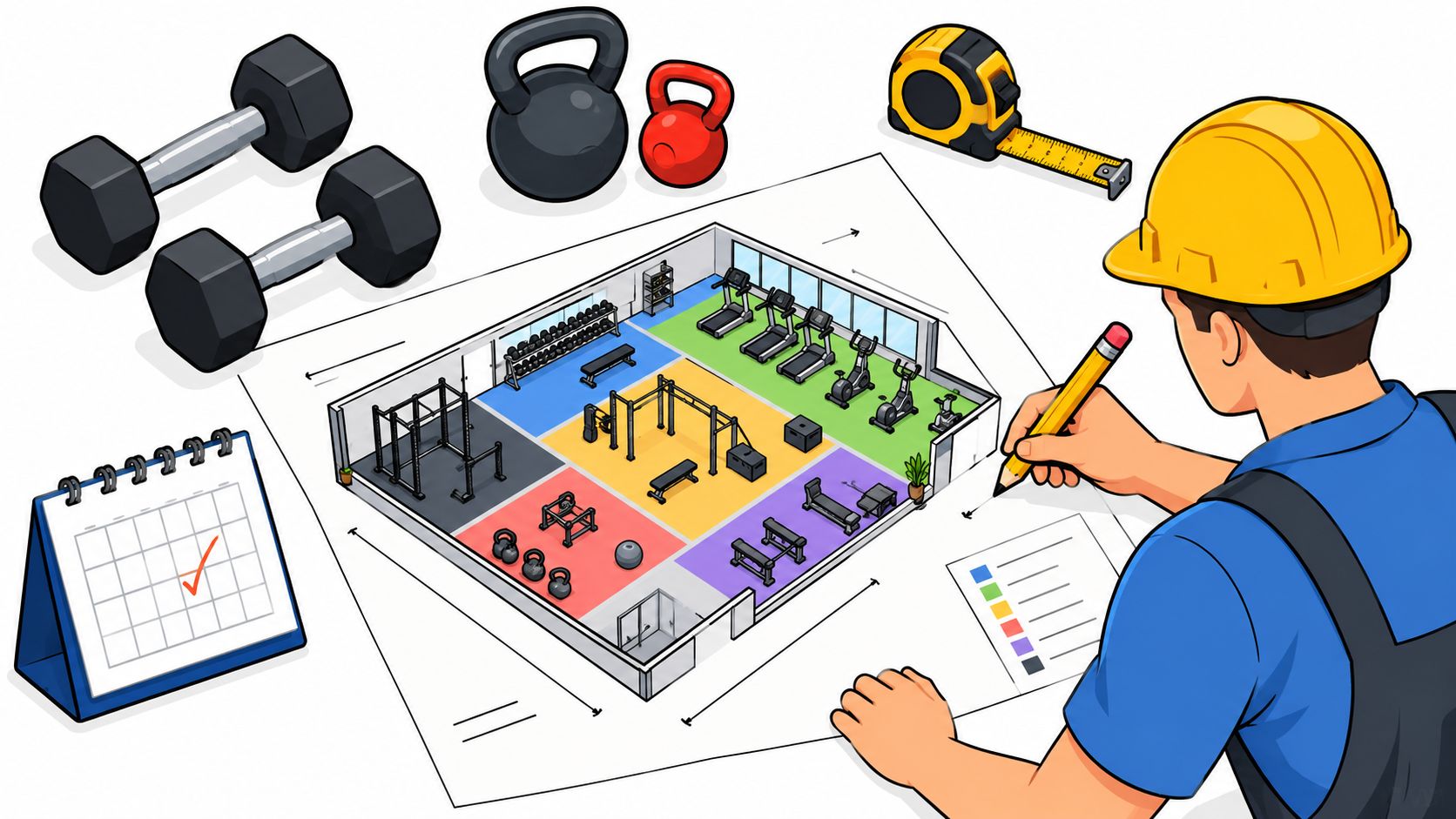
You've found a promising space, the equipment quotes are arriving, and you can already see your logo above the entrance. Then the contractor asks about electrical capacity, the landlord wants a deposit, and you realize the opening budget doesn't include paying staff while memberships ramp up.
That's the moment to stop shopping and start planning. Building a gym is a phased capital project, not a race to fill a room with machines. Install the infrastructure you can't afford to redo, open with an offer you can deliver well, and add amenities when the business can support them.
Validating the Concept Before You Spend a Dollar
A vacant building isn't a business opportunity until you know who will pay to train there. Start with the member, not the property.
Pre-pandemic, the global health-club market generated about US$96.7 billion across roughly 210,000 facilities, with the United States accounting for 64.2 million members, 41,370 clubs, and approximately US$35 billion in annual revenue, according to the 2020 IHRSA Global Report. That establishes market scale, not demand for your particular gym.
Define the Member and the Promise
Choose a primary audience and a reason they'd switch from their current routine. A strength-only gym, family-friendly club, boutique coaching studio, and hybrid training facility need different spaces, staffing, and membership offers.
Use these examples of gym niches to sharpen your positioning. Then write a sentence explaining who you serve, what they come to accomplish, and why your gym fits their lives.

Test the idea against the neighborhood:
- Map the actual trip: Define your trade area by realistic drive time during likely workout hours. Include residents, nearby workers, and competing facilities.
- Visit competing gyms: Look at crowding, class schedules, equipment availability, cleanliness, and the welcome a beginner receives. Record the complete membership cost, not just the advertised rate.
- Ask useful questions: Where owners are willing to talk, ask which services members request, which hours need staffing, and which building problems they wish they'd spotted earlier.
- Check purchasing power: Compare your proposed tiers with local household income information and conversations with prospective members. Don't assume enthusiasm means affordability.
Ask for Commitment Before Construction
A survey can reveal preferences. A paid founding-member offer tests whether someone will buy.
Run pop-up training sessions, collect a pre-sale waitlist, and present a concrete offer with clear opening conditions and refund terms. Ask prospects what would stop them joining. Listen closely when their objection concerns location, hours, childcare, or confidence rather than price.
Finish with a concept brief covering the target member, core service, price position, preferred location characteristics, and evidence of demand. Use it to reject tempting purchases that don't serve the offer.
Don't build the gym you'd enjoy owning. Build the gym your intended members will repeatedly choose to use.
Writing a Financial Plan That Survives the First Year
Your construction budget and your survival budget are different documents. You need both before you commit to a lease.
Among health clubs surveyed about 2025 construction plans, the average reported budget was $960,000, but the median was $290,000, having risen 52.6% from $190,000 in 2020, according to Recreation Management's health-club construction findings. These are survey benchmarks, not quotes for your project. The gap is a good reason to reject anyone's universal answer to what building a gym costs.
Separate the Build from the Cash Runway
Create a first-year operating model, a longer-term projection, and an opening-month cash forecast. Track when money leaves the bank, not merely when an accountant records the expense.
Include lease deposits, professional fees, permits, pre-opening payroll, equipment freight, installation, insurance, software, initial supplies, and marketing. Then model rent, debt payments, wages, utilities, maintenance, and owner compensation after opening.
If you need a structure for collecting those expenses, compare startup budgeting templates from Business Loan Warrior. Use the categories as a starting point, then replace assumptions with written local quotes.
Protect working capital from construction spending. Don't let a nicer reception desk consume the cash reserved for payroll. Set your runway using a slower sales forecast and a realistic opening-delay scenario, rather than an arbitrary reserve that merely feels comfortable.
Capital Spending by Phase
| Phase | Examples | Retrofit Difficulty |
|---|---|---|
| Minimum viable opening | HVAC, electrical capacity, plumbing, structural work, required locker facilities, accessibility routes, core equipment | High for concealed services and building alterations |
| Revenue-funded expansion | Additional equipment, movable storage, upgraded finishes, optional recovery amenities | Usually lower when services and space were planned |
| Major renovation | Expanded wet areas, new studios, substantial layout changes, increased building capacity | High, with potential permitting and closure implications |
Minimum viable doesn't mean unfinished or unsafe. It means the smallest complete facility that delivers the promise members purchased.
Have your design team distinguish must-install infrastructure from can-wait amenities on every quote. Deferring decorative finishes is different from opening walls later to increase electrical capacity or add plumbing.
Capital rule: Fund the systems that are painful to retrofit. Make optional amenities earn their place through demonstrated demand.
Before approving expansion, require stable operating cash flow, evidence of member demand, and a plan that preserves reserves. A crowded booking schedule may justify more capacity; a competitor's new lounge doesn't.
Keep contingency funding separate from planned purchases. Test permitting delays, construction-price changes, equipment replacement, and slower membership growth. If the downside forecast requires immediate success, reduce the opening scope before you increase the borrowing.
Choosing a Site and Designing the Floor Plan
Cheap rent can become an expensive construction project. Don't sign because the building looks spacious or the landlord says another fitness business used it before.
Inspect the location when members would arrive. Check visibility, parking availability, entrance access, delivery access, and the route from the street to reception. Have the relevant authorities and your professional team confirm permitted use, signage options, occupancy requirements, and the approvals needed for your proposed services.

Plan for Peak Use, Not Total Membership
A membership target doesn't tell an architect how many people will occupy the weight room at a busy hour. Estimate peak simultaneous occupancy by zone, including studios, cardio, changing areas, reception, and circulation.
Translate those assumptions into a layout with your architect and engineers. The capacity-first gym floor-planning guidance emphasizes code review, equipment clearances, structural loads, delivery paths, and testing peak-hour circulation. Don't count every part of the leased premises as usable training space.
- Protect movement routes: Map people entering, waiting, exercising, changing, and leaving. Keep emergency routes and accessible paths clear.
- Check the structure: Have an engineer assess proposed equipment loads and high-impact activities before selecting their locations.
- Reserve service access: Leave room to inspect, repair, and eventually replace equipment without dismantling the gym.
- Verify studio conditions: Confirm ceiling height, acoustic separation, and mechanical capacity against the activities you intend to run.
Use facility layout optimization guidance to assess member movement, but leave compliance decisions to qualified professionals. A visually attractive layout still needs architectural and engineering sign-off.
Engineer the Air Before Placing the Machines
Ventilation belongs in the design scope from the start. Separate activity rooms, weight areas, locker rooms, toilets, and offices into appropriate mechanical zones rather than treating the facility as one open room.
ASHRAE Standard 62.1-2022 lists health-club aerobic and weight rooms at 20 cfm per person plus 0.06 cfm per square foot of outdoor air, with default occupant densities of 40 people per 1,000 square feet for aerobic rooms and 10 people per 1,000 square feet for weight rooms. These are engineering inputs, not a substitute for local code review or a complete system calculation.
Ask the mechanical engineer to document occupancy assumptions, outdoor-air delivery, exhaust, filtration, controls, and heating and cooling capacity. Recirculating air isn't a substitute for supplying the required outdoor air.
Before handover, require commissioning records and a walkthrough under simulated busy conditions. Confirm airflow, exhaust operation, temperature, humidity, controls, and unobstructed exits. Get the maintenance requirements into the operating file, not buried in a contractor's inbox.
Selecting and Procuring the Right Equipment Mix
Buy for the workout your members will perform, not the photograph you want to post. A showroom-style assortment can leave you with idle machines and queues at the equipment people need.
In 2025, 59.8% of surveyed recreation and health-facility decision-makers named equipment and facility maintenance as a top challenge, up from 52.6% the previous year, while 52.5% cited staffing, according to Recreation Management's State of the Industry Report. Those respondents cover a broader facility market, but the planning lesson is directly relevant: procurement must include the cost of keeping equipment usable.

Compare Ownership Options Honestly
| Option | What to Verify | Reason to Consider It |
|---|---|---|
| New | Commercial-use warranty, local service coverage, parts availability, installation scope | Clear specifications and documented support |
| Refurbished | Replaced components, inspection records, warranty exclusions, service history | Lower acquisition cost when condition is verified |
| Leased | Total payments, maintenance duties, termination terms, end-of-contract ownership | Preserving opening cash when the agreement fits the model |
Don't compare a refurbished machine's asking price with a new machine's fully installed quote. Get equivalent scopes, including freight, assembly, testing, and service obligations.
For secondhand purchases, use this commercial used gym equipment guide to organize your evaluation. Have a qualified technician inspect safety-critical components before accepting a bargain.
Match Equipment to the Training Offer
For a strength-focused concept, prioritize the racks, benches, free weights, and complementary machines needed for your programming. For a general fitness audience, provide a coherent cardio and strength selection with straightforward orientation. For coached functional training, match rigs and open floor space to the movements and group sizes you intend to teach.
Don't choose functional rigs over selectorized machines as an ideological statement. Consider coaching availability, member confidence, supervision, and how independently members will train.
- Build an equipment schedule: Record model, footprint, operating clearance, power requirements, installation needs, and service contact.
- Price the secondary work: Include circuits, anchor points, floor protection, structural review, and delivery restrictions.
- Check replacement support: Ask who carries parts and who performs repairs locally. A warranty won't resolve a service bottleneck by itself.
- Leave room to adapt: Keep optional recovery equipment and specialist stations out of the opening order unless they support validated demand.
Buy a complete training experience, not a complete supplier catalog.
Approve equipment against the concept brief and peak-use plan. If a purchase serves neither, put it on the expansion list.
Pricing, Memberships, and Pre-Launch Sales
Don't copy the gym down the road and subtract a little. You don't know its lease terms, debt obligations, staffing model, or owner's pay.
Start with your operating model and the service you can reliably deliver. Compare expected recurring membership revenue with recurring costs, allowing for payment failures, cancellations, and differences between advertised and collected revenue. Then check whether the resulting member base fits your peak-capacity plan.
Give Each Tier a Clear Job
A limited-access membership should solve an off-peak need. All-access should provide your standard core experience, while family and corporate offers should have explicit eligibility and access rules.
| Tier | Member Promise | Policy to Resolve Before Selling |
|---|---|---|
| Limited-access | Training during designated quieter periods | Exact access hours and upgrade process |
| All-access | Access throughout normal member opening hours | Included services and booking rules |
| Family | An offer for eligible household members | Eligibility and account changes |
| Corporate | A defined arrangement for a participating employer | Enrollment, billing, and administration |
Keep the differences easy to explain at reception. Don't create a premium tier whose value depends on an amenity you haven't funded.

Turn Local Interest into an Organized Sales Process
Use founding-member pricing as a planned acquisition offer, not an emotional discount. State what buyers receive, when billing begins, and what happens if opening is delayed. Don't treat refundable deposits as unrestricted construction cash.
Build a simple pre-launch funnel. Offer a useful beginner session or local training guide, collect permission to follow up, invite prospects to experience your coaching, and make the membership offer clear.
- Reward relevant referrals: Give founding members an easy way to invite someone who fits the gym's audience.
- Approach employers directly: Present a concrete offer and an enrollment process their staff can understand.
- Schedule community activity: Run appropriate pop-ups, introductory sessions, and site previews when access is safe and authorized.
- Record the next action: Give every prospect a follow-up owner and a clear status rather than leaving inquiries in scattered inboxes.
Test billing software before launch using the membership arrangements you intend to sell. Check failed-payment handling, access permissions, refunds, freezes, cancellations, and staff access to account information.
Have local counsel review contracts and sales terms. Explain notice periods, recurring charges, and cancellation procedures plainly. I'd rather sell a membership someone understands than collect a payment that becomes a dispute.
Staffing, Operations, and Budgeting for Cleanliness
Before you open, decide who covers reception, coaches classes, handles billing, and cleans the building. If one owner is expected to do all four, an absence or urgent problem leaves the shift uncovered.
Assign responsibility for general management, front-desk service, coaching, cleaning, and maintenance coordination before hiring. A small team can share roles, but each task needs a named owner.
Build Work into the Shift
Set opening, busy-period, and closing duties. Staff need clear instructions for failed payments, broken equipment, supply restocking, and member complaints. Budget for labor as well as materials. Supplies in a cupboard do nothing if nobody has time to inspect the floor, clean a spill, or finish scheduled work.
- Opening checks: Inspect walkways, equipment, changing areas, accessible facilities, and supply levels.
- During-shift duties: Address hazards, check high-touch surfaces, and keep waste and cleaning stations usable.
- Closing work: Complete scheduled cleaning, record defects, and assign unresolved issues to a named person.
If you outsource cleaning, set the scope, reporting process, and insurance expectations before accepting a quote. Australian operators assessing contractors can review insurance for cleaners in Australia from ABS Insurance Brokers Pty Ltd, then confirm coverage against their contract and jurisdiction.
Make Sanitation Practical on the Floor
The CDC guidance for athletic facilities says shared equipment should be cleaned after each use and allowed to dry before reuse. Follow manufacturer instructions to avoid damage, and repair or remove damaged surfaces that cannot be cleaned adequately.
Place gym equipment wipes near strength, cardio, and mat areas. Add accessible waste bins and leave room for people to clean without blocking circulation. Choose disinfecting wipes based on authorized use and material compatibility, not packaging claims.
Train staff on product labels and contact time. The CDC facility cleaning and disinfection guidance explains that treated surfaces must remain visibly wet for the product's specified contact time. Staff must apply enough product and keep equipment out of use until that interval has passed.
Name a restocking owner for each gym wipe dispenser and keep reserve stock on site. Make product labels and Safety Data Sheets available. Set procedures for storage, protective equipment, and disposal.
Operating standard: Make the safe, clean route the easiest route for staff and members.
Budget for HVAC servicing, accessible-route upkeep, and cleaning equipment as recurring operating expenses, not occasional repairs. During construction, make sure staff can reach service points, move cleaning carts, and complete their work without disrupting workouts. Install the infrastructure needed for safe daily operations before opening. Add optional amenities in phases as revenue stabilizes, rather than tying up capital in extras before the gym has a reliable operating routine.
Launch Week and the First 90 Days of Retention
Opening day isn't proof that the project is finished. It's the first live test of the systems you've built.
Give the launch team clear assignments for check-in, tours, equipment orientation, and problem resolution. Keep a shared issue log with an owner for every item. When something fails, staff need to know whether to offer an alternative, take equipment out of service, or escalate to management.
Make the First Visits Easy
New members shouldn't have to guess where to go or whom to ask. Arrange a welcome, explain booking and access rules, and help each person choose a suitable next visit.
- During launch week: Watch the arrival flow and ask members what confused them.
- During early visits: Offer introductory sessions and coach-led activities that fit their experience.
- As routines develop: Contact members whose attendance has faded with a useful invitation, not a guilt-driven sales message.
- Before expanding: Review equipment queues, service requests, and unresolved complaints before funding another amenity.
A retention calendar should give members reasons to return while giving staff manageable work. Don't promise more challenges and classes than your team can deliver consistently.
Finish Every Shift with a Usable Floor
Keep the cleaning stations established earlier stocked and visible, and show members the approved equipment-care routine during orientation. For wipes for gym equipment, verify the label rather than assuming any antibacterial product is suitable.
The CDC's cleaning and disinfecting recommendations advise choosing an EPA-registered disinfecting product matched to the germ of concern, cleaning visibly dirty surfaces with soap or detergent and water before disinfection, and following label directions.
Put this operating priority where your team can see it: A clean, functional, welcoming floor is your everyday renewal pitch.
Before you authorize construction, mark every budget item as opening-critical or deferrable. Then assign owners to the pre-opening safety and cleaning audits, select compatible sanitizing products, and train the team on their labels. Open with a gym you can maintain confidently, and let proven demand fund what comes next.
Leave a Reply