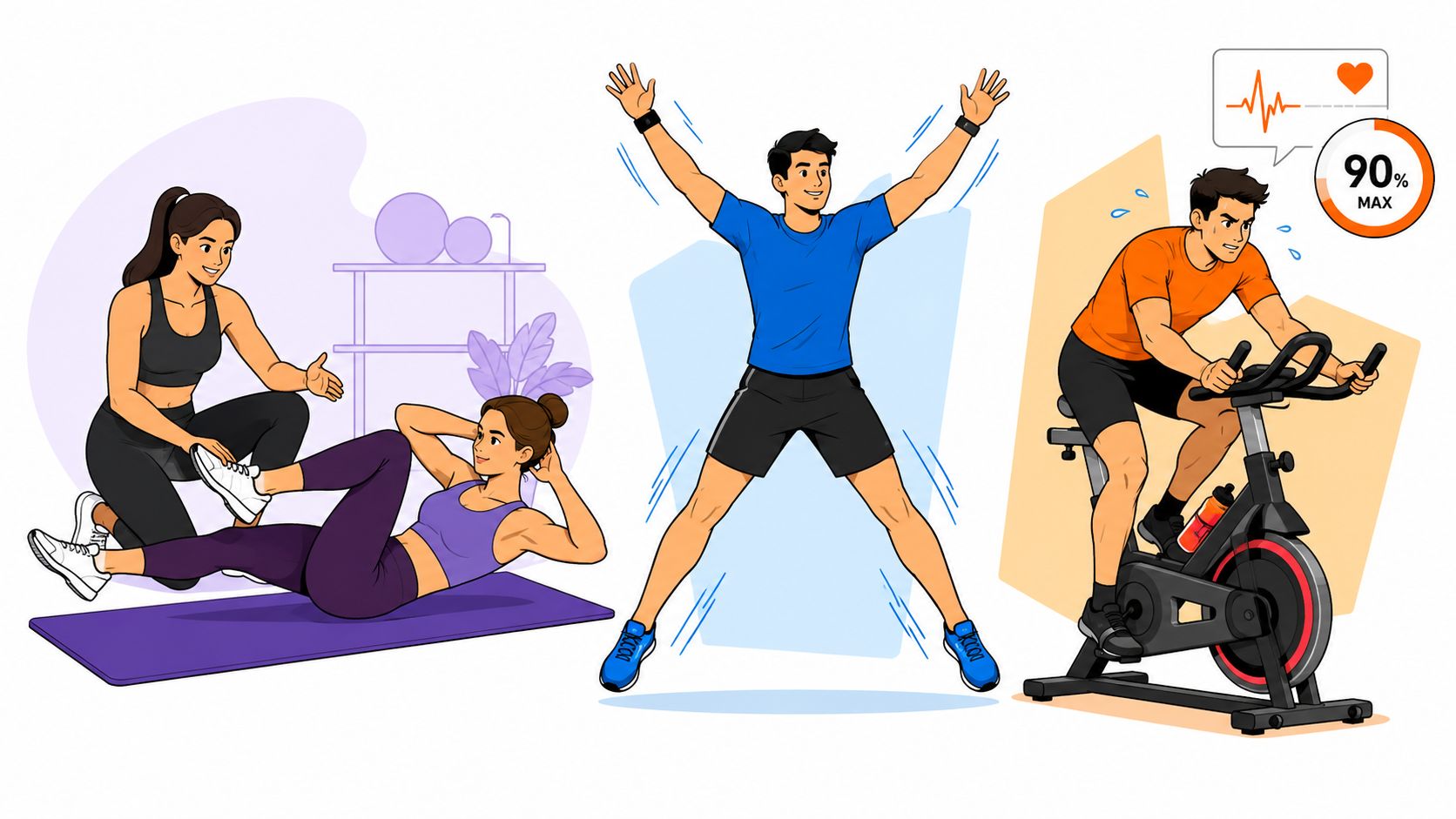
Most advice on a criss crosses workout starts from the wrong assumption. It treats criss cross as one exercise, usually the Pilates version, and leaves members to guess the rest.
That's a coaching problem and a business problem. Members search for the move, show up with different expectations, and then wonder why their lower back hurts or whether they're even doing the right version. That confusion is real. Fitness enthusiasts frequently ask “why does my lower back hurt?” or “am I doing the right version?” because most guides only cover the Pilates version and omit cardio or cycling variants, creating a gap between what members think they're getting and what coaches teach, as noted in this breakdown of criss cross confusion.
For gym owners and fitness directors, that gap is useful. If your team can teach the three meanings of criss cross clearly, you can program smarter classes, coach safer movement, and market with more precision. A member chasing core control shouldn't land in a fast cardio block by accident. A cyclist looking for threshold work shouldn't get a mat class when they asked for criss cross training.
The Criss Cross Confusion Your Members Face
The phrase criss crosses workout sounds simple. In practice, it means different things to different people on different days.
A Pilates instructor hears rotational abdominal work. A bootcamp coach may hear standing cross-body cardio. A cycling coach may hear a structured threshold session. When your front desk, your class descriptions, and your trainer cues use the same phrase for all three, members fill in the blanks themselves.
Why the confusion matters on the floor
This isn't just semantics. It affects class fit, member confidence, and injury risk.
If a member with a sensitive back joins a class expecting low-impact standing movement and gets loaded with repeated spinal rotation on a mat, trust drops fast. If a rider sees “criss cross” on the schedule and expects bike intervals but walks into a core class, the session starts with friction instead of buy-in.
Practical rule: If an exercise name can mean multiple things, your schedule and your coaches need to name the version, the goal, and the setting.
That one rule improves both teaching and retention. Members don't like guessing. They like knowing whether they're walking into core work, cardio, or cycling power development.
What strong operators do differently
The best clubs don't rely on a catchy move name alone. They package the move around the outcome:
- For Pilates members: call out obliques, control, and spinal mobility.
- For HIIT participants: call out rhythm, coordination, and heart rate.
- For cyclists: call out threshold structure and variable power demands.
- For beginners: call out modifications and back-friendly setup before intensity.
This approach also helps your sales team. It gives them language that matches the member's goal instead of forcing every prospect into a generic “core class” bucket.
A criss crosses workout can be a great programming asset. It just stops working when your brand treats three different training tools like they're interchangeable.
The Three Types of Criss Cross Workouts Explained
The easiest way to clean this up is to separate the term into three distinct training products. Once you do that, coaching gets sharper and class descriptions get easier to sell.

A quick comparison
| Version | Primary goal | Best setting | What members usually need |
|---|---|---|---|
| Pilates Criss Cross | Oblique strength, trunk control, spinal mobility | Pilates, core, small group training | Slow coaching, setup detail, breathing cues |
| Standing criss cross | Coordination and cardio flow | Bootcamp, warm-ups, group exercise circuits | Rhythm, low-impact options, clear tempo |
| Cycling Criss-Cross | Variable power output and threshold work | Indoor cycling, endurance coaching | Bike metrics, pacing discipline, interval compliance |
Pilates Criss Cross
This is the commonly understood version, and it's the one most online content describes. The movement uses torso rotation with leg extension to challenge the obliques and deeper core stabilizers. It belongs in mat Pilates, core circuits, and movement-quality blocks where precision matters more than speed.
From a programming standpoint, this version works best when the coach can see everyone's pelvis, rib position, and neck tension. It loses value in crowded, noisy environments where members rush to “touch elbow to knee” and stop controlling the actual rotation.
Standing criss cross
The standing version is the cardio cousin. Think of it as a cross-body jumping or stepping pattern used in warm-ups, low-equipment circuits, or dance-inspired conditioning. It's useful because it's accessible, easy to scale, and doesn't require anyone to get on the floor.
It also solves a commercial problem. Some members hear “core” and mentally check out. A standing variation gives you a gateway movement that feels energetic and friendly, especially in general population classes.
Use it when the goal is to build momentum, raise temperature, and improve coordination. Don't confuse it with the Pilates move just because the names match.
Cycling Criss-Cross
On the bike, Criss-Cross means something far more specific. The cycling Criss-Cross is a 65-minute threshold protocol with alternating 2-minute intervals at 90% and 100% of Functional Threshold Power (FTP) to simulate rolling road conditions and improve variable power output, according to this cycling workout reference.
That means it's not a generic “hard ride.” It's a structured session for riders who need to handle changing demands without falling apart when power fluctuates. In a club setting, this is a premium coaching opportunity. It gives your cycling program a more performance-led identity and a reason for serious riders to keep showing up.
Members stay more engaged when the same exercise name leads to clearly different experiences tied to clearly different outcomes.
If you label these three versions correctly, your timetable gets easier to understand, your trainers coach with more confidence, and your members stop treating “criss cross” like a vague internet term.
Coaching the Perfect Pilates Criss Cross
Most members don't need more reps of the Pilates Criss Cross. They need better reps.
This exercise pays off when the setup is exact and the tempo stays honest. When coaches rush it, members feel their neck, hip flexors, or lower back more than their obliques. When coaches slow it down and cue the pattern correctly, the move becomes one of the best rotational core drills you can teach in a mat setting.

The setup that makes the move work
Start with the member on the mat in tabletop. The hips and knees should be at 90 degrees, with shins parallel to the floor. Hands go behind the head, elbows wide, and the head, neck, and shoulders lift into an abdominal prep.
From there, the key action is clean and specific. One leg extends to a 45-degree angle while the torso rotates, bringing the opposite shoulder toward the bent knee. The rotation happens at the waist while the hips stay stationary to prevent pelvic rocking, as detailed in this Pilates technique guide.
That's the difference between a coached exercise and a casual crunch variation. The member isn't chasing elbow-to-knee contact. They're creating a diagonal line through the trunk while controlling the pelvis.
Coaching cues that actually land
I've found that members respond best when cues focus on what should stay quiet as much as what should move.
Use cues like:
- Keep the pelvis still: the hips shouldn't sway side to side.
- Reach the long leg away: don't just drop it out.
- Rotate the ribcage: avoid yanking the neck forward.
- Return to center with control: the reset matters.
- Breathe with the twist: exhale into the rotation, then come back deliberately.
A lot of instructors overcue the hands. The hands matter, but mainly because they should support the head without pulling. A key coaching achievement is getting the member to understand that the trunk rotates while the lower body stays organized.
For coaches working on class leadership, strong cueing in moves like this separates a decent class from a memorable one. Better verbal precision also makes group instruction easier to scale, especially in mixed-level formats. A resource on group fitness instruction can, therefore, help sharpen delivery and floor presence.
Slow beats sloppy. If members can't pause in the center without losing position, they're moving too fast.
The mistakes that drain the benefit
The common errors are predictable:
- Pulling the bent knee inward to force a fake “connection.”
- Rocking the pelvis instead of rotating through the waist.
- Tugging on the neck with the hands.
- Rushing side to side until it turns into momentum.
Another issue is intent. Members often treat this like an ab-burner only. In reality, the lift-and-twist pattern is valuable because it blends deep core engagement with functional movement. Done well, it improves how members organize the trunk during rotation rather than just how much fatigue they can tolerate.
That's why this version of a criss crosses workout belongs with instructors who can coach detail, not just count reps.
Progressions Regressions and Safety Cues
The best coaches don't ask whether Criss Cross is a good exercise. They ask for whom, on what day, and under what constraints.
That's the frame that keeps a criss crosses workout useful across a broad member base. The same move can be effective for a trained member in a Pilates class and a poor fit for someone who can't hold tabletop without losing lumbar control.

Regressions that preserve the pattern
If a member struggles, don't abandon the movement pattern right away. Strip it down.
Good regressions include:
- Feet down rotation work: keep both feet on the floor and train the upper-body pattern first.
- Smaller leg reach: shorten the lever so the member can keep the trunk organized.
- Reduced range of twist: teach controlled rotation before chasing amplitude.
- Head supported rest intervals: let the neck relax between reps if tension takes over.
These options keep the exercise recognizable while reducing the load on the system. That matters in group settings because members still feel included in the class rather than removed from it.
What to do when lower back discomfort shows up
Lower back complaints are common with this move, and lazy fixes don't help. A common suggestion is placing the hands under the glutes, but a better approach is to maintain low back contact with the mat and focus on core stability to protect the lumbar spine, as discussed in this lower-back modification reference.
In practice, that means checking three things fast:
| Checkpoint | What you want | What usually goes wrong |
|---|---|---|
| Lumbar position | Stable contact and controlled trunk tension | Back arches as the leg reaches |
| Leg reach | Long but manageable extension | Member reaches too low, too soon |
| Rotation source | Ribcage and waist | Member yanks from shoulders or neck |
If the back hurts, I usually reduce the leg reach before I reduce the rotation. A leg that extends too aggressively often creates the loss of control. Once the member can keep the trunk stable, the twist starts feeling productive instead of threatening.
If a member says they feel the move mostly in the lower back, treat that as feedback, not resistance. The setup needs changing.
Progressions that earn their place
Progressions should increase challenge without changing the identity of the exercise.
Try:
- Longer controlled sequences: keep quality high through sustained work.
- Slower tempo: more time under tension reveals weak control fast.
- Band-resisted reach or press variation: useful in small-group training if the member already owns the bodyweight version.
- More demanding transitions: add precise center pauses between sides.
What doesn't work is throwing complexity at members before they can stabilize. A wobblier setup doesn't automatically make a core exercise better. In most classes, better control is the progression that improves results.
Programming Criss Crosses Into Your Classes
Criss Cross becomes more valuable when you stop treating it like filler between bigger exercises. It can anchor a core block, finish a class cleanly, or create a themed challenge that gives members something easy to remember and talk about.
The key is matching the version to the class promise. If the class sells posture, control, and trunk strength, use the Pilates version. If the class sells sweat and pace, use standing criss cross. If the class sells performance, reserve the name for the bike session and coach it like a premium interval workout.
Three ways to use it immediately
A few formats work especially well on the gym floor:
- Oblique finisher in strength classes: place Pilates Criss Cross near the end, after major lifts, when members can focus on quality over load.
- Core focus block in group exercise: pair it with non-rotational trunk work so members feel the contrast between anti-movement control and rotational strength.
- Club-wide challenge theme: build a short member challenge around consistency, coaching quality, and progression options rather than speed.
If your instructors need fresh templates for these kinds of formats, group exercise ideas can help expand the schedule without turning every class into the same circuit with a new name.
Volume and pacing that make sense
The standard training volume for the Pilates Criss Cross is 2 to 3 sets of 10 to 20 repetitions per side, with beginners starting slower at 8 to 12 reps per side, while advanced members can aim for a continuous movement sequence lasting up to 45 seconds, according to this training guide.
That gives you enough structure to program it confidently without overcomplicating the block.
A practical class layout might look like this:
- Teach the pattern first with a few coached practice reps.
- Run the working sets inside a core station or finisher.
- Give a reset window before the next demand so members don't carry neck tension or rushed breathing forward.
What works and what doesn't
What works is using Criss Cross with purpose. It fits neatly into classes where members can feel the difference between controlled rotation and random flailing.
What doesn't work is burying it in the middle of a frantic circuit where no one can hear cues and everyone is chasing speed. In that setting, the move becomes a neck-pulling contest. Members may still sweat, but they won't learn.
That trade-off matters. Better programming isn't about adding more exercises. It's about putting the right move in the right moment and coaching it well enough that members want to come back for the next round.
Marketing The Move and Keeping Your Gym Clean
Criss Cross is hard to market well because the name is doing too much work. A member sees "criss cross workout" on the schedule and may expect a Pilates core block, a fast standing cardio pattern, or a cycling interval class. If your offer is vague, the class feels mismatched before the warm-up starts.
Clear positioning fixes that.
Call out the version, the goal, and the class feel in the title and description. "Pilates Criss Cross for Core Control" tells a very different story than "Standing Criss Cross Cardio Intervals" or "Criss Cross Climb Ride." That naming discipline helps the right members book, helps coaches set expectations faster, and cuts down on the small trust loss that happens when a class promise feels fuzzy.

Market the outcome each version delivers
Members rarely buy exercise names. They buy the result they believe they will feel.
For the Pilates version, lead with control, posture, and deeper core awareness. For the cardio version, sell coordination, heart rate, and a low-equipment sweat option. For the cycling version, focus on rhythm changes, power shifts, and ride variety. The same phrase, "criss cross," can support three different campaigns if the promised outcome is specific.
I also like to give instructors one line they can repeat in class and on camera. Something like: "This is our rotation pattern for core control," or "This is our cross-body cardio drill for coordination and conditioning." That consistency sharpens your brand voice across reels, posters, front-desk conversations, and class descriptions.
If your team needs a stronger campaign plan around specialty formats, review these marketing strategies for gym class promotion and retention. It helps turn a good class idea into a message members understand quickly.
Show coaching quality before you sell intensity
A short form video of one clean rep often outperforms a loud hype clip. Prospective members want evidence that your staff can teach, not just perform.
Good Criss Cross marketing content usually includes:
- a class label that identifies the version clearly
- one coaching cue that improves form right away
- one regression so beginners feel welcome
- one reason the move belongs in that specific class format
That last point matters for retention. If members understand why the move is in Pilates, cardio, or cycling, they are more likely to trust the programming instead of seeing it as recycled class filler.
Gyms also lose sign-ups by using insider language without explaining the payoff. If your captions and landing pages are cluttered or vague, review this guide on how to avoid marketing blunders before the next launch.
Clean presentation supports the promise
Cleanliness is part of the offer, especially for mat-based classes. A member who sees sweaty mats stacked in a corner will question your standards before they judge your coaching.
For Pilates Criss Cross sessions, clean mats, floor contact points, and shared props as soon as class ends. For cycling, wipe bars, saddles, adjustment knobs, and touchpoints between rides. For cardio classes, place wipes where members exit the floor so cleanup happens while the habit is fresh.
Visible systems work better than verbal reminders alone. Keep gym wipes easy to reach, place a gym wipe dispenser near the studio or cycle room entrance, and use commercial disinfecting wipes for the highest-touch surfaces. In mixed-use spaces, separate wipes for gym equipment from yoga mat wipes with simple labels so members know what goes where.
If you are comparing supply options, Wipes.com disinfecting wipes for fitness facilities is a practical place to start for gym equipment cleaning wipes, sanitizing wipes, and other fitness center wipes that support a cleaner member experience.
Clean mats, stocked stations, and instructors who reset the room quickly signal professionalism. That signal matters. It tells members your gym can coach details and manage standards, which is exactly the message you want attached to a move that already carries three different meanings.
The gyms that win with Criss Cross do two things well. They explain exactly what version they teach, and they make the room feel cared for every time members walk in.
Leave a Reply