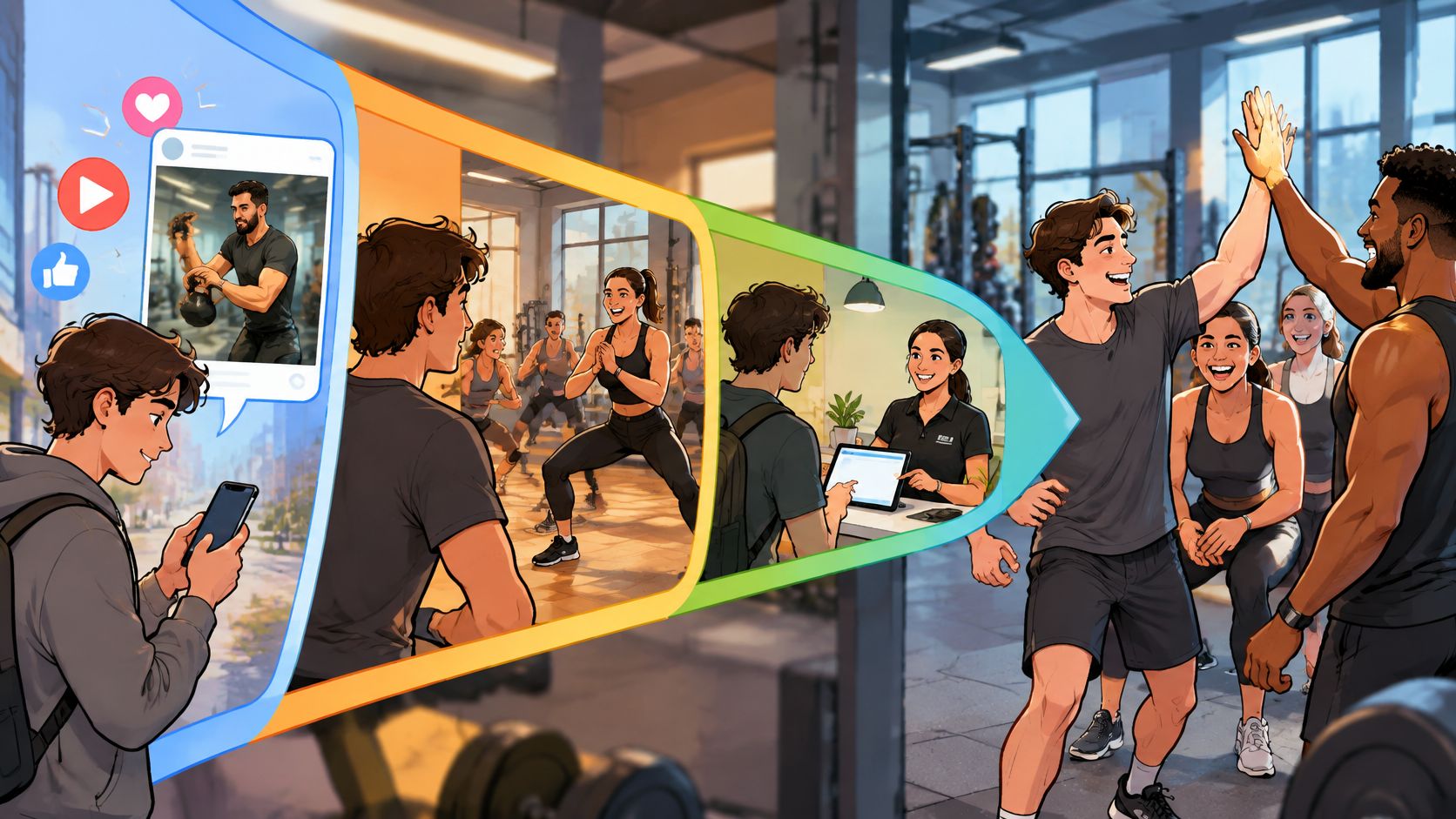
You're posting class clips every morning, answering comments between sessions, and watching the likes climb. Then Thursday arrives and half the intro spots are still empty. That gap isn't an effort problem. It's a handoff problem, and fixing it starts when you stop treating posts as the plan and start building a path.
Why Your Gym Posts Are Not a Funnel
A studio owner films a coach cueing a deadlift, adds a trending sound, and posts it by 7 a.m. Members comment. A few locals save it. Nobody books.
A social media marketing funnel is different from a content calendar. A calendar asks, what do we post today. A funnel asks, what does this person do next, and what helps them do it. One fills a feed. The other fills a trial class, a tour slot, and eventually a membership.
Think about your own floor. A walk in doesn't get handed a contract at the door. Someone greets them, shows them around, answers the awkward questions, and only then talks pricing. Your social content needs those same handoffs, just on a phone.
Four Jobs Your Calendar Is Probably Mixing Together
- Get found: A stranger within driving distance sees proof that real people like them train with you.
- Earn a second look: That stranger compares you with the big box gym down the road and checks whether beginners fit in.
- Book a trial or tour: They pick a date and show up, which is where your team does its best work.
- Keep the member: They stay, bring a friend, and post their own progress, which feeds the first job again.
Most gym calendars do job one on repeat and wonder why job three never happens.
The opportunity at the top is real. DataReportal's Digital 2025 analysis put active social media user identities at 5.24 billion worldwide, or 63.9% of the global population, up 4.1% and about 206 million identities in 12 months. Social reached 94.2% of internet users, and people reported using an average of 6.83 platforms monthly.
Those identities aren't unique people, and they certainly aren't qualified prospects in your postcode. DataReportal itself cautions about that. What the scale tells you is simpler. Your future members are already scrolling, probably on several apps, before they ever search for a gym near them.
Reach gives you raw material. Only clear next steps turn that material into bookings.
Prospects also rarely move in a neat straight line from first post to front desk, so your system needs ways back in, not just ways down.
So check your last ten posts against the four jobs. If nine of them only chase attention, you've found your leak. You don't need more content. You need content in the right order.
How a Social Media Marketing Funnel Actually Moves
Forget the slide image from marketing textbooks. Picture four rooms in your own facility. People wander in, wander out, check their phone, come back next week with a friend. Your funnel works the same way.

The Four Rooms
Awareness is the window. A non member walking past sees energy inside. On social, that's a transformation story told in plain words, a trainer demo a beginner can copy, a local challenge with familiar street names, or a short clip answering one question. The job isn't selling. It's getting a nod of recognition.
Consideration is the tour. Now they're inside looking closely. They want to know the difference between your class formats, whether coaches are qualified, what happens if they need to freeze, and whether they'll be the least fit person there. Honest explainers and member Q&A do this work. Vague hype doesn't.
Conversion is the sign up desk. One clear offer, one clear action. A trial class, a consultation, a tour at a set time, or a specific starter plan. If someone has to hunt for the booking link, you've added friction at the worst moment.
Retention is the community floor. Progress check ins, member challenges, shout outs for milestones, and referral prompts. This room keeps people paying and creates the proof that fills your window.
Why People Leave and Come Back
Real buying paths are messy. Research on flexible purchase paths found 87% of consumers switch between digital activities at least once an hour, 42% describe their path as entirely random, and 71% get distracted during research and return after a prompt. That same research found 72% of consumers under 34 have purchased inside a social app, so your website isn't the only finish line.
A prospect might see a TikTok at lunch, read Google reviews on the train, send a DM about parking, forget for four days, then walk in because they drove past. None of that is failure. That's normal.
Build re entry points that respect consent. A gentle reminder after a pricing page visit. A helpful reply when someone asks about cancellation. Retargeting for people who watched most of a trial class video. A front desk question that catches walk ins who first found you on Instagram.
Skipping these loops is one of the common funnel analysis mistakes that makes healthy campaigns look broken. Label every asset you own by room, then name one way back in for someone who stalls in each one. That small exercise changes how you brief every post from here on.
Platform Plays and Content Sequences That Fit Each Stage
Platform choice matters less than audience temperature. A freezing cold local and a warm pricing page visitor shouldn't see the same video, even if both open Instagram first.

Match the Surface to the Temperature
Cold local audiences get short native video on Instagram Reels, Facebook, and TikTok. Keep each clip to one problem, one demo, one neighbourhood cue. A coach fixing a goblet squat in 20 seconds, filmed on your actual floor, beats a polished brand film.
Warm audiences get depth. Carousel explainers comparing class types, a member answering beginner questions on camera, or a Google review shared with a short reply from the owner. These go to profile visitors and people who watched most of your cold videos.
Hot audiences get one offer with a date, a cap, and a booking link or lead form. No menu of five options. They've already decided they're interested. Your job is making the next step easy.
One Week You Can Film on a Phone
- Three awareness clips: One trainer demo, one member moment, one local challenge teaser, each under a minute.
- One consideration piece: A side by side of your two most confusing class formats, who each suits, and what week one feels like.
- One conversion invitation: This week's intro slots, shown only to engaged viewers and site visitors.
- One retention loop: A progress check post that ends with a bring a friend prompt for current members.
That's the difference between prospecting and retargeting. Prospecting finds new locals. Retargeting pools built from video views, profile visits, site visits, and lead form starts talk only to people who've raised a hand.
There's a good reason to keep that split firm. A Marketing Science Institute study found social media targeting positively associated with conversions among lower funnel consumers, while cross platform targeting helped lower funnel audiences but showed no measurable synergy for upper funnel consumers, across 101 million impressions and only 1,555 purchases. Blanketing the whole town on every platform wastes spend. Saving cross platform pressure for warm audiences puts it where it pays.
Once someone books, don't let the handoff die. A thoughtful welcome email sequence that confirms the visit and sets expectations carries the conversation from their feed to your front door without staff chasing manually.
Fitness Ad Examples That Match Audience Temperature
Let's make this concrete. Three ads, three temperatures, each judged by a different standard.

The cold ad opens on a coach setting up a beginner strength station, filmed vertically with captions on. The hook is a plain promise for people nearby who feel nervous starting. It ends by pointing to this week's intro class times. No hard close, no discount countdown. You're buying a second look, not a signature.
The warm ad tells one member's story with their actual schedule in it. Two sessions a week around school drop off, first month nerves and all. It goes to people who watched the demo or visited pricing, and it offers a free consultation. The story answers the objection, which is fit, not price.
The hot ad shows a limited intro block with the booking time visible on screen. It reaches lead form starters and recent site visitors. Short copy, one button, done.
The Cheap Lead Trap
Compare two forms. One asks only for an email address and returns plenty of cheap leads who never reply. The other asks preferred training time and main goal. It'll return fewer leads, but your team can open a real conversation with every one of them.
Practical rule: Judge an ad by attended consultations and new members, not by how cheaply it collects email addresses.
Benchmarks support that caution. A 2025 benchmark for Meta lead generation campaigns reported a 7.72% overall conversion rate, down from 8.67% the prior year, while cost per lead rose 21% to $27.66. Those are U.S. oriented figures, directional rather than a quota for your facility. A rising form fill rate can still hide falling show up rates.
So close the loop in your CRM. Log consultation attendance, join date, plan value, and cancellations against the campaign that sourced each lead. Then compare creative variants on member acquisition cost, not lead volume. For more creative patterns by placement, work through these fitness ad examples built for Facebook audiences and adapt one per temperature before you spend anything new.
Metrics That Show Which Stage Is Working
One overall conversion rate tells you almost nothing about a gym funnel. Awareness ads and decision ads do different jobs, so they deserve different scorecards.
Read the Transitions, Not Just the Total
One benchmark set reports average conversion rates of 0.6% for top of funnel awareness ads, 1.8% for middle of funnel consideration ads, and 3.2% for bottom of funnel decision ads. Treat those as directional. Audience, offer, and tracking setup will move your numbers.
Directional Social Funnel Benchmarks for Gyms
| Funnel point | Directional rate | Gym reading |
|---|---|---|
| Impressions to profile visits | 1% to 3% | Did the window display make locals stop |
| Profile visits to website clicks | 10% to 25% | Did the tour content earn a closer look |
| Website clicks to sign ups or leads | 3% to 8% | Did the desk make booking easy |
If profile visits are healthy but website clicks sag, your consideration content isn't answering doubts. If clicks are fine but leads stall, your offer or form is the problem. The transition points at the leak.
Give Early Touches Their Credit
A prospect watches your coach's video on Monday, searches your name on Thursday, and books. Last click reporting hands all the credit to search. Do that for a month and you'll cut the very ads creating your demand.
Set up separate events for video engagement, landing page visit, lead submission, trial booking, show up, and membership sale. Before moving budget, compare last interaction against a position based, linear, or data driven model so earlier touches keep visible value.
Then make your decisions on cost per attended consultation and cost per acquired member. Cost per lead is a vanity shortcut that punishes quality.
You don't need expensive software to triangulate. Try this small gym set:
- Ask every lead: One required field or desk question, how did you hear about us, logged every time.
- Use campaign specific doors: QR codes on posters and dedicated landing pages per offer.
- Watch the cluster together: Branded searches, qualified inquiries, tour attendance, and new member source notes rising together means social is working even when direct clicks look thin.
That's how you tell a healthy top of funnel from a campaign that only looks cheap.
How to Choose the Right Funnel Tools and Offers
Most owners face three real options, not an endless software list. Each solves a different problem, so choose by the gap you have.
Running ads from memory costs nothing and launches today. It also means every campaign depends on whoever's on shift, follow up lives in someone's inbox, and the front desk improvises the membership conversation. Fine for a first test. Fragile after that.
Stitching free native tools gives you scheduling, lead forms, and basic retargeting inside the platforms you already use. This works when your offer is clear and your main problem is the wrong people seeing it. Tighten audience splits before buying anything.
Using a fitness sales playbook helps when the offer itself is muddy. Gym Membership Tips fits as one option, with practical guidance for owners, studio operators, and fitness sales teams on membership packages, pricing structure, trial offers, social campaign ideas, and follow up that turns a booked visit into a longer stay. Ad platforms deliver reach. They don't write the conversation your staff has at the desk.
A Quick Decision Check
- Offer clarity: Can a new staff member explain your trial and best fit plan in two sentences.
- Speed to launch: Can you get one campaign live this week without a rebuild.
- Follow up: Does every lead get a confirmation, a reminder, and a no show rescue message.
- Desk readiness: Does the landing page promise match what staff say.
Your page matters here too, so build it from a gym landing page template structured around one offer and one booking action rather than sending ad traffic to a general homepage.
If trials book and then no show, fix confirmations and your desk script before buying more awareness. If content production is the bottleneck, look at how ai social media marketing tools can handle drafting and scheduling while your coaches stay on the floor. Match the tool to the leak, not to the loudest sales pitch.
Put the Funnel to Work and Keep the Floor Clean
A gym funnel works like the floor after class: people leave, come back, bring friends, and re-enter only when the door is open and they expect to be welcomed. Your job this week is to mark those doors clearly.

Your One Week Start
- Label what you have: Sort last month of posts into awareness, consideration, conversion, or retention and spot the empty room.
- Film two pieces: One awareness clip a nervous beginner would save, and one consideration explainer answering your most common DM question.
- Switch on one offer: Show a single trial or tour invitation only to people who have already engaged.
- Prompt your members: Post one progress check that ends with a simple referral ask.
Keep the scoreboard small. Track lead, attended trial or tour, and new member this month, then connect each number to the stage that fed it. A save points to awareness. A replied-to DM points to consideration. A booked visit points to conversion. A referral points back to retention and starts the loop again.
Make Re-Entry Earned
Re-entry should feel like consent, not pursuit. Someone who watched three videos can see a tour offer. Someone who opted into texts can get the reminder. Someone who finished a trial can get the “first week plan” message instead of a generic sales blast. Each step uses a signal the person already gave you.
Offline proof keeps the loop honest. The front desk knows who showed, coaches know who came back after day one, and members know whether the promise matched the room. If Tuesday's beginner class is full of people who found you through a saved clip, that is the funnel working in sneakers, not just in dashboards.
Start tonight. Sort the posts, film the beginner clip tomorrow, put one clear trial offer in front of warm viewers, and ask one happy member for a referral before Friday. By next week you will know which stage pulled people in, which stage let them drift, and which door needs a clearer sign.
Leave a Reply