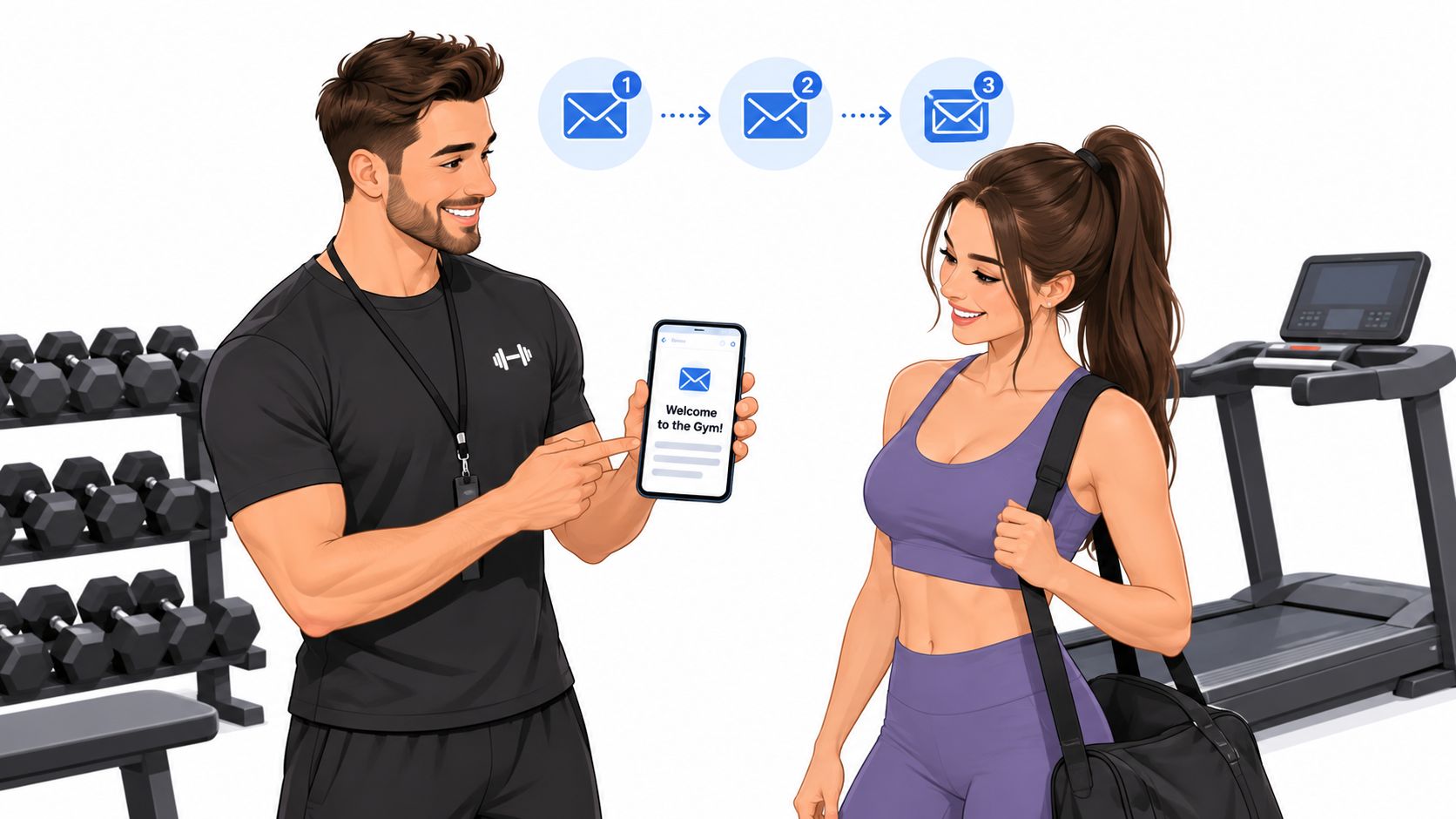
A new lead submits a free-trial form at 9:07 p.m. on a Sunday. By the time your gym responds, that lead has already compared two nearby facilities, forgotten what the trial included, and lost confidence that anyone is paying attention. The welcome email sequence should prevent that gap. It should function as a member-onboarding system that confirms the next step, answers practical questions, builds trust, and moves the right prospects toward membership without treating every subscriber like a discount hunter.
Why a Generic Welcome Email Leaves Gym Revenue on the Table
At 5:07 a.m. Monday, the lead receives an email titled “Welcome to our newsletter!” It mentions a membership discount that expired two weeks ago, says nothing about the free trial, and offers no booking link. The gym owner may believe the automation is working because a message went out. The prospect experiences something else entirely, a delayed and irrelevant response at the exact moment they wanted reassurance.
That mistake appears often because gym teams adapt templates written for retail brands, software companies, or general newsletters. Those templates might introduce a brand and promote a product, but they usually skip the fitness details that remove first-visit anxiety:
- Booking confirmation: The prospect needs to know whether the class, tour, or trial is reserved.
- Arrival guidance: Parking, check-in, clothing, equipment, and the right entrance matter more than a broad brand statement.
- A clear next action: A new lead should know whether to book a class, reply with a question, or arrive at a set time.
- Expectation setting: The email should explain what happens next and when the gym will contact them.
A welcome email sequence earns its place because it reaches people during a high-intent moment. Welcome emails have been reported at about four times the open rates and five times the click rates of bulk promotions in one widely cited analysis, while another benchmark set reported an 83.63% average open rate, 16.60% click-through rate, and 0.94% unsubscribe rate for welcome messages (Campaign Monitor's welcome email benchmarks). The figures vary by dataset, but the operating lesson is consistent. A new subscriber is more receptive immediately after taking action than after receiving a generic campaign days later.
Practical rule: The first email should make the prospect feel expected, not merely added to a list.
Before activating the flow, validate the addresses collected through lead forms and booking widgets. An Email Validation API can help a marketing team identify invalid or risky addresses before they damage deliverability, but validation won't fix weak messaging. The sequence still needs to reflect the prospect's actual entry point.
The cost of getting that first interaction wrong isn't only a missed click. A trial lead who never books a class may be comparing your gym with a competitor that replied immediately, explained exactly what to bring, and offered a simple appointment. The fix is to design the first 72 hours around the questions gym prospects ask, then let later emails handle trust, objections, and conversion.
Planning the Sequence Before You Write a Single Email
A free-trial lead submits a form at 11:45 p.m. A class-booking prospect expects arrival details, while a newsletter reader may only want training advice. Put all three into one identical flow and the timing, subject line, and CTA will miss at least two of them. Map the member-onboarding system before writing copy.
A five to seven-email welcome email sequence over 10 to 14 days gives a gym room to confirm the next step, build trust, answer objections, and invite membership without making every message a sales pitch. A three-email series has been reported to generate 90% more orders than a single welcome email, while one benchmark set reported about $6.16 in revenue per email for welcome flows (Mailmodo's welcome email statistics).
| Signup source | First message | Later path | Exit rule |
|---|---|---|---|
| Free trial | Confirm the trial, arrival details, and what to bring within 15 minutes | Proof, beginner guidance, and a membership decision before the trial window closes | Stop promotional emails when the lead becomes a member |
| Class booking | Confirm the class and reduce arrival anxiety within 15 minutes | Coach introduction, preparation advice, and a follow-up booking or membership invitation | Exit after a membership purchase |
| Newsletter | Deliver the promised content and introduce the gym's approach | Educational value first, then a relevant class, tour, or trial invitation | Exit when the subscriber books or joins |
Use hour-based delays rather than a simple “wait one day” rule, especially when someone submits a form late at night. Newsletter subscribers can receive a slower, value-first path because their intent is less immediate. For trial and booking leads, the first email should arrive while the action is still fresh.
These are operating guidelines, not guaranteed outcomes. Automated welcome emails have been reported at a 35.53% open rate, 3.94% click rate, 11.19% click-to-open rate, and 2.11% conversion rate in one benchmark set (Digital Applied's welcome onboarding framework). Compare each branch with the gym's own results, prioritizing booked visits, attended introductions, and memberships over opens alone.
Assign one job and one CTA to each email. A first message linking to the timetable, pricing page, trainer bios, social channels, blog, and every membership option creates decision fatigue. The email marketing guide for gyms provides context on connecting email activity with membership sales. In practice, each message should move one behavior forward.
Write the role beside every email in the automation map: confirmation, credibility, proof, objection handling, first visit, or conversion. Add the exit rule before launch, because a paying member should receive onboarding and retention communication, not continued trial-sales emails.
Five Gym-Specific Welcome Email Templates You Can Send Today
These templates are deliberately short. Replace the bracketed details with accurate information, keep one CTA, and remove any message when the subscriber completes the action it requests.
Email one, immediate confirmation
Send delay: Within 15 minutes
Subject: Your first visit to [Gym Name] is ready
Preview text: Your booking details, arrival instructions, and what to bring.
CTA: Confirm your first visit
Email body
Hi [First Name],
Thanks for booking your [free trial/class/tour] at [Gym Name].
You're booked for [date and time] with [coach or class name]. Please arrive at [arrival time] so we can show you where to check in and introduce you to your coach.
Wear comfortable workout clothes and bring water. You can park [parking instruction], and reception is located [entrance instruction].
Your next step is simple:
[Confirm your first visit]
If anything changes, reply to this email and our team will help.
See you soon,
[Name]
[Gym Name]
This message removes purchase anxiety because it confirms that the gym received the request and gives the prospect a practical plan. Guidance on welcome emails also emphasizes thanking the subscriber, reminding them why they signed up, describing what they'll receive, and setting expectations (Cyberimpact's welcome sequence guidance).
Email two, founder story
Send delay: Day 2
Subject: Why we built [Gym Name]
Preview text: The training problem our team wanted to solve.
CTA: Meet your coach
Email body
Hi [First Name],
[Founder Name] opened [Gym Name] because [specific founding reason]. We wanted to create a place where [target member] could train with [specific difference, such as coaching, welcoming classes, or structured progression].
That principle still shapes your first visit. [Coach Name] will show you how the gym works, answer your questions, and help you choose a starting point that fits your goal.
[Meet your coach]
You don't need to arrive experienced. You only need to arrive ready to begin.
[Founder Name]
[Gym Name]
The second email builds trust without repeating the booking confirmation. A real founder detail is more persuasive than a paragraph of generic mission language.
Email three, social proof
Send delay: Day 4
Subject: What members noticed after joining [Gym Name]
Preview text: Real experiences from people who started where you are.
CTA: Read member stories
Email body
Hi [First Name],
Starting somewhere new can feel uncomfortable. That's why we want you to hear from members who arrived with different goals, schedules, and experience levels.
[Member Name] used [specific program or class] to work toward [accurate result or experience]. [Member Name] appreciated [specific service detail]. Their stories show how coaching, consistency, and the right starting point can make training feel manageable.
[Read member stories]
Bring your questions to your first visit. We'll help you find the next step.
[Team Name]
Use genuine reviews and approved member stories. Don't imply a result that a testimonial doesn't support, and don't turn social proof into a promise.
Email four, objection handling
Send delay: Day 7
Subject: Is [Gym Name] right for you?
Preview text: Start with the class, coaching, and pace that fit your goals.
CTA: Find your starting class
Email body
Hi [First Name],
You may be wondering whether [Gym Name] is suitable for your current fitness level, schedule, or goal.
We offer [class types], with beginner guidance available through [intro option or coach consultation]. If you're focused on weight loss, strength, mobility, or building a consistent routine, our team can help you choose a sensible starting point.
You don't need to know every exercise before you arrive. Tell us what you want to improve, and we'll explain the options.
[Find your starting class]
Questions about pricing, class access, or equipment? Reply to this email and we'll answer directly.
[Name]
This email tackles hesitation before the final offer. It should answer the actual objections your front desk hears, not manufacture urgency.
Email five, conversion
Send delay: Day 10 to 14, tied to the actual trial end
Subject: Choose your next step at [Gym Name]
Preview text: Your trial ends [date]. Here are the membership options available to you.
CTA: Choose your membership
Email body
Hi [First Name],
Your [trial/class pass] ends on [date]. You've now seen how [Gym Name] works, and we'd like to help you continue if the experience feels right.
You can choose:
- [Membership option], for [clear benefit].
- [Membership option], for [clear benefit].
- [Membership option], for [clear benefit].
The [accurate deadline or trial-end date] is the point to choose your next step. If you're unsure which option fits, reply with your preferred training schedule and we'll guide you.
[Choose your membership]
Thanks for giving [Gym Name] a try,
[Name]
Tie urgency to the trial end, not an invented countdown. A clear deadline is useful only when it reflects an actual change in access, pricing, or eligibility.
Segmenting New Subscribers by Intent and Fitness Angle
Signup source should determine the first branch. A free-trial lead is asking, “What happens when I arrive?” A class-booking lead is asking, “How do I prepare and attend?” A newsletter subscriber is usually looking for useful training or facility information before considering a purchase. Sending all three the same message discards information your form already collected.

Use a source tag at entry, then add a small amount of stated preference data. A two-question form on the thank-you page can ask for the subscriber's main goal and preferred training format. This is zero-party data because the prospect supplies it directly, and it can guide the content of email three without requiring a complex scoring model.
A practical decision tree
- Free trial signup: Send the welcome, arrival, tour, and conversion track. Emphasize parking, check-in, coaching, trial conditions, and membership options.
- Class booking: Send the preparation and attendance track. Emphasize what to bring, class intensity, substitutions, arrival time, and how to reserve the next class.
- Newsletter or lead magnet: Send the education and nurture track. Establish the gym's expertise before introducing a consultation or membership offer.
- Goal response: Route the subscriber into a relevant content block for weight loss, strength, rehabilitation, or competition preparation by email three.
- Completed action: Move the subscriber to the next lifecycle stage rather than continuing the original pitch.
The segmentation should happen before the second email sends. Guidance on automated welcome flows recommends splitting by signup source or prior action and using progressive profiling or preference data to route future messages (Bloomreach's automated welcome series guidance). The same principle appears in practical lead nurturing best practices.
A common failure is waiting until email five to segment. By then, a trial lead may have received several generic educational messages while the trial window expired. Keep the architecture simple, source branch first, goal branch second, behavior-based exits throughout.
Setting Up the Automation Triggers and Exit Rules
Build the workflow around events, not calendar assumptions. In ActiveCampaign, HubSpot, or Klaviyo, the entry trigger can be a form submission, with a source tag applied at the same time. For example, source_free_trial, source_class_booking, and source_newsletter should route subscribers into distinct starting paths.
Use hour-based delays for the first transition. A lead who submits a form at 11 p.m. shouldn't receive the second message at 6 a.m. because the platform interpreted “one day” as the next calendar morning. Set a quiet period or delay until a reasonable local send window, then continue with the timing assigned to that branch.

The build sequence
- Capture the event: Trigger on the form submission or booking event, not on a manual list upload.
- Apply the source tag: Store the original entry point so later emails retain context.
- Check existing status: Suppress current members, staff, prior purchasers, and active clients from prospect messaging.
- Send the appropriate first email: Use booking details for trials and class instructions for class leads.
- Evaluate behavior: Check for a booking, paid session, reply, purchase, or meaningful lead-score change before each later email.
- Log the outcome: Pass the contact to the correct onboarding, nurture, or win-back workflow.
The exit rule is the part generic templates often omit. Anyone who purchases a membership, books a paid intro session, or reaches your defined lead-score threshold should leave the trial-pitch branch immediately and enter member onboarding or sales follow-up. Paying members must never receive a trial-offer email after conversion.
A useful automate follow-up emails guide can help teams think through event-based follow-up, but your gym's CRM fields and sales process should control the final implementation. For a practical operational reference, keep the client onboarding process template aligned with the automation's post-conversion handoff.
For a trial cancellation, add a re-entry condition. If the subscriber cancels within 14 days, send a win-back variant that acknowledges the cancellation and offers a relevant next step. Don't restart the full welcome email sequence, because the prospect has already received those messages and now needs a different conversation.
A Focused A/B Testing Plan That Lifts Membership Conversions
Testing works when the result answers one question. If you change the subject line, CTA, layout, and offer in one email, you won't know what influenced the outcome. Run a 50/50 split, keep the audience and timing consistent, and test one variable at a time.
The plan below ties each test to a business outcome rather than treating opens as the finish line.
| Test # | Variable Tested | Email Position | Primary KPI | Min. Sample Size |
|---|---|---|---|---|
| 1 | Subject-line length and tone | Email 1 | Trial-to-paid conversion | 1,000 subscribers per variant |
| 2 | CTA copy and button color | Email 2 | Intro-session booking rate | 1,000 subscribers per variant |
| 3 | Send-time window | Email 3 | Click-to-book rate | 1,000 subscribers per variant |
| 4 | Offer framing | Email 4 | Revenue per subscriber | 1,000 subscribers per variant |
| 5 | Trainer introduction versus facility tour | Email 5 | Trial-to-membership conversion | 1,000 subscribers per variant |
Call a winner only after reaching the minimum sample of 1,000 subscribers per variant and a 95% confidence threshold, as specified in this testing framework. These are operating requirements for a clean test, not promises that every gym will have enough volume to reach them quickly.
Your primary dashboard should include trial-to-paid conversion, intro-session booking, and revenue per subscriber within the first 30 days. Click rate can diagnose interest, but it shouldn't outrank a booked visit or paid membership. For practical experimentation ideas, the Otter A/B conversion optimization tips provide a useful testing reference.
Run testing in two-week sprints. Launch one test, read the data, implement the winner, document what changed, and start the next test. Don't leave conflicting variants running across the same audience, and don't optimize every email at once.
KPIs to Track and the Cleaning Tip That Closes the Loop
A welcome sequence should be managed like an onboarding system, not a broadcast report. Review six measures each week, compare them by email position and signup source, and change one part of the flow when a metric weakens. A free-trial lead, a class-booking prospect, and a newsletter subscriber should not share the same expectations or conversion path.
| KPI | Email 1 Benchmark | Email 2–3 Benchmark | Email 4–5 Benchmark | What a Dip Signals |
|---|---|---|---|---|
| Delivered rate | Stable and high | Stable and high | Stable and high | Poor data capture or deliverability trouble |
| Open rate | 42% to 55% | 35% to 45% | 28% to 38% | Weak subject line, timing, or declining relevance |
| Click-to-book rate | Clear booking activity | Growing appointment intent | Conversion-focused action | Friction in the booking path |
| Trial-to-membership conversion rate | Early activation | Consideration | Final decision | Weak offer, poor follow-up, or unresolved objections |
| Revenue per lead | Initial value signal | Qualified interest | Membership contribution | Commercial path isn't matching intent |
| Unsubscribe rate per email slot | Low and controlled | Watch for content mismatch | Watch for pressure or fatigue | Too much repetition or an irrelevant pitch |
These ranges are practical fitness-business operating targets, not universal standards. Use them as internal starting points, then replace them with a baseline built from your own audience and signup sources. Mailmodo's benchmark summary shows why outside comparisons need context: welcome performance changes across datasets. For a gym, booked visits, paid memberships, and revenue per lead matter more than a strong open rate alone.
Turn each weak KPI into one action
- Delivered rate falls: Audit form fields, remove invalid addresses, and review consent capture.
- Email one opens but receives few clicks: Rewrite the CTA, reduce competing links, and confirm that the next action matches the signup source.
- Clicks don't become bookings: Test the booking page, availability, mobile layout, and confirmation process.
- Trials don't become memberships: Add a coach conversation, clarify membership options, or address the objection raised by prospects.
- Unsubscribes spike at one slot: Remove repetition from that email and check whether the offer arrives before the prospect understands the value.
Track the same measures by conversion status. Once a prospect purchases, books a paid membership, or completes the intended conversion action, remove that person from the sales sequence. Send the appropriate member onboarding message instead. This exit rule prevents a new member from receiving trial reminders or pressure to buy after the decision is complete.
The member experience continues after purchase. Add a post-purchase reminder to wipe down benches, handles, mats, and shared equipment between sessions. Place clear cleaning stations where members naturally finish an exercise. Use gym equipment wipes or wipes to disinfect gym equipment according to the product label and your facility's safety procedures. At high-traffic facilities, a gym wipe dispenser and suitable commercial disinfecting wipes make the expected behavior visible without adding friction.
Cleaning supports the promise made in the welcome flow. A facility that feels organized, cared for, and ready for the next session gives new members a better reason to return. It cannot replace retention work, coach follow-up, or a useful first-month experience.
Review the sequence every 30 days. Compare each KPI by source, goal, email position, and conversion status. Keep emails that help members take the next action, rewrite messages that create friction, and update every deadline, class detail, price, and cleaning instruction before another lead enters the flow.
Map signup sources, write the five emails around real gym actions, and connect every purchase or paid booking to an exit rule. Then fix the first weak point in the dashboard, brief the front desk and coaches on the promised experience, and launch a sequence that helps each prospect take the next visit with confidence.
Leave a Reply