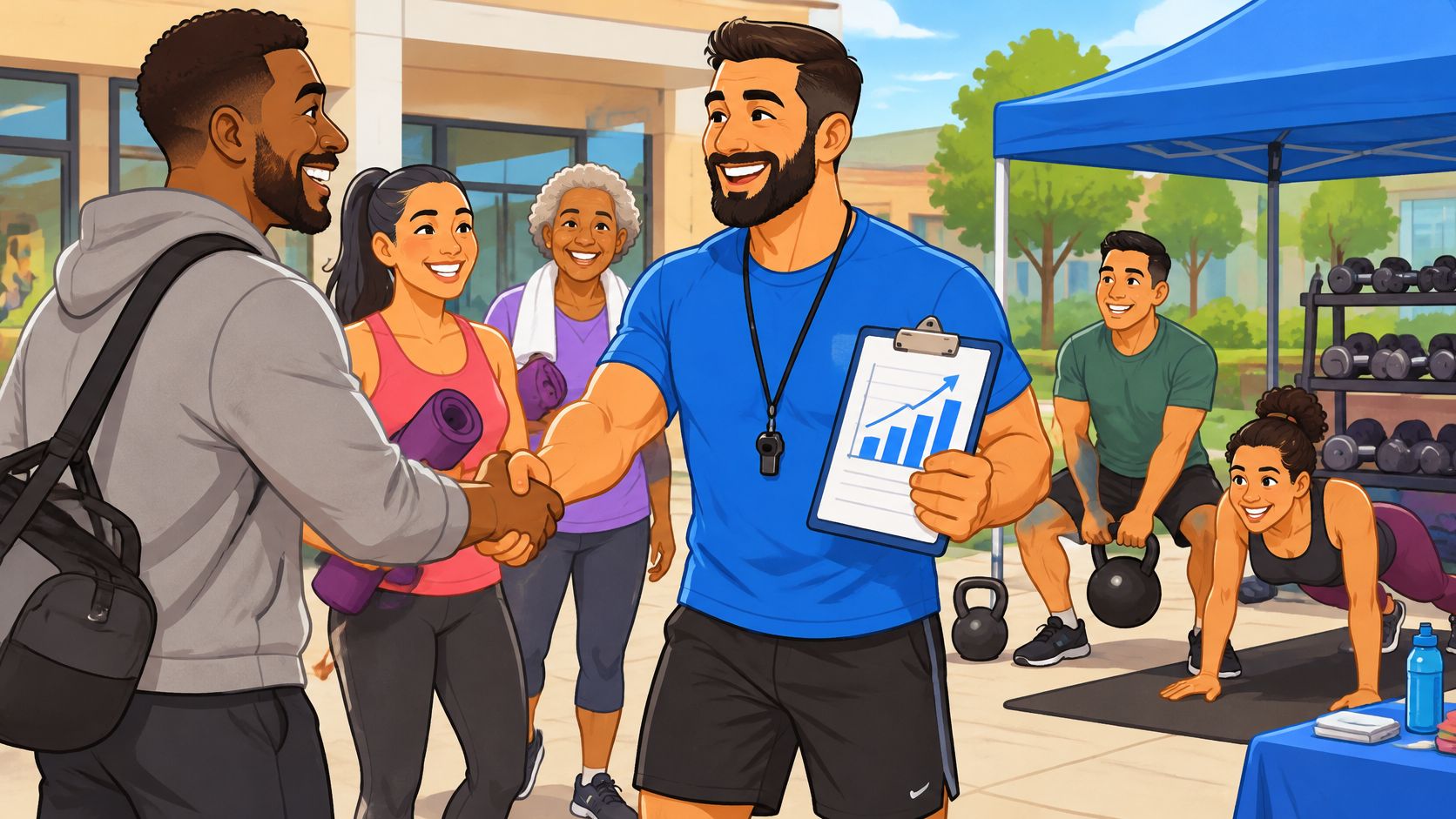
You've booked a free workout, posted it everywhere, and asked your trainers to bring friends. People turn up, enjoy the session, and leave. By the next staff meeting, nobody can tell you who booked a trial, who needed a different class time, or whether the event produced a member.
Learning how to do community outreach starts with fixing that gap. Your gym needs a repeatable way to meet residents, understand what would help them attend, and offer a useful next step. Flyers can support that process. They can't replace it.
Plan and Run a Six-Week Outreach Cycle
Start Monday with a shared spreadsheet, a named campaign owner, and protected staff time. Don't begin with a print order. Begin with the question you want answered: which local group can your gym serve well enough that people try it, join, and keep attending?
The CDC's community-engagement evaluation guidance recommends defining goals, outputs, outcomes, and collection methods before implementation. For a gym, that means deciding what counts as a qualified inquiry, a completed trial, and a new membership before staff start recording results.
Build the campaign before promoting it
Week 1 starts with your baseline. Record memberships sold, trial visits, inquiries, and referral sources using a consistent reporting window. Separate walk-ins, member referrals, employer introductions, and other identifiable sources rather than dropping everything into “local marketing.”
Use your booking system or membership software as the starting point, then reconcile missing sources with the front-desk team. A blank field means unknown, not organic. File the baseline sheet before launching anything, and note operational changes such as a new timetable or enrollment offer that might affect comparisons.
Week 2 defines whom you're serving. Segment inactive adults, parents, employers, and allied health providers by practical attendance constraints. Neighborhood, language, age, and work hours matter when they change the venue, message, or session you should offer.
Set a specific, measurable, achievable, relevant, time-bound objective for each priority group. For example, use 40 qualified trial bookings from a six-week neighborhood partnership as a planning target, not an expected result. Define “qualified” as someone your gym can appropriately serve who understands the offer and has selected an appointment.
Don't launch every segment together if your team can't follow up properly. I would start with the group whose needs best match an existing class, rather than promising a program the coaching team hasn't built.
Week 3 turns ideas into commitments. Match the invitation to the group. Employer referrals suit workplace sessions; library pop-up fitness assessments can introduce beginners to a coach; community-center workshops create room for questions; multilingual posts can support locally relevant invitations.
Contact schools, libraries, faith centers, and employers with a defined proposal. Confirm the venue, date, named contact, staffing responsibilities, and promotion arrangements in writing. File the signed partner list and event calendar, including email confirmations where appropriate.
Give each partner a distinct source label on your registration form. A dropdown such as “library workshop” is more useful than asking staff to reconstruct the source after someone joins.
Run the event without losing the next step
Week 4 delivers the first useful experience. Run the free workout, assessment, or beginner workshop with a clear scope. Tell attendees what will happen, what equipment they need, and whether they can participate without previous gym experience.
Keep an attendee list with explicit contact consent and preferred communication method. Separate permission to receive follow-up from attendance registration, and don't make promotional consent the price of joining a free activity. File attendance, participant questions, and any access problems staff couldn't resolve.
Week 5 connects attendance to action. Record each consenting participant's source, event attendance, consultation booking, trial start, membership decision, and subsequent attendance. Assign a staff owner to unanswered questions rather than letting them disappear into a shared inbox.
The handoff from response to appointment deserves its own workflow. Recepta.ai's resource on how to turn campaign responses into booked appointments is useful when you're designing that transition. Keep the actual booking choice simple: a suitable session, a named coach, and a clear confirmation.
File booked trials and the message log. Keep longer-term attendance and retention fields open, because you won't know every outcome before the campaign review.
Week 6 is a decision meeting. Compare channels against the baseline, then repeat the review every two weeks. Move effort toward channels producing stronger trial-to-member conversion at a cost you can support, while checking whether those members attend.
Don't cancel a promising partnership because its first session was small. Distinguish poor reach from poor fit: an employer might need a shift-friendly time, while a busy event with no trial bookings may have attracted people who never wanted the service.
Six-week outreach timeline
| Week | Main Task | Output to Have on File |
|---|---|---|
| Week 1 | Record baseline memberships, trial visits and inquiries | Baseline sheet with referral sources |
| Week 2 | Segment priority groups and set one objective per group | Segment list with target bookings |
| Week 3 | Recruit partners and book venues and dates | Signed partner list and event calendar |
| Week 4 | Run the first event with a sign-up sheet | Attendee list with contact consent |
| Week 5 | Start repeat contact and the follow-up sequence | Booked trials and message log |
| Week 6 | Review channels against baseline and reallocate effort | Channel scorecard and next-month plan |
Management check: Name the source of your last three new members. If nobody can, you skipped the practical work of week one.
Score Channels Against a Real Baseline
A crowded event and a successful acquisition channel aren't the same thing. In its 2025 community-health snapshot, Kaiser Permanente reported 2,737 people engaged, a 10% increase, and 5,470 services delivered, up 20% year over year. Those are service-program results, not gym conversion benchmarks, and totals alone don't tell you who returned.
Your gym's scorecard should answer a narrower commercial question: which channel brings suitable members who keep using the service?
Calculate outcomes consistently
Use the same definitions across channels. A completed trial isn't a booking, and a reachable prospect isn't everyone who might have passed a poster.
Channel metrics and how to calculate them
| Metric | Formula | How to Judge It |
|---|---|---|
| Response rate | Inquiries divided by reachable prospects | Compare with the week-one baseline |
| Show rate | Attended appointments divided by booked appointments | Track weekly by channel |
| Trial-to-member conversion | Memberships divided by completed trials | Compare by segment and channel |
| Cost per acquired member | Campaign cost divided by new members | Compare with your normal acquisition cost |
| Repeat attendance | Members attending again after 30 and 90 days divided by new members | Compare with existing members |
Include staff time, venue costs, printing, and partner payments in campaign cost. If a channel has no new members, report that directly rather than disguising the undefined acquisition cost. When reachable prospects can't be measured credibly, leave response rate uncalculated.
For print campaigns, use The Print Warehouse leaflet guide while planning the physical handout, then attach a distinct booking code or registration route. Print quality matters, but it can't tell you whether the offer converts.
Check who benefits and who drops out
Where privacy and consent permit, compare results by neighborhood, age, language, disability access needs, income-related pricing eligibility, and first-time versus returning participation. Collect only information you'll use, restrict access, and don't make sensitive disclosures compulsory.
Record cancellation rates, referral source, and whether participants felt safe and welcomed. Compare repeat attendance with existing members at a similar membership stage, not long-established regulars.
A cheap membership acquisition isn't good value if the person couldn't find an accessible class and immediately canceled.
Treat a segment as commercially successful when conversion beats its own baseline at an acceptable acquisition cost, with sustained attendance. Keep mission-led access activities visible as a separate decision rather than forcing every worthwhile activity to justify itself through immediate sales.
If inquiries are strong but enrollment stalls, examine the offer before buying more reach. At Gym Membership Tips, we can help with the next pass on packaging and enrollment scripts once your gym's menu is live.
Outreach Scripts and Partnership Templates
A partner doesn't need a speech about your equipment. They need to understand whom you want to help, what you're offering, and how much work you're asking them to take on.
The National Academies' 2016 review distinguishes communication, where information goes outward; consultation, where organizations collect opinions; and participation, where people help shape decisions. Use that progression to turn an announcement into a working relationship.

Start with an offer people can understand
Partner opener for a school or employer
Hi, I'm [name] from [gym]. We want to offer your staff a free 30-minute mobility session. Could we spend ten minutes finding a time that works?
That's a proposed conversation, not an invitation to send an unsolicited attachment full of packages. Get permission to discuss the idea, then ask about shift patterns, space, and staff interests.
Resident conversation at an outreach table
We're running free beginner workouts at the library on Thursday evenings. What time would make it easier for you to come?
Use a short consultation form asking which time works and what would make attendance easier. Don't offer a list of choices you have no capacity to deliver.
A no-pressure close
No pitch today. If you want to try a class, the first one is on us, and you can cancel any trial in writing.
Use that wording only after making it your actual offer and process. Staff must be able to explain the trial's terms plainly, including whether payment details are needed.
Put the partnership in writing
Send a concise email after the partner expresses interest:
Subject: Free beginner mobility session for [organization]
Hi [name],
Would you like to host a free staff mobility session with [gym] at [location] on [proposed date]?
Your team gets a coached beginner session and a co-branded invitation. We'll provide the trainer, suitable equipment, registration support, and pre-event and post-event cleaning.
Could you help us choose a suitable time and share the invitation through your normal staff channel? We'd also welcome your input on movements, access needs, and follow-on sessions.
If this isn't useful, reply to decline and we won't pursue this proposal.
Thanks,
[name and contact details]
Invite local trainers, residents, schools, employers, and health professionals to shape the program rather than only distribute it. When an employer wants an ongoing activity, use these corporate wellness challenge ideas to frame options around its staff's interests.
A small yes matters: permission to talk, a suitable date, a shared invitation. For another language, have a fluent community reviewer adapt the scripts and check the registration and cancellation wording too. Translating the headline while leaving the booking process inaccessible doesn't finish the job.
Event Checklist and Pre-Event Cleaning Routine
Run the venue check during the week before the event, not while attendees are arriving. A welcoming invitation loses credibility when someone reaches a locked accessible entrance or finds no suitable place to sit.
Use this checklist as your pre-event walkthrough.

Confirm access and practical supplies
- Venue and access: Choose a trusted location such as a library or faith center. Confirm step-free entry, accessible toilets, seating, and the route from public transport.
- Class times: Offer morning, lunchtime, and evening options across your program rather than assuming everyone can attend after work.
- Participant support: Arrange appropriate childcare where feasible, or give clear information about available options. Include transit information and ask about access requirements before arrival.
- Staffing: For a simple beginner event, plan one staff member per ten attendees as a starting arrangement, then increase coverage for activity risk and participant support needs.
- Registration and signage: Prepare a consent-based sign-in sheet, free trial pass, and directions in the languages your neighborhood uses.
- Floor preparation: Remove clutter, secure loose cables, and leave space around chairs, mats, and entrances.
Use an event invitation email to communicate arrival instructions, clothing, accessibility contacts, and what participation involves. If a faith partner wants take-home items, Custom Mark's branded giveaways for church outreach can inform that discussion. Keep giveaways secondary to coaching, access, and useful information.
Clean first, then disinfect correctly
Remove visible dirt before applying disinfectant. The CDC's facility-cleaning guidance explains that dirt and impurities can reduce the effectiveness of sanitizing or disinfecting chemicals.
Clean soiled benches, handles, mats, and shared touchscreens with soap and water or gym equipment cleaning wipes suitable for the material. Don't spray liquid directly into electronics; use the equipment manufacturer's cleaning method.
Then apply an EPA-registered disinfecting product appropriate for the surface and target pathogen. When comparing wipes for gym equipment at Wipes.com, check the specific product label, surface compatibility, and use directions rather than choosing solely by container size.
The EPA's disinfectant guidance explains that a treated surface must remain visibly wet for the full labeled contact time to work against SARS-CoV-2. Don't wipe the solution away immediately, and allow enough turnaround time before equipment is reused.
Place a gym wipe dispenser near shared equipment without obstructing access. Choose yoga mat wipes compatible with the mat material, and don't assume a cleaning-only wipe disinfects.
After the event, restock supplies, secure the sign-in records, and clean used equipment again. Assign those jobs before doors open so closing staff aren't left guessing.
Turn Attendees Into Members With Follow-Up
An open house introduces your gym. It doesn't resolve every concern about cost, confidence, transport, or fitting exercise around work.
In a community-health study spanning six months, average cumulative contact with community health workers was 1.1 hours in Haiti, 1.2 in Rwanda, and 3.3 in Malawi, and longer engagement was associated with higher trust in each country, according to the published community-engagement study. That isn't a gym sales forecast, but it supports prioritizing substantive contact over a single promotional encounter.
Give every contact a useful purpose
Use this proposed sequence over the first month, adapting it to consent and participant preferences.
Follow-up sequence after an event
| Day | Contact | Goal |
|---|---|---|
| Day 0 | Thank-you message with the next free session | Repeat visit |
| Day 2 | Invitation to a beginner orientation | Booked orientation |
| Day 7 | Trial offer with clear cancellation terms | Trial start |
| Day 14 | Personal call about progress and barriers | Resolve concerns and agree on the next step |
| Day 30 | Retention check and referral request | Referral or renewal |
A day-two message can be straightforward:
Thanks for coming Saturday. Our beginner orientation is Tuesday at 6 pm, and it's free. Would you like us to reserve a place?
Automate consent-based thank-you and reminder messages. Keep the day-fourteen check-in personal, and make the final retention contact a conversation rather than another blast. Use lead-nurturing best practices to organize ownership and reminders without making every participant receive identical messages.
Demonstrate that listening changed something
The Washington community-engagement draft report identifies barriers including inaccessible meeting times, language, economic hardship, and distrust following prior inaction. A follow-up message won't solve those problems unless staff can offer practical changes.
Publish what residents requested, what you changed, and what you couldn't fund. Budget for partners' recruitment and interpretation work rather than assuming it's free.
Track the percentage attending a second activity, minutes of substantive staff interaction, referrals, and trial-to-member conversion. Where residents prefer a familiar voice, coordinate consent-based follow-up through schools, employers, health professionals, or resident associations.
Choose one priority segment today, book a free event within two weeks, and lock the target before printing a flyer. Then prepare the room properly: clean soiled benches, handles, mats, and touchscreens with soap and water or suitable cleaning wipes before using EPA-registered disinfecting wipes, keep surfaces wet for the label's contact time, and restock the dispenser before attendees arrive.
Leave a Reply