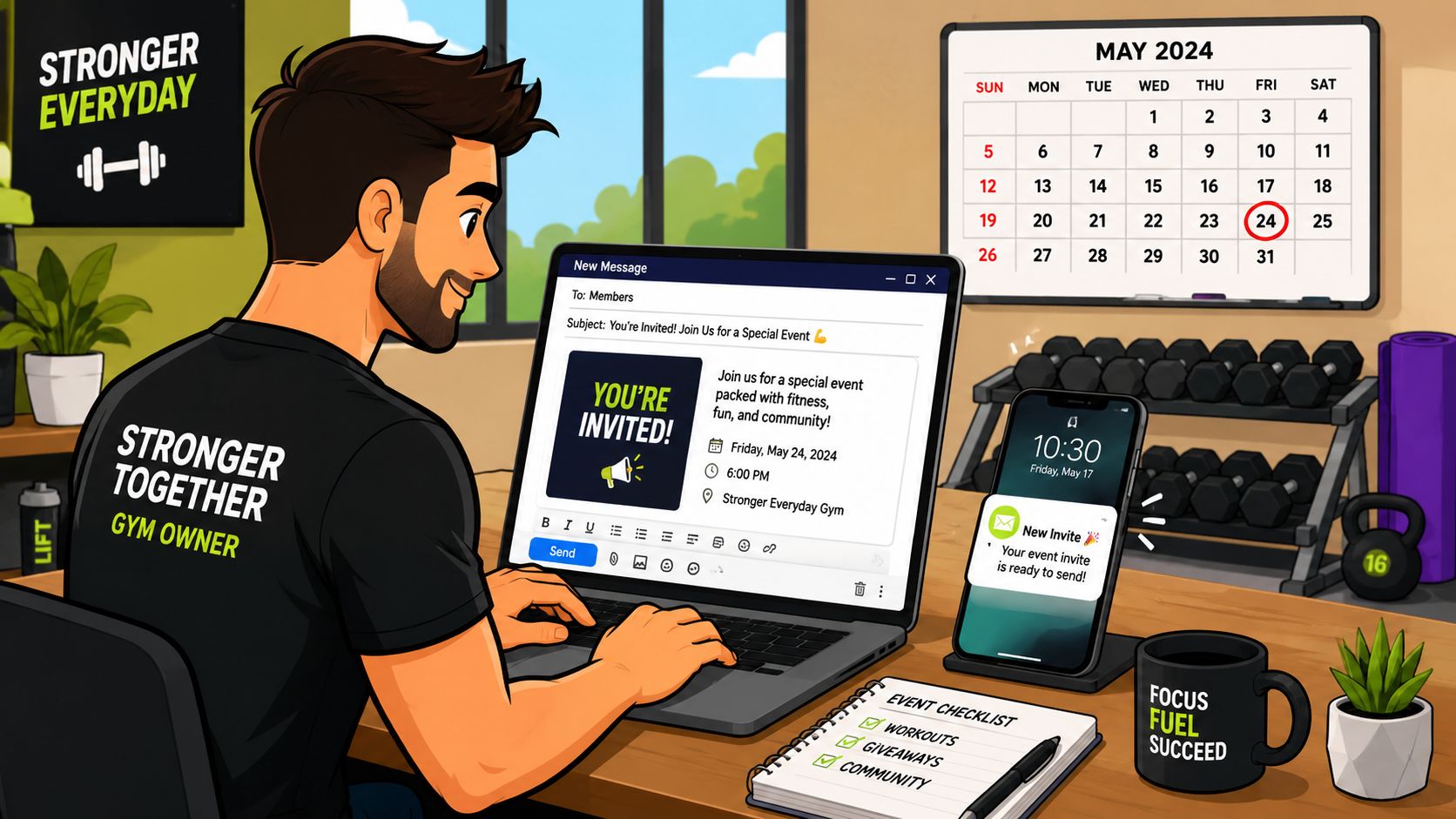
You've booked the trainer, set up the floor, planned the giveaway, and told the front desk to expect a crowd. Then the event invitation email goes out and the registrations barely move. That's the moment most gym owners realize the event wasn't the problem. The campaign was.
A packed gym event rarely comes from one clever subject line or one big blast to your whole list. It comes from clear targeting, sharp copy, a clean email layout, and a send schedule that keeps the event visible until people finally act. In fitness, that matters more than in most industries because your events usually serve a bigger goal. You're not just filling a room. You're creating trial visits, upgrade conversations, referrals, and membership sales.
The good news is that this is fixable. Once you treat every event invitation email like a sales asset instead of a calendar notice, attendance improves and follow-up gets easier.
Your Starting Point for a Packed Gym Event
A lot of gym events fail before the first email goes out. The owner assumes members will come because the event sounds exciting internally. Staff feels the energy. The programming is solid. But the inbox doesn't care how much effort went into the event. People respond to relevance, clarity, and timing.
That's why a strong event invitation email has one job. It must move someone from “I saw this” to “I'm saving my spot.” If it only announces the event, it's incomplete. If it makes people hunt for the value, it loses them. If it asks for too much attention, it gets skipped.
In fitness, the best campaigns usually promote one of three things:
- Community events that help prospects and members experience your gym culture
- Program launches that create urgency around a new class, challenge, or training block
- Workshops that position your coaches as experts and open the door to higher-ticket services
Each one needs a different angle. An open house sells atmosphere. A class launch sells momentum. A workshop sells expertise.
Practical rule: If your email could work for a dental office, a software demo, and a gym event without changing much, it's too generic.
A good campaign also respects how people decide. Most recipients won't register the first time they see your email. They need reminders, reasons, and a nudge that lowers friction. That's where significant wins happen.
When you get this right, your events stop feeling random. They become part of a repeatable system for lead generation, retention, referrals, and upsells. That's the playbook worth building.
The Strategic Blueprint Before You Write a Single Word
Most weak event campaigns have a writing problem on the surface and a strategy problem underneath. The copy feels vague because the offer is vague. The email gets ignored because it went to the wrong people. The fix starts before the subject line.

Start with the actual business goal
Don't begin with “we're hosting an event.” Begin with why the event exists.
If your event is meant to bring in leads, your email should sound welcoming, low-pressure, and easy to say yes to. If the event is for current members, the angle should reward belonging. If you're trying to upsell personal training or nutrition coaching, the email needs to frame the event as a next step, not just a fun night on the calendar.
Here's the filter I use:
- Lead generation event means the email should reduce commitment anxiety
- Member engagement event means the email should reinforce community
- Revenue event means the copy should connect attendance to a paid outcome
When you know the goal, the rest gets easier. Your CTA becomes obvious. Your list narrows. Your follow-up sequence has purpose.
Segment harder than you think you need to
Blanket sends are where gym event campaigns go soft. If you invite your entire database to everything, people stop believing the event is for them.
Event invitation emails sent midweek, Tuesday through Thursday, achieve significantly higher open rates, and segmentation improves conversion by reducing noise and increasing relevance, according to Fliplet's event invitation email guidance.
That matters in a gym because your list usually includes very different audiences:
- Current members who already know your coaches and space
- Former members who may need a specific reason to return
- Leads who never joined and need a low-friction first visit
- Class-specific fans such as yoga regulars, lifters, or bootcamp attendees
- High-value clients who are candidates for premium services
If you're still growing your audience, build the list first with a clean opt-in process and event-specific interest tagging. This guide on how to build an email list is useful if your database is messy or too broad to target well.
Nail the value proposition before the headline
Gym owners often lead with the event type instead of the outcome. “Join us for our mobility workshop” is weaker than “Move better, lift with less pain, and learn the warm-up our coaches use.”
People don't register because an event exists. They register because they want the result attached to it.
A simple value proposition formula works well:
- What it is
- Who it's for
- Why it matters now
Example:
- Open house: Try the gym, meet the coaching team, and bring a friend
- HIIT launch: Be first into our new class and lock in your weekly spot
- Barbell workshop: Fix the lifts that stall progress before they become habits
Keep a short stack of operational details ready too. If your event includes equipment demos, group stations, or mat work, a fast pre-event refresh with fitness center wipes helps the floor feel cared for before guests arrive.
Crafting Subject Lines and Copy That Get Opens and Clicks
Your subject line earns attention. The body earns the registration. If either one is weak, the campaign underperforms.

Write subject lines for one person, not a crowd
The fastest upgrade most gyms can make is personalization. Email subject lines that include personalized elements such as the recipient's name increase open rates by 26% compared with non-personalized invitations, based on FosterFlow's event invitation examples.
That doesn't mean stuffing in merge tags everywhere. It means making the subject line feel relevant to the recipient.
Better approaches:
- First-name personalization for member events
- Interest-based framing for class launches
- Local relevance for neighborhood open houses
- Past behavior cues for workshop follow-up
Examples:
- Sarah, you're invited to our member open house
- Ready for our new Saturday HIIT class?
- Downtown athletes, save your spot for mobility night
- You came to our last lift clinic. Join the next one?
If you want a quick style check before sending, this guide to email subject line capitalization is worth reviewing. Subject lines look minor, but sloppy capitalization can make a polished gym brand feel rushed.
Make the first screen do the heavy lifting
Most recipients decide fast. On mobile, they'll see the subject line, the preheader, the opening, and maybe one button before they choose to keep reading or move on.
Your top section should answer four things quickly:
- What is happening
- Who should attend
- Why it matters
- What to click
Don't open with “We're excited to announce.” Open with the offer.
If the first two lines don't explain the value, your email is asking readers to work too hard.
Use short paragraphs, bullets, and one clear CTA. If the event includes premium touches, mention them plainly. For a yoga workshop, for example, saying fresh yoga mat wipes will be available signals care without overexplaining.
Three templates that work in fitness
Community open house email
This works best when the goal is foot traffic, referrals, and low-pressure lead generation.
Subject: [First Name], join us for our open house
We're opening the doors for a community night at [Gym Name].
Come meet the coaches, tour the space, try mini workouts, and bring a friend who's been thinking about getting started.
What to expect
- Coach meet-and-greets
- Short demo sessions
- Member perks and guest offers
- A relaxed, no-pressure way to check out the gym
Reserve your spot
[Button: Save My Spot]We'd love to see you there.
New class launch email
This one needs energy and immediacy.
Subject: [First Name], be first into our new HIIT class
Our new HIIT class launches soon, and early spots go first.
If you want a fast, coached session with big energy and a clear format, this is for you.
Why members are excited
- Structured intervals
- High accountability
- A coach-led format that keeps momentum high
First session details are below. Grab your place before the launch fills up.
[Button: Reserve My Spot]
If you need more post-registration messaging after someone clicks but doesn't buy, these sales follow-up email templates can help you extend the campaign without sounding repetitive.
Skills workshop email
Here, precision matters more than hype.
Subject: Fix your squat setup at our lifting workshop
Small changes in setup can change how a lift feels.
At this workshop, our coaching team will break down squat mechanics, setup errors, and the cues we use on the gym floor with members every week.
You should come if you want to
- Improve movement quality
- Get coaching feedback
- Build confidence under the bar
[Button: Claim My Seat]
Keep the CTA singular
The more choices you give, the lower response usually gets. Don't ask readers to register, follow your Instagram, watch a video, reply with questions, and forward to a friend all in one email.
Pick the main action and support it. For event invitation email campaigns, that action is almost always the registration click.
Designing Emails for Maximum Impact and Action
An email can have solid copy and still lose because the layout fights the reader. Design isn't decoration. It's direction.

Mobile-first beats pretty-but-fragile
Most gym event emails get opened on a phone. That means the email should feel easy to scan with one thumb and a short attention span.
A clean event invitation email usually includes:
- Single-column layout so nothing breaks on mobile
- Short text blocks so readers can scan quickly
- Large CTA button that's easy to tap
- Visible event details near the top, not buried below a giant image
The gyms that struggle with email design often make the same mistake. They build for desktop, then hope it shrinks well. It rarely does.
Put the CTA where the eye naturally goes
If someone has to search for the button, your design is working against you. The CTA should appear high in the email and again near the bottom after the details.
Use action language that matches the event:
- Reserve My Spot for classes and workshops
- Join the Open House for community events
- Save My Seat for limited-capacity sessions
Photos help too, but only when they support the decision. Use real images of your gym, coaches, and members. A polished picture of your space says more than a stock photo ever will. It also reinforces trust, just like a tidy front desk or visible disinfecting wipes near high-touch areas.
Good email design reduces hesitation. It doesn't just make the message look nicer.
For gyms producing regular campaigns beyond events, this article on how do I write a newsletter is a helpful companion because the same readability rules carry over.
Brand it enough to feel familiar
You want recipients to know the email is from your gym immediately. Use your logo, your brand colors, and your usual tone. But don't let branding crowd out the offer.
The strongest event emails feel branded without feeling busy. That means:
- a recognizable header
- one core image if needed
- one dominant CTA color
- enough white space for the content to breathe
That last part matters more than people think. A cramped email feels demanding. A clean one feels manageable.
The Perfect Sending Cadence and Automation Flow
One email rarely fills a gym event. People miss it, forget it, or mean to come back later and never do. Cadence fixes that.

Sending approximately four well-spaced event invitation emails, plus two to three reminder messages, outperforms a single blast for registrations and attendee conversion, according to SalesHive's B2B event invite guidance.
The cadence I'd use for most gym events
This is the simplest automation flow that still gives you enough touchpoints to convert procrastinators.
| Timing | Focus | |
|---|---|---|
| Initial invitation | Early in the promotion window | Announce the event and present the main reason to attend |
| Benefit-focused follow-up | After the first send | Highlight one strong angle such as the coach, class format, or attendee experience |
| Urgency email | Closer to the event | Remind people to decide now and make the next step obvious |
| Final logistics email | Near the event | Confirm details, reduce confusion, and get registrants to show up |
Match timing to the event type
A local class launch doesn't need the same runway as a larger fitness event. The practical fit is what matters.
SalesHive notes that webinars and virtual events should be sent 1 to 2 weeks prior, local fitness events need 2 to 4 weeks notice, and conferences that require travel need 2 to 3 months lead time, with reminders 24 hours before physical events and 1 to 2 hours before virtual ones in the same source above.
That framework maps cleanly to gym operations:
- Open houses and in-gym workshops usually benefit from a few weeks of promotion
- Virtual coaching sessions or webinars need a tighter window and stronger reminders
- Big-format events with travel or guest presenters need much earlier awareness
Automation works best when each email changes the reason to care
Don't resend the same invite four times. Each touch should answer a different objection.
One email handles awareness. Another proves value. Another creates urgency. The last one removes friction.
Operational rule: Every send should add a new reason to register or attend.
For virtual events, there's one more detail gyms often miss. A three-touchpoint drip of invite, reminder two days prior, and final reminder one hour prior is standard, and reminders help address no-show risk that can range from 20% to 30% without reminders, according to Nunify's event invitation email guide. If you're hosting online, name the platform directly and include timezone conversions so nobody has to guess.
Tracking Success and Preparing a Professional Space
The send is only half the job. After that, you need to read the campaign critically.
Start with behavior, not opinions. Which subject line pulled the strongest opens? Which email in the sequence drove registrations? Which segment cared enough to click? Those answers tell you what to repeat and what to cut.
Track the signals that change the next campaign
You don't need a huge dashboard. You need a few useful comparisons.
Watch these closely:
- Open performance to see whether your subject line and audience match were strong
- Click response to judge whether the offer and CTA were clear
- RSVP conversion to understand whether the landing step closed the loop
- Attendance versus registration to spot show-up problems, not just signup problems
If your gym uses playful content in social or email, it can also help to study how humor lands without diluting the offer. These FindClout meme marketing insights are useful for thinking through where fun creative helps and where it can distract from action.
The in-person experience has to match the email promise
If your email looks polished and the gym feels messy on arrival, trust drops fast. Event marketing doesn't end in the inbox. It continues at check-in, on the training floor, and in the locker room.
That's why visible cleanliness matters. Set out gym wipes or sanitizing wipes where guests can find them without asking. Wipe down touchpoints before doors open. If you're hosting equipment demos or rotating class stations, have wipes for gym equipment and a gym wipe dispenser ready so the space stays presentable through the event.
For operators buying in volume, bulk gym wipes or commercial disinfecting wipes make more sense than scrambling for small consumer packs at the last minute. If you need supplies, Wipes.com cleaning products for gyms is a practical place to compare options such as gym equipment cleaning wipes, disinfectant wipes, and EPA registered disinfecting wipes.
A clean event tells guests you run a serious facility. That affects conversions as much as your welcome speech does.
Don't fake sanitation. Follow contact time.
This part matters. To achieve an EPA-registered kill claim against certain germs in gym facilities, the surface must remain visibly wet for the labeled contact time, which is typically two to four minutes, as explained in Millennium Facility Services' gym cleaning standards overview.
So if you're using workout wipes, antibacterial wipes, or other sanitizing products on benches, handles, mats, or shared stations, don't swipe once and assume the job is done. Keep the surface visibly wet for the full label time. On dirtier surfaces, clean first, then disinfect. For yoga areas, yoga mat wipes can help keep the setup process simple between attendees.
That final impression matters. A gym that sends sharp emails, runs a smooth check-in, and keeps the space clean is easier to trust and easier to join.
If you want more practical templates for filling classes, converting trials, and improving gym marketing systems, visit Gym Membership Tips.
Leave a Reply