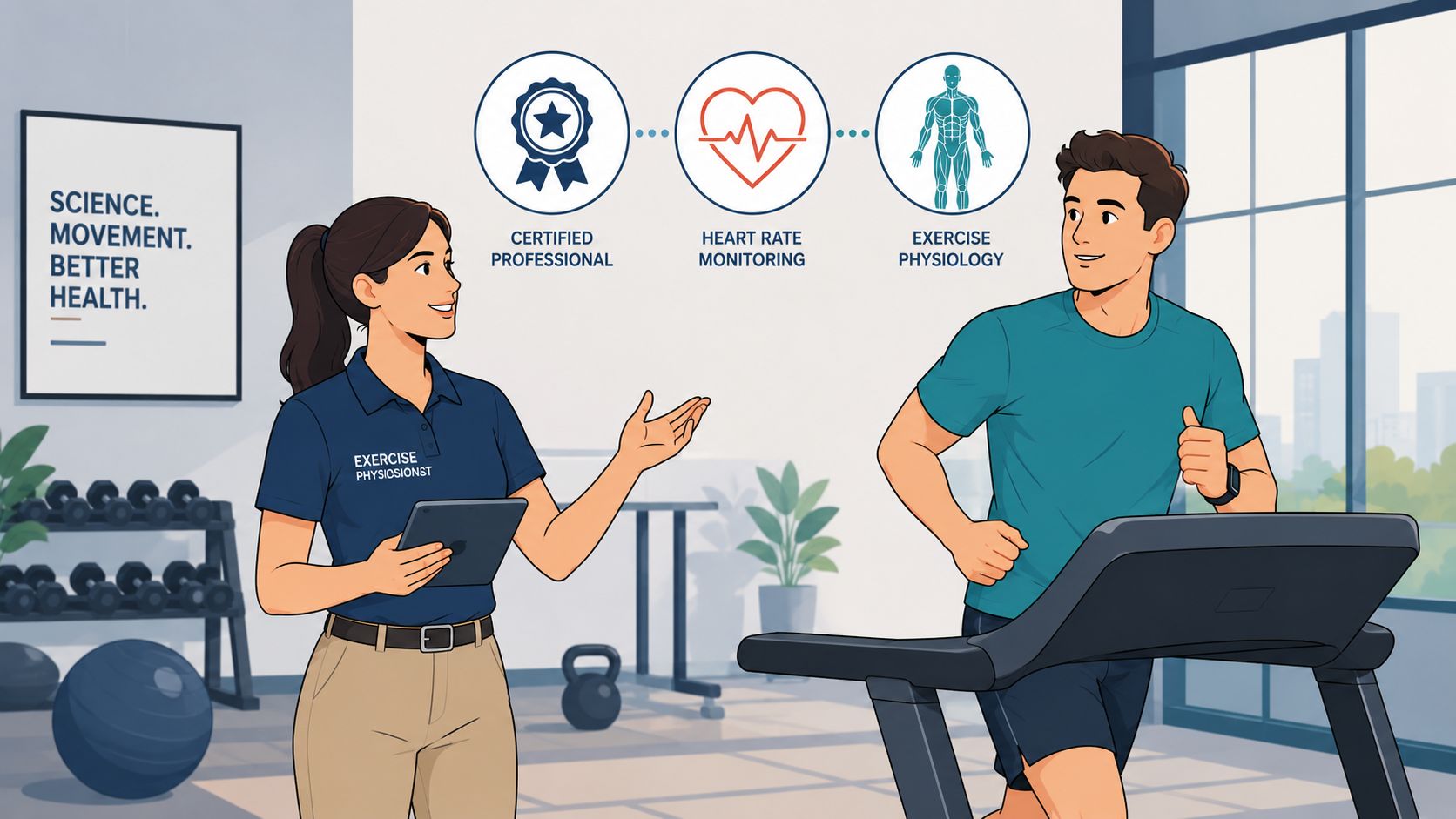
You're probably looking at a resume stack right now, trying to decide who helps your gym grow and who just sounds good on paper. One candidate has a personal training cert. Another has ACSM Exercise Physiologist certification. Both can talk programming. Both may interview well. But they don't bring the same level of value to your floor, your member experience, or your risk profile.
That difference matters most when your gym wants to serve more than the easy cases. The average member walking through the door isn't a college athlete with perfect joints and zero medications. They're often deconditioned, returning after rehab, managing weight, or trying to exercise safely with medically controlled chronic conditions. If your staff can't bridge that gap, those prospects either never join or they leave after a few confusing sessions.
For gym owners, this credential isn't just a line on a trainer bio. It can support stronger assessments, better retention conversations, smarter program design, and a more credible transition point for members who need more than generic coaching. For aspiring professionals, it's one of the clearest ways to separate yourself from the pack and build a serious career path in fitness and health.
Your Next Hire An ACSM-EP vs a CPT
A gym owner I've advised once had two finalists for the same role. One was a solid ACSM-CPT. Good energy, comfortable on the floor, strong with basic coaching. The other had ACSM-EP on the resume. The owner's first reaction was the same one I hear all the time: “Aren't they basically doing the same job?”
They aren't.
A CPT is often a strong fit when your business needs sales-floor energy, standard onboarding sessions, and general fitness coaching for healthy members. An ACSM-EP is a different hire. You bring that person in when you want deeper assessment skill, more confidence with special considerations, and a staff member who can work credibly with people who need careful exercise prescription instead of motivational noise.
What changes in a real gym
On paper, the difference can look academic. On the floor, it shows up fast.
- Member intake gets sharper. An ACSM-EP is better positioned to spot when a new member needs a more cautious plan instead of a hard-charging transformation pitch.
- Programming gets more individualized. That matters with older adults, post-rehab members, and people with medically controlled conditions.
- Your brand gets more credible. Local physicians, physical therapists, and wellness partners pay attention to staff quality.
Practical rule: Hire a CPT when you need broad coaching coverage. Hire an ACSM-EP when you want to expand the kind of member your gym can serve well.
That doesn't mean every facility needs a whole staff of exercise physiologists. Most don't. But many gyms benefit from at least one person who raises the standard for assessment, program design, and coaching judgment. If you're trying to stand out in a crowded market, this is one of the cleaner ways to do it without pretending you're a clinic.
What Is an ACSM Certified Exercise Physiologist
A member walks in with a knee replacement in their history, high blood pressure that is being managed, and real motivation to train. Your front desk can sell the membership. Your average trainer can probably start them. The question is who can assess them well, build an appropriate program, and keep their confidence long enough for them to stay.
An ACSM Certified Exercise Physiologist, or ACSM-EP, fills that role in many gyms. It is a professional credential for exercise science graduates who work with apparently healthy clients, plus people with stable, medically controlled conditions who need more careful exercise programming than a standard personal training model usually provides.

Where the credential fits
For gym owners, the clearest way to understand the ACSM-EP is by function. This professional is trained to conduct fitness and health-related assessments, write individualized exercise programs, coach behavior change, and manage risk within a non-clinical fitness setting. That scope is broader and more technical than what many clubs ask of a floor trainer, but it still stops short of licensed medical care and the more clinical CEP track.
That distinction matters commercially. An ACSM-EP helps a facility serve members who often hesitate to join, or who join and quit after one generic program fails them. In practice, these staff members are often strongest with adult beginners, older adults, deconditioned members, and people coming back from rehab who are cleared for exercise but still need sound judgment.
Why owners should care
This credential can support a better service mix, not just a better resume stack.
A good ACSM-EP can improve intake quality, support small-group programs for active aging or metabolic health, and give your sales team a more credible answer when a prospect says, “I'm not sure a normal gym is right for me.” That is where business value shows up. Better retention. Better referrals from allied professionals. Fewer members getting parked on a generic plan that does not match their needs.
For aspiring professionals, the ACSM-EP also sits on a different track than basic trainer certs. If you are comparing options, standard personal trainer certification requirements are usually easier to meet and faster to complete. The ACSM-EP asks for more academic preparation because the job asks for more judgment.
Who they serve best
In a commercial gym, an ACSM-EP is usually most useful with clients such as:
- Older adults who need progression based on function, not trends
- Beginners with low confidence who need structure and coaching that reduces dropout risk
- Members with medically controlled conditions who need exercise prescribed with care
- Post-rehab clients who are done with formal therapy but not ready for a random bootcamp approach
Many owners miss the post-rehab opportunity. The client has been discharged, wants to keep improving, and is willing to pay for guidance. They just do not want to feel like a test case for a young trainer with a clipboard.
If you want a candidate-side view of the profession, this exercise physiologist career guide gives a useful overview.
What they are not
An ACSM-EP is not a clinician, and smart operators keep that line clear. They should not be marketed as a substitute for physical therapy, cardiac rehab, or physician-led care. They work best as the bridge between general fitness and clinical services, which is exactly where many independent gyms can build a stronger position.
Used well, this credential gives your facility a practical middle tier of expertise. You can serve more complex members with confidence, charge appropriately for assessment and programming, and raise the standard of care without pretending your gym is a medical practice.
Unpacking the Eligibility and Prerequisites
For a gym owner, the entry requirements tell you why this hire costs more and why the role should produce more. The ACSM-EP is built on formal education, not a weekend test-prep cycle, so the credential usually signals a deeper base in assessment, exercise prescription, and working with members who need more care than general population training.

The degree requirement changes the hiring pool
An ACSM-EP candidate needs a bachelor's degree in an exercise science related field plus current Adult CPR/AED certification. That alone narrows the pool compared with entry-level trainer roles and helps explain why these candidates often interview differently. They tend to speak in terms of assessment findings, progression criteria, contraindications, and adherence, not just session energy and client motivation.
ACSM has also announced a future change to its standards. Starting August 15, 2027, candidates will be required to graduate from a CAAHEP-accredited program. If that timeline holds, it should make hiring easier for owners because “qualified” will be tied to a more consistent academic standard rather than a degree title that can mean very different things from one school to another.
Coursework is where the practical difference shows up
The stronger candidates do not just have a related degree. They have covered the subjects that show up on the gym floor with real members. ACSM's eligibility standards include specific exercise science coursework, including exercise physiology, applied kinesiology, and exercise testing and prescription, with attention to special populations.
That matters in business terms. A staff member with that background is usually better prepared to run a detailed intake, catch warning signs during onboarding, and write programs that feel appropriate for older adults, deconditioned beginners, and post-rehab members. Those are the clients who often stay longer when they trust the process.
What to verify before you hire
Do not stop at the credential name on the resume. Check the inputs that produced it.
- Degree fit: Confirm the bachelor's degree is in an exercise science related field, not a loosely connected major with limited technical coursework.
- Course depth: Ask which classes covered exercise testing, prescription, and special populations, and listen for clear examples rather than textbook jargon.
- CPR/AED status: Verify it is current.
- Applied judgment: Give a scenario from your gym, such as a sedentary new member with hypertension under medical control, and ask how the candidate would assess, start, and progress the program.
- Population match: If your gym serves active agers, weight-management clients, or post-physical-therapy referrals, ask for case examples from those groups.
Owners who make these checks usually place the ACSM-EP in the right lane from day one. That means better assessments, better retention opportunities, and fewer mismatches between the staff member's training and the members you want to serve.
For candidates, this is also a useful reality check. If you are comparing this route with entry-level trainer paths, this breakdown of personal trainer certification requirements shows why the ACSM-EP sits in a different category. For a broader profession overview, this exercise physiologist career guide is a helpful comparison point.
Decoding the ACSM-EP Exam Blueprint
If you want to understand what an ACSM-EP brings to your gym, look at what the exam tests. The exam highlights the credential's practicality. The blueprint tells you what the profession considers essential.

The four domains that matter on the floor
The ACSM-EP exam content is weighted across four areas: Health and Fitness Assessment (33%), Exercise Prescription and Implementation (40%), Exercise Counseling and Behavior Modification (20%), and Risk Management and Professional Responsibilities (7%) according to Engram Kinetics' certification guide.
For gym owners, the headline is obvious. Exercise Prescription and Implementation at 40% is the biggest section. That's why these professionals often stand out in program design. They're validated on building exercise plans, not just talking people through a workout.
Here's how I'd translate those domains into business value:
| Exam domain | Why it matters in a gym |
|---|---|
| Health and Fitness Assessment 33% | Better onboarding, safer progression, more credible consults |
| Exercise Prescription and Implementation 40% | Higher-quality programs for general and medically controlled populations |
| Exercise Counseling and Behavior Modification 20% | Better adherence, better communication, better retention conversations |
| Risk Management and Professional Responsibilities 7% | Fewer careless decisions and cleaner professional standards |
How candidates should study
The wrong way to prepare is memorizing isolated facts and hoping the exam rewards recall. The right way is to study as if you'll need to make judgment calls with real people, because that's what the credential is trying to validate.
A practical prep approach looks like this:
- Start with the exam weighting. Spend the most time on assessment and prescription because that's where the biggest share of tested competency sits.
- Work from scenarios. Don't just review definitions. Practice deciding what to do with a deconditioned adult, an older member, or someone with medically controlled concerns.
- Use ACSM materials first. Candidates usually waste time when they bounce across random third-party resources before they master the official framework.
- Review risk questions late in prep, not only at the start. Professional responsibilities seem smaller in weight, but they often expose weak judgment.
What gym owners can ask in interviews
You don't need to quiz people like an exam proctor. But you should ask questions that reflect the blueprint.
Try prompts like these:
- Assessment judgment: “How would you structure the first session with a member who hasn't trained in years?”
- Prescription skill: “What tells you a program is too aggressive for this person?”
- Behavior change: “How do you handle the member who wants results fast but keeps missing sessions?”
- Professional boundaries: “When would you stop and refer out?”
A strong ACSM-EP candidate won't just give textbook language. They'll show that they can make sound decisions inside a real commercial environment.
Good gyms don't just buy credentials. They hire people who can turn validated competency into a member experience that feels safe, specific, and worth paying for.
Career Paths and Salary Expectations
The value of ACSM Exercise Physiologist certification shows up in where it can take a professional, and in how a gym can build roles around that expertise. This isn't a dead-end credential for a training floor bio. It can support work in commercial fitness, corporate wellness, university recreation, community health, and specialized training settings.

What the compensation benchmark tells you
The Bureau of Labor Statistics reported an average annual salary of $50,280 for Exercise Physiologists in 2020, and the same reference notes that the advanced ACSM-CEP exam had a 70% national pass rate in 2024, based on Liberty University's ACSM exercise physiologist certification exam page.
Two practical takeaways come from that.
First, this is a credential path tied to a real profession, not just a short-term gym role. Second, advanced exercise physiology credentials aren't casual achievements. They require enough rigor that employers should treat them as signals of serious preparation.
How gym owners can create better roles
Too many clubs hire advanced staff and then pay them to do generic trainer tasks all day. That's a waste.
A smarter staffing model gives an ACSM-EP responsibilities such as:
- Premium assessments for new members who need more screening and confidence
- Bridge programming for people returning from physical therapy or long layoffs
- Small-group specialty coaching for older adults or members who need a lower-risk environment
- Staff mentorship on assessment quality and exercise modification
If you want context on how this role fits into broader compensation strategy, this guide to highest paying fitness jobs helps frame where higher-skill credentials can support stronger career ladders inside a facility.
For candidates, the big trade-off
The ACSM-EP path asks for more up front. More education, more preparation, more discipline. In return, you get access to a deeper professional identity and a wider set of credible opportunities. That's a better long game than collecting low-bar certifications and competing on personality alone.
A Gym Owners Guide to Hiring and Leveraging an ACSM-EP
A prospect walks into your club after physical therapy for a knee issue. She has medical clearance, but she does not trust her body yet. Your front desk hands her to a new trainer whose main strength is energy and sales. Sometimes that works. Often, she leaves unconvinced.
That is the kind of member an ACSM-EP can help you keep.
For a gym owner, the value of this credential is simple. It gives your business a stronger option for the large middle market between standard personal training and true clinical exercise services. That includes deconditioned adults, older members, post-rehab clients, and people with medically controlled conditions who need careful coaching, clear progressions, and good judgment.
The mistake is treating that hire like a more expensive CPT.
If an ACSM-EP spends the day running generic weight-loss sessions and first-time machine orientations, you are paying for skill your business is not using. The better model is to build services around the populations that want more confidence, more supervision, and better screening before they commit.
Strong uses for an ACSM-EP inside a commercial facility include:
- Post-rehab fitness transition programs for members who are done with formal care but still need structure
- On-ramp packages for deconditioned adults who are not ready for standard training or group classes
- Exercise consultations for medically controlled conditions where the goal is safe participation, not treatment
- Movement and modification support for the training staff so your CPTs know when to adjust, pause, or refer out
- Retention-focused check-ins for higher-risk members who are more likely to cancel if they feel lost or unsafe
These roles support revenue in more than one way. They create premium entry services, improve conversion for hesitant prospects, and reduce churn among members who need a slower start. They also give your club a cleaner referral story with physical therapists, physicians, and allied health professionals because your team can explain exactly where your scope begins and ends.
That last point matters.
Do not market an ACSM-EP as a substitute for a clinic. Market the role as advanced fitness support for people who need thoughtful progression. The language should stay grounded in exercise, function, confidence, and supervision. Once a club starts implying treatment or rehabilitation, it creates confusion for members and risk for the business.
A simple positioning guide helps:
| Positioning angle | Why it works |
|---|---|
| Advanced exercise assessment | Signals a higher-touch intake process without sounding medical |
| Safe progression after inactivity or injury | Speaks to people who want reassurance before joining |
| Fitness programs for medically controlled conditions | Expands your market while keeping the service in an appropriate lane |
| Post-therapy exercise support | Gives referral partners a clear handoff option |
Hiring well matters as much as marketing well. In interviews, skip the generic sales questions for part of the conversation. Ask how the candidate would handle a member with hypertension, a long training gap, low confidence, and inconsistent attendance. Ask what they would document, what they would modify, and when they would refer out. A strong ACSM-EP candidate usually shows calm judgment before they show charisma.
For staff development, set this role up as both a revenue producer and an internal standard-bearer. Have that coach review assessments, teach exercise modifications, and help newer trainers work with older adults and special populations. If you want your whole team to stay sharper over time, build that expectation into your education plan with a practical continuing education roadmap for trainers at https://gymmembershiptips.com/2026/04/20/continuing-education-for-personal-trainers/. Mature professions do this well, and a complete guide to nursing CE requirements is a useful example of how ongoing education supports public trust.
For candidates, the business case matters too. An ACSM-EP is easier to justify when you can explain the revenue attached to your skill set. Do not pitch yourself as "more educated." Show a gym owner how you can improve intake quality, convert nervous prospects, serve post-rehab members appropriately, and help standard trainers avoid mistakes. That is how the credential becomes a better job, not just a better line on a resume.
Maintaining Certification and Professional Standards
A credential keeps its market value only if the coach behind it keeps current. For an ACSM-EP, that means ongoing continuing education and renewal, not a one-time exam pass. Gym owners should care about that because a staff member who stays current is easier to trust with higher-risk members, harder to replace, and more useful in mentoring the rest of the floor team.
That standard also gives managers a practical way to set expectations. Do not stop at "maintain your cert." Require staff to show what they learned, how they applied it, and what changed in their coaching. A good education plan should sharpen screening, exercise modification, referral judgment, documentation, and communication with deconditioned or medically complex members. If you are building that system across multiple roles, this guide to continuing education for personal trainers is a useful reference.
Other professions handle continuing education the same way. a complete guide to nursing CE requirements is a good example of how ongoing education supports public trust and sets a visible professional baseline.
Professional standards have to be visible
Members do not read a resume on the wall and assume quality. They judge what they see in the session, at the front desk, and across the facility. If your ACSM-EP documents well, coaches conservatively when needed, and refers out appropriately, that builds confidence. If the building looks sloppy or inconsistent, that credibility drops fast.
That is why hygiene still belongs in this conversation. Clean equipment, stocked wipe stations, and consistent staff habits signal that your operation takes standards seriously across the board. A brief mention is enough here: keep disinfecting wipes accessible on the training floor and make equipment cleaning part of staff coaching standards, not just a closing-duty checklist.
Set standards that people can follow
The best professional standards are easy to observe and easy to audit.
- Track certification renewal dates before they become emergencies.
- Tie continuing education to the populations your gym serves most.
- Review session notes and assessments for quality, not just completion.
- Teach referral boundaries clearly so staff know when a member belongs with a clinician.
- Keep cleaning supplies visible and restocked so staff and members can maintain equipment between uses.
For candidates, this matters too. Employers notice the difference between someone who collects credits and someone who builds sharper judgment year after year. For gym owners, the payoff is a staff culture that looks more professional, manages risk better, and gives members more reasons to stay.
Leave a Reply