A lot of gyms think they have an onboarding problem when they really have an activation problem. The member signed the agreement, got the key tag, maybe even downloaded the app. Then real life showed up. They got sore, felt awkward, missed two planned visits, and suddenly the membership became an expense instead of a habit.
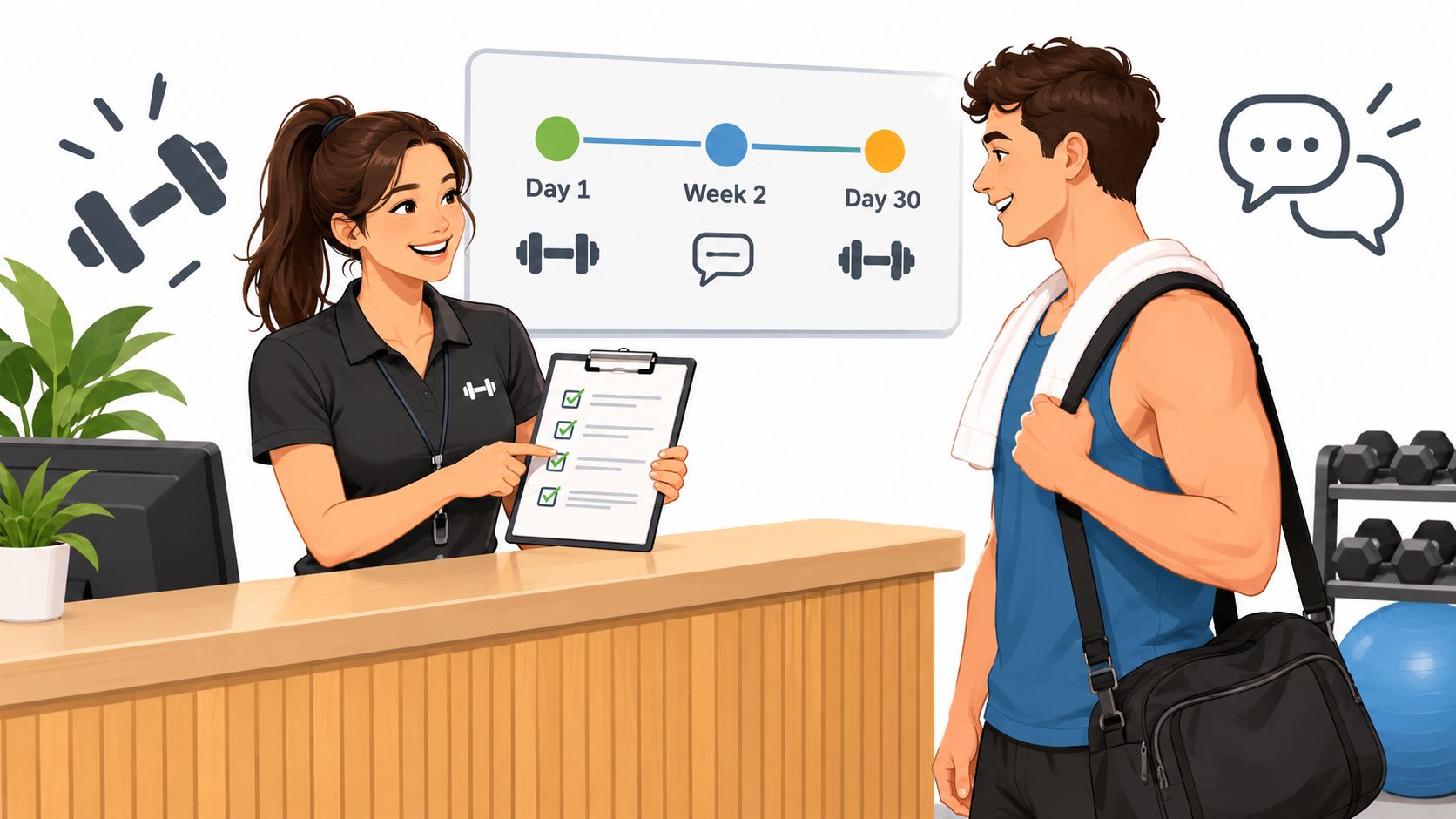
That's why a strong membership onboarding process can't be a welcome email plus a tour. It has to function like an operating system for the first 90 days. Staff need to know what happens on Day 1, what gets checked on Days 3 to 5, what gets escalated in Week 2, and which members need a different path based on motivation instead of a generic drip sequence.
Why the First 90 Days Decide Member Retention
Most gyms feel the pain of churn later, but the decision to stay usually happens much earlier. Industry retention summaries report that about 50% of new gym members quit within their first six months, with many cancellations concentrated in the first three months, while annual gym retention averages around 66.4% according to gym retention benchmarks from Keedia.
That early churn pattern is why onboarding needs to be treated as an operations function, not a hospitality task. Separate member onboarding research also notes that members who don't engage in their first three months are 60 to 70% more likely to churn at renewal, and organizations with formal onboarding see 25 to 40% higher first-year retention than those without, based on independent onboarding guidance from I4A.
If you need a broader framework for retention language and measurement, this guide on what member retention means in practice is a useful companion. For operators building more formal lifecycle workflows, it also helps to see how it works when onboarding is handled as a repeatable system rather than a one-off front desk task.
The drop-off points that actually matter
The mistake I see most often is treating the first quarter like one long communication stream. It isn't. It has distinct failure points.
- Day 1 confusion means the member doesn't know where to go, what to do, or who to ask.
- Days 3 to 5 friction shows up when soreness, scheduling, or intimidation interrupts momentum.
- Week 2 doubt is where members decide whether they belong here or not.
Practical rule: Don't build touchpoints by calendar alone. Build them around the reason members disappear.
First-90-Day Retention Benchmarks for New Gym Members
| Visit Frequency in First 30 Days | 90-Day Retention Rate | 12-Month Retention Rate |
|---|---|---|
| Low and inconsistent | Lower and at-risk | Usually weaker over time |
| Moderate and building | More stable | More likely to renew |
| Consistent early routine | Stronger | Better long-term retention |
The exact thresholds will vary by gym model, but the operating principle is stable. Members who act early stay longer. Members who drift early almost never fix it on their own.
Pre-Sign-Up and Day 1 Mechanics
The best Day 1 win happens before Day 1 starts. If staff wait until the member walks in to handle waivers, payments, app setup, and scheduling, the process drags and the member leaves without a clear second step.
Benchmark research across onboarding categories shows 72% of users abandon onboarding when it has too many steps, and every extra minute lowers conversion by about 3%, according to community onboarding benchmark data. That same benchmark found top performers complete onboarding in 5 days or fewer and automate follow-ups, which is directly relevant to a gym where speed matters.
A useful parallel sits outside fitness. Teams that orchestrate customer journeys for revenue do well when they remove handoffs and tighten the path to first value. A gym should do the same.
What to complete before the first visit
Use a short digital pre-arrival workflow. Keep it lean.
- Waiver completion: Send the waiver before arrival so nobody stands at the desk reading legal copy on a phone.
- Payment clarity: Confirm what was paid, what recurs, and when the next billing date hits.
- Arrival details: Include parking, entrance instructions, locker room basics, and what to bring.
- Booked intake slot: Attach a short intake appointment to the membership start so staff aren't improvising.

The intake fields worth collecting
Don't ask for everything. Ask for what changes follow-up.
- Injury history: This protects the member and tells coaches what movement options to avoid.
- Training background: A former athlete needs a different intro than someone who's never touched a cable machine.
- Preferred workout window: This helps staff recommend realistic visit times instead of idealized ones.
- Motivation type: Goal-driven, community-seeking, convenience-oriented, or recovery-focused members don't respond to the same message.
The operational point is simple. Every field should trigger a downstream action. If no one uses the answer, remove the field.
The Day 1 close-out that prevents drift
One industry guide recommends booking the first session before the member leaves and sending an automated SMS if they haven't visited within 72 hours of signing up, as noted in this gym onboarding recommendation.pdf).
That aligns with what works on the floor. Before a new member walks out, staff should:
- Set up the member app.
- Confirm the second visit on the calendar.
- Capture one measurable goal in plain language.
- Make the member recognizable to staff, whether that's a profile photo, CRM note, or front-desk alert.
Members don't need a polished speech. They need a clear next action.
The First Two Weeks of Real Connection
The first two weeks tell you whether a member is building confidence or just consuming information. Content helps, but connection closes the gap.
Recent gym retention guidance points to three high-risk windows in early onboarding: Day 1, Days 3 to 5, and Week 2, and recommends a real-person welcome, a first-workout follow-up, and a barrier-planning check-in during those moments, based on fitness retention guidance from Nutripy.
Day 1 resolves orientation anxiety
A new member arrives motivated and uncomfortable at the same time. The fix is not a long tour. It's a short floor walk with a named staff member who shows the training zones, locker rooms, wipe stations, and one or two pieces of equipment the member can use right away.
That touch should feel conversational. “Here's where to start if it's busy” works better than a lecture.
Days 3 to 5 resolve the soreness slump
Members disappear during onboarding. They got through the first visit, then they felt sore, got busy, or started wondering if they were doing it wrong.
What works is a human check-in that references their actual goal. If the member joined for weight loss, the message shouldn't invite them to a powerlifting clinic. If they joined because they wanted more energy after work, the message should steer them toward consistency, not intensity.
A coach who remembers the member's stated goal beats three perfectly timed reminder emails.

Week 2 resolves the belonging gap
Week 2 is less about instruction and more about identity. The member starts asking, “Am I the kind of person who comes here?”
That's why staff introduction matters. Not a vague “let us know if you need anything,” but a specific handoff. Introduce them to a coach, a trainer, or a front-desk person by name. If they're a class member, place them in a same-level session where they won't feel behind.
Log every touch in the CRM so the next staff member sees the story, not just the account. A decent note might say:
- Goal: train before work three times a week
- Barrier: nervous about free weights
- Completed: orientation and first cardio session
- Next move: introduced to beginner strength class for next Tuesday
That note changes the in-person experience. Staff can greet the member like someone they know, not someone they're meeting again for the first time.
Day 30 and Day 90 Milestones That Matter
By Day 30, you should know whether a member is activating. By Day 90, you should know whether they're building a routine or sliding toward cancellation.
Many gyms overcomplicate reporting. You don't need a giant dashboard. You need a weekly cohort review that tells staff who is green, who is yellow, and who needs a save call.
The four KPIs I'd actually review
Use four practical signals:
- Visit frequency: Are they showing up often enough to build habit?
- Program adherence: Did they complete the intro path they were given?
- Financial engagement: Have they attached to any program that deepens commitment?
- Qualitative signal: Is the member trending engaged or distant based on recency and feedback?
Day 30 and Day 90 Activation Decision Matrix
| KPI | Day 30 Green | Day 30 Yellow | Day 30 Red | Day 90 Green | Day 90 Yellow | Day 90 Red |
|---|---|---|---|---|---|---|
| Visit frequency | Consistent attendance and routine forming | Irregular pattern with gaps | Very low or stalled attendance | Stable long-term habit | Attendance softening | Extended absence or obvious drift |
| Program adherence | Intro steps completed | Partial completion | No real completion | Following assigned path | Inconsistent follow-through | Program abandoned |
| Financial engagement | Clear use of included services or add-ons | Interest without commitment | No engagement beyond base access | Attached to a deeper service layer | Light usage only | No added buy-in |
| Qualitative signal | Positive staff notes and recent visit | Mixed notes or uncertainty | Long silence or negative signal | Strong relationship and routine confidence | Some friction but recoverable | Save-risk profile |
How the matrix drives action
Yellow is where most recoverable members sit. A classic example is the member who has weaker visit frequency but strong program adherence. They completed orientation, understand the plan, and respond well to staff. They're not disengaged. They're struggling with scheduling.
That member doesn't need a hard sell. They need a short coach call that adjusts the plan to reality. Move them from a four-day ambition to a two-day minimum and one optional session. That's often enough to restore momentum.
Manager note: If staff can't name the exact intervention for yellow-status members by Friday, the review meeting was just reporting theater.
Cadence keeps the system alive
The mechanics matter more than the template.
- Weekly cohort pull: Review every new member in the active onboarding window.
- Monthly trend review: Check where members are stalling by segment.
- Quarterly recalibration: Update thresholds if your member mix changes.
The matrix only works when someone owns it. In most gyms, that should be one operations lead and one coaching lead, not a committee.
Automating the Sequence Without Losing the Human Touch
Automation should remove clerical drag, not replace staff judgment. If your sequence feels robotic, the problem usually isn't the software. It's that nobody designed the pauses, skips, and substitutions.
The simplest stack is enough for many operators: intake form, SMS provider, and CRM notes. Multi-location gyms usually need integrated CRM and marketing automation. If you're comparing systems, this guide to CRM software for gyms covers the operational side well. One practical option in the content and workflow category is Gym Membership Tips, which publishes templates and process ideas that teams can adapt into their own CRM logic.
A strong reference point here is the idea behind Truespeak human in the loop. The lesson applies perfectly to gyms. Let automation handle timing and task routing. Let humans handle doubt, nuance, and recovery.
A lean sequence that works
Use a simple rule set:
- At signup: Send welcome SMS with the next action.
- Before Day 1: Trigger the intake portal and waiver.
- 24 hours before arrival: Send a reminder with practical visit details.
- Day 3: Coach check-in goes out only if no human contact already happened.
- Week 2: Prompt booking for the next class or workout.
- Day 28: Send a milestone message and ask for one reply.
If a coach calls the member, the automated Day 3 message should cancel. If the member already booked a second class, the Week 2 prompt should swap to encouragement instead of another ask.
Editable message templates
Welcome text
You're all set. Your first step is to complete your profile and book your first visit. Reply here if you want help choosing the right time.
Pre-arrival reminder
You're booked for tomorrow. Bring workout clothes, water, and your questions. We'll help you get set up fast when you arrive.
Coach check-in
How did your first workout feel? Reply with “good,” “sore,” or “stuck,” and I'll help you plan your next visit.
Milestone ping
You're one month in. Want help tightening your routine for the next few weeks? Reply and we'll map out your next visits.
Guardrails that keep it human
Keep these rules in place:
- Name the staff member: Messages should come from a coach or team member, not “Gym Support.”
- Reference the stated goal: Members notice when the gym remembers why they joined.
- Limit automated volume: More than two automated touches per week usually feels noisy.
- Leave a reply path open: A no-reply workflow kills trust fast.
Automation should make staff more present, not less visible.
Onboarding Different Member Types
A one-size membership onboarding process usually pleases nobody. The member who wants a dead-simple routine doesn't need the same experience as the member who joined for community, and the intimidated member needs a completely different first week than the experienced lifter returning after time away.
Recent fitness-industry coverage increasingly frames community as a measurable retention lever, especially when onboarding moves members toward coach connection, friend connection, and visible early progress within the first 30 to 90 days, as discussed in this 90-day gym onboarding perspective. The practical gap is segmentation. Many gyms say “build community” without deciding for whom and how.

Four common motivation segments
Goal-driven members
These members want progress they can measure. Give them milestones, a visible plan, and a Day 30 check-in tied to one metric they care about. The biggest risk is frustration if they feel busy but not improving.
Social members
These members stay when relationships form early. Introduce them to a class, a coach, or a small recurring group in Week 1. Their main risk is anonymity. If nobody knows them, they won't anchor.
Intimidated members
They often need the most support and ask for the least. Give them a low-pressure first session, a quiet-hour orientation if possible, and one named contact they can return to. Their risk is a bad first workout that feels embarrassing or confusing.
Hybrid members
These people want results and belonging. They often do well with coach-led small groups, semi-private training, or a class path with built-in accountability. Their risk is being routed too hard toward either solo programming or pure social activity.
A simple routing rule
Ask one question during intake: What matters most in your first month here, results, confidence, convenience, or connection?
That answer usually tells you enough to route the first week without adding friction.
Don't segment by age first. Segment by what the member needs in order to come back next week.
Closing the Loop With Cleanliness and Member Trust
Cleanliness isn't a background task in onboarding. It's part of the member promise. New members read the room fast. They notice the front desk, the locker room smell, whether wipe stations are stocked, and whether staff clean visibly between rushes.
That's why sanitation belongs inside the operating playbook. If you're already collecting early feedback, a short pulse can be paired with broader member satisfaction survey practices so cleanliness concerns show up before they become cancellations.
The visible trust signals members actually notice
Toronto recreation cleaning guidance says weight rooms, fitness centres, and walking tracks should be closed twice per day for high-touch-point cleaning and disinfection, and the facility should receive a deep cleaning daily, according to this fitness facility cleaning checklist reference.
Another reopening protocol for health clubs says employees and members should be screened before entry, and anyone showing illness symptoms such as fever over 100.4°F, cough, or shortness of breath should not enter, based on this health club screening guidance.

The checklist I'd put in front of staff
- Front desk reset: Clean counters, check entry points, and keep sanitizing wipes visible.
- Locker room pass: Inspect floors, benches, mirrors, and refill dispensers.
- Training floor sweep: Refill gym wipes or fitness wipes stations and check high-touch areas.
- Water zone check: Sanitize refill points and nearby touch surfaces.
- Closing walk: Confirm deep-clean tasks and note any supply gaps for the next shift.
If you need facility supplies at scale, a gym should think in terms of stocked stations, a reliable gym wipe dispenser, and enough bulk gym wipes or commercial disinfecting wipes to avoid empty canisters during peak traffic. For cardio decks and strength areas, members also appreciate easy access to wipes for gym equipment and clearly labeled disinfectant wipes. In yoga or mobility rooms, yoga mat wipes make the expectation simple. For operators reviewing product options, EPA registered disinfecting wipes from Wipes.com are relevant to this kind of member-facing cleaning setup.
Cleaning tips that strengthen onboarding
Good onboarding includes explicit cleaning habits, not just clean results.
- Show new members where supplies are: Point out workout wipes, disposal bins, and refill stations during the first tour.
- Restock before peak windows: Empty wipe stations signal neglect faster than almost anything else on the floor.
- Use the right product in the right zone: Gym equipment cleaning wipes near strength areas, sanitizing wipes at service counters, and antibacterial wipes in shared touch zones keep the setup intuitive.
- Clean in plain sight: Members trust what they can see. Visible routines beat hidden standards.
- Post a simple log: A cleaning checklist near high-traffic areas reassures new members that the gym takes hygiene seriously.
A member's first impression of cleanliness becomes part of the retention story. When the floor feels organized, stocked, and cared for, the gym feels safer to return to. That matters just as much as the welcome text or the app setup.
Leave a Reply