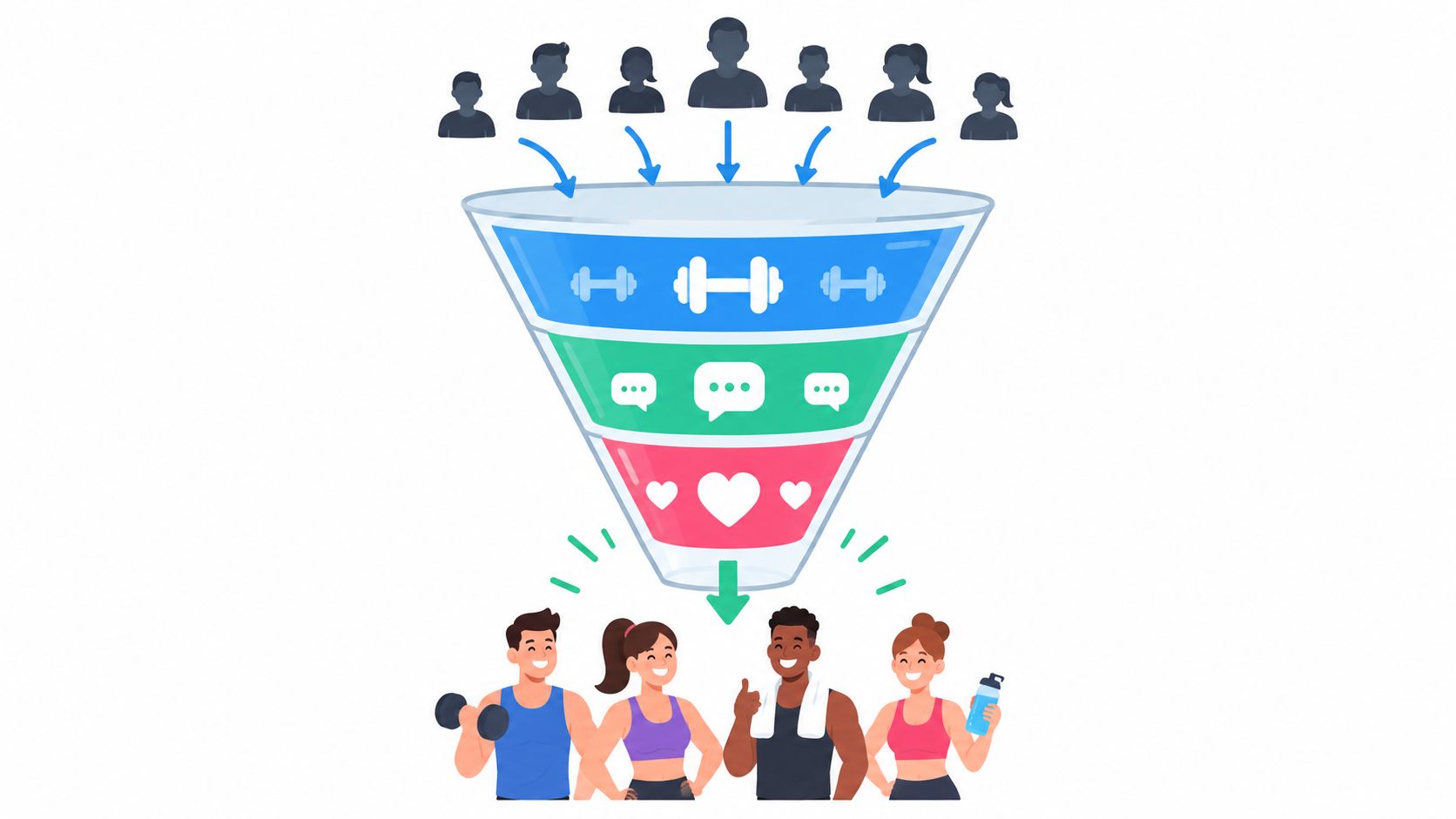
You probably know this feeling. The ads are running, the trial pass offer is solid, the front desk is busy, and your inbox proves people are interested. Then the month closes and enrollment looks nothing like the attention you paid for.
That gap is where most gyms lose money.
I've seen owners blame the offer, the staff, the local market, even the ad platform. Sometimes those things matter. More often, the issue is simpler. The gym has leads, but it doesn't have a managed path from first click to first workout to paid membership.
Most advice on sales funnel management still treats the buyer journey like a straight hallway. Real gym prospects don't behave that way. They click an ad, leave, check your Instagram, ask a friend, read reviews, compare schedules, maybe ask an AI tool about nearby gyms, then come back three days later and call with one question about cancellation terms.
If your funnel only tracks form fills and closes, you're blind through the most important part of the journey.
Why Your Gym Leads Are Disappearing Into Thin Air
A gym owner launches a free consultation offer. Plenty of people click. A decent batch fills out the form. A few answer the first call. Fewer book. Fewer show. By the time memberships are counted, the funnel feels broken.
That's not unusual. Benchmark summaries for 2024 to 2026 show the average lead-to-customer conversion rate in B2B funnels is only 2% to 5%, and one benchmark example translates 10,000 website visitors into roughly 20 to 50 customers at the end of the process (sales funnel benchmark summary). Gyms aren't identical to B2B companies, but the lesson is the same. Most of the loss happens between stages, not because the first campaign failed.
The problem usually isn't traffic
Owners often react by buying more traffic. That can work for a while, but it usually covers up a process problem.
If a prospect requests a guest pass at 9:00 a.m. and doesn't hear from your team until the next day, the lead hasn't disappeared. Your process pushed them out. If someone tours the club and leaves without a clear next step, the same thing happens. If the follow-up message reads like a canned sales script, they drift.
Practical rule: Treat every handoff like a possible leak. Ad to form. Form to reply. Reply to booking. Booking to visit. Visit to join.
What a managed funnel looks like in a gym
A working funnel guides people instead of chasing them. That means:
- Clear stage definitions: Everyone on staff knows what counts as a new lead, a booked trial, a completed visit, and a membership-ready prospect.
- Fast next actions: Each stage triggers a response, not a reminder to maybe respond later.
- Consistent follow-up: Prospects don't vanish because one busy shift forgot to call back.
This mindset change matters because sales funnel management is really stage management. You're not hoping enough people buy. You're reducing avoidable friction one step at a time.
Setting Up the Essential Tools for a Working Funnel
Most gyms don't need a giant software stack. They need a simple system that captures leads, stores them properly, and starts follow-up without waiting for a staff member to remember.
The foundation is boring on purpose. A form. A CRM. Calendar booking. Automated messages. Staff notes. Reporting. If those pieces connect, the funnel starts behaving like a system instead of a pile of tasks.

The minimum stack that actually works
Here's the setup I'd insist on before spending harder on ads.
| Funnel Stage | Tool Type | Primary Function |
|---|---|---|
| Website visit | Landing page builder | Presents one clear offer and captures intent |
| Inquiry | Lead form | Collects name, contact details, goal, and preferred location |
| New lead | CRM | Stores lead record, source, and stage |
| First response | Automation tool | Sends immediate email or SMS confirmation |
| Booking | Calendar scheduler | Lets prospect choose a consultation or trial time |
| Pre-visit | Reminder workflow | Reduces no-shows with timed reminders |
| Visit | Staff checklist or CRM notes | Records attendance, goals, objections, and next step |
| Decision | Sales pipeline view | Tracks pending join, follow-up, and close outcome |
Keep the handoffs clean
What matters isn't the brand logo on the software. It's whether the handoffs happen automatically.
A prospect fills out a form. The CRM creates the contact. A message confirms the request. A booking link goes out. Staff gets notified. The lead enters a follow-up sequence if they don't book. That's the machine.
For a practical view of how stages fit together, I like ViralRef's acquisition funnel breakdown because it helps owners separate awareness activity from conversion work. If you want a gym-specific version of that setup, this funnel build guide for gyms lays out the flow in a way a small team can implement.
Don't automate everything. Automate the repeatable parts so your staff has time for the human parts.
Choose tools your staff will actually use
Complicated systems usually die at the front desk.
Pick tools that make it easy to log three things every time: source, current stage, and next action. If staff has to open five tabs to update one lead, data quality falls apart fast. Good sales funnel management depends on simple discipline more than fancy dashboards.
Tracking the Non-Linear Path to Membership
The old funnel says a prospect sees an ad, fills out a form, tours the gym, and joins. Real life is messier than that.
A local buyer might find you on Google, watch a trainer clip on Instagram, read two bad reviews and ten good ones, ask a friend if your locker rooms are clean, check pricing twice, then walk in without ever touching the original lead form. Another prospect might inquire, go silent, then come back after seeing member transformation posts a week later.
That's why linear reporting misses so much.

Buyers don't move in straight lines anymore
Recent coverage argues that buyers now skip stages, move backward, and make decisions across many touchpoints. It also notes that part of the middle of the funnel now happens inside AI conversations instead of only on websites or in CRMs (Forbes council article on AI conversations and the middle funnel). For gyms, that rings true. Prospects compare schedules, classes, trainers, reviews, and policies long before they identify themselves.
What to track instead of a straight line
If you run a gym, I'd track decision loops, not just first touch.
- Assisted touches: Did the person view pricing, read reviews, click maps, or engage with social before booking?
- Return behavior: Did they come back after abandoning the form?
- Human touchpoints: Did they call, text, DM, or walk in without booking online?
- Objection patterns: Did questions cluster around schedule, childcare, price, or contract terms?
A CRM becomes much more useful when it captures these patterns. If your current system is messy, this guide to CRM software for gyms is a useful starting point for deciding what the front desk and sales staff should record.
The middle of the funnel needs content, not just reminders
Many gyms overbuild the top and bottom. They run ads and train closers, but leave the middle empty.
That middle needs proof and reassurance. Membership pages need schedule clarity. Trial pages need expectation setting. Follow-up emails should answer common concerns. Social posts should help a hesitant buyer picture themselves inside the gym.
If a prospect isn't ready today, the right job isn't pressure. The right job is reducing uncertainty.
That's the practical side of modern sales funnel management. You're not forcing people forward. You're giving them enough confidence to take the next step from whichever touchpoint they choose.
Identifying and Plugging Critical Conversion Leaks
A lead fills out your form at 8:12 p.m. After that, the trail gets messy. They check class times, leave, come back from Instagram two days later, start booking, stop at the waiver, then call the front desk on Saturday. If your funnel report only shows "lead created" and "did not convert," the leak stays hidden.

The leak usually sits between interest and commitment
For gyms, the biggest losses rarely happen at the ad click. They happen after a prospect raises their hand but before they commit to a visit, a conversation, or a first session.
One benchmark summary puts MQL-to-SQL conversion at about 13% in some datasets, with typical ranges around 13% to 27% or 13% to 35% (qualified-lead handoff benchmark summary). The exact number matters less than the pattern. A large share of "qualified" leads still are not ready for a sales conversation.
That matches what gym owners see every week. Someone can be interested, price-aware, and still not be ready. They may need schedule clarity, spouse buy-in, childcare details, confidence, or one more reminder that they will not get thrown into an intimidating class on day one.
Track leaks by behavior, not just stage names
A clean funnel view still matters, but stage labels alone are too blunt for a modern gym. "Lead to booked" misses the difference between someone who ghosted immediately and someone who clicked pricing three times, watched stories, and stalled at the final step.
The better approach is cohort-based tracking. One benchmark recommendation is to use 90-day cohorts, calculate each stage as conversions divided by entries into that stage, and avoid mixing different time windows because that distorts long-cycle performance (cohort-based funnel benchmark guidance).
For gym use, I would review one lead cohort and answer five plain questions:
- How many inquiries came in?
- How many started booking?
- How many finished booking?
- How many showed up?
- How many joined within that same cohort window?
That extra split between started and finished booking catches leaks a lot of owners miss.
What actually fixes the leaks
The best fixes are usually boring. They work because they remove friction at the exact point where intent starts to wobble.
- Ask for useful qualification upfront: Goal, preferred training time, and home or work location give staff enough context to follow up well without turning the form into homework.
- Speed up first contact: A slow callback turns warm interest into a stale lead. Fast response matters most for free trials and low-commitment offers, where curiosity fades quickly.
- Replace vague follow-up with a clear next action: "Let us know if you have questions" creates drift. "Choose your intro session here" gives the prospect one clean move.
- Fix handoffs between marketing and front desk: If ad leads land in a shared inbox and nobody owns them, conversion drops before a coach ever speaks to the prospect.
- Use nurture to answer objections: Good follow-up explains what the first visit looks like, what to bring, where to park, and who the program fits. Repetitive check-ins do not do that job.
Across industries, average funnel performance varies widely. One summary reports overall average funnels at about 2.35% to 7%, while stronger funnels can exceed 11% (funnel conversion benchmark summary). That spread matters because it shows how much room there usually is inside the process you already have.
More leads can help. Cleaner handoffs, faster follow-up, and fewer drop-offs in the middle often help more.
Shifting Focus From Acquisition to Retention
Monday looks great on the dashboard. Twelve new leads came in, three people started a trial, and one membership closed. By Friday, two trial users have gone quiet, the new member has not shown up since orientation, and the team is already chasing the next batch of leads.
That is not an acquisition problem. It is a retention problem sitting in the middle of the funnel.
Gym owners often treat the funnel like it ends at the sale. In practice, the highest-risk stretch starts right after someone joins. If the first two weeks feel awkward, inconsistent, or easy to skip, paid acquisition just feeds a leaky system.
Retention changes the economics
Retention matters because it changes what each hard-won lead is worth. One retention summary cites a widely referenced Harvard Business Review finding that a 5% increase in retention can have a large profit impact, and it also notes that repeat buying becomes more likely after earlier purchases (retention statistics summary). Gyms are subscription businesses, not ecommerce stores, but the behavior pattern still applies. Every positive step makes the next step easier.
That is the part many owners miss.
A prospect does not move in a straight line from ad to signup to loyal member. They loop. They join, hesitate, disappear for ten days, come back for a class, then decide whether the gym fits their life. The middle matters. So does the period right after the sale.
I have seen gyms spend heavily to fill the top of the funnel while ignoring the first month experience. The result is predictable. Front-end numbers look active, churn stays high, and staff assume they need more leads when they really need better follow-through after the membership starts.
Member success starts earlier than retention reports
Retention is usually framed as a back-end metric. For gyms, it starts during the sale.
If a coach sells a strength program to someone who really wants accountability at 6 a.m., that member is already at risk. If the front desk signs someone up and nobody shows them which class to book first, that member is at risk too. A working funnel has to carry context forward, from inquiry to trial to first month, or the handoff breaks.
One recent funnel guide argues that modern funnels work better as loops than one-way paths, and reports that only 22% of businesses rate their funnel as highly effective while 68% lack a fully defined, documented, or measured funnel strategy (2026 funnel guide with retention emphasis). Gyms feel that gap fast because retention depends on daily operations, not just marketing.
A few habits usually make the biggest difference:
- Give every new member a clear first-week plan: One class, one coach contact, one next booking. Too many choices create drift.
- Watch for early no-shows: Missing the second or third visit is often a stronger warning sign than a cancellation request.
- Match the offer to actual usage: The best membership on paper still fails if it does not fit the member's schedule, training style, or confidence level.
- Follow up on behavior, not just billing: Someone who pays but never builds a routine is still slipping out of the funnel.
The sale is not complete at signup. It is complete when the member has a routine strong enough to survive a busy week. Strong sales funnel management accounts for that messy reality, not just the moment a contract gets signed.
Building a Post-Trial Nurture System That Works
The trial period is where interest turns into a decision. It's also where a lot of gyms go quiet at exactly the wrong time.
A weak post-trial system usually sounds like this: one thank-you text, one sales call, then silence. A better system keeps the conversation going without sounding desperate.

Build the sequence around decisions, not pressure
After a trial, prospects usually fall into a few groups. They liked the gym but got busy. They're comparing options. They're unsure about price. They enjoyed the visit but don't know how they'd use the membership.
Your follow-up should match those realities.
- Right after the trial: Send a short thank-you message with one clear next step.
- Next contact: Reference something specific from their visit, such as strength training goals, class interest, or preferred workout time.
- Later follow-up: Handle one objection at a time. Don't dump every selling point into one message.
- Final check-in: Leave the door open with a simple re-entry option.
For operators building this from scratch, these lead nurturing best practices for gyms offer a useful framework for timing and message structure.
What staff should log after every trial
Good nurture depends on notes people can use later.
- Goal clarity: Weight loss, strength, rehab, group classes, or general fitness.
- Friction point: Price concern, commute, schedule fit, intimidation, or contract hesitation.
- Warm signal: Loved the equipment, asked about personal training, brought a spouse, or discussed start date.
- Next commitment: Second visit, class booking, follow-up call, or membership review.
Automation helps. The messages can be automatic. The insight can't. Someone on your team still needs to record what mattered.
Final Tips for a Clean and Inviting Gym Environment
A sales funnel can bring people in. The facility experience decides whether they stay.
That includes the basics owners sometimes stop noticing. Smudged mirrors. Dust around cardio machines. Damp locker rooms. Empty wipe stations. A prospect might not complain about any of that, but they'll absolutely factor it into whether the gym feels well run.
Cleanliness supports conversion and retention
Members read cleanliness as competence. If the floor is tidy, the front desk is sharp, and machines are easy to wipe down, people trust the operation more. That trust helps at every stage, from first tour to long-term renewal.
Keep visible cleaning routines simple and frequent:
- Stock high-traffic stations: Use gym wipes or fitness wipes near cardio, strength, and stretching areas so members can clean fast between sets.
- Match supplies to surfaces: Keep disinfecting wipes or sanitizing wipes available for touchpoints like benches, handles, and check-in counters.
- Think operationally: If you run a larger club, bulk gym wipes, a reliable gym wipe dispenser, and commercial disinfecting wipes save staff time and reduce empty stations.
- Cover specialty zones: Use wipes for gym equipment in the main training area and yoga mat wipes in studios where shared mats create different cleaning expectations.
For owners updating supply routines, Wipes.com disinfecting wipes are one option to review alongside your current vendors, especially if you're comparing refill consistency and commercial ordering needs.
A clean gym closes the loop on everything above. Good sales funnel management gets the prospect through the door. Consistent operations, including visible sanitizing habits and stocked gym equipment cleaning wipes, help make that first impression stick.
Leave a Reply