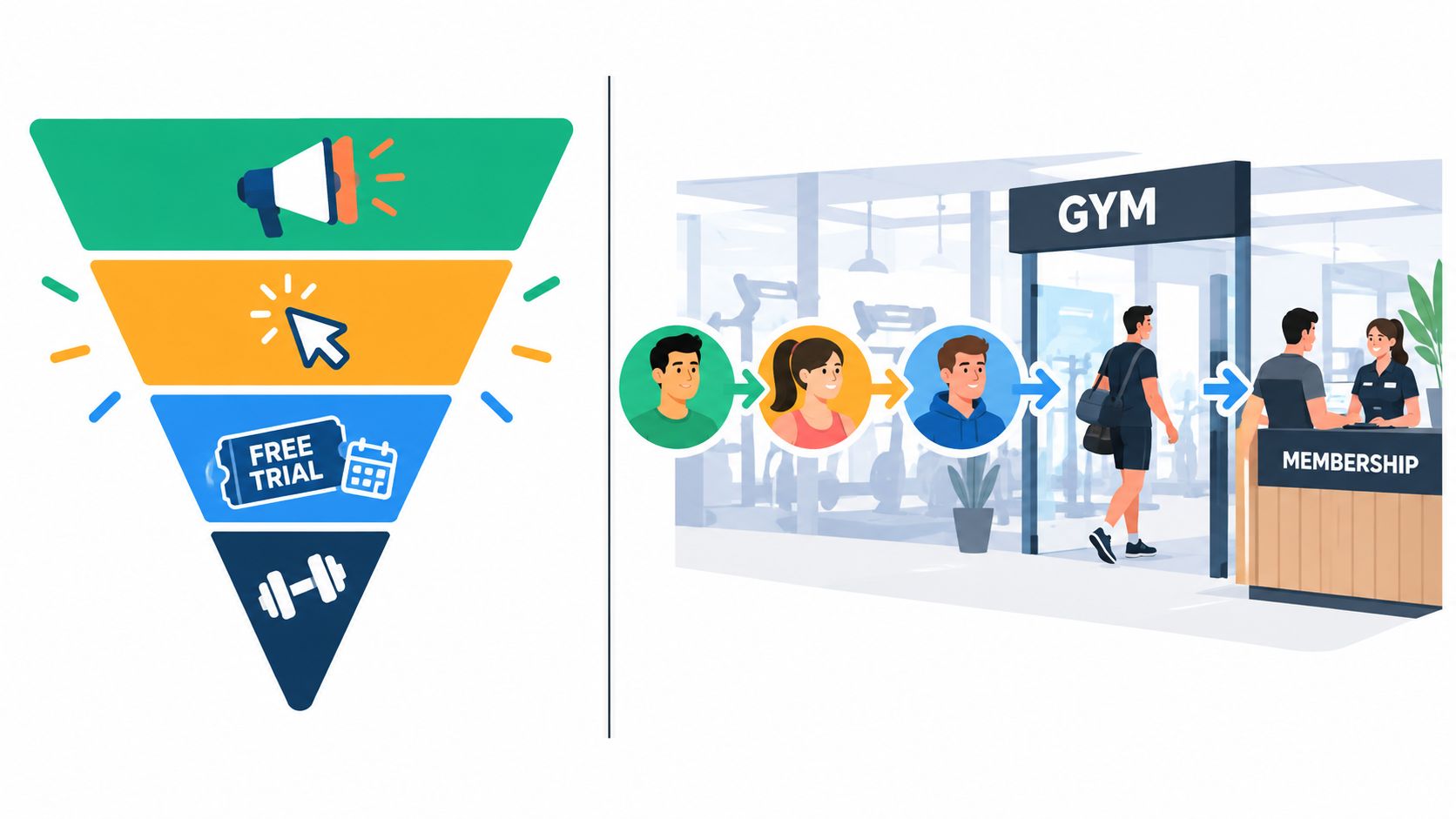
Most gym owners are told to choose between a sales funnel and a sales pipeline. That's bad advice. They aren't competing systems, and treating them as synonyms hides the reason memberships are being lost.
A funnel measures how strangers become aware, interested, and ready to book. A pipeline tracks what happens after a prospect becomes a real opportunity, including the tour, follow-up, offer, objections, and close. For gym membership sales, you need both views of the same member journey.
| Criterion | Sales Funnel | Sales Pipeline |
|---|---|---|
| Main viewpoint | Buyer journey | Seller process |
| Unit measured | Leads and audience volume | Active deals and opportunities |
| Primary owner | Marketing | Sales team |
| Time horizon | Campaign and period trends | Deal-by-deal progress |
| Core metrics | Drop-off and conversion rates | Value, win rate, velocity, and aging |
| Main question | Is demand generation healthy? | Are reps converting qualified prospects? |
Why Gym Owners Confuse the Sales Funnel and Pipeline
A studio owner can stare at a CRM dashboard packed with leads while reviewing a social advertising report full of reach and clicks, yet still have no reliable answer to a simple question: how many new members are likely to join next month?
That uncertainty usually starts with language. Gym teams call every contact a “lead,” every stage a “funnel,” and every opportunity a “pipeline.” The terms overlap because both describe movement toward a membership, but they measure different realities. The funnel is broad and audience-focused. The pipeline is specific and deal-focused, as explained in this sales funnel versus sales pipeline comparison.
One journey, two vantage points
The funnel asks:
- How many people saw the gym?
- How many clicked, opted in, or requested a pass?
- How many booked a tour or trial?
- Where did people stop responding?
The pipeline asks:
- Which prospects have a scheduled tour?
- Who attended?
- What offer did the rep present?
- What objection is blocking the decision?
- What action happens next?
Those questions belong to different teams. Marketing usually studies the funnel in aggregate, while sales managers inspect individual opportunities. A gym can have strong awareness and weak closing, or weak awareness and excellent closing. One dashboard won't diagnose both problems.
Practical rule: Use the funnel to judge whether your marketing creates enough qualified interest. Use the pipeline to judge whether your staff turns that interest into memberships.
The distinction matters because the broad market data shows heavy drop-off before a sales conversation begins. Benchmark summaries report that only 1% to 3% of website visitors convert into leads, while roughly 97% to 99% leave before a sales conversation in many B2B contexts, according to sales pipeline benchmark data from Landbase. That doesn't mean a local gym should copy B2B targets. It does show why traffic and active opportunities mustn't be placed in the same bucket.
For a gym, a funnel may reveal strong local awareness but weak free-pass response. The pipeline may reveal plenty of tours but poor follow-up. Measure the wrong layer, and you'll spend on ads when the issue is the sales floor.
What the Sales Funnel Measures in a Gym Context
A sales funnel answers the marketing question: is your gym turning local attention into buying intent? It tracks groups of people as they move from broad exposure toward a membership decision. The sales pipeline answers a different question, whether staff are closing individual opportunities. Treating them as competing models creates the wrong diagnosis.

The five useful funnel stages
Awareness covers local search visibility, social reach, paid ad impressions, referrals, and people who pass your facility. Measure exposure here, not sales readiness.
Interest starts when someone clicks an ad, visits a landing page, reads a class page, or reviews membership information. A click signals curiosity, not commitment.
Consideration appears when a prospect requests a free pass, downloads an offer, submits a contact form, or books an introductory conversation. Your marketing has created enough relevance for the person to identify themselves.
Intent shows through a scheduled tour, trial booking, or attended free trial. Define this stage carefully. A booked trial is different from an attended trial, and neither automatically means the prospect is ready for a purchase conversation.
Action is the membership sale. Some gyms extend the funnel through onboarding and retention because member experience affects referrals and future value.
Marketing owns the funnel, while sales needs clean handoffs from it. Review the model weekly or monthly for broad patterns, such as an offer generating clicks but few bookings. That pattern points to a problem with the offer, page, or booking path, not automatically with the sales team.
Gym funnel benchmarks rarely transfer cleanly between studios because offers, pricing, locations, and stage definitions differ. Set your own definitions and record what moves a prospect forward with this gym sales funnel building guide.
Read the shape, not just the top number
A large audience cannot compensate for weak progression. Rising impressions and clicks with flat opt-ins point to the offer or landing page. Growing opt-ins with few attended trials point to reminders, scheduling, or the booking experience.
Historical benchmark summaries report an average overall funnel conversion rate of 2.35%, with top performers exceeding 11.45%, and describe 15% to 21% conversion from MQL to SQL in common B2B funnel reporting, according to published sales funnel statistics. Use those figures as context, not gym targets. Your funnel should show where attention disappears before a sales rep can act.
What the Sales Pipeline Measures in a Gym Context
A sales pipeline tracks active membership opportunities one by one. It starts when a contact becomes a genuine sales opportunity and records the actions required to reach a decision. The funnel shows whether marketing creates demand. The pipeline shows whether the team converts that demand into memberships.
The pipeline is an operating board for the membership team, not a larger version of the funnel. Managers use it to assign ownership, inspect progress, and decide which prospect needs attention today.

Build stages around actions
A practical gym pipeline can include:
- Tour scheduled: The prospect has selected a date and time.
- Tour completed: A staff member showed the facility and confirmed attendance.
- Needs assessment completed: The rep knows the prospect's goals, schedule, barriers, and preferred training format.
- Options presented: Membership choices, pricing, and next steps were explained clearly.
- Objection handling: The rep addressed concerns about price, timing, confidence, commitment, or fit.
- Follow-up active: The prospect has a defined next action, rather than a vague “check back” note.
- Closed won or closed lost: The decision is recorded with a reason.
Sales owns this process. Managers should inspect it daily because each open opportunity may become a near-term membership. Flag deals without a next action, prospects stuck in one stage, and completed tours without a documented outcome.
Use this gym sales pipeline management guide to formalize stage definitions, follow-up actions, and ownership. A shared spreadsheet can suit a small studio, provided it shows the same information clearly.
Pipeline metrics forecast movement
Pipeline reporting focuses on deal count, pipeline value, win rate, average deal size, sales-cycle length, and aging. A commonly cited velocity formula is:
Pipeline velocity = opportunities × average deal size × win rate ÷ sales-cycle length
The formula appears in pipeline velocity guidance from Reevo. It prompts four practical checks: does the team have enough opportunities, is membership value understood, do reps win a healthy share of deals, and do prospects progress quickly?
A pipeline full of stale tours is unhealthy. A smaller pipeline with clear ownership and next steps is far more actionable. Use the funnel to diagnose marketing performance, then use the pipeline to manage the closing work.
Side-by-Side Comparison of Funnel and Pipeline
A sales funnel and a sales pipeline are not competing systems. For a gym, they answer different questions about the same member journey. The funnel shows whether marketing creates demand and where prospects drop out. The pipeline shows whether the sales team advances qualified prospects toward membership.
A free-pass download belongs in the funnel because it records audience response. A booked tour belongs in the pipeline once a staff member owns the opportunity and must manage its next action.
| Criterion | Sales Funnel | Sales Pipeline |
|---|---|---|
| Unit of measurement | Leads, visitors, opt-ins, trials | Deals, tours, proposals, decisions |
| Primary time horizon | Campaign, weekly, or monthly trend | Daily opportunity movement |
| Main owner | Marketing, with sales handoff | Sales reps and managers |
| Typical shape | Narrowing triangle | Horizontal process view |
| Core output | Stage conversion and drop-off | Velocity, aging, value, and forecast |
| Diagnostic question | Where are people losing interest? | Which opportunity needs action? |
| Common redesign trigger | Creative, offer, channel, or landing page | Script, tour flow, follow-up, or objection handling |
| Gym example | Free-pass opt-in rate | Tour-to-membership progression |
Why the metrics aren't interchangeable
A 4% trial-to-member conversion rate is a funnel result. It shows how many trial participants became members within the measured group. It does not identify whether a representative missed follow-up, staff gave inconsistent pricing, or the trial attracted poor-fit prospects.
A 12-day average close time belongs to the pipeline. It measures how long active opportunities take to reach a decision. It does not show whether marketing generated enough qualified trials or whether the offer attracted the right audience.
Industry summaries cite 20% to 25% from lead to MQL, 12% to 18% from MQL to SQL, and 6% to 9% for closed-won outcomes in B2B sales motion data, as reported in sales funnel and pipeline benchmark summaries. Those figures illustrate the separation between stages, but a gym should establish its own historical baseline rather than copy B2B benchmarks.
Use the funnel to judge demand generation. Use the pipeline to manage sales execution. A gym owner should inspect the funnel when lead volume or trial bookings weaken, then inspect the pipeline when tours are happening without decisions. Marketing owns the first diagnosis. Sales owns the second.
Key Metrics Each Model Demands
A gym needs simple definitions and disciplined data entry to manage both models. Track only metrics that change a marketing decision, a sales action, or the handoff between them.
Funnel metrics reveal marketing health
The funnel measures whether marketing creates useful demand:
- Impressions and reach show whether enough people encounter the gym's message.
- Cost per lead shows the advertising spend required to produce an identified prospect.
- Lead-to-trial rate shows whether the offer and follow-up turn interest into a scheduled experience.
- Trial-to-member conversion shows whether trials attract suitable prospects and whether the offer makes sense.
- Cost per acquisition connects marketing expense with new membership outcomes.
Do not celebrate a lower cost per lead when those contacts fail to book or attend. Cheap leads can still consume expensive front-desk time.
Pipeline metrics reveal sales execution
The pipeline starts when a prospect becomes an active opportunity. Track:
- Open opportunities show the team's current workload.
- Average deal size assigns a consistent planning value to each opportunity.
- Win rate shows how often qualified opportunities become members.
- Sales-cycle length exposes delays between meaningful contact and the prospect's decision.
- Pipeline velocity combines opportunity count, deal size, win rate, and cycle length to show how quickly potential revenue moves.
SaaS guidance reports a median win rate of about 19% across 172 B2B SaaS companies. That figure is not a gym membership benchmark, so keep it out of your target dashboard. Use win rate with deal quality and cycle length instead of judging it alone.

Match the system to the business moment
A new studio should prioritize funnel visibility to learn which local message creates qualified interest. A mature club with steady inquiries should prioritize pipeline discipline when tours occur but memberships remain flat. A seasonal campaign needs both: marketing creates demand, and sales must process each opportunity before interest fades.
Store funnel data in advertising platforms and landing-page tools, then connect the handoff to a CRM. Keep pipeline records in the CRM or a carefully maintained spreadsheet. Define exactly when a lead becomes an opportunity. Without that rule, staff enter stages differently and every downstream metric loses credibility.
When a Gym Should Lean on the Funnel and When the Pipeline Wins
The right model depends on where the constraint sits. Don't ask which system is superior. Ask where prospects are disappearing.
A new studio opening
A new studio in its first month has limited brand awareness and few active deals. The funnel deserves priority because the owner needs to learn whether local audiences notice the facility, understand the offer, and take the first action.
At this stage, watch the quality of the message, landing-page response, booked trials, and attendance. The pipeline still matters, but it should remain simple. Every early tour needs an owner and a recorded outcome, yet there's no reason to build a complex forecast before demand exists.
An established gym with slow sales
A mature club with consistent lead flow but stagnant memberships has a pipeline problem until proven otherwise. Marketing may already be producing enough interest, while staff lose prospects between the tour, needs assessment, presentation, and follow-up.
Inspect individual opportunities. If reps don't record the next action, if completed tours sit untouched, or if objections vary wildly from one conversation to another, coach the sales process rather than buying more traffic.
A seasonal rush
A January rush demands both models. The funnel shows whether your campaign creates useful demand and whether ad spend reaches the right local audience. The pipeline carries the urgency because high-intent prospects can disappear quickly when staff respond slowly or let follow-up become inconsistent.
Don't let a crowded calendar become an excuse for weak stage management. Assign every tour, define the next action before the prospect leaves, and review aging opportunities every day during the surge.
A boutique studio using paid social leads
A boutique studio running paid Instagram leads needs funnel diagnostics to prevent wasted spend. Check whether the offer attracts real prospects, not just form submissions. Then use pipeline diagnostics to ensure booked conversations receive reminders, personal outreach, and a clear membership recommendation.
The editorial rule is simple: if your problem is volume, fix the funnel; if your problem is conversion, fix the pipeline.
Building a Hybrid Model and Closing the Sale Cleanly
A gym should operate one connected system with two views. The funnel tells marketing whether its campaigns generate useful attention and identifiable interest. The pipeline tells sales whether staff advance each opportunity toward a decision.
Don't make the handoff a vague moment. Define the exact event that moves a prospect from marketing tracking into sales management, such as a confirmed tour or attended trial. Then require the assigned rep to record the next action, current stage, membership fit, and decision status.
A practical weekly operating rhythm
Use a short checklist that forces action:
- Review marketing efficiency: Check cost per lead, source quality, booking activity, and trial-to-member movement.
- Review sales execution: Inspect tour-to-member performance, open opportunities, pipeline velocity, and average days to close.
- Audit CRM hygiene: Require one definition for every stage, mandatory fields for important opportunity details, and updates after each meaningful interaction.
- Run a Monday pipeline standup: Discuss active deals, stalled stages, upcoming tours, and the next action for each priority opportunity.
- Run a Friday funnel review: Compare channels, offers, landing pages, and lead quality before changing the next campaign.
- Standardize post-tour follow-up: Give reps approved call, SMS, and email templates, but require personal context from the actual conversation.
For sales conversations, use this guide to asking for the sale as one possible training resource. A script shouldn't make reps sound robotic. It should stop them from avoiding a clear recommendation when the prospect has already explained what they want.
Keep the facility aligned with the promise
A clean tour experience supports the sales conversation. Fitness facilities should use EPA-registered disinfectants on hard, non-porous shared surfaces, and gym guidance accepts disinfecting wipes when the surface stays wet for the full label contact time, according to fitness facility cleaning guidance from the U.S. Navy.
Place gym equipment cleaning wipes or a gym wipe dispenser near high-touch equipment so staff can wipe down benches, cardio grips, free weights, and other shared surfaces between uses. Product guidance from the National Academy of Sports Medicine also shows why label instructions matter: one wipe may sanitize in 10 seconds but require 4 minutes to disinfect, depending on the claim and dwell time, as explained in NASM's disinfecting guidance for fitness professionals.
Use wipes to disinfect gym equipment only as the product label allows, keep surfaces visibly wet for the required contact time, and train staff to replenish supplies. Clean equipment won't close a deal by itself, but a neglected facility can undermine the trust your rep just worked to build.
Gym Membership Tips is one resource that publishes practical material on membership offers, sales processes, and retention for fitness operators. Pair that education with a CRM or shared spreadsheet your staff will maintain.
This week, map every gym prospect from first response to membership decision, label each step as funnel or pipeline activity, and assign one owner to each action. Then place clearly labeled disinfecting wipes near shared equipment, train staff on the product's contact time, and review both your funnel and pipeline before changing your advertising budget.
Leave a Reply