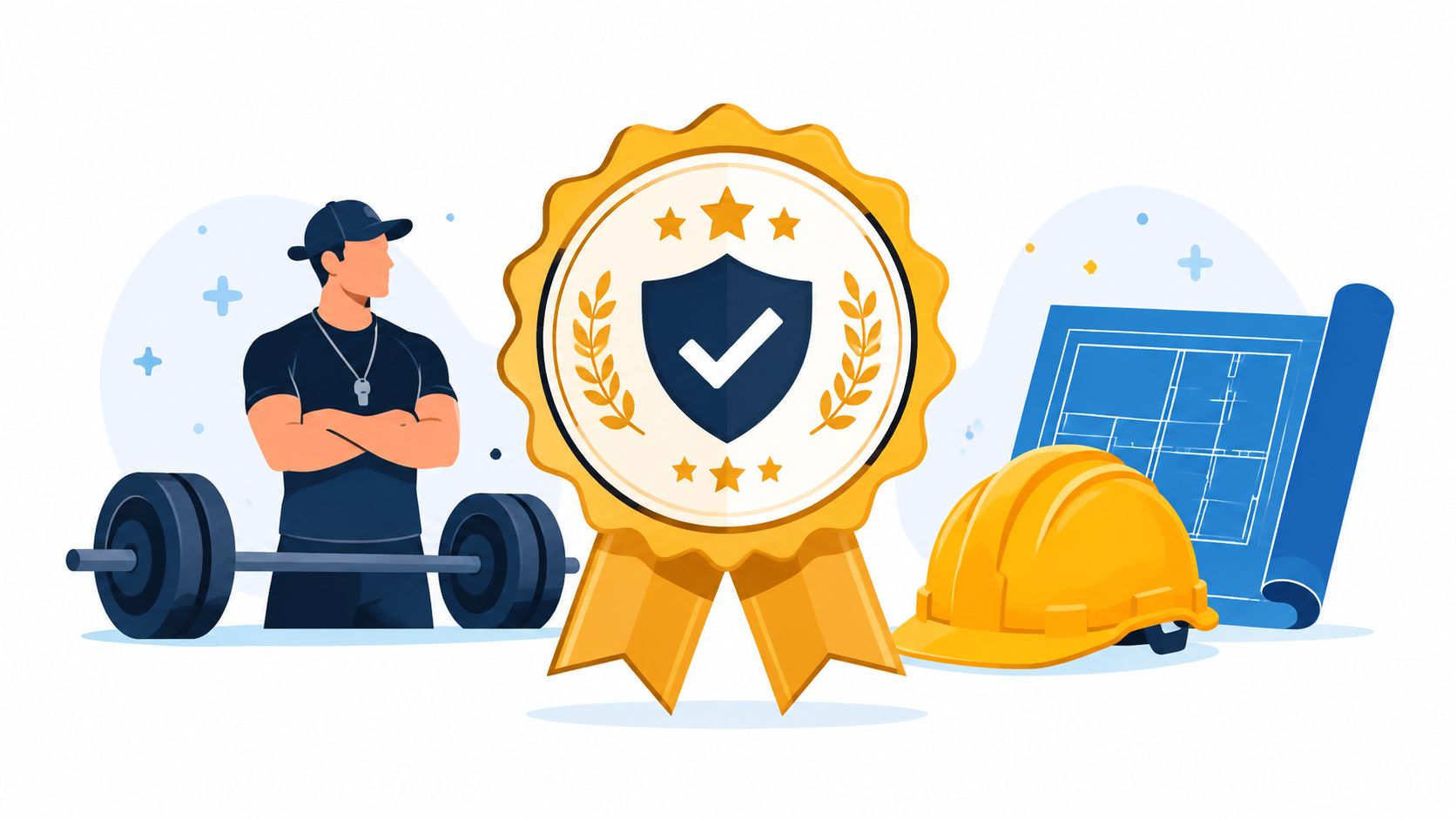
The CSCS certification is the NSCA's Certified Strength and Conditioning Specialist credential, and it's built around a two-section exam covering Scientific Foundations and Practical/Applied content. In 2024, over 6,200 candidates sat for both sections, and 41% passed both sections.
A gym owner hears “CSCS” in two different meetings and gets two completely different answers. One candidate means a construction card, another means a performance-coaching credential, and both people sound confident.
That confusion is normal. Same acronym, different industries, different governing bodies, different hiring meaning. If you're screening coaches, building a staff page, or trying to understand whether a credential really signals sport-performance expertise, you need the NSCA version of CSCS, not the construction one.
The NSCA credential sits in the strength and conditioning lane, not the general gym-floor lane. It's the kind of certification you'd expect from someone coaching athletes, planning performance work, and speaking the language of exercise science with confidence. For a gym owner, that difference matters because the wrong credential can look polished on a résumé while telling you almost nothing about coaching quality.
Why Two Different CSCS Certifications Confuse Everyone
The first mistake is assuming the acronym tells you enough. It doesn't. A contractor in the UK can mention a CSCS card and mean the Construction Skills Certification Scheme, while a coach in the U.S. can mention CSCS and mean the NSCA Certified Strength and Conditioning Specialist.
The simplest way to separate them
The NSCA credential is for performance coaching. The construction card is for site safety and access in the building trades. One belongs in a weight room and the other belongs on a construction site.
If you hire for a gym, the question is straightforward. Does the person hold the NSCA CSCS, the sport-performance credential, or are they referring to something unrelated to fitness? The NSCA's own framing makes the boundary clear, the credential is for professionals who train athletes and teams to improve performance, not for general gym-floor instruction or broad personal training.
Practical rule: ask which country, which industry, and which governing body. If the answer doesn't point to the NSCA, you're probably looking at the wrong CSCS.
The rest of this guide stays focused on the NSCA version, because that's the one that affects staffing, coaching standards, and athletic programming. If your business serves teams, student-athletes, or performance-minded clients, this is the credential that changes how a candidate is evaluated.
CSCS NSCA vs CSCS Construction Skills
The fastest way to kill the acronym confusion is to compare the two versions side by side. They share letters, but they don't share purpose, audience, or professional signal.
Side-by-side comparison
| Criterion | NSCA CSCS | UK CSCS Construction Card |
|---|---|---|
| Purpose | Strength and conditioning coaching for athletes and teams | Construction-site competence and access |
| Governing body | National Strength and Conditioning Association | Construction Skills Certification Scheme |
| Target audience | Performance coaches and sport-support professionals | Construction workers and contractors |
| Main focus | Exercise science, program design, technique, and applied coaching | Site safety and trade access |
| Prerequisites | Bachelor's degree and CPR/AED certification | Varies by card type and trade path |
| Best use in hiring | Athletic performance and sports-training roles | Construction labor and trade roles |
A good hiring filter follows the use case, not the acronym. If the opening is for speed work, lifting technique, testing, or team programming, the NSCA credential is the relevant one. If the job is about scaffolding, site compliance, or trades, the construction card is the one that matters.
The wrong card can look impressive to a casual reader and still be meaningless in your context. That's why gym owners should ask for the issuing organization, not just the initials. A coach who really knows the field won't be offended by the clarification.
For a broader look at how degree paths can support gym hiring, you can also review this guide on personal training degree paths.
A clean rule keeps this simple, which country, which industry, which governing body. If those three don't line up with sport performance, it isn't the credential you want for a fitness role.
Inside the NSCA CSCS Exam
The NSCA CSCS exam is not a quick screening test you can cram for over a weekend. It is built around two scored sections, Scientific Foundations and Practical/Applied, and the structure alone tells you the credential is meant to measure real depth.
What the exam actually looks like
Scientific Foundations includes 80 scored questions and 15 non-scored questions. Practical/Applied includes 110 scored questions and 15 non-scored questions, and the exam content stretches across exercise science, sport psychology, nutrition, program design, exercise technique, implementation, and administration. The testing design shows that the certification is a detailed competency assessment, not a light familiarity check.

In 2024, over 6,200 candidates sat for both sections, and 41% passed both sections. The section-level pass rates were 68% for Scientific Foundations and 44% for Practical/Applied, which tells you where candidates tend to struggle most, the applied coaching side. Those numbers don't make the exam impossible, but they do make one thing obvious, serious preparation matters. NSCA exam description
How to think about the exam content
If you've coached in a busy facility, think of the two sections like theory and field work. Scientific Foundations asks whether you understand the “why.” Practical/Applied asks whether you can turn that knowledge into coaching decisions under pressure.
That's why prep time often stretches longer than candidates expect. Someone can know the major lifts and still miss the exam if they haven't studied the science behind adaptation, testing, and program construction. The exam rewards people who can connect the classroom with the weight room.
Eligibility and the 2030 Academic Shift
CSCS eligibility starts with the basics, but the direction of travel matters just as much as the current checklist. Right now, candidates need a bachelor's degree and a current CPR/AED certification to sit for the exam, and the NSCA also sets application and testing requirements through its own process. NSCA prerequisites
What the current path looks like
The qualification standard is already more serious than many entry-level fitness credentials. That's intentional. The NSCA is signaling that this is a performance-coaching credential for people who can handle deeper science, not a quick badge for floor coverage.

The academic path gets stricter on a future timeline. From January 1, 2030, U.S. candidates will need a bachelor's degree from a CASCE-accredited program, and candidates outside the U.S. won't face that requirement until January 2036. CASCE is the accreditation body tied to strength and conditioning education standards, so the move points toward a more standardized academic pipeline for the profession. NSCA prerequisites
What gym owners should do with that information
If you're hiring now, the shift tells you where the credential is heading. The bar is moving toward more formalized education, which means a CSCS holder in the future is likely to have walked through a more structured academic route.
That doesn't mean a current CSCS holder is automatically better than every other coach. It does mean the credential is being anchored more tightly to formal preparation. If you're building a coaching team for athletic performance, that matters when you compare résumés and plan future staffing.
Candidates also need to think about their own education path early. If you're mapping that out from the gym-owner side, a useful related read is this overview of what a good personal trainer certification looks like.
The cleanest hiring habit is to verify the degree requirement now, then keep an eye on where the academic standard is heading. That saves you from surprises when a candidate looks qualified on paper but doesn't meet the right eligibility lane.
How Selective and Sought-After the Credential Really Is
The CSCS has become a real global standard, not a niche badge tucked into a corner of the industry. As of December 31, 2025, the NSCA reported 45,669 professionals held the credential worldwide, up from 40,660 at the end of 2024, a rise of about 5,009 certificants in one year. NSCA exam report
Why those numbers matter to gym owners
A credential grows like that only when the market keeps finding it useful. More holders usually means more visibility, but it also means the credential has stayed relevant enough to keep attracting serious candidates. For a gym owner, that makes CSCS a recognizable shorthand for advanced performance coaching.
The 2025 exam cycle also shows the credential is still selective. The NSCA reported 9,650 candidates, with 50% passing both sections, while section pass rates were 71% for Scientific Foundations and 55% for Practical/Applied. NSCA exam report

What selective actually means in the real world
Selective doesn't mean rare for the sake of being rare. It means the credential still filters for people who can handle advanced sport-performance demands. That's useful in a market where a lot of certifications are easy to earn but hard to trust.
If you're a gym owner, that balance matters. You want a credential that's recognized enough to impress educated clients, but demanding enough to mean something when a coach walks onto your floor. CSCS fits that middle ground better than most general fitness credentials.
Why Gym Owners Should Care About the CSCS
A CSCS-credentialed coach changes more than the training floor. They can change how prospects perceive your business, how clients talk about results, and how confidently your staff explains programming choices.
Hiring, credibility, and the coaching floor
The biggest business value is confidence. A CSCS coach is trained in the language of performance, so they're often better equipped to build athlete-facing systems, support team programming, and explain why a given block of training exists. That makes them easier to feature in sales conversations and on your website when you're trying to show depth instead of just enthusiasm.
The NSCA's definition matters here, because it draws the boundary clearly. CSCS is for people who train athletes and teams to improve performance, not for general gym instruction. That means you shouldn't use it as a broad substitute for every coaching role, but you can absolutely use it as a premium signal for performance-focused services. If you want a simple comparison point for broader fitness credentials, this piece on athlete VO2 max training zones is a useful reminder of how performance concepts differ from general health and wellness conversations.

What to say in your marketing
Use the credential where it helps a customer understand your difference. A headline about “advanced strength and conditioning coaching” says more than a generic promise of “expert training.” That's especially useful if you serve youth athletes, competitive teams, or adults who want structured performance work rather than casual fitness support.
You can also keep the message grounded with clean operations. A polished coach plus a polished facility sends the same signal, professional standards matter here. For a quick reference on broader certification fit, you can compare that role against what good personal trainer certification options look like.
Professionalism isn't just what your coaches know. It's also what clients see every time they walk in.
Verifying a CSCS Credential the Right Way
Never treat a résumé line as the final word. If a coach says they're CSCS-certified, verify it through the NSCA before you advertise the credential or finalize the hire. The registry is the point of truth, not the formatting on the application.
A simple verification workflow
Check the NSCA public directory first. Confirm the candidate appears under the correct name and credential status, then compare that with the application. If a candidate doesn't show up, ask for the exact spelling used on the credential record and whether the person has let anything lapse.
Trust the registry over the résumé.
That matters because the credential alone doesn't tell you everything. A person can hold the certification and still have an expired CPR card, and the current CPR/AED requirement still matters for eligibility and continued professional readiness. If the candidate can't be found, don't argue, document the issue, ask for clarification, and pause the offer until you have a clean answer. For a related look at vetting training staff, this guide on action certified personal trainer can help you build a stronger screening process.
A professional script for the conversation
Try this: “I'd like to confirm your CSCS status in our records before we move forward. Can you share the exact name and credential details you use in the NSCA directory?”
That keeps the tone respectful and direct. It also lets the candidate help you verify the record without making the process feel accusatory.
Once you've confirmed the credential, save a note in your hiring file. That way your team has a repeatable process, and you're not rechecking the same details every time a coach updates a profile page or starts a new assignment.
Next Steps, Resources, and a Quick Hygiene Reminder
If you're preparing for the CSCS, start with the NSCA exam outline, then map your study time across the two exam sections instead of trying to learn everything at once. A strong prep plan usually works best when it moves from foundations to applied coaching, because that mirrors how the test itself is built.
For study rhythm and time management, this piece on exam prep tips for 2026 can help you organize your weeks more efficiently. If you're hiring, update your website copy so the credential is described accurately, then feature it where performance clients will notice it.
Keep the presentation consistent with the coaching standard. Wipe down benches, racks, and mats between sessions with wipes for gym equipment, including EPA registered disinfecting wipes on yoga mats and high-touch surfaces, because visible cleanliness reinforces the same professionalism a CSCS coach brings to the floor. Gym wipes, gym equipment wipes, and sanitizing wipes aren't a side detail, they're part of the trust signal.
If you run a busy facility, place a gym wipe dispenser where staff can use it without thinking. That small operational habit supports the bigger message your staff credentials already make.
Bring those pieces together, and the business starts to feel more serious, more organized, and easier to trust. If you want more practical ways to turn credentials into conversions, keep building your training-staff pages and facility standards with the same discipline you'd expect from a top coach at Gym Membership Tips.
Leave a Reply