You're probably staring at a calendar full of “special offers,” a pile of new leads, and a team that's still asking, “Did anyone follow up with that trial from Tuesday?” That's the gap. Sales tactics make noise, but sales strategy moves memberships, because strategy decides who you sell to, how you contact them, what you say, and when you stop guessing.
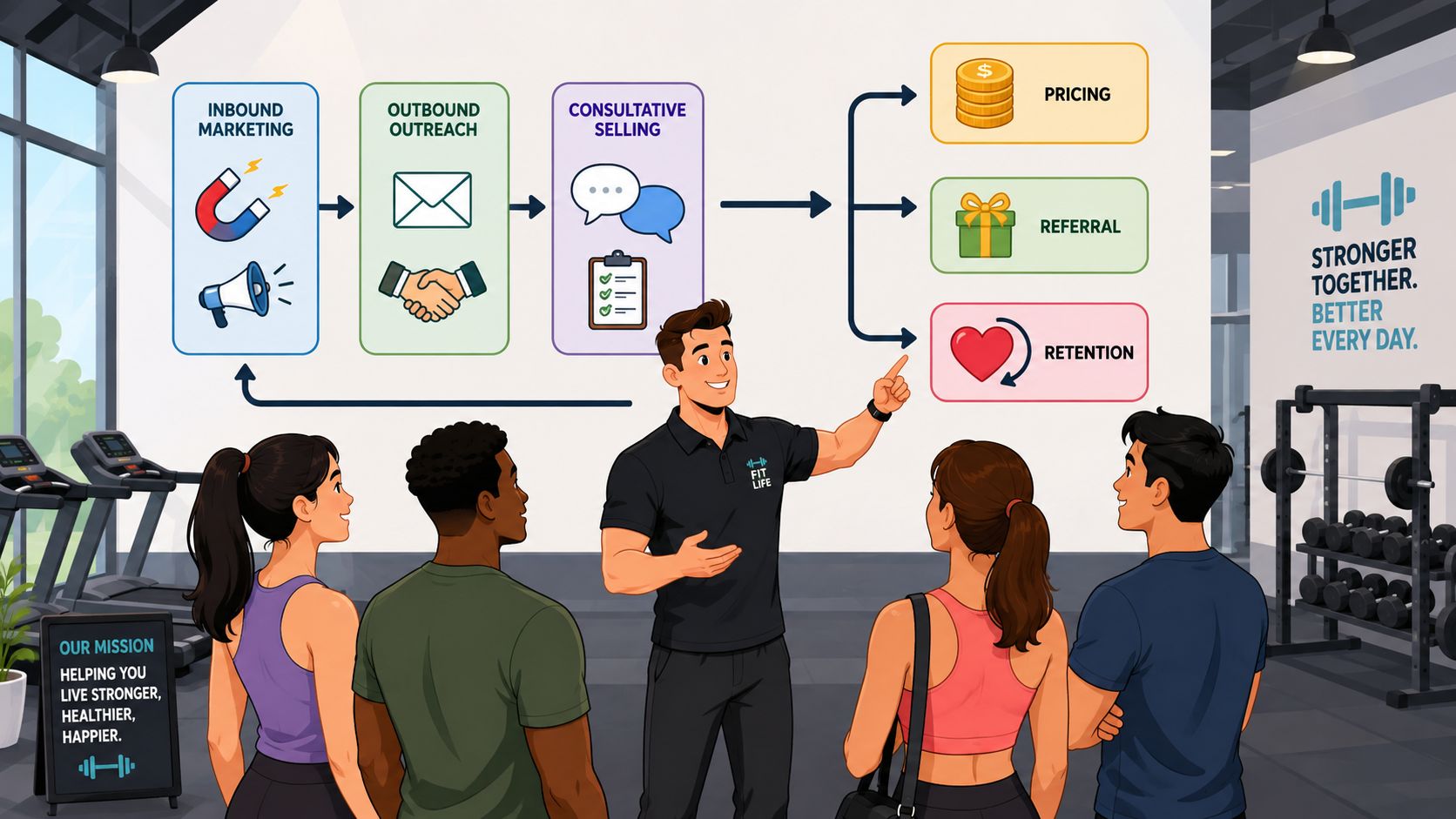
For gyms, what are the sales strategies? They're the repeatable system behind the close, not the close itself. The best operators use a mix of inbound, outbound, consultative selling, pricing, promotions, referrals, and retention, then measure which member type responds to which motion. That's the game.

| Dimension | Sales Tactics | Sales Strategy |
|---|---|---|
| Purpose | Gets attention fast | Builds a repeatable path to growth |
| Time horizon | Short-term | Long-term |
| Focus | One message, one offer, one close | Target customer, channel mix, follow-up, retention |
| Result | A burst of activity | A steady pipeline and better member quality |
| Risk | Random promotion fatigue | Clear execution with measurable improvement |
Why Sales Tactics Alone Won't Grow Your Gym
A lot of gym owners confuse hustle with strategy. They run a 7-day trial, post a few reels, text old leads, and call that a sales plan. It's not. It's a set of disconnected moves, and disconnected moves don't scale.
A real strategy starts with the fact that modern selling is no longer one-channel, one-call, or one-shot. By 2025, 80% of B2B sales interactions were expected to happen through digital channels, and by 2026, 65% of B2B sales organizations were expected to shift from intuition-based to data-driven decision-making, according to the sales statistics cited in the Clevenio research roundup (digital interaction and data-driven sales projections). The same dataset says prospects interact across up to 10 channels, and 72% of B2B companies selling through seven or more channels grow faster than peers. That's the direction gym sales has gone too, even if your business is local.
Tactics are tools, strategy is the blueprint
Practical rule: if you can't name the member type, the channel, the follow-up cadence, and the metric, you don't have a strategy yet.
That's why this whole article is organized around the way gyms sell memberships. First-timers need reassurance. Families need convenience. Budget shoppers need value. Corporate prospects need business outcomes. Each group needs a different approach, and each approach needs a number attached to it.
The strongest gym sales strategy is built on seven pillars: lead capture, outbound prospecting, consultative selling, pricing and packaging, promotions, referrals, and retention. Those pillars don't compete with each other. They support one another, because a better funnel on the front end usually produces better retention on the back end.
The Seven Core Sales Strategies Every Gym Needs
A gym sales strategy is a structured plan for turning the right people into the right memberships through the right channels. That definition matters because it keeps you from treating sales like a random collection of scripts. It also lines up with the idea that strategy is a long-term, measurable system, not a loose set of one-off tactics, as described in ESADE's overview of sales strategy.

The seven pillars that actually matter
Lead generation is the first pillar. This is your website forms, social posts, walk-ins, local search, and trial offers. Its job is simple, bring qualified interest into the funnel.
Sales process is the second pillar. That means a defined path from inquiry to tour, from tour to trial, and from trial to membership. Close's breakdown of a typical B2B process, outreach, qualification, discovery, meeting, proposal, negotiation, and close, gives gym operators a clean model to adapt (sales process stages).
Follow-up system is the third pillar. Gyms win or lose the majority of deals here, because people don't always decide on the first visit.
Pricing and packaging is the fourth pillar. A smart offer stack gives prospects choices without turning your gym into a discount bin.
Team and training is the fifth pillar. Your scripts only work if your staff can deliver them consistently.
Communication plan is the sixth pillar. That includes what you say on the phone, in text, in email, and on the tour. If your messaging changes every week, your pipeline will too.
Retention and loyalty is the seventh pillar. The membership sale isn't finished at the sign-up table, it's finished when the member stays long enough to become a promoter.
A useful companion resource here is this breakdown of small business social media strategy, because your content plan should feed lead capture instead of living on its own. That's the mistake most gyms make, they post for attention but don't build a path to a tour or trial.
Inbound Versus Outbound Strategies for Gyms
Most gyms lean too hard on one side. They either wait for leads and hope content does the work, or they chase everyone in town with the same generic pitch. Neither side is enough on its own.
Inbound works best when the buyer needs time. That's true for premium training, boutique memberships, and anything that requires trust before purchase. Outbound works best when the buyer is harder to reach directly, like corporate wellness contacts, nearby offices, local partners, or a new facility trying to create awareness quickly.
Which channel fits which situation
| Scenario | Best Channel | Why It Works |
|---|---|---|
| Premium membership with coaching | Inbound | The buyer wants proof, clarity, and time to compare |
| New gym location launch | Outbound | You need local attention fast and a direct opening message |
| Corporate wellness deal | Outbound | You're selling to a business, not a walk-in lead |
| Family membership | Hybrid | Parents compare options online, then respond to direct outreach |
| Intro offer for a general audience | Inbound | A simple landing page and local search capture active interest |
A small gym team can handle both if it stops pretending every channel deserves equal effort. Pick one inbound engine, usually local SEO, social proof, or lead forms. Pick one outbound engine, usually partner outreach or nearby business development. Then keep the same message across both.
A good hybrid system doesn't mean doing more. It means doing the same core pitch in the places your buyer already pays attention.
If you need quick creative support for outbound ads, a tool like ShortGenius AI ad generator can help turn one offer into multiple formats fast. That matters when you're testing local campaigns, but don't let the creative tool distract you from the work, which is matching the offer to the buyer.
Consultative Selling and the Membership Tour
Sam walks into your gym for a tour. He says he wants to “get back in shape,” but he hasn't trained consistently in a year, he's nervous about crowded floors, and he's comparing you to two other clubs down the road. If your manager launches into price and closes hard, you lose the sale.
Ask before you pitch
Start with discovery, not pricing.
“Tell me what you're hoping will change over the next few months.”
“What's gotten in the way before?”
“What kind of environment helps you stick with it?”
“How soon are you hoping to start?”
“What's most important to you, classes, lifting, coaching, convenience, or price?”
Those questions uncover the buying reason. They also help you match the right membership type to the right person instead of forcing everyone into the same script.
A good consultative response sounds like this.
“Based on what you said, I wouldn't push the most expensive plan on you. I'd rather show you the option that gets you here consistently and keeps you comfortable enough to stay.”
That line works because it shifts the role from seller to guide. Business.com's advice on fact-based selling supports this approach too, because the rep should know the relevant facts, know how competitors compare on key metrics, and be careful not to exaggerate anything that can backfire later (fact-based selling guidance).
Objections need reframing, not pressure
Price: “I get it. Let's compare what you'd use here so you only pay for what helps.”
Time: “If time is tight, the plan has to make attendance easier, not harder.”
Intimidation: “People feel that way at first, so we'll keep the first visit simple and structured.”
Bad past experience: “That tells me you need a clearer onboarding path, not more hype.”
If you want a deeper script reference, this internal guide on what is consultative selling is a useful companion. The core idea is simple, your tour should feel like a conversation about outcomes, not a performance about features.
Pricing Packaging and Promotions That Protect Margin
Price is not just a number on the wall. It's a sales tool. If you use it badly, you train people to wait for discounts. If you use it well, you help different buyer types choose without eroding your margin.
Build offers around behavior, not panic
Use tiers with intent. A basic access plan gives the budget shopper a way in. A mid-tier option can bundle classes or a few coaching touches. A premium option should feel like the fastest path to a result, not just a bigger invoice.
Family and couple packaging work for a simple reason, they reduce friction for households that want convenience. Pay-per-visit models can help with hesitant prospects, but they're usually a bridge, not the core business. Annual prepay can be strong when you want commitment without a sticker shock discount, because you're trading payment timing for retention clarity.
Promotions should be rare enough to matter. A New Year Reset challenge makes sense because motivation is already high. A Bring a Friend Month campaign works because it lowers fear and increases social proof. A corporate wellness pilot fits outbound because it gives a business a low-risk way to test value before expanding.
If you discount every month, your offer loses authority. If you use promotions for launches, seasonal pushes, or equipment upgrades, they feel earned. That's the difference between a sales strategy and a bargain bin.
Trade-off to remember: every discount has to be paid for somewhere, usually in margin, brand perception, or future price resistance.
Referral Programs and Retention-Focused Selling
The smartest gyms stop acting like every new lead is a fresh start. They treat every member as a potential referral source and every first month as the beginning of the renewal conversation.
Make the referral ask specific
A weak referral program asks for “friends and family.” A strong one ties the ask to a clear moment. After a first result, after a 30-day milestone, or after a member posts progress, ask directly.
“Who do you know who'd feel more comfortable starting with you?”
“If this has helped your routine, would you be open to bringing one person in this month?”
“If a friend has been thinking about starting, I'd love to give them the same first-step experience.”
The incentive should match your audience. Credit works well because it feels practical. A free month can be effective when the value is obvious. Branded merchandise can work for culture-driven communities. A charity donation can fit a mission-led brand. Track it with unique codes, member tags, or a spreadsheet. Don't overcomplicate the system and kill adoption.
Retention starts on day one. That means an onboarding ritual, a 30-day check-in, a 60-day motivation touchpoint, and a 90-day review for at-risk members. The renewal happens later, but the experience that creates renewal begins immediately.
The acquisition-versus-retention point matters here. The brief data notes that acquiring a new member can cost roughly five to seven times more than retaining one, and that's the logic behind a retention-first growth model. A helpful reference for building that kind of program is this guide on client referral program ideas.

Retention also improves your sales floor because long-term members become living proof. They answer objections for you, especially in group classes and community events where emotional commitment grows naturally.
Sales Metrics That Tell You Which Strategy Is Working
You don't need a dashboard full of vanity numbers. You need a few metrics that tell you where the funnel is leaking.
Track the numbers that expose the bottleneck
Lead-to-trial conversion tells you whether your offer and first response are strong enough to earn the visit. If that number is weak, your inbound message or outbound list is off.
Trial-to-member conversion tells you whether your tour, pricing, or objection handling is failing. That's where consultative selling lives or dies.
Average membership value shows whether your packaging is too thin or whether your team can move people into better-fit plans.
Cancellation rate by cohort tells you whether your onboarding and retention system is working for the people you sell.
Member lifetime value helps you judge whether you should keep pushing for higher-quality members, even if they take longer to close.
For process discipline, this guide on sales pipeline management best practices is a useful reference point. The main rule is simple, don't let your team celebrate lead volume if the trial and retention numbers are weak.

Use the dashboard to move effort, not to admire it
If trials are strong but memberships are weak, fix the tour and offer stack. If memberships are strong but cancellations spike early, fix onboarding. If lead response is slow, your team needs a faster reply system. That's the point of tracking metrics, not reporting them.
Your 30-60-90 Day Implementation Plan and Member Experience Close
A gym sales plan only works if it changes what happens on the floor. Use the first 30 days to audit lead sources, response speed, and tour quality. Check which channels bring first-timers, families, budget shoppers, and corporate prospects, then compare that mix with who shows up and buys. If lead quality is weak, stop blaming the close. Fix the source list, the follow-up timing, or the handoff from marketing to sales.
Days 1 to 30 should produce a cleaner process, not more noise. Call every new lead fast, set a hard standard for reply time, and tighten the first message so it does three things: confirms the goal, sets the next step, and gets the prospect on a tour or call. Then listen to recorded tours and mark where the team rambles, talks price too soon, or misses the actual objection. A bad script can make a strong offer look weak.
Days 31 to 60 is the time to launch one strategy pillar and measure it with discipline. If you are selling first-timers, build a simple trial follow-up cadence. If you are selling families, create a tour path that shows childcare, peak-hour space, and convenience. If you are chasing budget shoppers, keep the offer plain and the value clear. If you want corporate accounts, bring a short proposal, a contact list, and a clean next-step calendar.
Do not layer in five new tactics at once. Pick one change, train it, and hold the team to the same script for every prospect type. Then track the metric that matches the tactic. More tours should raise conversion if the pitch is working. Better follow-up should lift show rates if the lead handling is fixed. If neither moves, the idea is wrong or the execution is sloppy.
Days 61 to 90 are about retention and the member experience close. The facility has to look ready every hour of the day, because people judge the gym before they judge the contract. Keep the floor clean, the equipment wiped, and the tour path easy to trust. Stock gym equipment wipes, fitness wipes, and EPA registered disinfecting wipes where members can see them, place a visible gym wipe dispenser near high-touch stations, and keep wipes.com gym equipment wipes available as a bulk-friendly option that supports a clean, organized floor. A well-managed gym makes the sale easier, because it shows prospects they are joining a place that respects the details.
By the end of 90 days, the manager should know which membership type responds to which message, which follow-up cadence gets replies, and which parts of the member experience help close the sale. If the numbers improve but the floor looks neglected, the gains will not last. If the floor stays sharp and the process stays tight, the next round of leads becomes much easier to close.
Leave a Reply