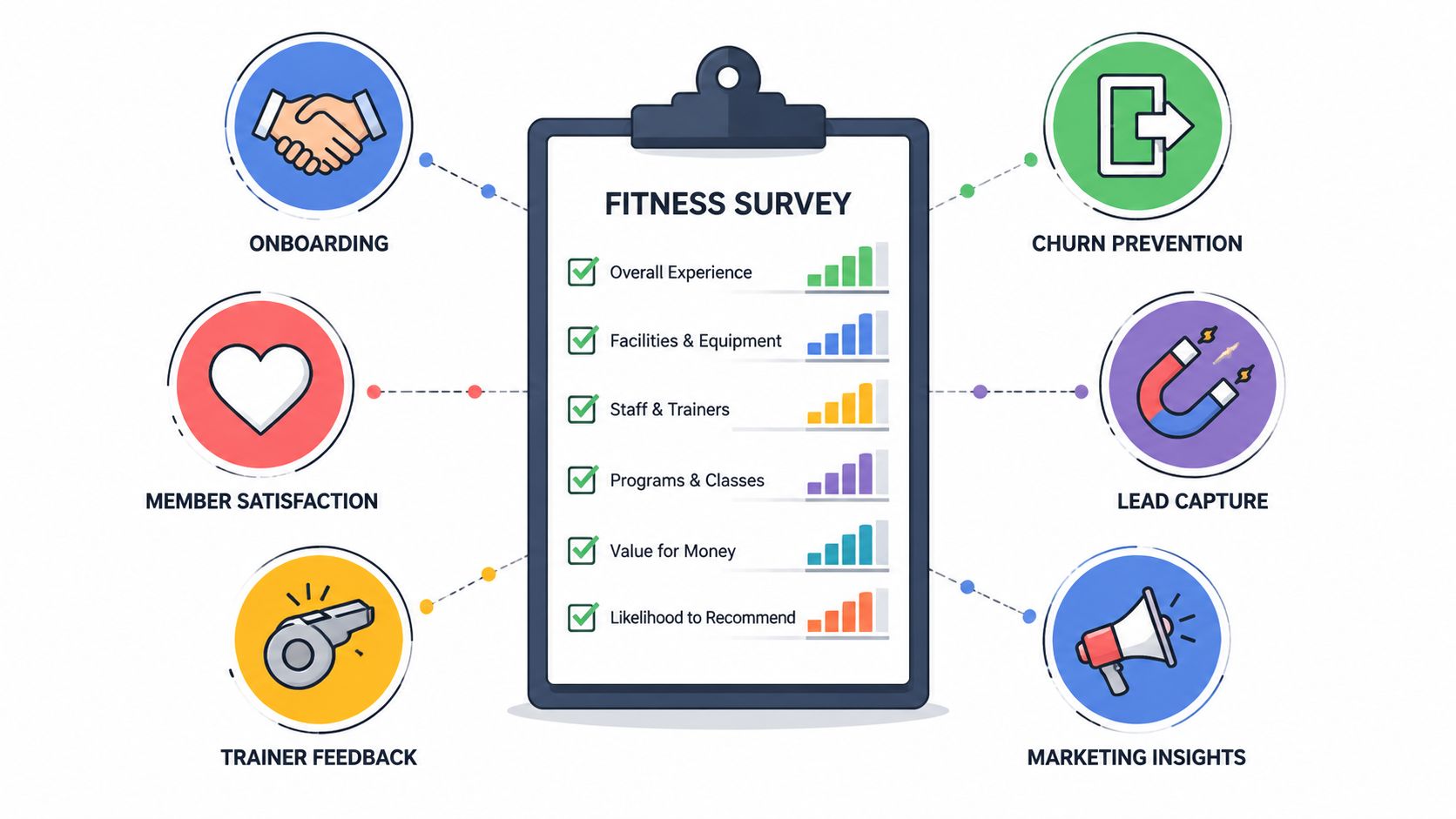
What if the biggest leak in your sales funnel isn't your pricing, your trainers, or your ads, but the fact that you're asking members the wrong questions? Fitness survey questions work best when they reveal why people join, what keeps them coming back, and what pushes them out the door. Done well, they help you improve onboarding, sharpen programming, and make retention decisions with real evidence instead of guesswork.
For gym owners, that matters because survey design changes what you learn. The World Health Organization's adult physical activity guidance gives a clear benchmark, adults should accumulate at least 150 minutes of moderate-intensity activity or 75 minutes of vigorous activity per week, and NHS England's 2021 data shows 64% of adults aged 16 and over met the aerobic guideline, while 20% were inactive. That same dataset shows a gender gap, 70% of men met the guideline versus 59% of women, with regional variation from 58% in the North West to 71% in the East Midlands. find data analysis research training The lesson is simple, if your survey questions are vague, your answers will be vague too.
1. Current Fitness Level and Experience
A member's starting point shapes everything, from the first equipment recommendation to the tone of your onboarding emails. If someone is brand new, asks for help, or is returning after injury, the right question prevents intimidation and sets you up for better retention. If you misread that baseline, you can overwhelm beginners or underserve experienced lifters who expect faster progress.

Ask for the real starting point
The best question is specific enough to segment people cleanly. Ask whether they're new to exercise, moderately active, returning after time away, or advanced, then add a follow-up about limitations, prior injuries, or movements they avoid. That mirrors the logic behind standardized public-health question wording, where structure matters because it changes data quality, not just wording style, as seen in the CDC's National Health Interview Survey instruments. CDC National Health Interview Survey physical activity questions
Practical rule: Don't stop at “How would you rate your fitness level?” A vague self-rating tells you less than a short set of defined response options.
Gym operators can use this to segment onboarding. A beginner-friendly club can route new members into orientation, while a performance-focused gym can fast-track experienced members into advanced coaching or specialty programming. Planet Fitness, Equinox, and CrossFit boxes all show, in different ways, that knowing who walks in the door changes how the whole experience should feel.
Turn the answer into action
Use the response to do three things quickly. First, match the person to the right starting plan. Second, make sure staff know whether to speak in beginner language or performance language. Third, revisit the question quarterly so you can see progression and avoid treating someone like a novice months after they've already built habits.
- Segment onboarding: Put first-time exercisers in a gentler path and show them beginner-friendly classes.
- Protect credibility: Review limitations during the first session so staff don't repeat questions the member already answered.
- Refine marketing: Use the data to highlight the classes and equipment that fit each experience level.
If your survey doesn't capture baseline fitness and limits, it can't support smart sales conversations or sensible equipment planning. The point isn't to label people, it's to meet them where they are.
2. Primary Fitness Goals
A member who wants muscle gain, fat loss, better endurance, or a steadier routine will respond to your gym in different ways. Those goals shape package interest, follow-up emails, trainer conversations, and whether the person sees your club as a short-term fix or a place to stay. Survey data only becomes useful when it changes how you sell and how you keep people engaged.
The 2024 fitness survey found that building muscle was the top fitness goal at 35.9%, among nearly 3,000 respondents, while 64% said they planned to prioritize health and wellbeing more in 2024 than in 2023. It also showed that 45% exercised 4 to 5 times per week and 50.8% reported a balanced mix of cardio and strength training. 2024 fitness survey findings Those results matter because they point to members who are not thinking in one lane. They are balancing body composition, consistency, and training style at the same time. Learn how to recompile your body composition with a smart scale at how to recomp with a smart scale.
Ask for multiple goals, then ask why
A single choice leaves money on the table. Let members select more than one goal, then follow up with a short prompt that asks why those goals matter now. That extra detail separates practical intent from emotional motivation, which gives your team a better script for sales and retention.
A member who wants confidence before a trip does not need the same message as someone who wants to rebuild strength after maternity leave. One may respond to a visible milestone and accountability. The other may need reassurance, low-pressure check-ins, and a plan that feels realistic in a crowded week. Ask why it matters, and you learn what kind of support will keep the member active after the first visit.
Turn goal answers into offers and follow-up
Goal data should shape the offers you put in front of people. A member who selects muscle gain should see strength-program content, trainer support, and progress tracking that matches that goal. Someone who wants general wellness may respond better to habit-building, beginner-friendly entry points, and simpler weekly routines. A member focused on endurance should see cardio classes, indoor cycling, or conditioning blocks that fit the target.
That same data should also guide your front desk, your app, and your email flow. If the goal is visible in the survey, staff should be able to reference it at check-in without making the conversation feel scripted. If the goal is tied to follow-up emails, the message can stay specific instead of generic, which improves response rates and keeps the member from feeling like a number.
- Create goal-specific emails: Send separate onboarding sequences for muscle gain, fat loss, endurance, or flexibility.
- Use visible progress tools: Add tracking charts, app milestones, or in-gym challenges tied to the goal.
- Coach the front desk: Train staff to mention the services that match the member's stated outcome.
The best fitness survey questions about goals do more than record intent. They show where a member is likely to spend attention, time, and money, and they give your team a cleaner way to match the right offer to the right person.
3. Preferred Workout Times and Schedule Constraints
A class can lose value fast if members cannot attend it. That is why workout-time questions belong near the top of a survey that is meant to affect revenue. You are not only asking when people prefer to train, you are finding out when they can show up, which often separates a packed room from a slow one.
Survey design guidance from the fitness market consistently recommends keeping the questionnaire short and focused, with 2 to 3 objectives and concise, single-idea questions, because cluttered surveys reduce clarity and completion quality. fitness market research survey guidance If the time-slot question sits under a stack of vague prompts, the scheduling insight that drives attendance gets lost.
Separate preferred times from realistic availability
Ask about both. First, find out when members want to work out. Then ask when they could realistically attend if their first choice is not available. That split matters because some members will adjust for the right class, while others will not.
Use schedule constraints to understand the reason behind the timing. Work hours, childcare, commuting, and shift work create different forms of friction. Once you know that friction, you can adjust class times, staffing, and sales messaging around convenience instead of just promoting “more options.”
A parent who can only train after drop-off needs a different offer than a commuter who wants an early session before work. The survey should reveal that difference clearly.
Turn timing data into operational decisions
The most practical use is class duplication. If the survey shows strong demand in a specific time band, repeat that class before you invest in an entirely new format. The same logic applies to staffing, because front desk coverage and coaching hours should match the periods when traffic peaks. That keeps operations lean without cutting service quality.
- Segment by lifestyle: Group remote workers, parents, and shift workers so the schedule reflects real availability.
- Test capacity gaps: Compare survey preference with attendance and identify where demand exceeds booking space.
- Sell convenience directly: If the schedule matches what members said they needed, use that in the sales conversation.
A time-based survey can also expose missed commercial opportunities. Corporate partnerships, early-morning training blocks, and weekend family offerings are easier to justify once you know when members want to train. The right question does not just fill classes, it helps you sell access with confidence.
4. Previous Gym Experience and Reasons for Membership Cancellation
Which members leave, and why did they decide to go?
Exit feedback often gives you the clearest answer. People usually cancel because of friction, not because they stopped caring about fitness. Cost, crowding, boredom, weak follow-up, intimidation, and poor cleanliness routines all surface here, and each one points to a specific retention problem you need to fix.
Collect that feedback at the point of cancellation or very soon after. The closer you are to the decision, the more direct and useful the response tends to be. A short exit survey usually outperforms a long annual questionnaire because it captures the exact reason the member walked away, while the experience is still fresh enough to describe.
The goal is not just to record churn. It is to learn which parts of your offer fail under pressure, then use that information to reduce future cancellations and improve sales conversations with prospects who raise the same concerns.
Turn cancellation reasons into a response plan
If members leave because they do not feel accountable, your coaching frequency or check-in process needs work. If they leave because they feel intimidated, onboarding should look more welcoming and less intimidating from day one. If they leave because of cleanliness or layout, sales needs a better proof point than a generic promise.
Repeated cancellation reasons should shape your rebuttal script. When staff hears the same complaint from lapsed members, they can explain how your gym handles that problem differently, and back it up with a real process, not a slogan. That turns survey data into a sales asset instead of a reporting exercise.
Practical rule: If the same reason keeps appearing, treat it like a product issue, not a personal preference.
Lapsed-member feedback also protects your reputation. Current members may tolerate minor inconvenience. Former members usually will not, and they are more likely to explain what finally broke the habit.
Keep the survey short and useful
A brief survey works better than an overbuilt one. Three or four focused questions are often enough to surface the main reason for cancellation, whether the member would consider returning, and what change would matter most. That keeps the feedback easy to route to sales, cleaning, and programming teams without creating analysis paralysis.
- Ask immediately: Capture feedback at cancellation, not weeks later.
- Compare tenure: Short-term and long-term members leave for different reasons.
- Share internally: Let staff see the reasons behind churn so policy changes feel concrete.
A better exit survey does more than explain why someone left. It shows where the member experience breaks down, which offers feel weak in the market, and which retention fixes are worth prioritizing before more members churn.
5. Preferred Class Types and Equipment Focus
The answers to this section shape both your floor plan and your sales pitch. A gym that attracts people who want lifting, conditioning, and recovery will need a different setup than one built around group classes or open cardio. If you ask the question well, you learn what kind of business you are really running. If you ask it poorly, you collect preferences that never show up in attendance.
Ask about actual behavior first. What classes have members taken in the last 30 days? Which formats would they attend if they were offered more often? The first answer is a stronger indicator of retention because it reflects habit, not hope. The second answer helps identify demand you may be under-serving.
Compare attendance with aspiration
Gym owners often place too much weight on stated interest. Members may say they want yoga, Pilates, strength circuits, and boxing, but only some formats earn repeat bookings. That gap between interest and attendance should guide your decisions, because it separates a nice-to-have idea from a class that supports renewals.
Survey results should also shape equipment spending. If a large share of members asks for functional training, the floor should reflect that demand. If the response leans toward mobility or recovery, that affects how you present the programming and how you staff the room. Those choices have sales implications, because members are more likely to buy into a gym that clearly matches the training style they want.
The same logic applies to positioning. A gym that knows which modalities matter most can market with more clarity and fewer mixed signals. Equinox, Barry's Bootcamp, and Crunch Fitness each show how programming can sharpen market identity, whether the focus is recovery, customizable intensity, or accessible specialty classes. For a detailed breakdown of different class options, see a detailed breakdown of different types of workout classes.
Make the class promise measurable
Keep the survey grounded in decisions your team can act on. Ask what class members would attend, what equipment feels missing, and what format would make it easier to stay consistent. Those answers should feed directly into scheduling, purchasing, and staff training.
- Use real attendance data: Compare survey responses with bookings and waitlists, then look for patterns that repeat.
- Guide hiring: Bring in instructors whose style fits the formats members request most often.
- Clarify your brand: Build your message around the few modalities members use, not around every possible option.
A gym does not need to offer everything. It needs a mix that members can see themselves using often enough to keep showing up.
6. Hygiene, Cleanliness, and Facility Maintenance Standards
Cleanliness affects conversion as much as it affects comfort. Members notice whether the floor looks maintained, whether equipment is being cared for, and whether the space feels safe during peak traffic. If your survey only asks a broad question like “Are you satisfied with cleanliness?”, you miss the detail that explains why someone hesitates to join or decides not to renew.
The better approach is to separate the issue into specific checkpoints. Ask about locker rooms, cardio stations, strength equipment, bathrooms, showers, water stations, ventilation, crowding, and whether staff cleaning habits are visible during the day. That gives you a clearer read on whether the problem is a weak process, a perception gap, or one area that needs immediate attention.
Make hygiene measurable, not vague
Members respond to visible standards. A gym that keeps cleaning supplies near high-touch areas signals control and accountability better than one that only talks about cleanliness. The goal is not to stack every product term into the room. The goal is to make the routine obvious, fast, and easy for staff to maintain.
Ask how often members expect cleaning between classes and after classes. That answer tells you whether they want immediate turnaround or whether a scheduled cleaning cycle is enough. It also helps you decide where visible supplies should be placed so the room matches the standard members expect, without cluttering the floor.
For guidance on maintenance standards, see our article on maintenance gym equipment. If you are comparing supply options for a member-facing environment, Wipes.com is a practical reference point for facilities that want a straightforward cleaning setup. Keep the focus on whether the products fit your workflow and leave the room looking orderly.
Use cleanliness data to protect retention
Cleanliness feedback should shape both operations and the sales conversation. If members keep mentioning sanitation, show them the routine on the floor and make it part of your message. If they care more about comfort after training, then showers, towel access, and air quality deserve more attention than another generic promise about being clean. The point is to turn survey responses into standards the team can enforce.
The clearest gyms make hygiene part of the member experience, not a back-of-house task. That matters even more in facilities where the fitness pros shaping the brand set the tone for how seriously the room is managed.
- Ask specifics: Separate cleanliness, ventilation, and crowding into different questions.
- Show the routine: Make wipe-down and reset procedures visible to members.
- Stock access points: Keep cleaning supplies where members use them, not hidden in storage.
This is one of the fastest areas to improve and one of the easiest to overlook. Members notice the difference right away, and that perception shapes whether they trust the gym enough to stay.
7. Trainer Interaction Preferences and Support Needs
Some members want coaching. Others want room to train on their own. If your survey does not separate those two groups, your team can end up pitching personal training to people who do not want it, while missing the members who would pay for accountability. That is a revenue problem, not just a service preference.
The best survey question covers both ideal support and realistic support. A member may like daily check-ins in theory but only have time for a weekly session. That gap shows you what kind of coaching package is sellable.
Match support to the member profile
Survey responses usually fall into a few clear patterns, high-touch personal training, occasional check-ins, app-based guidance, or complete autonomy. Once you know which pattern a member prefers, your sales team can stop using generic pitches and start offering the right level of help.
Tenure matters too. New members often want more support at the start, then move toward independence once they feel confident. That means the best time to sell accountability is often early, before the member settles into a routine that leaves no room for coaching.
Build offers around support preferences
One coaching product will not fit every member. Tiers work better. A member who wants frequent accountability should see a different offer from someone who wants minimal contact. That makes your training staff more effective and cuts down on the awkwardness that comes from mismatched expectations.
Practical rule: Sell support as a fit, not as a rescue.
This question also protects retention. Members who feel over-contacted often churn. Members who feel ignored often stall out. The right survey question helps you stay between those extremes and keep both groups engaged.
- Offer tiers: Create intensive, maintenance, app-based, and self-directed options.
- Time the pitch: Focus on accountability-seeking members in their first month.
- Align staff behavior: Train coaches to match communication style to preference.
For a practical overview of coaching roles, see what is a personal trainer. That context helps staff decide when to guide, when to step back, and when to hand the conversation to fitness pros shaping the brand. When your team understands who wants guidance and who wants independence, personal training stops feeling pushy and starts feeling useful.
8. Price Sensitivity and Membership Package Preferences
Pricing questions make a lot of gyms hesitant, and that hesitation costs real revenue. If you do not ask what members expect to pay, what they value, and which package structure feels right, you are guessing at the point where acquisition, retention, and margin all meet. Survey data gives you a better read on both first-time sales and long-term value.
Start with value, then move to price. An open-ended question about what a premium gym should cost usually gives you better context than a forced-choice answer, because people anchor to what they already see as fair. After that, test the way they want to buy, unlimited visits, limited visits, class-inclusive memberships, or premium amenity access, so you can match the offer to buying behavior instead of forcing everyone into one model.
Ask about value before price
The strongest pricing surveys do not begin with discounts. They begin with value. If a member sees premium features as worth extra, you have room for tiered offers, add-ons, and higher revenue per member. If price sensitivity is high, the offer needs to stay simple and make the access pattern easy to understand.
As noted earlier, members are treating workouts as protected time, not as an optional extra they can keep interrupting for work. That matters for pricing because it tells you the session itself has value beyond the equipment or the room. For gym owners, that is a signal to sell membership packages around time protection, convenience, and consistency, not just around square footage or amenity lists.
Package design should reflect how people buy
Test configurations, not just price points. Some members want unlimited access. Others want a smaller visit bundle with class access or premium add-ons. The survey should show which structure feels easiest to purchase and easiest to renew, because a package that looks cheap but feels restrictive often creates churn later.
The trade-off is straightforward. More package choice can raise revenue, but too many options slow the sale and confuse staff. Fewer options make the decision easier, but they can leave money on the table if you fail to separate the price-sensitive buyer from the member who will pay more for flexibility.
- Start open-ended: Ask what people expect a premium gym to cost before offering ranges.
- Test bundles: Compare unlimited, limited-visit, and class-plus-amenity packages.
- Probe add-ons: Ask about personal training, nutrition coaching, app access, and premium classes.
If your pricing feels arbitrary, members notice. If it matches what they already value, the sale gets easier and retention gets stronger.
8-Point Fitness Survey Comparison
| Item | Implementation complexity | Resource requirements | Expected outcomes | Ideal use cases | Key advantages |
|---|---|---|---|---|---|
| Current Fitness Level and Experience | Low, single intake question; needs interpretation | Minimal, survey tool + trainer review | Personalized onboarding; appropriate class/equipment matches | New-member intake; segmentation for programming | Tailors services; reduces intimidation and early dropout |
| Primary Fitness Goals | Low, multi-select with follow-ups recommended | Minimal–Moderate, survey + goal-tracking tools | Improved retention; goal-aligned programming and upsells | Marketing segmentation; goal-specific programs and challenges | Aligns offerings to motivation; drives targeted sales |
| Preferred Workout Times and Schedule Constraints | Low, scheduling preference capture; needs segmentation | Moderate, analytics, staffing adjustments | Optimized class schedules; higher attendance rates | Class scheduling; peak-capacity planning; corporate partnerships | Increases attendance and group-class revenue |
| Previous Gym Experience and Reasons for Membership Cancellation | Medium, exit outreach and qualitative collection | Moderate, outreach, analysis, corrective actions | Identifies churn drivers; informs retention fixes | Exit interviews; competitive positioning; retention strategy | Reveals systemic issues; improves objection handling |
| Preferred Class Types and Equipment Focus | Low–Medium, preference vs behavior tracking advised | Moderate, equipment investment, instructor hiring | Informed capital decisions; targeted class offerings | Facility layout planning; specialty class launches | Prevents wasted purchases; enables niche positioning |
| Hygiene, Cleanliness, and Facility Maintenance Standards | Low, explicit preference questions; visible enforcement needed | High, cleaning supplies, staff time, systems | Greater member confidence; reduced churn among health-focused members | Marketing to safety-conscious segments; post-pandemic reassurance | Addresses top retention concern; justifies premium pricing |
| Trainer Interaction Preferences and Support Needs | Medium, requires segmentation and tiered options | High, trainers, scheduling, apps or check-in systems | Higher PT conversion; better trainer utilization and member fit | Personal training sales; coaching program design | Targets high-value members; improves sales efficiency |
| Price Sensitivity and Membership Package Preferences | Medium, careful question design and price testing | Moderate, pricing analysis, A/B tests, package changes | Optimized pricing and bundling; increased ARPM | Membership tiering; promotional strategy; bundling decisions | Prevents underpricing; informs profitable package design |
From Insights to Action
Survey data only matters when it changes what happens on the floor. The strongest fitness survey questions help you improve onboarding, sharpen class schedules, reduce churn, and build offers members want. That means using answers to guide staffing, messaging, equipment decisions, coaching tiers, and price packaging instead of letting them sit in a spreadsheet.
The most valuable pattern across all of these questions is simple. Ask for specificity, not slogans. Ask about behavior, not just aspiration. Ask what people need from your gym now, because that's what drives sales and retention next month.
Use the response data to segment your audience. Beginners need different support from advanced members. Early risers need different schedules from parents and shift workers. Coaching-seeking members need different follow-up from self-directed lifters. And members who left for cleanliness concerns need visible proof that your standards are real, not just claimed.
That last point matters more than most owners think. A clean, well-maintained gym signals that you care about the details, and details are what members remember. Keep high-touch surfaces stocked with sanitizing wipes, maintain visible access to fitness wipes or workout wipes, and use gym towel wipes or other disinfectant wipes where quick cleanup makes the experience feel dependable. If you want a practical supply check, review your cleaning routine, replace anything that looks worn, and make sure members can see the standard being enforced.
Your next step is straightforward. Pick the eight questions that match your biggest business problem, add one or two follow-ups for context, and send the survey to members, prospects, and lapsed customers. Then act on the patterns fast, because a survey that doesn't change operations is just noise.
Leave a Reply