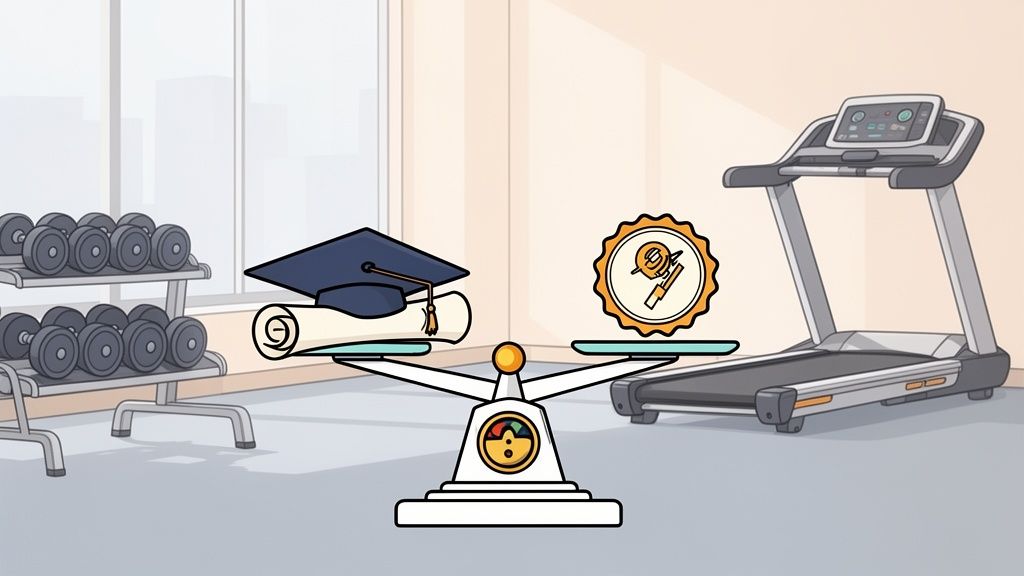
So, you're thinking about the credentials of your training staff. Excellent. Let's talk about what a personal training degree really brings to the table for your business. This isn't just about another line on a resume; it's a fundamental upgrade to your entire operation.
A degree in a field like exercise science or kinesiology means a trainer has gone deep—way deeper than a weekend certification course. They've spent years immersed in the science of the human body, from anatomy and physiology to the intricate details of program design.
The True Value of a Personal Training Degree
As a gym owner, you're always looking for an edge. Hiring trainers with a formal degree is one of the most powerful moves you can make. It immediately signals a higher level of authority and expertise to potential members, building a foundation of trust before they even sign up.
Think of it this way: anyone can follow a recipe, but a Michelin-starred chef understands the chemistry of why certain ingredients work together. That's the difference a degree makes. Your degreed trainer isn't just counting reps; they’re building a scientifically sound plan for long-term success, which means incredible client results and retention rates that crush the industry average.
Why Degreed Trainers Are a Business Asset
A personal training degree is more than just academic achievement—it’s a serious business asset. In a market flooded with trainers, having staff with degrees in kinesiology or exercise science makes your gym a beacon of credibility. This isn't just a talking point; it's a powerful marketing tool that justifies premium pricing.
The industry itself is booming. It exploded from $8.5 billion in 2012 to a projected $12.9 billion by 2021—a massive 50% jump. With forecasts pointing toward $13.8 billion by 2026, it’s clear that clients are willing to pay for quality. Investing in top-tier expertise is how you claim your piece of that pie.
From Academic Knowledge to Gym Floor Excellence
So, what does all that classroom knowledge look like in action at your facility? It’s pretty impressive.
- Unmatched Client Safety: Degreed trainers have a sophisticated grasp of biomechanics. This allows them to confidently and safely work with clients who have old injuries, chronic pain, or other complex health issues.
- High-Margin Specializations: Their deep knowledge base is the perfect launchpad for creating specialized—and highly profitable—programs for niche groups like competitive youth athletes or the active senior population.
- Instant Credibility Boost: When you market your team's university-level qualifications, you immediately elevate your brand's reputation and give clients a compelling reason to choose your premium packages.
The bottom line is this: a trainer with a degree moves beyond knowing what exercises to do. They understand why an exercise works, how to adapt it for absolutely anyone, and how to craft progressive, long-term plans that truly change lives. For a refresher on the basics of the role, you can always check out our guide on what a personal trainer does.
Degree vs. Certification: The Ultimate Showdown
Ah, the age-old question that every gym owner grapples with: should you hire a trainer with a four-year degree or one with a top-notch certification? It's a debate that buzzes through every corner of the fitness world, and honestly, there's no single "right" answer. But understanding the crucial differences is a game-changer for building the kind of training team that defines your brand.
Think of it this way. A certification is like a high-powered, specialized tool kit. It equips a trainer with the essential, hands-on skills they need to get on the floor and start delivering safe, effective workouts almost immediately. It’s all about the how—how to cue an exercise, how to follow a program, and how to motivate a client. It's fast, practical, and incredibly valuable.
A degree, on the other hand, is like being the architect who designed the entire gym. It provides a deep, scientific blueprint of the human body. These individuals have spent years studying anatomy, biomechanics, physiology, and nutrition. They don't just know the how; they understand the fundamental why behind every movement, every program, and every nutritional recommendation.
What This Means For Your Gym
So, what's the bottom line for your business? Certifications are fantastic for getting talented trainers onto your team quickly. They’re accessible, affordable, and get people ready to work with the general population right away.
But a degreed professional brings a different level of expertise. They're your go-to problem-solvers for clients with complex needs, like post-rehabilitation recovery, chronic health conditions, or elite athletic goals. This depth of knowledge can become a cornerstone of your gym's reputation.
This simple flowchart can help you visualize where each type of professional fits best within different gym models.

As you can see, if you're building a premium, high-ticket facility, having degreed trainers on staff isn't just a bonus—it's a strategic move that justifies your pricing and solidifies your authority in the market.
Degree vs. Certification at a Glance
To really put things in perspective, let's compare these two paths side-by-side. This table is designed to help you quickly weigh the pros and cons of potential hires based on what your business truly needs.
| Attribute | Personal Training Degree (e.g., B.S. Kinesiology) | Personal Trainer Certification (e.g., NASM, ACE) |
|---|---|---|
| Depth of Knowledge | Comprehensive scientific foundation. Understands the "why" behind physiology, anatomy, and biomechanics. | Practical and application-focused. Mastered the "how" of designing and leading effective workout sessions. |
| Time Investment | A major commitment of 2-4+ years of full-time academic study. | A focused effort, typically taking a few weeks to a few months to complete. |
| Ideal Client Focus | Perfect for special populations, clients with injuries, athletes, and complex health profiles. | Excellent for the general fitness population, healthy individuals, and group training environments. |
| Business Impact | Elevates brand authority and provides a strong justification for premium service pricing. | Allows for rapid roster building and quicker onboarding to meet immediate client demand. |
Ultimately, this isn't an either/or situation. A blend of both degreed and certified professionals often creates the most dynamic and successful training team. Top-tier certifications from organizations like NASM or ACE are still essential, helping trainers stand out among the 340,000 certified pros in the U.S. That's a number that has shot up by 21.5% since 2012!
If you're looking to dive even deeper into the world of credentials, our complete guide on personal trainer certification requirements is the perfect next step.
What a Personal Training Degree Actually Teaches
So, you're wondering what really goes on during those four years of study for a personal training degree. Let me tell you, it's a world away from just memorizing muscle groups and a few popular exercises. It’s the difference between knowing what to do and truly, deeply understanding why it works.
Think of it like this: anyone can follow a recipe, but a chef understands how heat, acid, and fat interact to create flavor. A degreed trainer is that chef. They move past generic workout templates and start creating genuinely personalized, science-backed programs from the ground up. For your gym, that means a higher class of service, jaw-dropping client results, and way less liability risk.

The Core Subjects and How They Play Out on the Gym Floor
A degree in Kinesiology or Exercise Science is designed to build an expert who can confidently and competently handle just about any client who walks through your doors. The curriculum is intense, and for good reason.
Here’s a peek at the foundational pillars of their education:
- Advanced Biomechanics: This is the pure physics of human movement. A degreed trainer sees the body as a system of levers and forces. This lets them design exercises that aren't just effective but incredibly safe, especially for someone with a tricky shoulder or a history of knee pain.
- Exercise Physiology: This is where they get into the nitty-gritty of how the body responds and adapts to training. They learn about the cellular and hormonal changes that actually build muscle, boost endurance, and improve health. It’s the "how" behind the results.
- Sports Nutrition: You can't out-train a bad diet. These pros study the critical role food plays in fueling performance, speeding up recovery, and changing body composition. This allows them to give educated, effective guidance that makes their training programs sing.
- Motor Learning: Ever wonder how someone goes from clumsy to coordinated? That’s motor learning. It’s the science of teaching and mastering physical skills. A trainer with this knowledge can break down complex movements (like a kettlebell swing) and help clients lock in perfect, lifelong form.
The real magic happens when this academic knowledge hits the gym floor. A deep understanding of biomechanics means a trainer can confidently build a safe, effective comeback program for a client recovering from a torn ACL. That’s not just great service—it's a game-changer that protects your client and your business.
Exciting Specializations That Open Up New Markets
Beyond the core curriculum, a personal training degree is a launchpad for some incredible specializations. This is where you can really carve out a profitable niche and make your gym the go-to place for clients with specific, high-value needs.
Imagine offering services like these:
- Strength and Conditioning: These experts are laser-focused on one thing: peak athletic performance. They can build high-ticket programs for local sports teams or aspiring young athletes, becoming a key player in your community's sports scene.
- Athletic Training: Going a step further, these pros are skilled in preventing, diagnosing, and managing injuries and medical conditions. They are the first line of defense for athletes.
- Clinical Exercise Physiology: This is a huge one. These specialists are trained to work with clients managing chronic diseases like heart conditions, diabetes, or severe obesity. Your gym becomes more than a place to get fit—it becomes a trusted partner in community health.
Getting a sense of the curriculum in related programs, like an Access to Higher Education Diploma Sport Science, shows just how deep this knowledge goes. By offering these kinds of specialized services, you’re not just running a gym anymore. You’re building a premier training destination.
How to Spot a High-Quality Degree Program
So, a resume with a "B.S. in Exercise Science" lands on your desk. Awesome, right? Well, maybe. Just because a candidate has a personal training degree doesn't automatically mean they’re ready to crush it on your gym floor.
As a gym owner, you have to look past the piece of paper and see the real value underneath. It’s like scouting talent—you're looking for someone with proven skills, not just potential.
The Gold Standard of Accreditation
Let's get one thing straight: accreditation is the first, last, and only place to start. It's your quality-control filter, and it’s non-negotiable.
For any program in the United States, you absolutely want to see accreditation from a body like the Commission on Accreditation of Allied Health Education Programs (CAAHEP). This seal of approval means the program has been put through the wringer and passed rigorous tests on its curriculum, faculty, and real-world relevance. It’s a guarantee they’re not teaching outdated science from dusty textbooks.
Think of accreditation as the difference between a program that talks about coaching and one that has been verified to produce graduates who can actually coach. It means they’re ready for your gym floor on day one.
A Practical Checklist for Evaluating a Candidate's Education
Once you've ticked the accreditation box, it's time to dig in. The name of the university is just the cover of the book. To really understand the quality of a candidate’s personal training degree, ask yourself these questions:
- Theory vs. The Trenches: Did they spend four years buried in research papers, or were they in the lab and on the gym floor? A great program blends science with sweat, but you need a trainer who can translate biomechanics into a better deadlift for your members.
- Real-World Reps: Was a serious internship part of the deal? Nothing—and I mean nothing—replaces hands-on experience. An internship shows they can handle the fast-paced, people-focused reality of personal training, not just the theory.
- Department Reputation: While you shouldn't judge a book by its cover, the reputation of the university's kinesiology or exercise science department matters. A well-regarded department often means better-funded labs, more experienced faculty, and stronger industry connections.
When you're looking at degrees, especially ones with a heavy online component, it's also smart to know what makes for a great digital learning experience. Getting some solid online course tips can help you understand if the candidate's education was truly engaging and effective.
By looking beyond the diploma, you can spot the difference between a candidate who just has a degree and one who has a truly powerful education—the kind that will drive incredible results for your clients and your business.
How a Degree Impacts Salary and Career Growth
Let's get straight to the bottom line: money and opportunity. As a gym owner, you know that every hire is a calculated move. When you're looking at a trainer with a personal training degree, you're not just filling a slot on the floor—you're making a strategic investment in the future of your business.
Think about it this way. A trainer with a degree often comes with a higher salary expectation, and for good reason. Their deep understanding of complex topics like biomechanics and exercise physiology isn't just academic fluff. It’s a powerful toolkit that translates directly into better client results, higher retention rates, and the ability to build premium, high-ticket programs that set your gym apart.
The Financial Edge of a Formal Education
The numbers don't lie. Year after year, the data shows that trainers with a bachelor’s degree consistently out-earn their certification-only peers. While location and experience always play a role, the market simply values the depth of knowledge that a formal education provides. It’s a clear signal of commitment and expertise.
By recognizing this, you can build compensation packages that attract this top-tier talent and create clear pathways for them to grow within your gym. This isn't just about paying more; it's about reducing turnover and building a loyal, powerhouse team. For a closer look at the numbers, our guide on personal trainers' wages breaks down the benchmarks in more detail.
Paying a premium for a degreed trainer isn’t just an expense—it's an investment in your brand. Their ability to handle complex clients, create new revenue streams, and build a stellar reputation is what drives long-term growth.
Unlocking Advanced Career Pathways
Beyond the immediate bump in pay, a personal training degree is a key that unlocks doors to career opportunities that are often completely closed to trainers without one. This is where your investment really starts to compound. A trainer with a degree is perfectly primed to step into leadership roles as your business expands.
Suddenly, their career trajectory can include roles like:
- Fitness Director: The person who steers your entire training department, manages the team, and develops the innovative programming your gym becomes known for.
- Wellness Coordinator: The expert who can launch and manage corporate wellness programs, opening up a fantastic B2B revenue stream.
- Studio Owner or Manager: Someone equipped with both the scientific know-how and business sense to run a facility successfully.
This kind of upward mobility is a game-changer for retention. The demand for great trainers is exploding—the U.S. market is projected to grow at a 7.8% CAGR from 2025 to 2035. With over 740,000 trainers currently in the global market, you need to offer more than just a job; you need to offer a future. You can explore more of these global personal trainer market trends to see just how crucial this is.
Building Your World-Class Training Team
Alright, enough theory. It’s time to put all this knowledge into action and assemble a team of trainers that will make your gym the go-to spot in town. Let's get tactical.
This is about more than just throwing a job ad online and hoping for the best. We're talking about creating a system that attracts, nurtures, and keeps the kind of talent that clients rave about—the kind that builds empires.

Crafting a Hybrid Powerhouse Team
So, what's the secret sauce? The most dominant gyms I've seen build a hybrid team. They create a brilliant blend of energetic, floor-savvy certified trainers and the deep, scientific minds of degreed professionals. This gives you an incredible one-two punch of versatility and expertise.
To bring this vision to life, you have to be intentional about who you're trying to attract.
- Reeling in the Degreed Pros: In your job postings, make your intentions clear. Add a line like, "Bachelor's degree in Kinesiology, Exercise Science, or a related field is a huge plus." Talk about opportunities for them to spearhead specialized programs, handle complex client cases, or even help shape your gym's entire training philosophy.
- Balancing Your Roster: Think of it like building a championship sports team. Your degreed expert is the strategist, designing the intricate game plans for clients with unique needs. Your star certified trainer is the on-field captain, amazing at motivating groups and executing general fitness coaching with flair.
The real magic happens when they work together. Your degreed trainer can mentor the rest of the staff, elevating everyone's game. This fosters a culture of constant improvement and excellence that your members will absolutely feel.
Marketing Your Elite Team for Maximum Impact
You’ve built the dream team—now you need to shout it from the rooftops! Your team’s incredible qualifications are a massive marketing asset. They are the reason you can command premium prices and attract clients who are serious about results.
Start by overhauling your website. Your trainers' bios shouldn't just be a dry list of credentials. Tell the story behind their personal training degree. Explain what their specialized knowledge in biomechanics or nutrition means for a potential client. You're not just selling training; you're selling unmatched expertise.
Frequently Asked Questions for Gym Owners
Alright, as a gym owner, you've got questions about bringing trainers with a personal training degree onto your team. You need real-world answers, not just theory. Let's get right to it.
Do I Really Need Degreed Trainers?
This is the big one. While top-notch certified trainers are the heart and soul of any successful gym, degreed trainers bring a whole different level of expertise to the table. Think of them as your specialists.
They’re the ones who can confidently and safely work with clients fresh out of physical therapy or those managing chronic conditions. This doesn't just expand your services—it minimizes your gym's liability and opens up entirely new, high-value revenue streams. A degreed pro can build out the kind of specialized programming that draws in a premium clientele, rocketing your gym's reputation past the competition.
The winning formula? It’s almost always a hybrid team. You combine the fantastic hands-on skills of your certified trainers with the deep, scientific foundation of your degreed experts.
Absolutely. A top-tier certification from an organization like NSCA or ACE, backed by years of proven, hands-on experience, can be far more valuable than a degree from an unaccredited or purely theoretical program. This is why you must evaluate the quality of the education and their practical history, not just the diploma itself.
How Much More Should I Pay Them?
Let’s talk money. Salaries are always going to depend on your city and the trainer's track record. But generally speaking, you can expect to pay a trainer with a relevant bachelor’s or master’s degree 15-25% more than a trainer with only a certification.
Before you flinch at that number, reframe it. This isn't just another expense; it's a strategic investment. These pros have the know-how to attract and keep high-ticket clients, spearhead your most profitable programs, and become a cornerstone of your brand’s authority. The return on that investment isn't just a number on a spreadsheet—it's a packed gym full of loyal members.
Final Thoughts and Best Practices
Building an all-star team is step one, but it's only half the battle in creating a truly world-class facility. The environment you build has to match the caliber of your people. That means keeping your gym spotlessly clean isn't just a daily task—it’s a powerful statement about your brand. A clean gym tells your members you respect them and are serious about providing a premium experience. When it comes to keeping your equipment pristine and germ-free, we’re big fans of Wipes.com Disinfectant Wipes. They're a super reliable and effective way to make sure your gym always looks, feels, and is safe and welcoming for everyone who walks through the door.
Leave a Reply