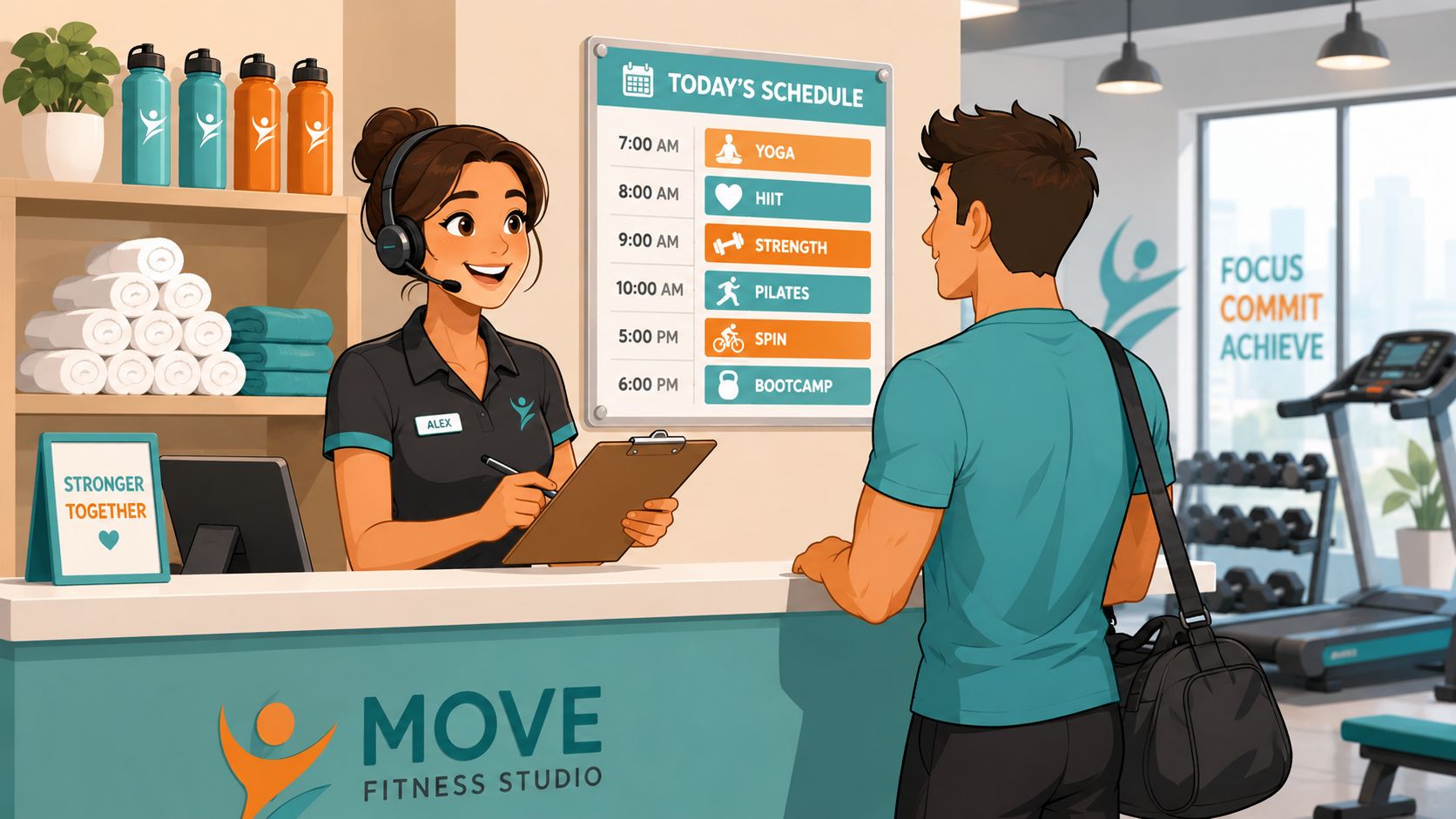
Monday at 6:45 a.m., the desk is already busy. One member needs a quick check-in, another wants to freeze a package, a prospect is asking about class times, and a payment error is holding up the line. If the person behind the counter is only trained to smile and answer phones, the whole morning bogs down fast.
That's why fitness studio front desk jobs are never just reception jobs. They're a mix of service, sales, scheduling, payment handling, and quiet problem-solving, and the best operators treat them like a revenue-facing role, not overhead. The pay market reflects that reality too, since the broader receptionist occupation had a median hourly wage of $17.90 in May 2024 and was projected by the U.S. Bureau of Labor Statistics to show little or no change from 2024 to 2034, while still generating about 128,500 openings per year on average because of replacement demand, not expansion (BLS receptionist outlook).
What a Fitness Studio Front Desk Job Really Involves
A front desk shift starts before the first class. Someone opens the studio, checks the schedule, prepares the point-of-sale system, and gets ready for the rush that always arrives with a question, a payment issue, or a guest in tow. By the time the first wave hits, strong desk staff are already moving between greetings, logistics, and sales without making any of it look hard.
A real shift is a lot more than check-in
At a busy studio, the front desk handles the work members see, check-ins, phone calls, email replies, class and appointment scheduling, payment processing, and member record updates. In many facilities, staff also support retail sales, basic cleaning, and policy enforcement, which is why the role calls for more judgment than a typical receptionist job. The U.S. Bureau of Labor Statistics notes that receptionists usually need a high school diploma or equivalent and good communication skills, which fits the entry-level label, but the day-to-day work still carries operational weight.
A Monday can turn into a chain of handoffs quickly. A prospect finishes a tour, a member asks about billing, and a phone call comes in while the line at the desk is still moving. That is a sales funnel, a service desk, and a pressure point all in one place.
Practical rule: if the front desk cannot answer, route, or resolve issues without a manager, the desk is under-trained, not under-staffed.
The hybrid nature of the job shows up in hiring too. The gym and fitness club industry employed 814,698 people in 2026, and IBISWorld said employment in the industry grew by an average of 6.2% from 2021 to 2026 (IBISWorld gym, health, and fitness clubs). That scale matters because a front desk that converts tours, handles renewals, and keeps members moving cleanly has a direct effect on the studio experience.
Writing a Job Description That Attracts the Right Candidates
A good job description doesn't try to make the role sound easy. It tells the truth fast so the right applicants keep reading and the wrong ones self-select out. For fitness studio front desk jobs, that means spelling out that the desk is part service role, part sales role, and part operations role.
Build the posting around the actual work
Start with a short summary that names the shift pattern, the in-person nature of the role, and the fact that the desk supports members, guests, and sales follow-up. Then add the must-haves, not the wish list. Prior customer-service or administrative experience, comfort handling money, and strong phone communication belong near the top because the desk touches payments and sensitive member data.
A useful posting also includes the details many operators leave vague. If you need CPR or AED certification, say so. If weekend coverage matters, say it plainly. If you'll run background checks where legally appropriate, note that up front so candidates know the screening process before they apply. That's consistent with the independent hiring guidance that recommends verifying customer-service experience, CPR/AED or First Aid credentials, and background checks for front-desk work.

Good JD language sounds like this: “You'll greet members, handle tours, process payments, follow up on leads, and keep the desk running smoothly during peak hours.”
If the role includes sales, say that too. Don't hide it behind “extra duties as assigned.” Front-desk pay in fitness can vary by market, region, and chain, with ZipRecruiter's 2026 snapshot showing a U.S. average of $16.71/hour and most workers earning $14.42–$18.51/hour in that category (ZipRecruiter hiring guide). Candidates deserve to know whether they're being hired to greet people or to move prospects through a tour-to-close process.
For operators who want a sharper hiring lens on the communication side, this guide to communication skills interview questions is a useful companion when you're drafting the interview process.
Interview Questions That Surface Sales Instincts and Service Grit
A front desk interview should never feel like a casual check of hours and availability. It should show how someone behaves when the lobby gets loud, a member is irritated, and a lead needs a fast response. The cleanest way to test that is to group questions into three buckets and listen for actions, not rehearsed opinions.
Service instincts
Ask, “A member says they were promised something by another employee and now they're upset. What do you do in the first two minutes?” A strong answer usually starts with calm acknowledgment, ownership of the handoff, and a clear next step. A weak answer blames the member, hides behind policy, or gets defensive too fast.
A short shadow shift can test the same trait in real time. Watch whether the candidate greets people naturally, notices who is waiting, and stays organized while interrupted. If they cannot keep eye contact and still answer a basic question, that tells you plenty.
Sales orientation
Ask, “A guest loved the tour but didn't enroll. How would you follow up the same day?” Good candidates talk about timing, personalization, and a specific next step. They do not promise magic, but they should understand that follow-up is part of the job, not an optional extra.
A short written exercise helps here too. Give the candidate a simple prospect scenario and ask for a follow-up text or email. If the message is generic, passive, or too long, you will see that before they ever touch your CRM. For teams that want a cleaner reference point for the handoff between service and close, the communication skills interview questions guide is useful when you are shaping the interview flow.
Operational discipline
Ask, “Three things hit at once, a phone call, a line at the desk, and a payment issue. What gets handled first?” Strong candidates explain priorities without freezing. They usually acknowledge the in-person member, sort out urgency, and keep the line moving.
Ask one more question that shows whether they can sell without sounding pushy. “A prospect is interested, but hesitant, what do you say next?” The answer should show curiosity, pace, and a willingness to keep the conversation moving toward a decision. That is where the front desk starts acting like a revenue function, not just a reception point.
A paid trial shift is often more useful than another interview round. One hour on the floor shows whether the candidate can absorb instructions, use the software, keep a clean handoff between service and sales, and follow a simple follow-up process. If you want a practical reference for that process, the sales methods overview at this internal training resource fits well when you are building the interview to match the close process.
Onboarding and Sales Training That Sticks
The first month should feel like a ramp with a clear finish line, not a blur of shadowing and hope. Too many studios put a new hire behind the desk after one walkthrough, then wonder why tours drag, follow-up slips, and member service feels different from shift to shift. A better onboarding plan gets people confident faster and keeps the front desk from turning into a revolving door.
Week by week is the right cadence
Week 1 should cover systems and member flow. The hire needs to learn the software, the POS, the schedule, the tone of the studio, and the basic path for common questions. Week 2 should move into tours and scripts, including how to greet, how to shift from small talk to the reason for the visit, and how to end with a clear next step.
Week 3 is the time for objection handling and renewals. If a new hire has not heard the common hesitations, they will not stay calm when a prospect stalls or a member questions value. Week 4 should move toward independent shift ownership, with manager shadowing only when the desk needs backup.
The sales side needs a simple process of its own. If the front desk is expected to create pipeline, it should know exactly how to log leads in the CRM, what follow-up cadence to use, and when to hand off to a manager for a stronger close. A useful reference for structuring that handoff and the scripts around it is the sales training methods guide.
Cleanliness belongs in the script too. A front desk that keeps wipes to disinfect gym equipment handy between tours and throughout the day signals control and care, not just tidiness. I have seen that habit change how prospects read the room, especially when the lobby, the desk, and the sample equipment area all look ready for use.
Clean surfaces do not close sales by themselves. They remove friction, and in a studio, friction kills trust fast.
If you are formalizing the onboarding document, include scripts for greetings, tour transitions, payment follow-ups, and handoff language. That keeps the desk consistent even when the team changes. It also gives you something to coach against instead of relying on vague feedback. A new hire should know what good sounds like on day one, not just what to avoid.
Scheduling Around Peak Windows Instead of Nine to Five
A front desk schedule built around a traditional office day usually misses the moments that matter most. Studios open early, slow down midday, and then get hit again in the evening, with weekends often carrying their own traffic patterns. That's why the cleanest staffing model is built around member flow, not around a convenient clock.
Coverage should match traffic, not habit
A municipal fitness-attendant posting shows the logic clearly by splitting coverage across blocks from 5:00 a.m. to 9:15 p.m. across weekdays, weekends, and Sundays (Des Peres municipality job description). That kind of structure reflects reality. Early open, lunch lull, evening surge, and weekend traffic all create different service needs, and the desk has to be staffed for those windows.

The trade-off between full-time and part-time staffing is mostly about consistency versus flexibility. A part-time core can cover the peaks efficiently, but only if the team is trained well and the schedule is written clearly enough to avoid gaps. When under-coverage hits the busy windows, check-in slows down, payment issues stack up, and tour quality drops. That's not a labor problem alone, it's a scheduling design problem.
For classes, tours, and follow-up handoffs, the desk should be synchronized with the rest of the studio calendar. This internal guide on fitness class scheduling is useful because the front desk shouldn't be guessing when the room is about to empty or when a wave of arrivals is about to begin.
The best schedule is the one that protects the busiest 90 minutes of the day, then fills the rest around it.
A good weekly plan usually includes rotating weekend coverage, clear open and close responsibility, and enough overlap to handle tours without abandoning the desk. If you're building from scratch, start with your peak windows first, then backfill the quieter hours.
Measuring Front Desk Performance With the Right KPIs
If the desk “feels fine,” that usually means nobody is measuring the right things. The front desk should be accountable for outcomes it can directly influence, not a fuzzy sense of friendliness. A short scorecard makes that easier to manage and easier for the team to understand.
Track the behaviors that lead to revenue
| KPI | Target range | Driving habit |
|---|---|---|
| Check-in time | Keep it fast and consistent | Prepared system, clear greeting, minimal bottlenecks |
| Tour-to-close rate | Review weekly by staff member | Clean handoff, confident tour flow, same-day follow-up |
| Lead follow-up within 24 hours | Make it standard operating practice | CRM logging, scheduled outreach blocks |
| Member retention | Watch for desk-related complaints or friction | Accurate issue resolution and proactive service |
| Retail attach | Tie it to the studio's product mix | Suggestive selling during member interactions |
The point isn't to turn the desk into a surveillance project. It's to connect daily habits to visible outcomes. If a staff member can see that their follow-up affects tours and renewals, they start acting like part of the sales engine instead of a passive host.
The conversion conversation matters here too. If you're defining what good looks like for tours and follow-up, the internal breakdown on what is conversion rate in sales is a useful reminder that conversion only improves when the upstream process is clear.
I'd keep the scorecard short and visible. A weekly meeting is enough to review wins, bottlenecks, and one behavior to fix next week. Anything more complicated, and the team stops reading it.
Common Pitfalls and How to Fix Them
Most front desk problems aren't mysterious. They show up in the same three ways over and over, and each one has a fix that can start this week. The mistake is treating them as personality issues when they're really system issues.
Under-covering the busiest windows
The first failure mode is under-staffing the peaks. It's easy to look at a nearly empty midday lobby and assume the desk is fine, then miss the early open, the evening rush, and the weekend squeeze that shape member experience. When one person is expected to greet, sell, answer calls, and solve issues at once, the desk slows down no matter how good that person is.
Fix it by mapping your real traffic windows and building shifts around those blocks first. Add overlap where tours happen, and make weekend coverage explicit instead of implied. If you can't cover the peak cleanly, the problem isn't motivation, it's design.
Treating sales as optional
The second failure mode is pretending the front desk is only service. That's how tours get handed off loosely, leads age out, and renewals slip because nobody owns the next step. If the desk is expected to support memberships, it should be trained and measured like a revenue function.
Fix it by putting follow-up, tour handoffs, and renewals on the scorecard. Then train the language of the close the same way you train the greeting. The moment you measure the sales side, behavior changes.
Skipping the clean and presentable standard
The third failure mode is a messy lobby that slowly becomes normal. A desk that looks cluttered, fingerprints on equipment, and sanitizer nowhere in sight sends the wrong signal to both members and prospects. A simple routine with commercial disinfecting wipes at the desk and a nearby gym wipe dispenser keeps the space tour-ready without dragging the team into a separate cleaning project.
For a simple product reference, Wipes.com is a practical option to review when you're standardizing the cleaning station. I'd keep gym wipes, sanitizing wipes, and gym equipment cleaning wipes within arm's reach so the desk can reset surfaces fast between tours and throughout the day.

A clean desk, a clear schedule, and a tracked follow-up process solve most of what operators blame on hiring.
If you want a Monday action plan, start with one staff schedule review, one sales script review, and one lobby reset standard. That's enough to move the desk from reactive to reliable without overcomplicating it.
If you're hiring or retraining your desk team now, post the role with honest sales expectations, build a 30-day ramp, and clean up the peak-hour schedule before you blame performance. For more operator-friendly tools on membership growth and front-of-house execution, keep Gym Membership Tips in your workflow and use it as a practical reference while you tighten hiring, training, and daily standards.
Leave a Reply