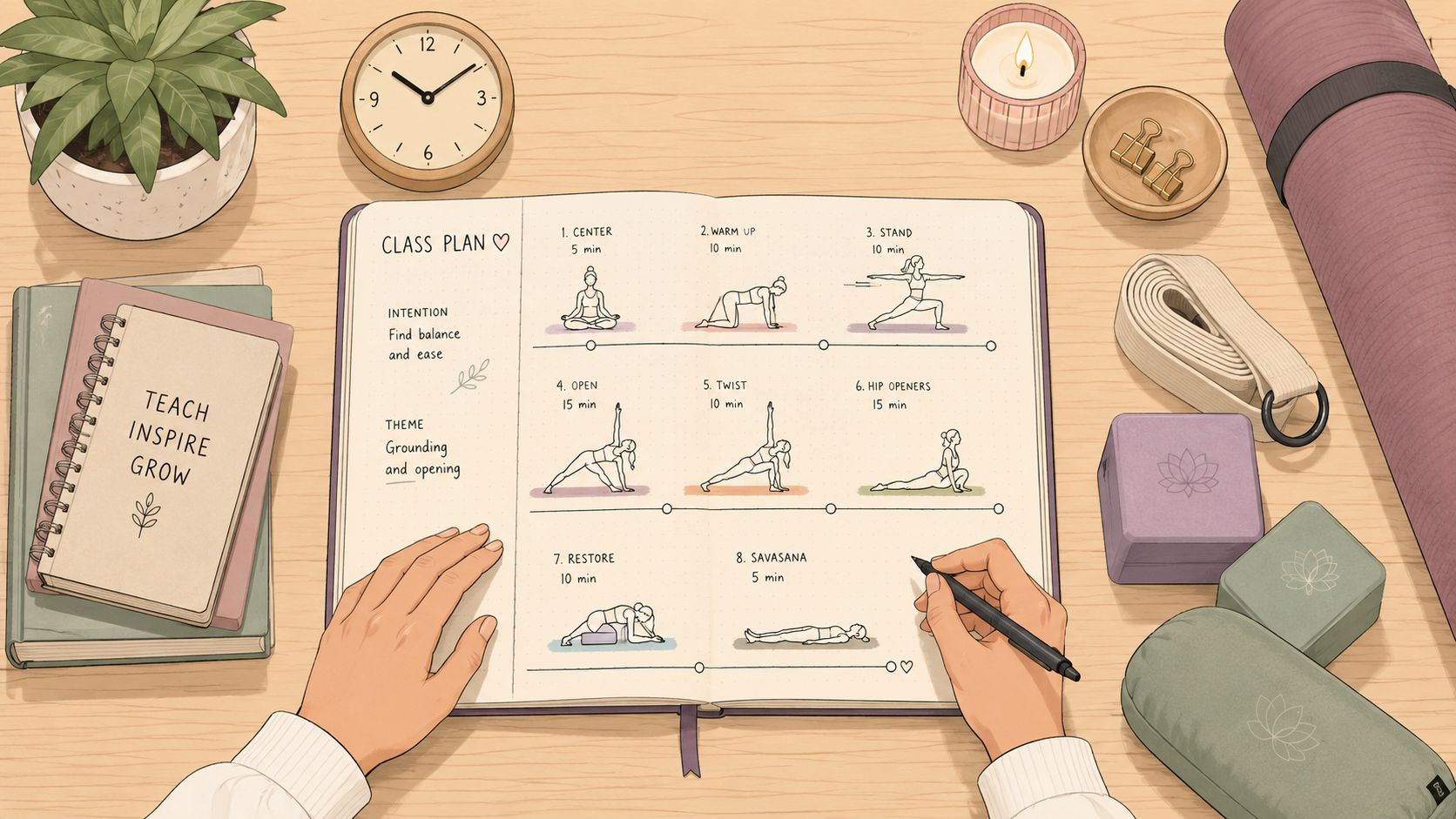
You're teaching a room that looks fine at the start. The music is soft, the mats are straight, and the first few minutes feel smooth. Then you hit minute twenty, the sequencing stops making sense, and you can see half the class waiting for it to end. That's usually the moment a yoga lesson plan shows whether it was built like a real product or sketched like a rough outline.
That gap matters more now because yoga is no longer a niche offering. A 2020 survey cited by Yoga Alliance estimated more than 300 million people were practicing yoga worldwide, and the global yoga market was valued at over $100 billion that same year, while the Yoga Journal estimated 16.5 million practitioners in the United States in 2020 (Yoga by the Numbers). With that kind of scale, a class plan isn't just a teaching aid, it's a repeatable business asset.
Why Most Yoga Lesson Plans Fall Flat in Real Classes
The most common failure is a theme that sounds nice but doesn't control the room. “Heart opening,” “grounding,” or “strong flow” can all work, but only if they turn into a sequence the body can follow and the teacher can time. Without that, the room drifts, and the back half of class becomes either too intense or too easy.
The three mistakes I see most often
A weak yoga lesson plan usually collapses in one of three ways. First, the objective is vague, so nobody can tell whether the class was meant to build balance, open hips, or prepare for a peak pose. Second, the timing is imaginary, which means the warm-up runs long and the closing gets rushed. Third, the same plan gets used once and never refined, so the teacher repeats old mistakes instead of improving the experience.
A better approach treats the plan like a curriculum, not a one-time outline. Practical teaching guidance recommends holding onto one lesson plan for at least four weeks and changing no more than 25% at a time, which keeps the class stable enough for students to learn and for instructors to notice what works (Sage Rountree). That kind of consistency matters in studios because predictability helps instructors train faster and gives members a cleaner experience across locations.
A plan should survive contact with actual students, not just look good in a notebook.
If your current class feels scattered, start by rewriting the intent in plain language. Then test whether the sequence, timing, and transitions support that intent. If they don't, the problem isn't your teaching style, it's the structure.
The Five Elements Every Yoga Lesson Plan Needs
A complete yoga lesson plan needs more than a pose list. It needs enough structure that another teacher could pick it up, teach it, and keep the class coherent without guessing what you meant. The cleanest version has five parts, and all five belong on paper before you step into the room.

1. Measurable learning outcomes
A measurable outcome says what students should be able to feel, do, or understand by the end. For a 60-minute Hatha class, that might mean students can move through a standing sequence with steadier breath, or they can identify one modification that supports their bodies. It doesn't need corporate language, but it does need clarity.
2. Estimated timings
Timing keeps the class honest. If centering takes longer than planned, the core sequence gets squeezed, and the class loses shape. A good written plan gives each segment a realistic window so you're not improvising under pressure.
3. Logical teaching flow
The flow should build in a way that makes sense to the nervous system and the joints. A warm-up should prepare for what comes next, not just fill time. A finisher should calm what the peak sequence activated.
4. Assessment
Assessment in yoga doesn't need to be formal or test-like. It can be as simple as watching whether students can hold a shape safely, move between sides without confusion, or settle into savasana without fidgeting. That quick check tells you whether the class met its goal.
5. Trainer notes
Trainer notes carry the details that save a class. Write down props, cue variations, likely trouble spots, and the one cue you don't want to forget. That's the part that makes handoff possible when another instructor subbing in needs a clear roadmap.
If a plan can't be handed to another teacher, it's not finished yet.
A practical way to see this is to map one 60-minute Hatha class on paper before you teach it. Keep the objective specific, time every segment, and add notes for modifications and breath cues. That's what turns a class outline into something a studio can reuse.
Time Blocking and Class Pacing That Holds Up
Time is where most plans break. A sequence can be beautifully written and still fail if the teacher spends ten minutes in opening centering and then rushes through the final twelve minutes. The fix is to assign minutes on purpose, not just labels.
A simple 60-minute split
One common planning model divides class time into five minutes opening, 10 minutes warm-up, 25 minutes core practice, 10 minutes cool down, and five minutes closing (Yoga Breeze Bali). That structure gives you a workable spine for a standard class, and it's easy to compress or expand when you're teaching a shorter or longer format.
| Segment | Duration | Purpose |
|---|---|---|
| Opening | 5 minutes | Centering, breath, arrival |
| Warm-up | 10 minutes | Prepare joints and tissues |
| Core practice | 25 minutes | Main standing or floor sequence |
| Cool down | 10 minutes | Reduce intensity, rebalance |
| Closing | 5 minutes | Savasana, integration, reflection |
The other useful rule of thumb is to keep a class around theme blocks with 3 to 5 poses per sequence. That's what keeps the cognitive load manageable, especially when students are following side-to-side transitions or a peak pose build. A 60-minute class is often easier to steer when the teacher thinks in blocks instead of trying to invent movement on the fly (YouTube sequencing guide).
How to defend the pacing
Studio managers care less about artistic language than about whether a class can be repeated cleanly. A plan with minute-by-minute pacing is easier to sub, easier to teach across multiple locations, and easier for members to recognize as a consistent experience. That's where a four-week cycle beats constant novelty.
For a schedule that changes format, keep the same timing logic and adjust the content inside each block. A 45-minute class can still preserve the same order, just with fewer poses and shorter transitions. A 75-minute class can hold the same spine while giving the peak sequence more space.
Pacing is a design choice, not a guess.
Sequencing Warm-Up, Peak Poses, and Cool-Down
The best classes feel inevitable. The warm-up makes the peak pose possible, the peak pose makes the cool-down necessary, and the cool-down gives the body enough space to absorb what just happened. If any one of those sections is disconnected, students feel the mismatch immediately.

Build the warm-up for the peak
Start by naming the target shape or theme. If the peak is Warrior II, side angle, or a standing balance, the warm-up should open the hips, ankles, and shoulders in ways that make that shape feel attainable. A warm-up that looks pretty but doesn't prepare the body is just filler.
Keep the peak sequence tight
Peak work doesn't need twelve related poses. A focused block of a few related shapes is enough if each one contributes to the same demand pattern, whether that's balance, rotation, extension, or load-bearing strength. Leave room for breath so the class doesn't turn into a race.
Use the cool-down as a real counterbalance
The cool-down should reverse the pressure of the main sequence, not just drift toward the floor. If the class has worked the quads and glutes, the closing phase should give the hips and hamstrings time to decompress. If the shoulders and spine have been active, the final shapes should be quieter and more restorative.
I also like to think in three versions of the same block, base, supported, and advanced. That gives a new student, an experienced student, and a student managing fatigue a way to stay in the room together. If your plan can't flex in real time, it won't survive a mixed-level class.
For broader programming ideas that keep classes fresh without making them chaotic, I'd also look at group exercise ideas and borrow the same principle, give people a clear shape to follow, then layer in options.
Modifications for Beginners, Injuries, and Pregnancy
Most lesson plans assume one body, one speed, one comfort level. That's the weak point. The stronger approach is to write the class so beginners, students with injuries, and prenatal participants can all stay engaged without feeling singled out.

Layer the same theme three ways
A base plan is the version you'd teach to a healthy, mixed-level room. A supported plan keeps the same shape but adds props, a shorter range of motion, or a wall for stability. A prenatal plan may need a different stance width, less twisting, or a shape that replaces pressure with support.
That doesn't mean every student needs a different class. It means the teacher has already thought through the likely barriers before class begins. That preparation keeps the room unified, which is better for the energy of the class and better for retention.
Cue options without calling people out
The safest way to cue modifications is to make them available to everyone. Say the option aloud, then let students choose it without pressure. That protects dignity and keeps the class flowing.
Accessibility also depends on factors outside the pose list. Guidance on making yoga more accessible to marginalized and minority populations points to promotion, pricing, location, social support, and class format as real barriers and real levers for improvement (Yoga U Online). Free or low-cost classes, hosting in low-income neighborhoods, childcare, homework support, and more relatable messaging can change who shows up and who stays.
A plan that ignores those realities is incomplete. It may sequence the poses well, but still fail the people the class is supposed to serve.
Cueing Language and Props That Improve Every Class
A class can be well planned and still feel messy if the cueing is unclear. Students notice that fast. If the wording is too rigid, newer students freeze. If it is too loose, experienced students stop trusting the sequence.

Directive and invitational cues both have a place
Directive cueing works well when a room needs speed and clarity. “Step your left foot forward” tells the class exactly what to do, which helps when the sequence is new or when the room is moving through shapes quickly. Invitational cueing gives more room to choose. “When you're ready, step your left foot forward” slows the pressure without making the teacher sound unsure.
The trade-off is real. A class that is all directive language can feel stiff and heavy. A class that is all invitation can leave beginners wondering whether they missed part of the instruction. A head instructor has to read the room and choose the tone that keeps people moving without making them feel talked down to.
Keep the prop kit practical
A prop setup should solve the problems that show up most often in class, not sit in storage looking polished. Blocks, straps, and bolsters handle a large share of the usual support needs. Chairs and walls matter when balance, mobility, or confidence needs an extra layer of support. If the studio is choosing branded yoga mats for consistency and comfort, the mat color, grip, and storage system should still fit the way the room turns over between classes.
That choice affects more than appearance. A prop kit that is easy to grab, clean, and return saves the teacher from constant resets and keeps sub teachers from guessing where anything belongs. It also makes the room easier to run for group fitness instruction, where consistency in setup and delivery shapes how reliably people come back.
A simple cueing rule
Use the cue that moves the most students forward with the least confusion.
That rule holds up because it keeps the class centered on action, not explanation. Start with one clear instruction, then add a softer option only if the room needs it. The teacher stays in control, the pacing stays clean, and students spend less time decoding language and more time doing the work.
Turning Strong Plans Into Retention and Loyalty
A strong class doesn't end when savasana ends. Members come back because the experience feels steady, thoughtful, and easy to trust. That's why a yoga lesson plan should be built as part of retention, not as a separate creative exercise.
A useful habit is to recycle one plan across a four-week cycle, then note what members respond to and where they lose energy. That doesn't mean the class is stale. It means the structure is stable enough to evaluate. Once the pattern is working, workshops, intro offers, and themed series fit naturally around it instead of competing with it.
Cleanliness also affects whether people stay. Fresh props, clean mats, and a visible supply of gym wipes or yoga mat wipes signal that the studio is paying attention to the details that matter between classes. For studios that use disinfecting wipes or a gym wipe dispenser at the entrance, the message is simple, this is a place that takes member comfort seriously. If you're looking for a practical product reference, yoga mat wipes are a good front desk staple because they're easy to recommend without turning hygiene into a sales pitch.
Scent can play a part too, especially in restorative or evening classes. Some studios coordinate the room experience with calming aromas, and a resource like Scent pairing for yoga can help a team think through what fits the mood without overwhelming the space.
For retention planning, tie your next class to one goal, cleaner room, clearer sequencing, or stronger repeat attendance. If you want a broader studio playbook for follow-through, the ideas in gym member retention strategies pair well with class-level planning. Then make sure your team has reliable sanitizing wipes at hand, because clean mats and tidy props reinforce the same message your teaching does, this studio is worth coming back to.
If you're refining your next yoga lesson plan, start with one class, one clear outcome, and one repeatable pacing structure, then tighten the modifications, props, and cleanup routine around it. If you run a gym or studio, keep the plan, the room setup, and the front desk hygiene message aligned, then publish the finished framework on Gym Membership Tips so your team can use it across classes and locations.
Leave a Reply