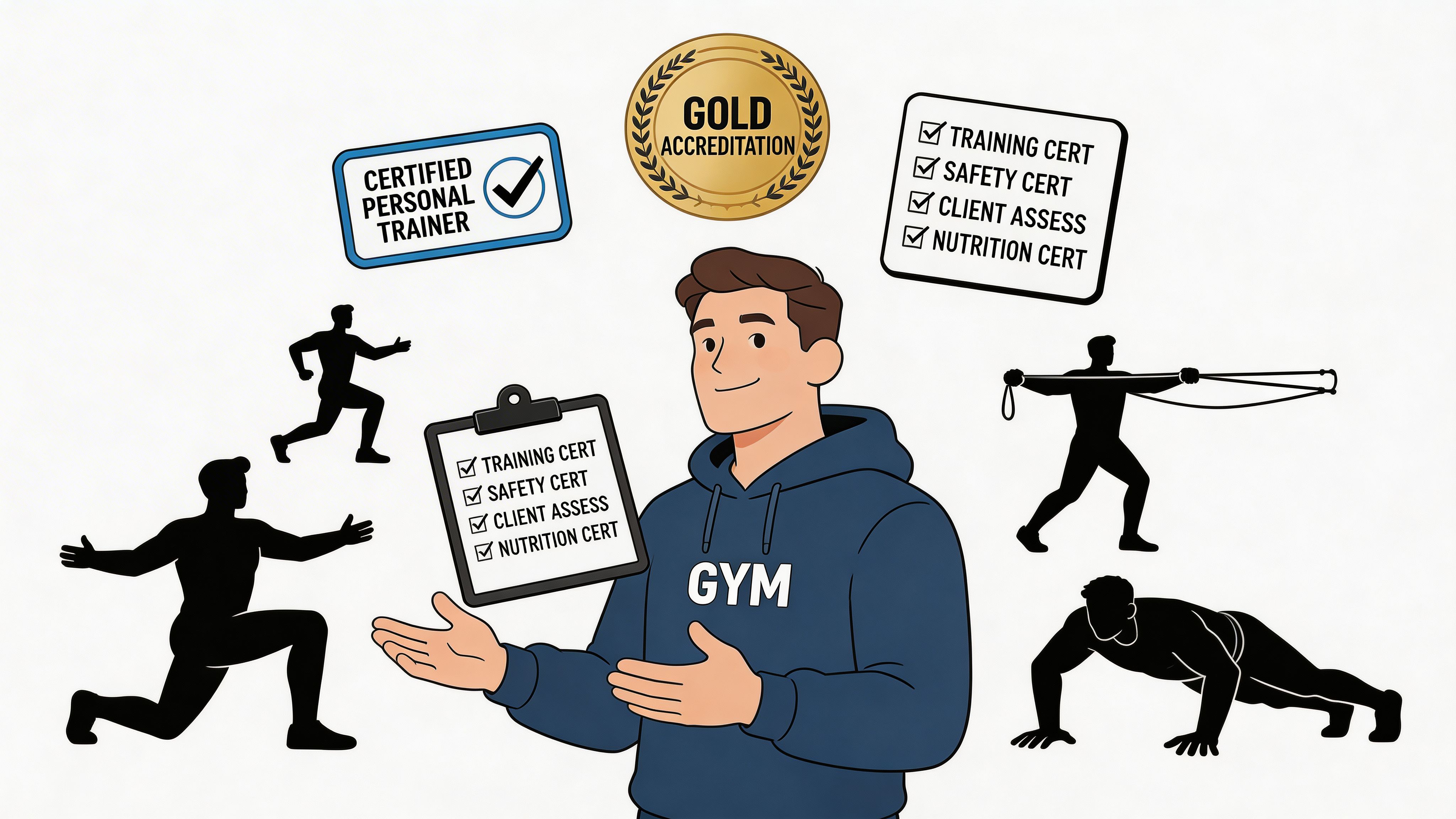
You’re hiring your first few trainers, or replacing a weak one, and the resumes start to blur together. One candidate has NASM-CPT. Another has ACSM. Another has a certification you’ve never heard of, plus a slick Instagram page and a great smile. On paper, they all look “certified.”
That’s where new owners make an expensive mistake.
If you treat certification like a box to tick, you’ll hire for surface credibility instead of real business protection. A good certification isn’t just about whether a trainer can count reps. It affects how safely they coach, how confidently your sales team sells training, how members judge your brand, and how exposed you are when a client gets hurt or complains that coaching feels sloppy.
When gym owners ask what is a good personal trainer certification, they usually mean, “Which logo should I trust?” The better question is, “Which standard helps me build a safer, more marketable, more profitable coaching team?”
That’s the owner lens. And it changes everything.
Why Your Trainer's Certification Is Your Gym's Brand Promise
A gym owner sits down with a stack of resumes and sees a mess of acronyms. Some are familiar. Some look legitimate. Some sound like they were invented in a weekend.
The temptation is to focus on personality first. Can this person sell? Will members like them? Can they cover early mornings?
Those matter. But the member doesn’t separate the trainer from your business. If your trainer programs poorly, misses red flags, or coaches recklessly, the client doesn’t blame the certificate. They blame your gym.
What members hear
When you advertise personal training, members hear a promise:
- Safety: “Your staff won’t put me in a bad position.”
- Competence: “Your coaches know how to assess me and progress me.”
- Results: “This program won’t be random.”
- Professionalism: “This facility has standards.”
That promise starts before the first session. It starts with who you hire.
A trainer’s credential is part of your offer, even if you never mention it in an ad.
Why this is more than HR
Owners often separate hiring from branding. That’s a mistake. Your hiring standard becomes part of your market position.
If you allow weak or questionable certifications, you create downstream problems:
- Sales friction when prospects ask why your training costs more than the budget gym down the road
- Retention issues when clients feel sessions are generic or inconsistent
- Manager headaches when every trainer uses a different logic for assessments, progressions, and injury modifications
- Legal exposure when you can’t defend your hiring standards with a straight face
A respected credential doesn’t make someone a great coach by itself. Plenty of certified trainers still need mentoring, observation, and accountability. But poor credentials create a bad floor. They lower the minimum standard before the trainer even touches a member.
The owner’s practical test
When I review trainer standards for a facility, I ask one simple question: if a member’s spouse, physician, or attorney asked why this trainer was qualified to coach inside your gym, would your answer sound solid?
If the answer is fuzzy, your standard is weak.
That’s why the smartest owners stop arguing over flashy branding first and start with accreditation.
The Undeniable Gold Standard NCCA Accreditation
If you only use one filter when screening trainer certifications, use this one. NCCA accreditation should be your baseline.
It's comparable to university accreditation. A school can call itself impressive, but if it lacks recognized accreditation, serious employers immediately become skeptical. Trainer certifications work the same way. The certificate name may sound polished, but what matters is whether an independent body has validated the quality of the credential.

Why NCCA matters to an owner
The National Commission for Certifying Agencies is the outside check. It verifies that a certification meets rigorous standards for curriculum and assessment quality. According to PTPioneer’s certification guide, NCCA accreditation is the gold standard for personal trainer certifications, and certifications such as NASM-CPT, NCSF-CPT, NSCA-CPT, and ACE-CPT are NCCA-accredited.
That matters because hiring standards need to be defensible. If a trainer hurts a client or makes a poor programming call, “we hired someone with a certificate” is weak. “We require an independently accredited certification recognized across the industry” is much stronger.
What NCCA accreditation tells you
It doesn’t tell you that a candidate is elite. It tells you the certification clears a serious baseline.
Here’s what that baseline does for your business:
- Protects your hiring process: You’re not relying on marketing copy from the certifying company.
- Improves trust: Members and referral partners respond better when your team carries recognized credentials.
- Creates consistency: Trainers come in with a more reliable foundation in exercise science, client assessment, and program design.
- Reduces noise: You can eliminate a large chunk of questionable certifications quickly.
PTPioneer also states that employer surveys rank NCCA credentials significantly higher for hiring decisions and that mandating them can boost trainer retention in hiring environments that treat certification standards as a real career ladder.
Make it a mandatory hiring rule
If you’re building policy, keep it simple.
A workable standard
- Primary rule: Require an NCCA-accredited CPT for all trainers on the floor.
- Exception policy: If a candidate is outstanding in another way, require them to obtain an approved NCCA-accredited credential before coaching independently.
- Documentation rule: Verify the credential directly, not just from the resume.
- Renewal rule: Track expiration and continuing education internally.
If you need a starting point for policy language and screening criteria, this guide on personal trainer certification requirements is useful for shaping a cleaner standard.
Practical rule: Don’t debate fringe certifications one by one. Set the accreditation rule first, then evaluate the person.
What NCCA does not solve
Owners sometimes get lazy at this point. They assume accredited means hire immediately. It doesn’t.
A trainer can hold a legitimate certification and still be weak in communication, session flow, or coaching judgment. NCCA is the floor, not the finish line. It helps you avoid the obvious mistakes, not all mistakes.
So use it the way strong operators use standards. As an entry gate.
A good certification starts with accreditation. Without that, you’re gambling with your brand for no good reason.
Comparing the Titans The Big Four Certification Bodies
Once you’ve set the accreditation filter, most hiring conversations narrow fast. In practice, four names dominate the discussion: ACSM, NSCA, NASM, and ACE.
That isn’t just anecdotal. A survey of over 500 trainers found that 89.0% held at least one certification, and among those, ACSM was held by 59.2%, NSCA by 28.9%, NASM by 12.4%, and ACE by 10.2%, according to the NCBI survey on trainer demographics and practices.

Those numbers tell you who owns the market. They don’t tell you what kind of coach you’re hiring. That part matters more.
Each certification brings a different coaching flavor
A gym owner shouldn’t ask only, “Is this cert respected?” Ask, “What style of trainer does this cert tend to produce?”
Here’s the fast comparison:
| Certification body | Best fit for | What owners should expect |
|---|---|---|
| ACSM | Clinical, older adults, special populations, health-focused settings | Stronger comfort around screening, risk awareness, and evidence-based structure |
| NSCA | Strength training, athletic performance, power development | Better fit for barbell culture, sports performance, and serious lifting environments |
| NASM | General population, corrective emphasis, structured progressions | Trainers often arrive with a system-oriented approach and movement assessment mindset |
| ACE | Lifestyle coaching, behavior change, broad population support | Good fit for members who need adherence, encouragement, and approachable coaching |
This is not absolute. Great coaches can come from any of the four. But the pattern is useful when staffing deliberately.
How to match the credential to your business model
If you run a general population membership gym
NASM and ACE often fit the floor well because many members need habit-building, confidence, and simple structure more than advanced sport performance. The best candidates from these pathways usually coach clearly and keep programs accessible.
If you serve rehab-adjacent or medically cautious clients
ACSM tends to carry more weight. If your gym attracts older adults, post-rehab members, or clients referred by healthcare providers, that clinical lean matters.
If your brand is strength-first
NSCA stands out. The same NCBI survey found that NSCA-certified trainers were 52.0% more likely to incorporate Olympic weightlifting, compared with 13.5% for ACE holders. That doesn’t mean one is better across the board. It means the credential often aligns with more technical strength and power work.
If your gym sells barbells, performance, and serious progression, a strength-oriented certification is a business fit, not just an educational preference.
The wrong way to compare them
A lot of owners ask which one is “best” as if there’s a universal winner. That’s not how staffing works.
The wrong comparisons sound like this:
- Which one has the coolest brand?
- Which one is easiest to recognize?
- Which one did my last manager prefer?
The right comparisons are operational:
- Does this trainer’s education fit my member base?
- Can my sales team explain this coach’s value in plain English?
- Will this credential support the training services I want to expand?
The better owner decision
You don’t need every trainer to come from the same school. In fact, that can narrow your team too much.
You want a coherent mix:
- One or two coaches who are excellent with deconditioned adults
- One coach who handles strength-focused members confidently
- One coach who can work well with cautious beginners or behavior-change clients
That’s how you turn certifications into staffing strategy instead of resume decoration.
Thinking Globally and Niche Specialized Certifications
A strong hiring standard in one market can become a weak one in another.
That catches owners off guard when they expand, recruit internationally, or build a coaching offer that includes online clients across borders. A certification that looks airtight in a US commercial gym may not transfer cleanly into Europe or Asia.
According to the NSCA certification page, NCCA accreditation dominates in the US, but it often lacks mutual recognition in Europe or Asia, where REPs Level 3 or CIMSPA equivalents are standard. The same source notes that the NSCA was the first to achieve NCCA accreditation for a strength and conditioning credential in 1993.
What that means for an owner
If you operate one local gym in one local market, this may not change your day-to-day hiring much.
If you do any of the following, it matters fast:
- hire trainers from abroad
- place coaches in international franchise environments
- run online coaching across multiple countries
- market to expat-heavy urban populations
- partner with brands that maintain international compliance expectations
In those settings, a US-based standard alone may not be enough. Owners need to think like operators, not just local employers.
If your business already reviews broader operational standards, a resource like global compliance certification can help frame how certification recognition fits into larger compliance thinking across borders.
General certification versus specialist value
A general CPT is your entry-level license to coach broad populations. It is not proof that someone should lead every high-value service line in your business.
That’s where specialization starts to matter.
Roles where specialist credentials can outweigh a general CPT alone
- Performance coach in a sports or athlete-focused facility: A strength-oriented pathway carries more weight.
- Lead coach for serious barbell members: Technical lifting fluency matters more than generic wellness language.
- Coach for older adults or medically cautious populations: Clinical literacy and screening judgment become central.
- Nutrition-adjacent service offerings: You need clear scope boundaries and the right supporting education, not casual advice.
Build your staff map by niche
A smart gym doesn’t hire six versions of the same trainer. It builds coverage.
A practical perspective:
| Role in your gym | Credential priority | Why it matters |
|---|---|---|
| Entry-level floor trainer | Accredited general CPT | Baseline safety and coaching structure |
| Strength coach | Strength-oriented credential mix | Better fit for advanced lifting and performance culture |
| Special populations coach | Clinical-leaning education | Better judgment with risk, limitations, and screening |
| Hybrid online coach | Portable, recognized credentials | Easier trust-building across borders and remote settings |
For owners trying to sharpen service positioning, these examples of niches are useful because they show how staffing, offers, and audience selection should line up.
The best team isn’t the team with the most certifications. It’s the team whose credentials match the clients you really want to serve.
What doesn’t work
Two mistakes show up constantly.
First, owners assume every accredited CPT has equal value in every role. That leads to mismatches, especially when you assign a generalist to a specialist lane.
Second, owners chase obscure specialist titles before they’ve built a clean baseline. A niche cert on top of a weak foundation doesn’t solve much.
Start with a credible base. Then layer specializations where the business model demands them.
The Business Case How Certifications Drive Gym Growth
Owners often talk about trainer certifications like they’re an expense line. Exam reimbursement. Continuing education. Payroll pressure. Time spent onboarding.
That’s too narrow.
A good certification standard is part of your revenue engine because it shapes risk, pricing power, sales confidence, and member experience.

Better credentials support premium positioning
Higher-end gyms don’t just sell equipment access. They sell confidence. Members pay more when they believe the coaching is serious.
That confidence has market value. According to a 2020 PTDC analysis summarized by RunRepeat’s personal trainer statistics, NSCA-certified professionals earn an average of $65,300, which is 42% more than non-certified trainers. The same source states that US Bureau of Labor Statistics projections show fitness trainer employment growing 12% from 2024-2034.
Owners should read that correctly. The premium isn’t just a wage fact. It’s a market signal. Businesses and clients are willing to place more value on stronger credentials.
Four ways certifications affect growth
Liability control
A defensible hiring standard helps if problems surface. It also improves day-to-day coaching quality because trainers start from a stronger knowledge base.
Weak standards create avoidable risk. You may still carry insurance and waivers, but those aren’t substitutes for competent staffing.
Sales conversion
Sales staff perform better when they can clearly explain why your coaching is worth the price. “All our trainers hold accredited certifications” is simple, believable, and usable in a tour.
That message works best when operations back it up with real standards, not vague claims.
Member trust
Members don’t usually compare curriculum details. They look for signs of seriousness. Recognized certifications, consistent assessments, clear progressions, and competent session delivery all reinforce trust.
Trust is what turns “I might try a package” into “I’ll commit.”
Retention and referrals
Competent coaching helps members feel progress, safety, and structure. That keeps people engaged longer and gives them something specific to recommend to friends.
You can market people into training once. You need coaching quality to keep them there.
Don’t waste the credential after hiring
Plenty of gyms hire qualified trainers and then fail to monetize the advantage.
Use the credential in visible ways:
- On trainer bios: Name the credential and explain what it means in plain language
- In tour scripts: Train your staff to connect the credential to member outcomes
- In lead nurture: Highlight that your coaches follow structured assessment and programming methods
- In onboarding: Let new members know who is best suited for their goals
If you want those consultations and recurring sessions organized cleanly, good booking software for sports coaches can tighten the operational side so your trainers spend less time juggling calendars and more time coaching.
The payroll trap
Some owners hire the cheapest acceptable trainer and then wonder why training revenue stalls.
Cheap labor often becomes expensive labor. You spend more management time correcting mistakes, smoothing over poor member experiences, and replacing trainers who never should have been on the floor unsupervised.
The better way is to treat certification standards as one layer of revenue protection. Not the only layer, but one of the most controllable.
If your gym wants stronger margins, stronger retention, and a cleaner premium story, hiring standards belong in the growth conversation.
Your Hiring Checklist Evaluating Trainer Credentials Like a Pro
The best hiring systems are boring. They don’t rely on charisma, gut feel, or whether a candidate “seems like a good fit.” They use the same screen every time.
That protects your brand and your managers.
Step one on paper
Before you even schedule the interview, verify the basics.
Resume screen
- Check the actual certification name: Don’t accept “certified personal trainer” without the issuing body.
- Confirm accreditation status: If the credential doesn’t meet your standard, stop there.
- Look for role fit: Match the cert and background to the position you’re filling.
- Review expiration and recency: An old credential with no visible continuing education deserves follow-up.
A resume should answer one question quickly: is this candidate qualified enough to earn interview time?
Step two in conversation
Interviews should test reasoning, not just enthusiasm.
Questions worth asking
- “Tell me about the programming model you learned and how you apply it with a new client.”
- “How do you handle a client with a previous injury while staying inside your scope?”
- “What would your first three sessions look like for a sedentary beginner?”
- “How do you decide when to progress load, volume, or exercise complexity?”
- “What kinds of clients are you best with, and which ones are not your best fit?”
These questions reveal whether the candidate can think in systems or only talk in fitness clichés.
A weak candidate answers with buzzwords. A solid candidate explains decisions.
Step three on the floor
You need to see coaching, not just hear about it.
Practical assessment ideas
Use a short paid practical or working interview. Keep it structured.
| Test area | What to observe | Red flags |
|---|---|---|
| Client intake | Can they ask clear, relevant questions? | Jumps into programming with no context |
| Exercise setup | Do they teach clearly and safely? | Overcomplicates cues or ignores form issues |
| Modification judgment | Can they regress or progress well? | Uses the same template regardless of client |
| Presence | Are they calm, attentive, and professional? | Performs for the room instead of coaching the person |
A practical screen often exposes what resumes hide. Some trainers know terminology but can’t manage a live session with clarity.
Step four after the offer
Hiring isn’t the end of evaluation. It’s the start of monitored trust.
Internal standards that make new hires stronger
- Shadow period: Let them observe your session standards before they coach alone.
- Programming review: Have a lead coach review early client plans.
- Scope boundaries: Be explicit about what they can and cannot advise on.
- Continuing education expectations: Require ongoing development that fits your business model.
What owners should document
If you want a hiring process that feels professional and defensible, record:
- the credential verified
- the date verified
- interview notes
- practical assessment notes
- onboarding completion
- any probation milestones
That record matters operationally. It also matters if a hiring decision is ever challenged.
A good personal trainer certification helps someone get through the first gate. A professional evaluation system tells you whether they should coach under your logo.
Conclusion Building Your Elite Team and A Culture of Cleanliness
A good personal trainer certification is one that protects your business before it boosts your marketing. That’s the simplest answer.
For most gym owners, that means starting with NCCA-accredited certifications, then matching the credential to the role. A general population floor coach doesn’t need the exact same profile as a strength specialist or a trainer working with older adults. The smart move isn’t chasing the most impressive acronym. It’s building a team whose qualifications fit your service mix, member base, and risk tolerance.
That’s why this question matters so much more than people think.
When owners ask what is a good personal trainer certification, they’re really deciding what kind of business they want to run. One standard leads to random hiring, uneven coaching, preventable complaints, and weak premium positioning. The other leads to cleaner systems, stronger member trust, and a team your sales staff can sell with confidence.
The bigger brand lesson
Members notice standards even when they can’t name them.
They notice when sessions feel structured. They notice when trainers communicate clearly. They notice when staff handle limitations carefully. They notice when your business feels disciplined rather than improvised.
That same discipline should extend past hiring and onto the floor.
A gym that presents itself as professional should also look and feel professional. That means sanitizing benches, handles, machines, mats, and other high-touch surfaces between sessions. It also means training staff to treat cleanliness as part of the service, not an afterthought. If your team needs a routine for keeping equipment in better condition, this guide on maintenance gym equipment is a practical place to start.
Clean coaching and a clean facility send the same message. This gym takes standards seriously.
Keep the promise visible
Your trainers represent one half of the promise. Your environment represents the other half.
Set up a simple sanitation routine:
- Wipe down equipment after every training session
- Disinfect high-touch areas throughout the day
- Stock visible cleaning stations so members see the standard
- Include cleaning expectations in staff onboarding and audits
For a fast, practical option, consider Wipes.com Disinfectant Wipes for cleaning machines, free weights, handles, and other shared surfaces. They fit the same operating principle that strong certification standards do. Reduce risk, reinforce trust, and make professionalism obvious.
Build the kind of team you’d be proud to defend in a sales meeting, a member complaint, or a legal review. Then make sure the rest of the facility reflects that same level of care.
Want more practical systems for selling training, improving retention, and running a sharper fitness business? Visit Gym Membership Tips for operator-focused guidance built for gym owners and managers.
Leave a Reply