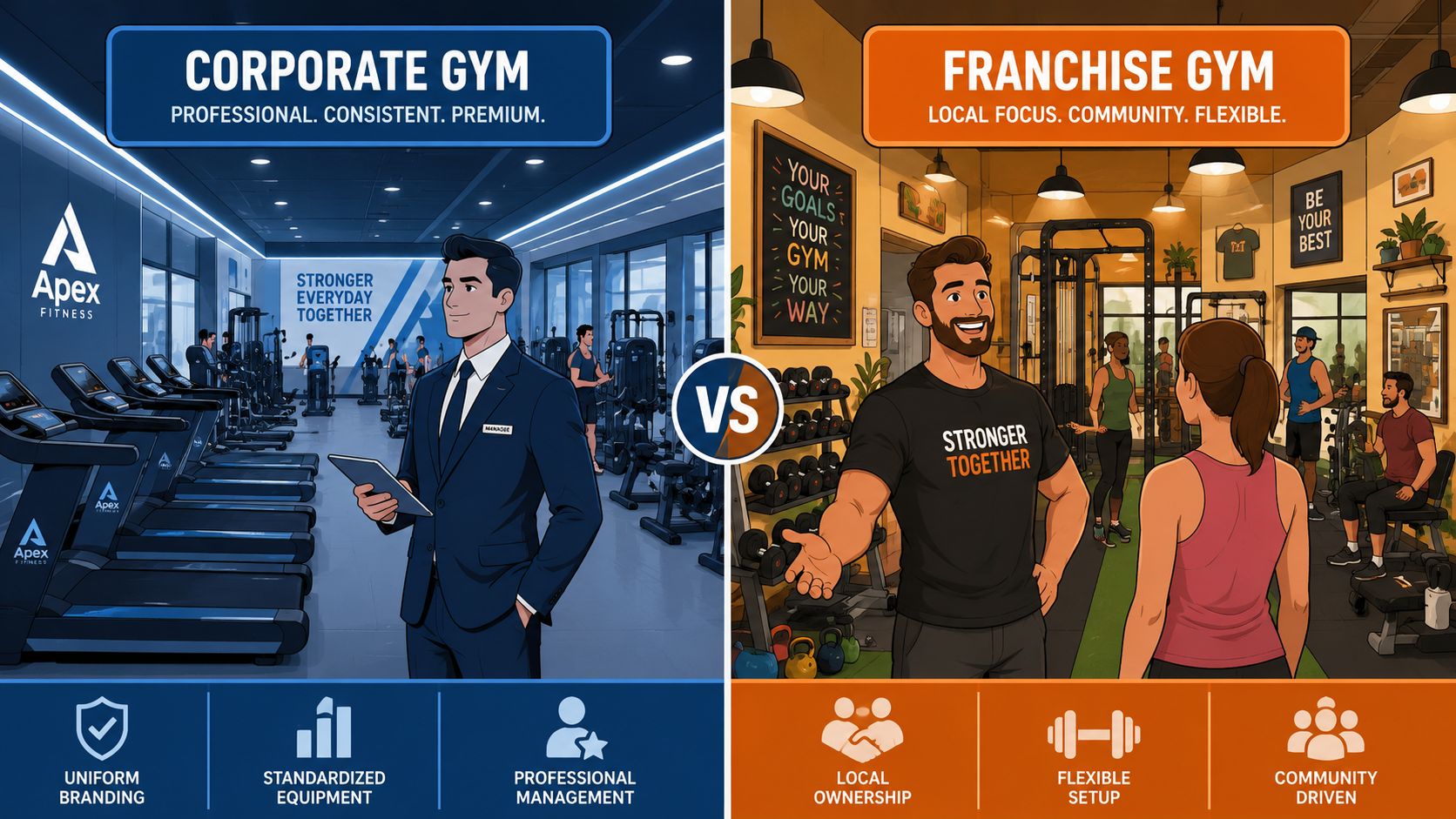
You're probably in the exact spot where most first-time gym entrepreneurs stall out.
You know you want in. You've pictured the floor plan, the training culture, the launch party, the first hundred members. Then the question hits: do you build something under an established brand, or do you stay on the corporate side of the industry where one company owns and controls everything?
That's the difference between corporate and franchise, and it's not a technicality. It decides who puts up the money, who controls the playbook, who absorbs the risk, and who gets squeezed when margins tighten.
Most articles reduce this choice to “freedom versus support.” That's lazy. The actual decision is harsher than that. You're choosing between two very different financial structures and two very different operating realities. In fitness, those differences show up fast in staffing, retention, pricing, local marketing, and even basic standards like keeping a gym wipe dispenser stocked and making sure members can always find wipes for gym equipment.
The Crossroads for Every Gym Entrepreneur
You might be a trainer who wants your first facility. You might be a sales manager leaving a chain. You might be an investor who loves the category but doesn't want to invent a brand from scratch. Different backgrounds, same fork in the road.
One path gives you a recognized name, a system, and a playbook. The other gives the parent company total control and puts local operators in a management role instead of an ownership role. That sounds simple until you put real money and real responsibility next to each option.

A quick side by side view
| Decision Area | Corporate Gym | Franchise Gym |
|---|---|---|
| Ownership | Parent company owns the location | Local franchisee owns the business under a brand license |
| Capital burden | Parent company funds locations | Franchisee invests personal capital |
| Brand control | Fully centralized | Shared, but guided by franchisor rules |
| Fees | No franchise royalties at unit level | Upfront fee plus ongoing royalties |
| Local flexibility | Low | Moderate within brand rules |
| Expansion style | Slower, capital-heavy | Faster, using franchisee capital |
| Retention consistency | Typically stronger | Can vary by operator |
Why this choice matters more in fitness
Gyms aren't passive businesses. They're operationally noisy. Staff quality, cleanliness, class energy, equipment uptime, and follow-up all affect retention.
Practical rule: If you choose the wrong model for your personality and budget, the business will punish you every month.
A weak operator inside a franchise can damage service quality even with a strong brand. A slow corporate decision chain can kill local momentum even with solid funding. That's why this isn't about what sounds more exciting. It's about what you can execute.
Defining The Two Gym Ownership Models
Before you compare profit, control, or growth, get the structure right.
A corporate gym is owned and run by the parent company. A franchise gym is owned by an independent operator who buys the right to use a brand and system. That's the core split.

Corporate gyms are fully owned and operated by a parent company where all locations are managed under a single corporate structure, with centralized control over branding, pricing, staff hiring, and marketing decisions handled exclusively at the company level. In contrast, gym franchisees are independent business owners who invest their own capital to operate locations under an established brand, paying upfront franchise fees and ongoing royalties while retaining operational control within brand guidelines. MyFliip's explanation of corporate gyms and franchise gyms
What corporate ownership actually means
In a corporate model, headquarters calls the shots. Pricing, promotions, hiring frameworks, brand standards, and marketing are controlled centrally. If you run one location, you're managing an asset for the company, not building your own equity in the same way a franchisee does.
That creates consistency. It also creates bureaucracy.
If you like structure, this can be a relief. If you hate asking permission, it'll drive you nuts.
What franchise ownership actually means
A franchise is not “independent, but easier.” It's a contract-heavy middle ground. You own the business locally, but the brand owner still sets major guardrails.
If you're evaluating one, study the agreement hard. A solid master franchise agreement analysis helps you understand how control, territory, obligations, and system requirements can shape your economics long after opening day. If you're still browsing opportunities, this roundup of a gym franchise for sale gives a useful market snapshot.
The simplest way to think about it
- Corporate model: one owner, many locations, one command structure.
- Franchise model: one brand, many owners, shared standards.
- Real-world consequence: corporate gives tighter consistency, franchise gives more entrepreneurial upside with more personal exposure.
That's the legal and operating baseline. Everything else flows from it.
The Financial Showdown Costs and Profitability
Many entrepreneurs fool themselves in this regard.
They see a franchise and think “lower risk because the brand is established.” What they should be asking is, “Lower risk for who?” In many cases, the brand reduces risk for the franchisor, not for you.
What it costs to get in
The financial entry barrier for a gym franchise typically runs $300,000 to $750,000 per location, including a one-time franchise fee of $20,000 to $50,000, fit-out and construction costs, and equipment costs of $50,000 to $300,000, according to Rework's gym franchise model overview.
That's the first reality check. A franchise is not cheap access. It's branded access.
Corporate gym managers don't bear those capital costs because they're employees of the parent company, not owners investing personal money into the asset.
Corporate vs. Franchise Gym Financial Comparison
| Financial Metric | Corporate-Owned Gym | Franchise Gym |
|---|---|---|
| Initial personal capital | Typically not borne by local manager | $300,000 to $750,000 per location |
| Upfront brand fee | None for manager | $20,000 to $50,000 one-time franchise fee |
| Equipment cost exposure | Parent company pays | $50,000 to $300,000 included in setup range |
| Construction and fit-out | Parent company funds | Franchisee funds fit-out and construction |
| Ongoing royalties | None at manager level | Ongoing royalties apply |
| Marketing contributions | Centrally funded by parent company | Franchisee often contributes under brand rules |
| Profit capture | Parent company keeps economics | Franchisee keeps local revenue but gives up fee layers |
The hidden trap most buyers miss
The biggest mistake I see is underestimating royalty stacking.
The franchise model can reduce profit margin because you're paying ongoing royalties and required brand spend allocations. One fitness franchise comparison notes those costs are typically embedded in the 30 to 35% ROI range, while independent corporate-style operators keep 100% of revenue but absorb all capital costs and risk themselves, according to Crunch India's fitness franchise versus studio analysis.
Then it gets uglier for niche operators. One underserved angle from recent franchise commentary is the “franchise fee trap.” It states that 30% of new fitness franchisees fail within 3 years due to undercapitalization from hidden royalty stacking, including year-one fees, ongoing 6 to 8% royalties, and marketing contributions. It also notes corporate-owned studios break even 18 months faster on average because those costs are absorbed centrally, according to Home Franchise Concepts on franchise vs corporation pros and cons.
That's the part glossy franchise brochures gloss over. A gym can be busy and still feel cash-starved if too much revenue gets shaved off before you build any cushion.
What these numbers mean in practice
If you're opening a premium studio with thinner margins, stacking fees on top of payroll, rent, software, marketing, equipment financing, and supplies can hurt fast. Even routine operating items matter. Ordering bulk gym wipes, refill rolls, towels, and commercial disinfecting wipes for a busy floor is basic overhead, but in a fee-heavy model every recurring line item has more bite.
Buy a franchise if the system advantage is strong enough to justify permanent fees. Don't buy one just because the logo feels safer.
If you need financing, review the debt side before you sign anything. A practical primer like Business Loan Warrior's franchise guide can help you think through funding structure, and this breakdown of the cost of gym franchise is worth reading before you build your budget.
My blunt recommendation on money
- Choose franchise if you want a known system and you have enough capital to survive slow ramp-up plus fee drag.
- Choose corporate employment or management if you want industry experience without risking your own balance sheet.
- Avoid franchising if your budget is tight and your business depends on premium pricing with very little margin for error.
Operational Control and Brand Identity
This is the emotional part of the decision, but it still comes down to economics.
Control matters because control affects speed. If you can change pricing, staffing, local offers, class formats, and partnerships quickly, you can respond to your market faster. If you can't, you're stuck waiting while opportunities die.
When corporate control helps
Corporate systems are excellent when consistency is the goal. Everyone uses the same playbook. The look, voice, onboarding, staffing standards, and promotions stay aligned.
That's valuable in fitness because members notice inconsistency immediately. Different pricing explanations, different front-desk energy, different cleaning standards, different sales scripts. Those gaps cost trust.
When corporate control gets in your way
Say your market has a strong youth sports community and you want to launch a local recovery membership for parents and teen athletes. In a corporate setting, that idea often has to climb layers of approval.
By the time headquarters reviews the idea, your local window may be gone.
What franchise freedom actually looks like
A franchisee gets more room to operate day to day, but not unlimited freedom. You can usually manage staff locally, drive local outreach, and execute inside the brand framework. You cannot decide you're suddenly a different concept.
That means your best local ideas still have to fit the brand box.
A franchise is not creative freedom. It's supervised entrepreneurship.
Two common scenarios
You want a unique local campaign
You want to run a six-week challenge with a nearby smoothie shop, a chiropractor, and a youth soccer club.
- Corporate model: possible, but likely slower and more approval-heavy.
- Franchise model: often easier if the promotion fits brand standards.
You want to change the member experience
You want to rewrite the onboarding flow, create a stronger accountability check-in, and build a member welcome ritual that feels more boutique.
- Corporate model: you'll probably follow the standard script.
- Franchise model: you may have room to improve delivery, but not to rewrite the brand promise.
My recommendation on control
Pick based on your wiring.
- If you like systems, accountability, and consistency, corporate structures suit you.
- If you want ownership and local say, franchising makes more sense.
- If you need total creative freedom, neither may fit. You may be better off building an independent brand instead of comparing only the difference between corporate and franchise.
And one operational detail people ignore until members complain: cleanliness standards. Whether you're running a corporate location or a franchise, brand identity is shaped by the basics. Empty wipe stations, dirty benches, and no visible gym equipment cleaning wipes tell members you don't run a serious operation.
Growth Strategy and Scalability
Your growth plan should drive the model choice. Not your ego.
If you want one excellent gym with tight culture and local depth, you don't need the same structure as someone trying to open multiple units quickly. That's where the difference between corporate and franchise becomes strategic.

Why franchising scales faster
Franchising enables faster expansion because the parent brand doesn't have to fund every location itself. The U.S. franchise industry generated $897 billion in economic output in 2024, up from $794 billion in 2019, a 13% increase, according to WINI's franchise success statistics.
That matters because it shows why brands love franchising. It's capital efficient. The franchisor expands while local owners bring the money and carry much of the operating burden.
If your ambition is multi-location growth under an existing flag, this model is built for speed.
Unit economics matter more than hype
A big-box franchise model typically needs 1,200 to 2,000 active members to cover overhead and hit profitability. A boutique independent studio may only need 80 to 120 members paying $150+/month to cover costs. The same source notes that franchise systems often target CAC payback under 6 months, while independent gyms usually grow more slowly and can face member churn closer to the 4 to 7% industry target, according to CTA Acquisitions on gym business valuation.
That should change how you think.
A franchise may scale faster, but some formats need a lot of bodies to make the math work. If your market can't support that volume, the system won't save you.
Who should choose which path
Franchise growth fits you if
- You want multiple locations. The model is built for replication.
- You value proven acquisition math. Predictable systems can reduce guesswork.
- You're comfortable operating inside brand rules. Speed comes with structure.
Corporate growth fits the parent brand if
- Control is the priority. Every site stays under one command structure.
- Expansion can be slower. The company funds each new location.
- Consistency matters more than local entrepreneurship. That's the trade.
If you're thinking beyond one unit, study how a chain of gyms works before you assume bigger automatically means better.
My opinion on scaling
Franchising is the better machine for rapid footprint growth. Corporate ownership is the better machine for tighter control.
Neither is automatically smarter. A lot of first-time operators chase scale before they've proven they can keep one gym full, clean, staffed, and profitable. That's backwards.
Member Experience and Long-Term Retention
This is the part most comparison pieces miss, and it's the part that can insidiously wreck your business.
Selling memberships gets attention. Keeping members pays the bills. If your model creates inconsistent service, your retention suffers, your sales team works harder just to replace losses, and your marketing spend becomes a treadmill.
The hidden retention risk in franchising
Corporate-owned gyms maintain 15 to 20% higher retention rates than franchisees because they use more standardized staff training and more unified member experience protocols, according to UpCounsel's discussion of franchise and corporate structure.
That's a big deal.
Many franchise agreements focus heavily on brand compliance, fees, and operating requirements, but they often don't enforce retention KPIs the way a strong operator would. So two locations under the same sign can feel wildly different to members.
Why members notice the split fast
Retention isn't abstract. It lives in everyday moments:
- Front desk consistency: Are people greeted the same way every time?
- Coach quality: Do staff follow one standard or improvise?
- Problem handling: Does billing confusion get solved cleanly?
- Cleanliness discipline: Are there always fitness wipes available, or are stations empty by noon?
A member doesn't care whether inconsistency came from the franchise structure. They just cancel.
The gym business doesn't reward brand recognition alone. It rewards repeatable trust.
Cleanliness is part of retention, not housekeeping
Operators often get shortsighted on this point. Clean gyms keep members comfortable. Dirty gyms create doubt. If members have to hunt for sanitizing wipes, see sweat left on benches, or notice mats going uncleaned, they question everything else too.
For specialty spaces, that extends beyond machines. Yoga and stretching zones need yoga mat wipes or equivalent cleaning routines that members can see and trust. Strength areas need visible access to wipes to disinfect gym equipment between sets. Group training spaces need staff who enforce standards without making the room feel policed.
My recommendation on member experience
If retention is your top priority, favor the model that gives you the strongest operational discipline.
That may be corporate if you value tight systems and uniform standards. It may be franchise if you're a hands-on owner who can out-execute the average operator. But don't assume a franchise gives you a perfect “business in a box.” In fitness, member experience still comes down to leadership, training, and daily discipline.
Your Decision Checklist Which Path Is Right for You
You don't need another vague pro-and-con list. You need a decision filter.
Start with honesty. Not optimism.

Ask yourself these questions
- Do you want ownership or a role? If you want equity and local control, franchise is closer. If you want experience without risking your personal capital, corporate management is safer.
- Can your cash reserves handle fee drag? Franchise fees don't stop after opening.
- Do you need creative control? If yes, corporate will frustrate you.
- Do you want fast multi-unit growth? Franchise systems are built for that.
- Is retention your strongest skill? If not, don't assume brand recognition will cover sloppy execution.
My clear recommendations
Choose a franchise if
You want entrepreneurship with guardrails, have the capital to absorb upfront investment and ongoing fees, and you plan to scale faster than a single independent site usually can.
Choose corporate if
You want to learn operations inside a structured system, avoid personal capital exposure, and build experience before you ever sign a lease or franchise agreement.
Walk away from both if
You need full creative freedom and your concept depends on a highly customized member experience that a franchise brand would constrain.
Your best model is the one that matches your risk tolerance, your cash position, and your operating style. Not the one with the best pitch deck.
One final point. Whatever path you pick, finish with a real cleaning and sanitizing plan before opening. Stock reliable disinfecting wipes, keep a visible gym wipe dispenser near high-touch zones, and use commercial-grade products that members trust. If you need dependable supplies from day one, source them from Wipes.com. For high-traffic clubs, I'd prioritize EPA registered disinfecting wipes, clear refill schedules, and staff checks every shift so members never wonder whether your facility is clean.
If you want more practical guidance on gym ownership, sales, and retention, keep reading Gym Membership Tips for straightforward advice you can apply.
Leave a Reply