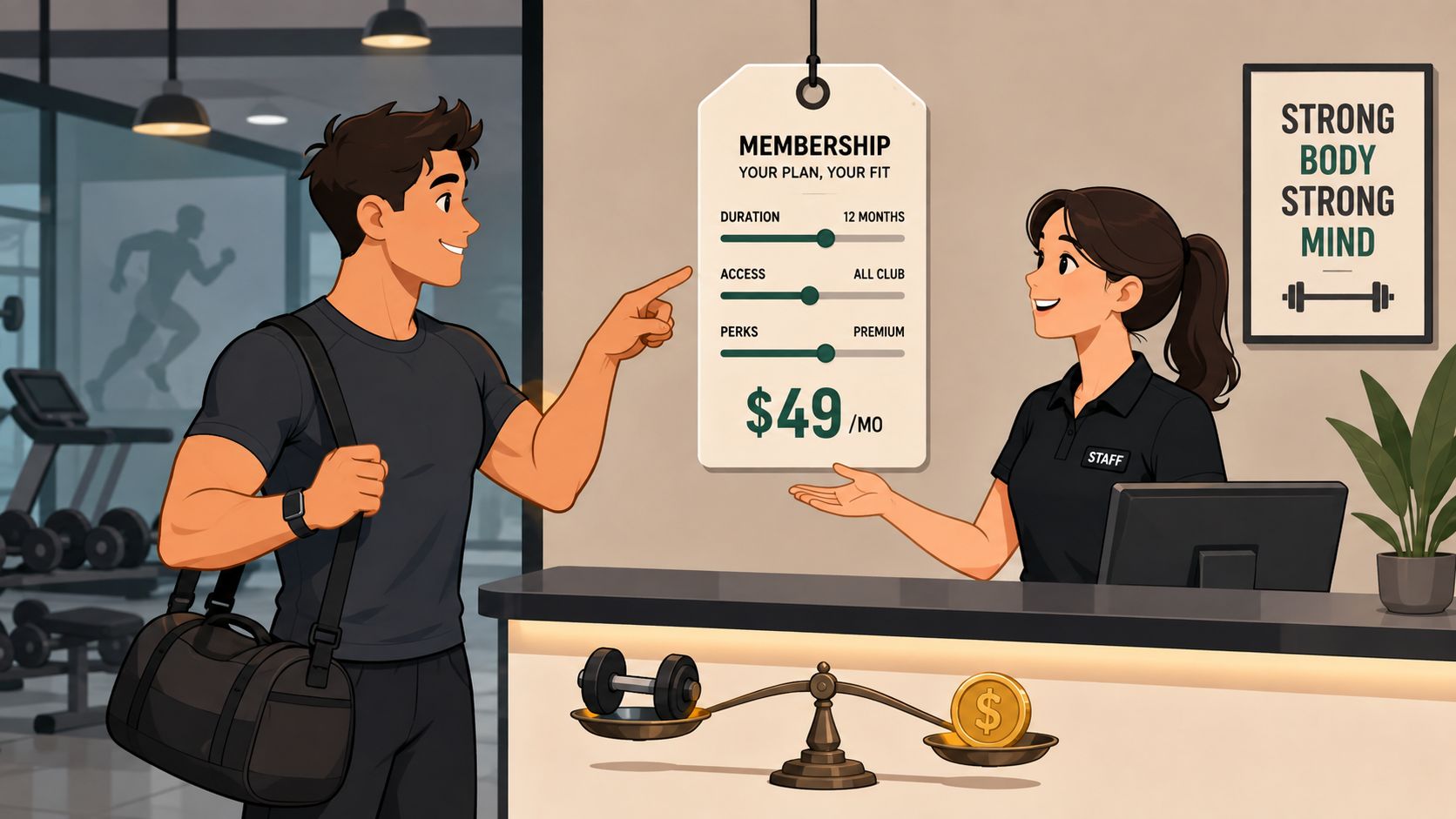
You're standing at the gym's front desk, holding a glossy membership brochure while someone explains a “limited-time” rate that somehow costs more once enrollment, maintenance, billing, and cancellation fees appear. Many either accept the first offer or try a vague, awkward “Can you do better?” That's not how to negotiate gym membership successfully.
The useful question isn't, “Can you lower the monthly price?” It's which charges can move, when the gym is most likely to approve a concession, and whether the contract lets the savings survive past the promotional period. Approach those three issues in the right order, and you'll negotiate from facts instead of nerves.
Before You Walk In, Know What You're Negotiating
A gym sales floor rewards preparation. Walk in without numbers and the salesperson controls the frame. Walk in knowing nearby alternatives, your true cost, and your exit point, and the conversation becomes a rate review rather than a performance designed to get you signed immediately.
Build your three-part research file
Start with two or three nearby gyms. Call each one or take a quick tour as a casual shopper, then ask for the complete move-in cost, not just the advertised monthly rate. Record the initiation fee, recurring dues, annual maintenance charge, class surcharge, locker rental, personal training minimum, guest privileges, and any child-watch add-on.
Create a simple comparison sheet. You can also review fitness club membership costs before you visit, but treat every published rate as an opening anchor. Screenshot promotional prices, save the page, and note when each promotion expires. A salesperson may match a competitor's public offer, but you need proof of what that offer includes.
Next, calculate your own usage. Check the class schedule against your commute, work hours, and preferred training times. A low rate at a club you rarely reach is expensive in practice. A slightly higher rate at a location you'll use consistently may be the more sensible purchase.
Set a walk-away number
Choose two limits before you enter:
- Monthly target: The recurring amount you'd be happy to pay.
- Maximum first-year outlay: Every recurring fee, initiation charge, tax, add-on, and required purchase included.
Don't volunteer either figure at the start. Ask the gym to state its complete offer first, then compare it with your prepared ceiling. Your strength comes from knowing exactly what you're willing to accept and what would make you leave.
Practical rule: Negotiate the total first-year cost, then negotiate the line items that create it.
Gym contracts often focus on early exit rights rather than pure price bargaining. The New Zealand Commerce Commission's gym-contract review notes that gyms commonly charge early termination fees before a minimum term ends. That makes preparation especially valuable, because your strongest advantage usually exists before signing, at renewal, or when an auto-renewal clause is costly.
Running the Conversation Like a Pro
The first objective isn't to haggle. It's to collect information while keeping your options open.
Ask for a tour before discussing payment. Look at the equipment, changing rooms, peak-hour crowding, class availability, and practical details that determine whether you'll use the facility. Then ask, “What's the in-club rate, and how does it differ from the website rate?” The question forces the representative to explain whether the online promotion is the genuine offer or just a lead-generation price.
When the first pitch arrives, don't reveal your budget. Try:
“I'm comparing three clubs this week. What's your best move-in offer, including every required fee?”
That sentence establishes competition without sounding hostile. If the salesperson asks what you want to spend, redirect politely: “I'm deciding based on the complete annual cost. What would I pay over the first year?”
Trade value instead of demanding a favor
Gyms may have more flexibility with enrollment fees, introductory promotions, sessions, or add-ons than with the recurring base rate. Give the representative something to exchange for the concession.
A realistic conversation might sound like this:
You: “If I commit to the longer term, can you remove the initiation fee?”
Representative: “I may be able to reduce it, but I can't remove it.”
You: “Could you ask the manager about waiving it and adding a personal training session instead?”
If the gym won't move on the fee, ask about a rate match, an amenity downgrade, guest access, or a better prepayment arrangement. Consumer guidance from Consumer NZ on cancelling a gym contract supports the practical reason for handling this before signing. Cancellation and termination charges are common, so negotiating the structure early is usually safer than trying to escape an expensive agreement later.
When the closer pushes for an immediate decision, say, “I'd like to think about it overnight. What does the price look like if I start today?” Then stop talking. Silence gives the representative room to improve the offer without your volunteering a concession.
Ask the salesperson to repeat the complete annual total slowly. Listen for initiation charges, maintenance fees, billing fees, and add-ons. If the number still exceeds your ceiling, use the clean exit: “Thanks for walking me through it. It doesn't fit my limit, so I'm going to compare the other clubs.” Leave without apologizing.
Which Fees Are Actually Flexible
The monthly dues get all the attention, but they're often not the easiest line item to change. A gym may protect its headline rate while waiving an enrollment charge or adding value elsewhere. Focus your energy where the business has discretion.
| Fee | Negotiable? | Typical Range | Best Lever |
|---|---|---|---|
| Initiation or enrollment fee | Often | Varies by gym | Longer commitment, immediate start, competitor quote |
| Annual maintenance or club-improvement fee | Sometimes | Varies by contract | Written fee waiver, promotional enrollment |
| Personal training bundle | Often | Varies by package | Ask for an included session or smaller bundle |
| Guest passes | Sometimes | Varies by membership | Family or longer-term commitment |
| Child-watch add-on | Sometimes | Varies by facility | Off-peak use or bundled membership |
| State-mandated tax | Generally no | Set by applicable rules | Don't spend negotiation time here |
| Insurance rider | Usually limited | Varies by agreement | Ask whether it's optional or required |
| Third-party billing fee | Usually limited | Varies by provider | Request an alternative payment method |
The principle is straightforward. A charge tied to member acquisition, sales targets, or an in-house service is more likely to move. A pass-through charge from the government, insurer, or billing provider usually isn't. Policies still vary by owner and franchise, so ask even when a representative calls something “fixed.”
You can use a public pricing resource such as Vanta Sports pricing plans as a comparison reference when evaluating how clearly another fitness-related service presents its packages. The point isn't to assume identical pricing. It's to train yourself to compare package structure, inclusions, and upgrade paths rather than staring at one monthly figure.
A strong ask could be: “If I choose the 12-month term, can you waive the $99 initiation fee and apply a 50% discount to the first two months?” Those figures are a negotiation example, not a universal expectation. Asking the gym to waive sales tax, by contrast, is a dead end.
For additional context on how clubs separate membership charges from extras, review sports club membership fees. The useful habit is to negotiate the fee structure, not perform a theatrical argument over a charge the representative can't control.
Timing, Demand, and When to Push Hardest
Walk in during the slow mid-afternoon period, not the crowded after-work rush. The representative has more time to answer detailed questions, and you are less likely to compete with a line of tours. End-of-month and end-of-quarter enrollment pushes can also give a manager a reason to approve a concession.
The calendar matters, but the gym's actual demand matters more. February and March can be useful times to test the market after the post-New Year surge has cooled. Look for evidence before you push: sparse classes, empty training areas, open appointment slots, or a representative who is unusually eager to keep you talking. A packed schedule and a waitlist point in the opposite direction.
Consumer guidance from Me, Myself and Money on negotiating purchases identifies the end of the month as a period when representatives may be chasing quotas and lists initiation fees as a common negotiation target.
| Timing Window | Salesperson Advantage | Your Advantage | Typical Extra Savings |
|---|---|---|---|
| Busy after-work hours | High | Low | Varies |
| Slow mid-afternoon | Moderate | Moderate | Varies |
| End of month | Moderate | High | Varies |
| End of quarter | Moderate | High | Varies |
| February or March | Often moderate | Moderate to high | Varies |
| About 15 days before billing resets | Moderate | High | Varies |
No timing window guarantees extra savings. Use the moment to request one specific change, such as a fee waiver, rate match, longer promotional period, or included service. Avoid asking vaguely for “a better deal.” A precise request gives the representative something concrete to approve or take to a manager.
Showing up 15 days before the billing cycle resets gives you a practical opening: “Are there any new-member promotions planned for the next cycle?” The front desk may know about an offer that has not been advertised, or may need a manager's approval. Treat any answer as a starting point, then ask for the change in writing.
Your strongest position comes from combining good timing with a membership you can leave cleanly. A small discount loses its value if the agreement later imposes an auto-renewal, narrow notice window, or early-exit fee. Push hardest for lower upfront cost and a clean exit, rather than a flashy monthly rate that keeps charging after the promotion ends.
Reading the Contract Before You Sign
A promotional rate is only a good deal if you know what replaces it. Read the agreement at the desk, on your phone, or at home before the deadline. Don't rely on a salesperson's summary.

Find the clauses that change your exit cost
Look for auto-renewal language, the rate-lock duration, the promotional-rate duration, cancellation windows, and the post-discount price. “Cancel anytime” can mean something very different from “cancel during a 30-day window each year.” Confirm whether notice must be sent by email, certified mail, an online portal, or in person.
Check the freeze policy. Ask whether freezing costs money, whether the freeze extends the term, and whether medical documentation is required. Review family add-on pricing, personal training session expiration, and whether an initiation fee appears again at renewal.
Cooling-off rights depend on location and how you signed. In the UK, distance gym contracts generally have a 14-day cooling-off right under the Consumer Contracts Regulations 2013. If the required cancellation information wasn't provided, that period can extend to 12 months plus 14 days, according to Fight My Corner's UK gym cancellation guidance. The same guidance says a cancellation during the cooling-off period should result in a refund without a cancellation fee for that period.
Queensland's fitness-service rules provide a 48-hour cooling-off period for new gym agreements. The period starts when the contract is signed, or when the business opens if the customer signed before opening. Cancellation must be in writing, and the provider must refund advance fees within 14 days, subject to permitted deductions described by Queensland Government fitness-service guidance.
In the UK, the statutory 14-day right generally applies to distance contracts, not agreements signed face-to-face. Consumer rights guidance for gym contracts also explains that requesting immediate service can affect cancellation rights for services fully provided during the cooling-off period.
Put promises into the agreement
Ask for riders or written confirmation stating:
- “The membership rate remains unchanged for 12 months.”
- “Cancellation requires 30 days' notice by email.”
- “The initiation fee is waived and won't reappear at renewal.”
- “Unused personal training sessions expire only under the terms stated here.”
If the representative refuses to write down a promise, treat it as nonexistent. You can compare the gym's wording with service terms for lifters to sharpen your eye for definitions, payment terms, and cancellation language. For a broader look at local rules, consult gym membership cancellation law, then verify the contract against the law that applies where you live.
Why Contract Length Matters More Than the Monthly Price
The cheapest monthly rate can become the most expensive decision if your schedule changes. A long commitment makes relocation, injury, work changes, and loss of motivation financially relevant. That's why I'd negotiate the exit clause before chasing a tiny monthly reduction.
Consider the comparison below. The figures are a simple illustration using the stated rates, with no added fees and no assumed cancellation cost.
| Contract Type | Monthly Rate | 24-Month Total | Exit Flexibility |
|---|---|---|---|
| 12-month agreement renewed for a second year | $29 | $696 | Limited during each fixed term |
| Month-to-month agreement | $39 | $936 | Higher, subject to the written notice terms |
The difference is $240 across 24 months before extras. But the cheaper arrangement only wins if you keep it through the relevant commitment periods and avoid penalties. If a move or injury causes you to pay for unused months, the apparent saving can disappear.
The break-even question is simple: how many months must you use the lower-rate plan before its savings justify the loss of flexibility? Calculate the higher monthly cost of the flexible option, then compare it with the amount you could lose if the fixed-term plan becomes unusable. Don't pretend you know the answer without checking the contract's early-exit formula.
Make flexibility your main ask
Try this in the room:
“I'll take the lower rate if you add a 30-day cancellation option in writing.”
If that fails, ask for the shorter term at the lower rate. You can also request a freeze right that pauses billing during a documented injury or relocation, provided the agreement states exactly how it works. Québec consumer guidance says a member may cancel before service starts without a fee, or within a period up to one-tenth of the contract duration, with a possible fee equal to one-tenth of the total contract cost. The Québec fitness-membership cancellation guidance gives consumers a concrete benchmark for discussing early cancellation.
New Zealand consumer guidance describes early-cancellation fees as commonly based on a percentage of the remaining term or a flat fee, but says they must be reasonable. Use that principle to negotiate a shorter commitment, reduced penalty, or rolling monthly plan instead of obsessing over the headline rate.
Quick Checklist, Common Mistakes, and Staying Hygienic
Before you sign, run through this list:
- Total cost calculation: Add dues, initiation, maintenance, taxes, billing, and add-ons.
- Cancellation clause review: Confirm the method, notice period, and early-exit formula.
- Freezing policy confirmation: Ask about cost, documentation, and term extensions.
- Add-on audit: Remove child-watch, locker, training, and class charges you won't use.
- Verbal promises confirmation: Put every concession in the written agreement.
- Guest pass policy: Confirm the number and any restrictions.
- Price match guarantee: Ask whether a competitor's written offer can be matched.
- Off-peak discount availability: Check whether limited access lowers the rate.
- Personal training session limits: Verify expiration and transfer rules.
- Security deposit terms: Confirm when and how any deposit is returned.

Five mistakes repeatedly waste negotiating power:
- Revealing your budget first: Make the gym state its offer.
- Accepting the first offer: Ask what else can move.
- Ignoring auto-renewal: Record the notice date and cancellation method.
- Skipping exit terms: A discount doesn't protect you from a bad commitment.
- Assuming the lowest monthly rate wins: Compare the total obligation and flexibility.
Keep the gym experience clean, too. Bring your own towel and lock instead of renting shared items, wear flip-flops in the showers, wipe benches before and after use, and use deodorant without an overpowering scent. For shared machines, choose EPA registered disinfecting wipes when disinfection is the goal. Products such as Athletix disinfectant wipes are positioned for hard surfaces and equipment, while wipes for gym equipment belong in your bag when the facility's supplies are empty.
Before your next visit, write down three competitor offers, your maximum first-year outlay, and the contract clauses you won't accept. Take that sheet to the gym, ask for the complete annual total, and leave unless the written deal fits your number.
Contact your preferred gym today, request its full membership agreement and itemized pricing, then negotiate one specific concession, such as a waived enrollment fee, a written rate lock, or a 30-day cancellation option. Don't sign until every promise appears in the contract.
Leave a Reply