Successful fitness marketing doesn't sell facility access alone. It sells belonging, confidence, convenience, identity, or measurable progress, then gives prospects proof that the promise can become part of their lives. That's why case studies marketing matters for gyms. One widely cited benchmark reports that 73% of B2B buyers find case studies the most influential content type during a purchasing decision, while 66% of B2B marketers rank them among the top three lead-generation content types and 77% use them in their content strategy (case study benchmark data). Buyers also consume an average of 13 pieces of content before deciding, making proof especially useful after educational content has created interest.
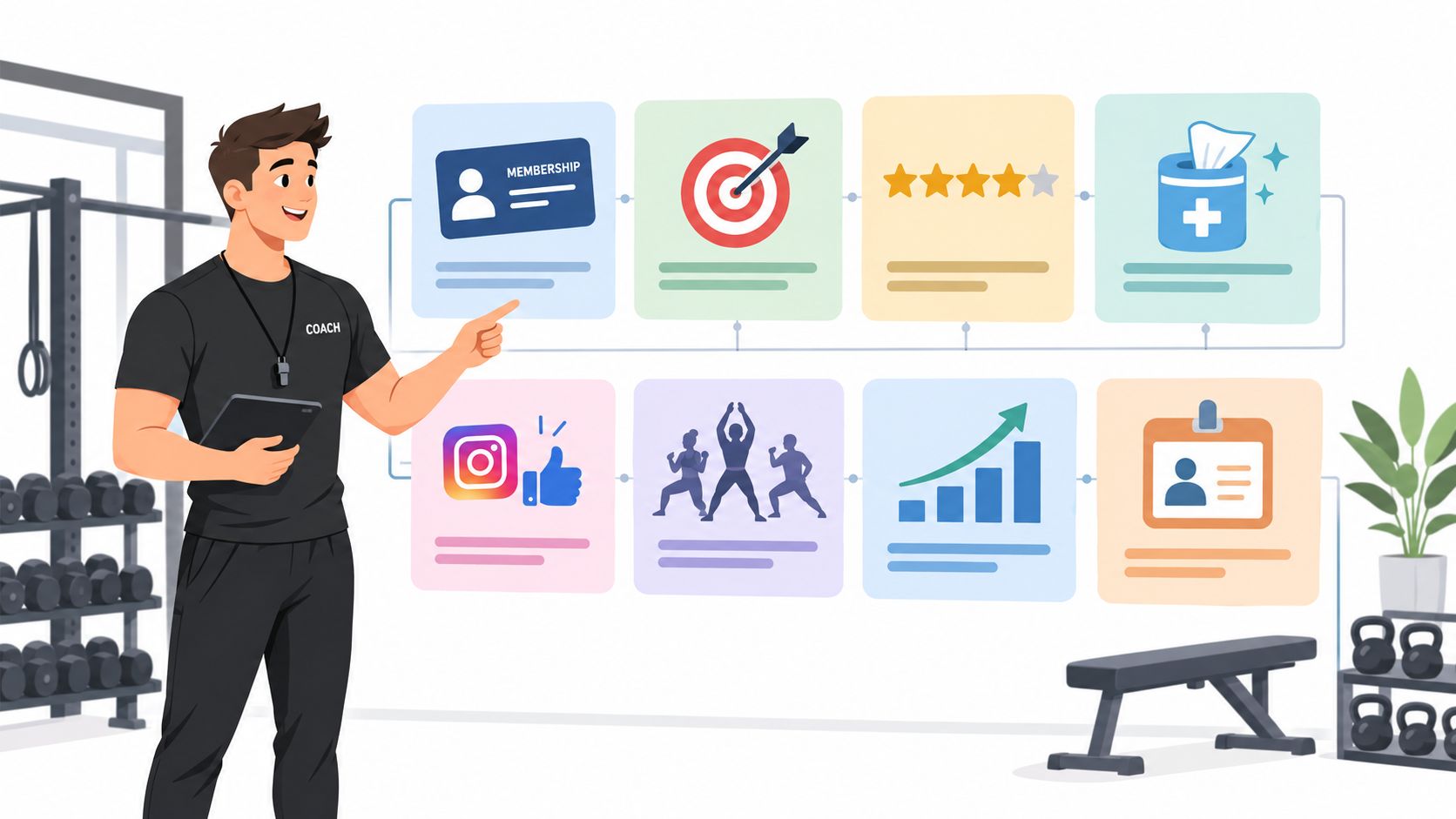
The eight models below connect a recognizable fitness brand with one specific membership lever, from community and positioning to technology and performance. Each example separates the strategy, execution, trade-offs, and actions a gym can replicate at its own scale. A strong member experience also includes visible hygiene practices, from gym equipment wipes near high-touch machines to sanitizing wipes that make cleaning feel like a normal part of every workout.
1. Peloton's Community-Driven Growth Strategy
Peloton's most transferable lesson is simple: a workout becomes harder to abandon when members feel other people are expecting them to show up. The brand extended beyond connected equipment through live classes, on-demand content, social features, instructors, leaderboards, and branded events. Those elements turned an individual session into a shared ritual.
The strategy sells accountability as much as exercise. A member can recognize a familiar instructor, compare progress with friends, celebrate milestones, or join a class at a scheduled time. That emotional layer gives the product a reason to remain relevant between visits.
Gyms can build a similar system without copying Peloton's technology investment. A local facility might run a monthly attendance challenge, celebrate member milestones on its social channels, or create small groups around strength training, beginner fitness, or weekend running. A referral program can also reward community milestones rather than only individual purchases.
Community lesson: Retention improves when members have people, rituals, and recognition attached to the place.
Execution and trade-offs
Community programming requires moderation, staff time, and consistent recognition. A leaderboard can motivate experienced members while discouraging beginners, so operators should offer several ways to participate. Recognition might include attendance streaks, first class completion, a personal best, or helping another member.
Use testimonials and success stories in landing pages, email follow-up, and tours. Gym owners can also connect this approach with online fitness community ideas to maintain engagement when members aren't physically in the facility.
Start with one repeatable ritual, such as a weekly group challenge. Track attendance, referrals, and cancellations separately. The aim isn't to imitate Peloton's ecosystem. It's to make your gym feel socially valuable enough that leaving means losing more than equipment access.
2. Equinox's Premium Positioning and Luxury Brand Strategy
Equinox demonstrates how a gym can compete on curation rather than convenience or price. Its positioning combines design, service, amenities, personal attention, and an aspirational lifestyle. The product isn't a room filled with machines. It's a managed environment where the member expects the details to feel deliberate.
That approach begins with audience selection. A premium gym shouldn't write messaging for everyone. It needs to identify members who value time savings, atmosphere, privacy, service, and consistency, then make those benefits visible across every touchpoint.
The execution can include highly designed spaces, private training areas, premium recovery services, partnerships with complementary wellness providers, and carefully structured membership tiers. Staff behavior matters just as much as décor. A premium promise weakens quickly when prospects encounter confusing billing, cluttered equipment, or indifferent reception teams.
What smaller gyms can borrow
Smaller operators don't need to reproduce a luxury chain. They can create a premium micro-experience inside a broader facility. A reserved training zone, appointment-based assessments, quieter workout hours, or a members-only event can provide distinction without a complete renovation.
A selective offer also creates useful scarcity. Membership caps, limited coaching availability, or scheduled onboarding sessions can communicate capacity while protecting service quality. The trade-off is that premium positioning narrows the audience, and higher expectations increase the cost of inconsistency.
Use photography, testimonials, and case studies to show what members receive beyond access. A prospect considering a high-value membership wants evidence of the experience, not just polished claims. For more context on premium pricing models, see this guide to the most expensive gym memberships.
Premium positioning works only when the operational details support the promise every day.
3. Planet Fitness's Accessibility and Mass-Market Strategy
Planet Fitness built its identity around lowering the psychological barrier to gym membership. The Judgement Free Zone directly addresses a fear many prospects understand: walking into a gym and feeling watched, unqualified, or out of place. The model makes belonging the entry point.
That message is stronger than generic claims about modern equipment. A beginner may not care about the full equipment inventory yet. They care whether staff will help them, whether other members will judge them, and whether the price and rules feel understandable.
Accessibility has several layers:
- Clear pricing: Make the entry offer easy to understand, with terms explained before signup.
- Inclusive language: Show different ages, abilities, and experience levels in creative assets.
- Convenient access: Use hours, locations, digital booking, and simple onboarding to reduce friction.
- Upgrade paths: Offer coaching, small-group training, or premium services without making the basic member feel secondary.
Execution without eroding value
A low-friction offer can generate volume, but it also creates pressure on staffing, equipment availability, and retention. If operators focus only on acquisition, the facility can become crowded or impersonal. The solution is to pair accessible entry with a clear first-month experience, digital reminders, introductory orientations, and relevant follow-up.
A local gym can adapt the positioning through a “beginner welcome” pathway. The prospect sees a short tour, receives a simple starter plan, meets a coach, and gets an invitation to a low-pressure class. Marketing should show the process rather than merely declare that the gym is welcoming.
The deeper lesson is that accessibility is a conversion strategy and a service standard. If advertising removes fear but the first visit creates confusion, the brand breaks its promise. Review the path from ad to tour to first workout, then remove one intimidating step at a time.
4. Barry's Bootcamp's Experience Marketing
Barry's Bootcamp sells a highly recognizable experience built around instructor energy, structured programming, music, atmosphere, and intensity. The member doesn't reserve a room. They reserve a time-bound event led by a person whose style becomes part of the product.
That model makes instructors important marketing assets. Their expertise and personality can attract prospects, while consistent class formats make the experience repeatable across locations. Orangetheory uses a related boutique approach with a stronger emphasis on data, and F45 shows how a distinctive class concept can support a scalable format.
From class format to membership engine
A traditional gym can create its own signature experience without turning every workout into a boutique class. It might introduce a recurring small-group session with a memorable name, a defined progression system, and a consistent coaching standard. The format should be easy to explain in one sentence and recognizable when a member sees it on the schedule.
Execution depends on staff development. Coaches need training in teaching, safety, welcome rituals, and follow-up, not only exercise selection. Social content can feature instructor tips, member milestones, class preparation, and event highlights, while avoiding exaggerated promises about physical outcomes.
The trade-off is operational intensity. Experience-led models depend heavily on schedule quality and instructor consistency. A weak substitute instructor, poor audio, or overcrowded class can damage perceived value quickly.
Experience rule: Give members a repeatable moment they can describe to a friend, not merely a list of amenities.
Build one flagship class first. Invite current members to test it, gather structured feedback, and refine the format. Then turn the strongest reactions into a case study with the baseline problem, intervention, and outcome. That evidence can support trial offers and sales conversations without reducing the brand to generic hype.
5. Apple Fitness+ and Tech Integration
Apple Fitness+ illustrates the power of placing fitness inside a broader ecosystem. Workouts connect with devices, screens, software, and service relationships, creating a smoother path from intention to action. The strategic advantage isn't just the video library. It's the reduction of friction between tracking, choosing, starting, and reviewing a workout.
A gym can apply this lesson by connecting its physical experience with digital tools. A member might book a class through an app, sync wearable data, receive a personalized recommendation, and view attendance or performance history after the session. The technology should make the membership easier to use, not create another disconnected login.
Execution at different budgets
A smaller facility can begin with a reliable mobile booking system, automated reminders, digital workout plans, and a member portal. Larger operators might integrate Apple Watch, Fitbit, or Garmin data, provided they explain what information is collected and how it supports the member.
Personalization should remain transparent. If the system recommends a class, the member should understand why. If staff use performance data, they need training to discuss trends responsibly rather than treating one metric as a complete picture of fitness.
The trade-off is maintenance. Apps require support, integrations change, and poor user experience can make a gym seem less professional than a simple manual process. Technology also creates privacy responsibilities, so collect only what the business can protect and use meaningfully.
Place digital benefits in the membership offer itself. “Book faster, receive guided plans, and review your progress” is more concrete than “technology-enabled fitness.” Then measure whether app engagement connects with attendance, class bookings, and renewal conversations. The lesson isn't to chase every new device. It's to remove the small obstacles that stop members from using what they've already purchased.
6. CrossFit's Affiliate Model and Grassroots Growth
CrossFit's affiliate model shows how a strong methodology can give independent operators a common identity without requiring every location to look identical. Affiliates retain local ownership and community character while connecting to a broader system of training standards, events, education, and brand recognition.
That balance creates a useful growth model for gyms with limited expansion capital. Instead of building every site centrally, an operator can develop a repeatable program, document the operating standards, train partners, and let local leaders adapt delivery to their communities.
Build a method people can explain
The first requirement is distinctiveness. “We offer workouts” isn't a methodology. A stronger proposition might center on coached functional training for beginners, structured strength progression, or short sessions for busy professionals. The promise must be specific enough for staff to deliver and members to repeat accurately.
The second requirement is partner enablement. Provide class templates, onboarding materials, visual standards, sales scripts, and community programming. Leave room for local events and relationships, because a rigid system can remove the grassroots energy that makes the model compelling.
Operators can explore the mechanics of the CrossFit affiliate program while considering what should remain standardized in their own business. A local gym might create a branded eight-week strength pathway, certify coaches internally, and invite nearby employers or community groups to participate.
The trade-off is control. More autonomy can produce inconsistent service, while too much central control can make local owners feel constrained. Set essential standards for safety, coaching, member communication, and brand conduct. Allow flexibility in events, scheduling, and local partnerships.
Grassroots marketing works best when members become visible participants. Competitions aren't required. Progress celebrations, team challenges, charity workouts, and partner events can create the same sense of shared identity at a smaller scale.
7. Lululemon's Lifestyle Branding Strategy
Lululemon's fitness relevance comes from its ability to connect products with a broader wellness lifestyle. The brand has used instructors, community events, ambassadors, and philosophy-led storytelling to create touchpoints beyond a transaction. Fitness businesses can borrow the principle even if they don't sell apparel.
A gym becomes more memorable when it stands for a way of living. That might mean disciplined strength training, balanced wellness, neighborhood connection, outdoor activity, or confident beginner progress. The point is to define a philosophy members can recognize in classes, emails, events, merchandise, and staff interactions.
Extend the relationship beyond the workout
A facility could host a mobility workshop, a recovery discussion, a local run, a nutrition education session, or a social gathering. The event doesn't need to sell immediately. It should reinforce the identity of the community and give members a reason to invite someone who isn't ready for a full membership.
Merchandise can support recognition, but it shouldn't become a substitute for service. A branded shirt works when members feel proud of the group it represents. Staff and instructors can also act as ambassadors by sharing useful education and showing the values in practice, rather than posting constant promotions.
Partnerships expand reach. A gym might collaborate with a local physical therapist, healthy café, running club, or employer wellness program. Each partner introduces a different audience, but the arrangement needs clear boundaries and a shared member benefit.
The trade-off is brand drift. Lifestyle marketing can become vague if every wellness topic is included. Choose a narrow set of themes and repeat them consistently.
A lifestyle brand gives members more reasons to remember you between workouts.
Create a quarterly event calendar, one ambassador program, and a small set of content themes. Then track registrations, guest visits, referrals, and subsequent membership conversations. The strongest story will connect the lifestyle activity with a real membership decision without pretending that every attendee is ready to buy.
8. Orangetheory's Data-Driven Personalization
Orangetheory makes performance data central to the member experience. Heart-rate zones, class feedback, progress tracking, and competitive elements help turn an abstract workout into something members can see and discuss. That clarity appeals to people who want evidence of effort and improvement.
The same principle works in a conventional gym, but operators should choose metrics carefully. Attendance consistency, completed sessions, lifting progression, mobility milestones, class participation, and coach-assessed improvements can all support useful conversations. One number rarely explains a member's full result.
Turn measurements into motivation
Technology can support leaderboards, challenges, badges, and personalized recommendations. Yet gamification has a trade-off. Public competition energizes some members and alienates others, especially when the system rewards only speed, weight, or intensity. Offer private milestones and team-based challenges so members can choose a comfortable form of recognition.
Staff training matters more than the dashboard. Coaches need to explain what a metric means, what it doesn't mean, and which action the member should take next. A performance email might celebrate consistent attendance and recommend a suitable class, while a sales conversation uses a member's stated goal rather than overwhelming them with data.
The case study format is particularly valuable here. A credible story establishes a baseline, describes the intervention, and reports the outcome. Marketing case study collections emphasize this before-and-after structure because it shows how a specific tactic relates to a measured change (conversion-focused case study guidance).
Use member consent and protect sensitive information. Share anonymized trends when possible, and ask members before publishing identifiable results. The replicable tactic is not expensive biometrics. It's the habit of turning progress into visible, personally relevant feedback.
8-Case Marketing Strategy Comparison
| Strategy | Implementation Complexity | Resource Requirements | Expected Outcomes | Ideal Use Cases | Key Advantages |
|---|---|---|---|---|---|
| Peloton's Community-Driven Growth Strategy | High, build integrated digital + live ecosystem | Significant tech, ongoing content production, dedicated community team | Recurring subscription revenue, high retention, organic referrals | Gyms seeking digital memberships and community engagement | Emotional loyalty, diversified revenue, rich member data |
| Equinox's Premium Positioning and Luxury Brand Strategy | Medium–High, premium design and service systems | Large capital for facilities, high-touch staff, curated partnerships | High ARPM, strong brand prestige, selective growth | Urban, affluent markets or boutique luxury clubs | High margins, exclusivity, strong perceived quality |
| Planet Fitness's Accessibility and Mass-Market Strategy | Low–Medium, standardized, replicable operations | Low per-unit capex, franchise operations, efficient staffing | Rapid scale, high membership volume, thin margins | Mass-market expansion, franchise-based growth | Broad reach, low-price appeal, scalable model |
| Barry's Bootcamp's Experience Marketing | Medium, signature class format and experiential design | Intensive instructor training, studio setup, event marketing | High per-class revenue, passionate advocates, social buzz | Boutique studios focused on premium class experiences | Instructor-driven loyalty, viral social content, premium pricing |
| Apple Fitness+ and Tech Integration | Very High, seamless hardware/software/service integration | Massive tech investment, content production, wearable partnerships | Ecosystem lock-in, personalized experiences, high retention among device users | Tech-forward offerings or partnerships with wearable platforms | Seamless integration, personalized metrics, scalability |
| CrossFit's Affiliate Model and Grassroots Growth | Medium, standardized methodology with decentralized execution | Certification systems, community events, low central capex | Rapid grassroots expansion, strong community identity | Decentralized networks, affiliate-led scaling | Low corporate capital needs, motivated owners, global community |
| Lululemon's Lifestyle Branding Strategy | Medium, retail + community + brand storytelling | Brand marketing, retail inventory, ambassador programs | Multiple revenue streams, strong lifestyle loyalty | Businesses wanting merchandise + community monetization | Merchandise margins, lifestyle positioning, ambassador-led growth |
| Orangetheory's Data-Driven Personalization | Medium–High, tech-enabled monitoring and gamification | Wearable tech, monitoring infrastructure, staff training | Quantifiable member outcomes, improved retention, data-led marketing | Performance-focused studios and data-conscious members | Measurable results, gamification, personalized programming |
Turn These Fitness Wins Into Your Growth Playbook
The eight models point to a practical decision framework. Don't copy a complete brand system. Choose the membership lever that matches your audience, capabilities, and current constraint.
Start with the audience. A beginner-focused neighborhood gym may benefit from Planet Fitness's accessibility principles, while a coaching-led studio may gain more from Barry's experience model or Orangetheory's measurable progress. A premium facility should define its service and atmosphere before adding more features. The audience determines which promise sounds credible.
Next, define the promise in emotional or functional terms. “A welcoming place for first-time gym members,” “structured coaching for measurable strength progress,” and “a premium training environment for time-poor professionals” point to different operations. Avoid combining every benefit into one message. Prospects remember a clear promise more easily than a crowded list of claims.
Then select one repeatable engagement mechanism:
- Community: Run a recurring challenge, group, or member event.
- Experience: Build a signature class or onboarding ritual.
- Technology: Connect booking, reminders, plans, and progress feedback.
- Partnerships: Create a useful local relationship with a shared audience.
- Measurement: Choose a small set of outcomes coaches can explain.
- Lifestyle: Extend the brand into education, events, and member identity.
A case study should document the mechanism rather than describe the entire business. Use the before, intervention, and after structure. Include at least three relevant metrics, a timeline, and the exact method or technology used, an approach recommended in benchmark-style case study reporting (before-and-after case study framework). Quantified proof is especially important because pages with case studies have been reported to convert 62% more leads than pages without social proof, while case studies containing specific metrics and ROI numbers convert 46% better than narrative-only versions (case study conversion data).
A practical implementation checklist
- Positioning: Select one audience and one promise.
- Community: Create a recurring ritual members can join.
- Conversion: Place a relevant success story on the landing page, sales deck, and follow-up sequence.
- Retention: Connect onboarding, coaching, recognition, and progress reviews.
- Measurement: Track the membership outcome the tactic should influence, such as tours, trial conversions, attendance, cancellations, or referrals.
- Cleaning: Put appropriate disinfecting wipes where members can reach them, and make equipment care part of the visible experience.
Cleaning needs operational accuracy. The EPA explains that disinfectant contact time is how long a product must remain on a surface to work, and the surface should stay visibly wet for the full period (EPA contact-time guidance). An EPA label for PEAK Disinfectant Wipes lists gym equipment, exercise machines, and non-porous exercise mats as approved surfaces, with a 1 minute wet contact time for the pathogens on that label (PEAK product-label information). Follow the label for the product you use, provide wipes for gym equipment, and place a gym wipe dispenser near high-touch areas.
The CDC recommends EPA-registered products, diluted bleach solutions, or 70% alcohol for gym and fitness-center surface disinfection, and advises providing disinfecting wipes or paper towels with disinfectant so patrons can clean equipment before and after use (CDC gym cleaning guidance). For facilities comparing suppliers, Wispra customer results can serve as one reference point when reviewing proof and implementation examples.
Apply one model, document the change, and publish what your own members can verify. Your next step is to choose the membership lever most likely to move your current bottleneck, assign an owner, define the baseline, and schedule a review. Then turn the result into a case study that helps your next prospect believe the promise before they ever walk through the door.
Leave a Reply