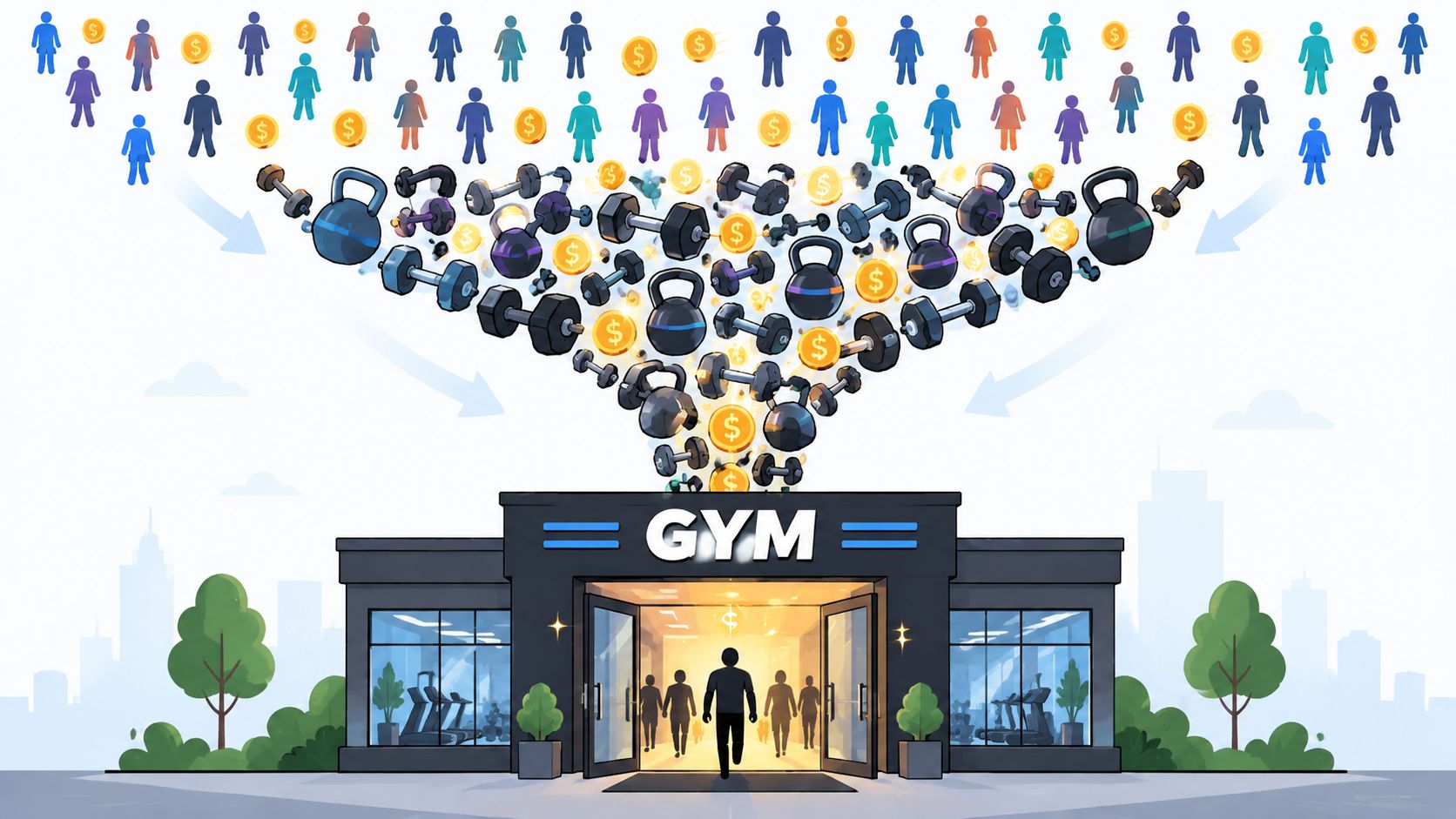
You know the feeling. The month closes, your gym is busy enough to look healthy, and your bank account tells a different story. You paid for boosted posts, printed flyers, maybe ran a local ad, maybe sponsored a community event. New leads came in, sort of. A few memberships sold, maybe. But when you ask the simplest question, which campaign produced paying members, nobody can answer it cleanly.
That's where a lot of gym owners get trapped. They aren't failing because they refuse to market. They're failing because they're buying activity instead of outcomes.
Direct response marketers approach the problem differently. They don't start with “let's get your name out there.” They start with “what specific action do we want, from whom, by when, and how will we track it?” For gyms, that shift matters because memberships are not abstract. A lead books a trial. A prospect redeems an offer. A former member returns. A no-show gets nudged back into the pipeline. Every one of those actions can be measured if the campaign is built correctly.
If you run a gym, studio, or training facility, direct response is one of the fastest ways to stop guessing and start making decisions from evidence. Done well, it gives you clearer offers, stronger follow-up, and a better grip on whether your marketing is creating revenue or just making noise.
Is Your Marketing a Black Hole for Money
A gym owner I've met in some form a hundred times usually says the same thing. “We're doing a lot, but I can't tell what's working.”
They post class clips on Instagram, pay a freelancer to make graphics, send a few emails when promotions feel urgent, and drop money on ads when membership dips. The front desk staff ask new members how they heard about the gym, but the answers are inconsistent. One person says Instagram. Another says Google. Another says a friend, even though the friend first saw an ad. By the end of the month, the owner has spent money in five places and still can't connect spend to sales.
That's not a discipline problem. It's a system problem.
A gym doesn't need more random exposure. It needs a campaign that asks for one clear action and tracks the path from first touch to signed agreement. If you're trying to tighten that process, these insights into marketing ROI for businesses can help frame the right questions before you spend another dollar. For a gym-specific breakdown, this guide on how to measure marketing ROI is useful when you want to connect campaigns to memberships instead of vanity reports.
What the black hole looks like
Most wasted gym marketing follows a familiar pattern:
- Too many offers: The ad mentions personal training, classes, recovery, nutrition coaching, and day passes all at once.
- No response path: A prospect clicks and lands on the home page instead of a focused page built to convert.
- Weak intake: Staff don't log source data consistently, so leads blur together.
- No follow-up rhythm: A prospect fills out a form and hears nothing until the next day, or not at all.
The money usually isn't disappearing. It's leaking through unclear offers, bad tracking, and slow follow-up.
What changes when you switch
Direct response changes the standard. Every campaign has one job. Book a consultation. Claim a trial. Rejoin with a win-back offer. That clarity makes it easier to judge performance and easier to improve what's underperforming.
For gym owners, that's relief. You stop asking whether marketing “feels busy” and start asking whether a specific campaign generated profitable member action.
The Two Worlds of Gym Marketing
There are two very different types of marketing at work in the fitness industry, and gym owners often hire one while expecting the other.
One builds recognition. The other drives response.
A brand marketer wants your gym to look polished, memorable, and credible over time. That has value. A strong brand can support pricing, referrals, and retention. But brand marketing often works on a long timeline, and the link between spend and membership sales is usually less direct.
A direct response marketer is built for immediate movement. Their question is simpler and sharper. What can we put in front of the right prospect today that gets them to take a measurable action now?

Brand marketer versus direct response marketer
The easiest way to understand the gap is to compare how each one thinks.
| Focus | Brand marketer | Direct response marketer |
|---|---|---|
| Primary goal | Shape perception over time | Trigger an immediate action |
| Typical message | “Here's who we are” | “Claim this offer now” |
| Common gym asset | Lifestyle video, polished social feed | Landing page, offer ad, follow-up sequence |
| Success signal | Reach, engagement, recall | Leads, appointments, sales |
| Time horizon | Longer-term | Immediate and testable |
A gym needs both eventually. But if memberships are soft and you need predictable acquisition, direct response usually deserves the first budget priority.
Why this matters more for gyms
Fitness is local, competitive, and full of hesitation. People compare commute times, price points, cleanliness, class times, and whether they'll feel comfortable walking in. A campaign that says “join our community” is often too vague to cut through.
Direct response marketing is built around prompting an immediate, measurable action. Postalytics reports that 84% of marketers agree direct mail delivers the highest ROI of any channel they use, and direct mail shows an open rate of 80 to 90% versus 20 to 30% for email according to Postalytics direct mail statistics. For gyms, that matters because local offers often perform better when the message is concrete and the next step is obvious.
What each one gets wrong
Brand-heavy gym marketing tends to fail when it becomes decorative. Nice photos. Clean logo. Zero urgency. No clear reason to act today.
Direct response campaigns fail when they become too aggressive and attract people who only want the cheapest possible deal. That's why good direct response marketers don't just chase leads. They shape the offer to attract the right kind of lead.
A gym owner shouldn't ask, “Do I need marketing?” The better question is, “Do I need awareness right now, or do I need booked appointments and memberships?”
If your goal is growth you can forecast, direct response is usually the operating system. Brand work supports it, but it doesn't replace it.
High-Impact Direct Response Tactics
Gym owners usually overcomplicate direct response. The mechanics are simpler than they look. A strong campaign needs four parts working together: an offer, a path, persuasive copy, and tracking.

Start with one offer
At this point, most campaigns break.
A core principle in direct response is sticking to one specific offer and a clear CTA to reduce ambiguity and improve tracking. Basis notes that campaigns work best when they ask a prospect to take a single action, and CTA optimization can include testing wording, color, and placement, as explained in this guide to direct response marketing from Basis.
For gyms, “one offer” means one. Not free trial plus free shirt plus class bundle plus nutrition intro. One offer with one next step.
Strong gym offers usually share three traits:
- They lower friction: A short trial, intro session, or limited challenge is easier to say yes to than a full membership decision.
- They show tangible value: “Two coaching sessions included” is stronger than a vague discount.
- They fit the buyer stage: Cold prospects need a lower-commitment ask than people already visiting your site repeatedly.
A weak gym offer says, “Join now and save.”
A stronger one says, “Claim your 7-day pass and book your first coaching session.”
Build a clean conversion path
The ad is not the campaign. The funnel is the campaign.
A direct response marketer will map a simple path:
- Ad or mail piece: one message, one promise
- Landing page: one offer, one form, one CTA
- Confirmation page: immediate next step, usually booking or calling
- Follow-up: email, text, phone call, or all three
If you need a practical walkthrough for that structure, this resource on building a gym funnel is a useful starting point.
A lot of gym operators send traffic to their homepage. That usually kills momentum. Homepages are built to explain everything. Direct response pages are built to get one thing done.
Write copy that sells the outcome
Fitness buyers don't care about your dumbbells, turf strip, or app integration until they believe your gym can help them change something in their life.
That means your copy should speak to the result and the obstacle.
- Result language: More energy, more confidence, better structure, consistent training
- Obstacle language: Intimidation, lack of time, old injuries, past failed attempts
- Specific fit: Busy parents, professionals, beginners, former members, new movers
Practical rule: Don't lead with equipment. Lead with the kind of member experience that solves a real problem.
Many agencies in fitness miss the mark. They recycle generic ad language that could fit a dentist, med spa, or real estate office. Good direct response marketers write like they understand why someone hesitates to join a gym in the first place.
Use creatives that stop and qualify
Your visuals need to do more than look polished. They should help the right prospect self-identify.
A few examples that usually outperform generic gym glamour shots:
- Beginner-focused photos: Real people who look approachable, not only elite physiques
- Coach-led video clips: A trainer explaining what happens on day one
- Offer-led graphics: Clean creative with the offer and deadline visible
- Environment shots: Bright, clean, uncrowded spaces reduce intimidation
If you want more context on lead generation for small businesses, especially around social channels and conversion thinking, that framework adapts well when you tailor it to a local gym audience. For a more fitness-specific companion piece, this article on direct response advertising connects the same logic to membership sales.
Track every click and call
None of this works if you can't trace response.
Track form submissions. Track booked appointments. Track calls from ads. Track show rates. Track which leads become paying members. Direct response marketers earn their keep by building a campaign you can diagnose. When a gym owner says, “The leads are cheap but nobody buys,” that's not the end of the conversation. That's the beginning of useful analysis.
The Only Metrics That Actually Matter
Gym owners get shown a lot of numbers that don't help them make decisions. Reach. Impressions. Likes. Video views. Those can be useful context, but they don't tell you whether your campaign is creating profitable members.
The numbers that matter are the ones tied to acquisition quality and revenue.

The scorecard a gym owner should read
Here's the short list I care about when evaluating gym campaigns:
| Metric | What it tells you | Why it matters |
|---|---|---|
| Cost per lead | What you paid to generate an inquiry | Shows traffic efficiency |
| Cost per acquisition | What you paid to get a paying member | Shows sales efficiency |
| Return on ad spend | Revenue tied to ad spend | Shows whether media is justified |
| Conversion rate | The share of prospects moving to the next step | Reveals funnel strength |
| Lifetime value | The long-term revenue value of a member | Keeps you from underinvesting in good leads |
How to use them without getting lost
A low cost per lead can be a bad sign if the leads are weak. A high cost per lead can be acceptable if those people buy and stay.
That's why cost per acquisition matters more than lead cost by itself. If your gym gets cheap leads who ghost after requesting a pass, you didn't buy efficiency. You bought admin work.
Lifetime value matters because gyms often make the wrong decision when they judge campaigns too early. A campaign that attracts serious members may look more expensive upfront than a bargain-heavy campaign, but the better-fit member usually creates more revenue over time and causes less churn pressure for the sales team.
If a marketer can't show the path from lead to member, they're reporting activity, not performance.
The focus on accountable results is why direct response keeps its place in performance marketing. Postalytics data cited by Perion indicates the average ROI of direct campaigns is 35%, and the same report cites direct mail ROI at 112%, ahead of SMS at 102% and email at 93%, as summarized in Perion's overview of direct response marketing ROI.
Questions to ask when reading a report
When a marketer sends your monthly recap, ask these instead of “How did it do?”
- Which offer produced actual members?
- Where are leads dropping off most often?
- What happened after form fill, before sale?
- Did one audience produce stronger buyers than another?
- What are we testing next?
If you want a broader framework for measuring marketing ROI, it can help sharpen how you evaluate campaign effectiveness beyond surface metrics.
Good direct response marketers welcome those questions. Weak ones hide behind dashboards full of color and no accountability.
Putting Direct Response to Work in Your Gym
Theory matters less than execution. If you want this to work in a gym, you need two things: the right operator and the right campaign structure.

Hiring and briefing checklist
A direct response marketer for a gym should be able to do more than launch ads. They need to understand offers, intake, sales handoff, and lead quality.
Use this checklist when interviewing:
- Ask how they define success: If they talk mostly about engagement, brand lift, or awareness, keep digging.
- Ask what they need access to: They should want your CRM, lead tracking process, landing pages, and sales follow-up flow.
- Ask how they handle weak lead quality: A serious operator will talk about offer design, targeting, qualification, and follow-up, not just “getting more traffic.”
- Ask what happens after the click: If they only handle ads and ignore the landing page and sales process, expect leaks.
- Ask for reporting examples: You want reports tied to leads, appointments, sales, and campaign decisions.
Red flags show up fast. Watch out for people who promise instant scale, can't explain attribution in plain language, or insist every gym should run the same offer.
One practical tool in the mix can be a niche resource like Gym Membership Tips, which organizes sales and membership tactics in a gym-specific format. It won't replace a marketer, but it can help owners brief one more effectively.
Three gym campaign templates
The best gym campaigns are simple enough to launch quickly and specific enough to attract the right person.
New mover campaign
Target people who recently relocated into your area. They're actively rebuilding routines.
- Offer: Intro pass plus a guided first visit
- Audience angle: New neighborhood, new schedule, new gym
- Copy direction: Remove friction. Stress convenience, support, and a clear starting point.
This campaign works because it meets people during a routine reset, when they're open to new habits.
Seven-day challenge funnel
This is still one of the cleanest entry offers for many facilities when it's handled well.
- Offer: Short challenge with coaching or accountability built in
- Audience angle: People who want structure, not just access
- Copy direction: Focus on momentum, support, and a first win
The trap is making it too cheap and too broad. It's critical to balance aggressive acquisition with lead quality, especially for a high-consideration service like a gym membership. The Small Business Expo notes that direct response works best when the offer is strong, relevant, and matched to the right audience, a useful lens when building direct response campaigns for marketing success.
Win-back offer
Former members are often your easiest revenue opportunity if they left for timing reasons instead of serious dissatisfaction.
- Offer: Return incentive tied to a fresh restart
- Audience angle: Familiar place, easier comeback, no awkward re-entry
- Copy direction: Respectful, low-pressure, action-oriented
This one performs best when your staff follows up personally. A text or email alone rarely does the full job.
What works and what doesn't
What works in gyms:
- A narrow audience
- A single offer
- Fast follow-up
- Sales scripts that match the ad promise
- Clean facilities that support the first impression
What usually fails:
- Discounts with no positioning
- Generic “join now” ads
- Homepage traffic instead of offer pages
- Leads sitting untouched overnight
- Campaigns that attract deal-seekers the gym can't retain
The marketer matters. The offer matters more. The follow-up often matters most.
Your Next Action Step for Gym Growth
The biggest shift is this. Stop treating marketing like overhead and start treating it like an investment that has to justify itself.
That doesn't mean every campaign must produce immediate perfection. It means every campaign should have a clear offer, a defined audience, a tracked response path, and a real decision point at the end. Keep it simple. One offer. One landing page. One follow-up process. One weekly review of leads, appointments, and memberships sold.
If you only do one thing this week, audit your current campaigns and answer three questions:
- What action is each campaign asking for
- Where is that action being tracked
- How many paying members came from it
If you can't answer those cleanly, start there before spending another dollar.
One more point gym owners shouldn't ignore is hygiene. Cleanliness affects tours, retention, and trust. Wipe down cardio equipment, free weights, benches, handles, touchscreens, locker room touchpoints, and front desk surfaces on a consistent schedule. Members notice clean equipment immediately, and they also notice when sanitation feels sloppy. For commercial fitness spaces that want a straightforward supply option, consider Wipes.com Disinfectant Wipes.
A gym grows faster when its marketing is accountable, its offers are specific, and its environment feels safe and well-run. Direct response gets you the first two. Daily sanitizing habits protect the third.
Leave a Reply