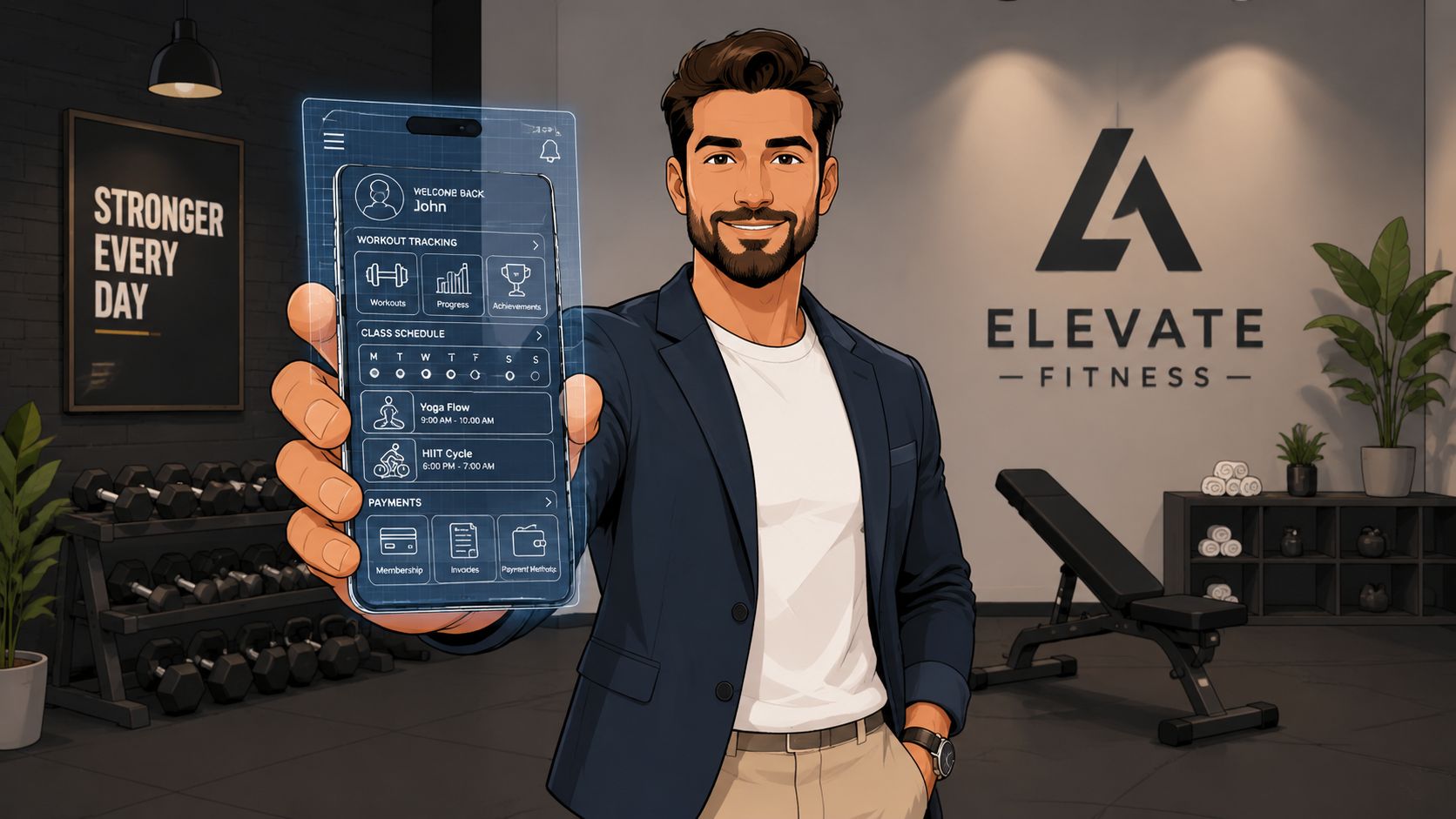
You can see the problem on your gym floor every day. A member finishes a session, sits on a bench, and opens Apple Notes, MyFitnessPal, Strava, or some generic workout app to record the work they just did in your facility. They're building a habit, but they're building it somewhere you don't control.
That doesn't mean you've lost them. It means the opportunity is obvious.
A gym app used to feel optional, like a nice extra for bigger chains. That window has closed. The digital fitness category is already mainstream, with 345 million people using fitness apps, 850 million downloads recorded worldwide, and $3.98 billion in revenue in 2024, up 11.1% from the prior year, according to Business of Apps fitness app market data. The same source notes that Statista projects $9.22 billion in fitness app revenue in 2026.
If you run a gym, studio, or training business, the central question isn't whether members want digital support. They already do. The question is whether your business will own any of that relationship.
Your Gym Needs Its Own App Yesterday
A lot of owners still think about an app as software. Members don't. They experience it as convenience.
They want to book a class without calling the front desk. They want their workout plan on their phone. They want a reminder when they haven't shown up in a few days. They want proof they're making progress. If your gym doesn't provide that layer, another app will.
What happens when you rely on generic apps
Generic apps solve the member's problem, but not yours. They don't strengthen your brand, deepen your coaching relationship, or create a direct channel for upsells and retention campaigns.
They also train members to separate your facility from their fitness habit. Your gym becomes the place with equipment. The third-party app becomes the place where motivation, tracking, and progress live.
Your strongest retention tool is usually not the treadmill, the rack, or the group room. It's the system that keeps your member engaged between visits.
That's why a branded fitness app creator matters. Not because it's trendy, but because it gives you a way to stay present when the member is at home, at work, traveling, or thinking about canceling.
The business upside is bigger than convenience
The market data matters because it confirms this isn't niche behavior anymore. Fitness apps have become mass-market consumer software, not a fringe wellness category. Business of Apps also notes that MyFitnessPal helped define the category early by combining food logging, workout tracking, and user-generated entries. That matters for gym owners because it shows what users already expect from digital fitness products: tracking, personalization, and daily habit support.
A good gym app does three things at once:
- Protects retention: It gives members reasons to interact with your brand on days they don't visit.
- Builds community: It creates digital touchpoints through challenges, messages, and class participation.
- Creates revenue options: It gives you somewhere to sell coaching, premium plans, and digital services.
Most articles about a fitness app creator stop at features and development stacks. That's backward for a gym owner. The app only matters if it keeps members longer, increases average revenue per member, or reduces operational friction.
Blueprint Your App's Core Business Goals
The first mistake I see is owners starting with features. They ask for class booking, on-demand workouts, messaging, nutrition tracking, progress photos, wearable sync, push notifications, and challenges before they've decided what the app is supposed to fix.
That approach burns budget fast.

Start with one primary business problem
Your app should have a main job. Not six.
For most gyms, the primary goal falls into one of these buckets:
Retention
You want members to stay active between visits, stay accountable, and feel connected to your coaching.
New revenue
You want to sell digital coaching, hybrid memberships, nutrition plans, or premium content.
Operational efficiency
You want fewer calls, fewer manual booking issues, cleaner communication, and less front-desk admin.
Community growth
You want members interacting with each other, joining events, and identifying more strongly with your brand.
If you try to pursue all four equally on day one, the product usually becomes cluttered. Users feel that clutter immediately.
Pick KPIs before you pick screens
A gym owner doesn't need to think like a developer, but you do need to think like an operator. Every major feature should tie back to a measurable outcome.
A simple planning exercise looks like this:
| Business goal | Useful KPI | Feature implications |
|---|---|---|
| Retention | Visit frequency, app activity, class attendance | Push reminders, workout plans, progress tracking |
| Revenue | Paid upgrades, coaching purchases, digital plan sales | Checkout flow, subscription access, member offers |
| Operations | Booking completion, support requests, staff workload | Schedules, self-service account actions, notifications |
| Community | Challenge participation, message engagement, event signups | Leaderboards, groups, announcements |
You don't need a giant product strategy deck. You need clarity. If your biggest pain point is churn after the first few months, your app should focus on habit formation and accountability. If your issue is unused trainer capacity, your app should make coaching easy to buy and deliver.
Practical rule: If a feature doesn't connect to retention, revenue, or workload reduction, push it out of version one.
Match the app to your business model
A boutique studio, a strength gym, and a multi-location health club shouldn't build the same app. The model has to fit the business.
Consider these examples:
- Boutique class studio: Lead with booking, waitlists, reminders, instructor follow-up, and social energy.
- Personal training gym: Lead with programs, check-ins, habit tracking, messaging, and premium coaching offers.
- Large membership facility: Lead with self-service convenience, schedules, account tools, and segmented communication.
That's why I often point owners to frameworks like Refact for building online products. Not because you need to become a product manager, but because the discipline of defining users, problems, and scope saves money.
Decide what success looks like before launch
An app can look polished and still fail. If members download it once and ignore it, you've built a brochure, not a retention engine.
Before development starts, write down:
- Who the app is for: New members, current members, premium clients, or all of the above.
- What behavior you want: More bookings, more check-ins, more coaching purchases, or better attendance consistency.
- What you won't build yet: Anything attractive but nonessential.
- What your staff will do: Promote downloads, answer questions, and reinforce usage in person.
That discipline keeps the fitness app creator process grounded in business outcomes instead of feature envy.
Define Your Minimum Viable Feature Set
Once your business goal is clear, feature decisions get easier. The right question is no longer “What can we add?” It becomes “What does the member need in order to get value quickly, and what does the business need in order to see results?”
That's your MVP.
Your MVP needs to earn its place
For most gyms, the first release should solve a few jobs very well. It should not try to imitate every major fitness platform on the market.
A sensible MVP usually includes:
- Member account access: Basic login, profile, membership status, and settings.
- Class schedules and booking: Easy discovery, reservations, and confirmations.
- Workout or program delivery: A place for members to see assigned training or session structure.
- Progress visibility: Simple history, completed sessions, and signs of momentum.
- Push communication: Alerts for classes, reminders, and important updates.
- Basic payments or upgrade access: If you plan to monetize from the app, don't bolt checkout on later.
If your gym relies heavily on coaching, in-app messaging often belongs in the MVP too. If your gym is class-heavy, booking and reminders matter more than advanced tracking.
Nice-to-have features usually arrive too early
Owners often get excited about wearables, AI recommendations, meal plans, leaderboards, video libraries, and complex challenges. Some of those will absolutely help later. Most don't belong in the first release.
Features to delay unless they directly support your primary goal:
- Large on-demand content libraries
- Deep social feeds
- Advanced analytics dashboards
- Complex device integrations
- Multiple premium tiers
- Custom nutrition engines
Those features add build time, testing overhead, and user complexity. They also create more ways for the launch to go sideways.
A lean product with one clear habit loop beats a bloated app that tries to impress everyone.
Accessibility is not a side topic
One of the biggest openings I see in the fitness app creator space is accessibility. Build guides often miss seniors, people with disabilities, and members who need adaptive programming. That's short-sighted. As noted in Lovable's guide on how to build a fitness app, designing for limited mobility, sensory needs, or adaptive workouts at launch can be a strong differentiator.
That doesn't mean your MVP needs every accessibility feature imaginable. It means your first release should avoid excluding people by design.
A practical accessibility-first checklist includes:
- Readable text and clear contrast: Don't force members to squint through tiny labels.
- Simple navigation: Fewer taps, obvious buttons, and predictable flows.
- Exercise alternatives: Offer seated, low-impact, or limited-mobility options where relevant.
- Instruction clarity: Use plain language and straightforward visual cues.
- Audio and visual flexibility: Don't assume every user interacts the same way.
For many gyms, this isn't just inclusive design. It's business strategy. If you serve older adults, rehab-adjacent populations, or general population members who feel intimidated by hardcore fitness apps, accessibility can become a competitive edge.
A simple way to prioritize features
I use a three-tier filter with clients.
MVP features
These directly support the main business goal and are required for launch.
Examples include booking, account access, assigned workouts, reminders, and payment basics.
Growth features
These improve engagement after the core experience is proven.
Examples include challenges, habit streaks, segmented messaging, referral prompts, and trainer chat.
Scale features
These are worth building when usage patterns justify them.
Examples include wearable integrations, deeper automation, premium content bundles, and advanced personalization.
If a feature can't clearly fit one of those tiers, it probably doesn't belong on the roadmap yet.
Choose Your Build Path Vendor Or Custom
To save themselves a lot of pain, gym owners should know: You do not need a custom app just because custom sounds impressive. You also should not choose a vendor platform just because the demo looked easy.
The right answer depends on control, speed, budget tolerance, and how unique your operating model really is.
Vendor platforms win on speed and simplicity
A vendor or no-code fitness app creator usually makes sense if you want to launch quickly and your needs are common. Most gyms don't need to invent a new digital behavior. They need solid execution around booking, communication, workouts, payments, and branding.
Vendor platforms work best when you want:
- A faster launch
- Lower upfront complexity
- Built-in support and updates
- Standard fitness business workflows
- Less technical management on your side
The trade-off is dependency. You'll be working inside someone else's framework. If the platform limits a feature, changes pricing, or restricts integrations, you'll feel it.
Custom development wins on control
Custom development makes sense when your gym has a distinct model that off-the-shelf tools can't support cleanly. That might mean a hybrid coaching product, a unique assessment process, a strong multi-location brand strategy, or a plan to turn the app into a major standalone revenue line.
Custom is stronger when you need:
- Customized workflows
- Unique member experiences
- Tighter integration control
- Long-term product ownership
- Freedom to evolve without vendor limits
The price of that freedom is effort. Custom builds require sharper decisions, more testing, more project management, and usually more patience. You also own more of the maintenance burden after launch.
Vendor and custom side by side
| Factor | Vendor / No-Code Platform | Custom Development |
|---|---|---|
| Speed to launch | Faster if your workflows are standard | Slower because everything is specified and built |
| Upfront cost | Usually easier to absorb | Usually higher and less forgiving of scope changes |
| Customization | Limited to platform rules | High control over flows and branding |
| Integrations | Good if your required tools are supported | Better if you need unusual or deeper integrations |
| Maintenance | Vendor handles much of it | Your team or agency handles it |
| Scalability | Fine for many gyms, but platform constraints can appear later | Stronger if digital becomes a strategic growth channel |
| Ownership | You operate on rented rails | You own the product logic and roadmap |
The real-world decision test
Ask yourself four blunt questions:
- Are your needs unique, or do you just want a nicer interface?
- Can your team support a longer project with more moving parts?
- Will the app become central to your revenue strategy?
- Can a vendor handle your core integrations cleanly?
If most of your pain points revolve around bookings, communication, coaching delivery, and retention, vendor software may be enough. If you're trying to build a differentiated digital product tied tightly to your sales and operations systems, custom starts to make more sense.
A lot of owners also benefit from reviewing adjacent software decisions first. If your internal systems are still messy, it helps to sort that out before you layer on an app. This guide to membership software for gyms is a useful starting point for that audit.
Execute The Build And Integration Roadmap
Once you've chosen your path, the project becomes operational. Good ideas often get derailed by bad sequencing during this phase. Owners approve mockups, get excited, and then discover too late that booking doesn't sync properly, payments break, or staff have no launch plan.
The build has to follow a usable order.

Build around critical member journeys
Don't organize the project around departments. Organize it around member actions.
Your first journeys should usually be:
- Sign up and onboarding
- Browse and book
- View a plan or workout
- Receive reminders and updates
- Buy or upgrade
- Get help or contact staff
If those flows work smoothly, members will forgive a lot. If they don't, no amount of visual polish will save the app.
Integration work decides whether the app feels real
Your app shouldn't operate as a disconnected extra. It needs to talk to the systems that already run your gym.
That usually includes:
- Gym management software: For membership validation, scheduling, attendance, and account status
- Payment processing: For subscriptions, upgrades, and one-off purchases
- CRM or communication tools: For member messaging and automation
- Content or coaching systems: If you deliver workouts, plans, or digital programs
I'd also review your CRM readiness before launch. If your follow-up workflows are weak, the app won't fix that by itself. This overview of gym CRM software helps owners evaluate that side of the stack.
Launch small, but measure hard
A successful launch focuses on an MVP that gets onboarding and early retention right. According to OpenArc's fitness app launch guide, top fitness apps see Day-1 retention around 30 to 35%, and tracking that metric along with session frequency from the start is critical.
That matters because many gym owners launch an app as if launch day is the finish line. It isn't. Launch day is when you start learning whether members return after the first use.
If members don't complete onboarding, book quickly, or find their next action within minutes, your app has a product problem, not a marketing problem.
A good early measurement set includes:
- Day-1 retention
- Day-7 retention
- Session frequency
- Booking completion
- Workout completion or content views
- Upgrade or purchase actions
If you need a broader product thinking reference, this roadmap for product managers creating apps gives a useful high-level framework for sequencing product work.
Keep your timeline honest
Vendor launches are usually shorter because the infrastructure already exists. Custom projects take longer because every requirement, edge case, and integration has to be defined and tested more thoroughly.
What matters more than calendar promises is scope discipline. Most delays come from late feature additions, unclear approval ownership, and underestimating integration work.
The cleanest projects typically have:
- One decision-maker on the gym side
- A locked MVP scope
- A test group of real members
- Staff training before release
- A post-launch iteration plan
That's what separates a workable app from a gym owner saying six months later, “We have an app, but nobody really uses it.”
Design Your App Monetization Strategy
A gym app doesn't need to be a direct profit center on day one. In many cases, its first job is retention. But if you ignore monetization entirely, you'll miss one of the strongest reasons to invest in a digital channel.
The key is to choose a model that fits your business instead of copying a consumer app playbook that doesn't match how your members buy.

Know the economics before you scale
Monetization in fitness can be attractive, but it punishes sloppy math. According to Financial Model Lab's KPI framework for personal fitness apps, fitness apps monetize about 2x better than other categories. The same source points to benchmarks such as customer acquisition costs starting around $30, trial-to-paid conversion above 15%, and contribution margin near 80%.
Those numbers don't mean every gym app will hit those benchmarks. They do mean the category can support real revenue if acquisition, conversion, and retention work together.
Pick a monetization model that feels natural
For gyms, these are the most practical models.
Included with membership
This works well when retention is the main objective. The app becomes part of the membership value, not a separate sale.
Best for gyms that want stronger engagement, simpler adoption, and better member experience.
Tiered membership access
This is strong when you already sell multiple plans. Standard members get basics. Premium members get coaching, programs, or extra digital content.
That setup supports upsells without making the app itself feel paywalled.
Freemium or premium add-ons
This works if you want broad access but still want paid digital offers inside the app.
Good premium items include:
- Personalized coaching
- Nutrition guidance
- Specialized programs
- Habit accountability packages
- Small-group digital challenges
One-off purchases
Useful for short programs, challenges, workshops, and seasonal offers.
This model is easier to test than a complex subscription strategy because members can buy one clear outcome.
What usually doesn't work for gyms
Advertising inside a member-facing gym app often weakens the experience. It can make your product feel cheap and distract from the brand trust you're trying to build.
Overcomplicated pricing also hurts conversion. If members need a chart to understand what they get, you've already made the sale harder.
Sell outcomes, not feature lists. “Get a custom training plan with weekly accountability” converts better than “Unlock premium app tier three.”
The best monetization plan is usually staged. Start with retention value. Add one premium offer. Then expand based on what members buy and use.
Drive Adoption And Grow Your Digital Community
Most gym apps fail for a simple reason. The owner assumes members will download and use the app because it exists.
They won't. Staff has to sell the habit.
Make adoption part of the member journey
If the app matters, it has to show up in your daily operation.
Use a simple rollout checklist:
- At the front desk: Staff should ask every new member to download it during signup.
- On the gym floor: Trainers should reference it during sessions, not just mention it once.
- In class areas: Put QR codes where members wait, stretch, or check schedules.
- In email and SMS: Send a clear reason to install, not a vague announcement.
- On social media: Show one useful action at a time, such as booking, tracking, or joining a challenge.
For many gyms, a challenge is the easiest habit starter. It gives members a reason to open the app again tomorrow.
Train your staff before you market to members
A member asks, “What do I use the app for?” Your team should answer in one sentence.
Bad answer: “It does a lot of things.”
Good answer: “Use it to book classes, follow your program, and stay accountable between visits.”
That clarity matters more than a long feature tour. The same principle applies to post-launch communication and community growth. If you're trying to build stronger interaction around your brand, this guide on creating an online fitness community is worth reviewing.
Watch payment and platform changes closely
If you sell digital services inside the app, platform rules can affect margins and purchase flow. Owners who plan to charge through the app should keep up with policy shifts, especially on iOS. A practical reference is this guide to Apple's payment changes for apps, which helps frame the implications for subscriptions and in-app purchases.
Keep the physical gym as strong as the digital one
A clean app experience matters. So does a clean facility.
Members notice the small things: sweaty benches, smudged touchscreens, sticky cardio handles, dirty locker hardware. Your digital brand and your physical environment reinforce each other. If you're asking members to trust your coaching, your space has to feel cared for.
Build sanitizing into the daily routine:
- Wipe high-touch surfaces frequently: Cardio consoles, door handles, benches, free weights, and check-in counters.
- Stock visible cleaning stations: Members use them more when they're easy to find.
- Assign shift ownership: Don't leave cleanliness to whoever remembers.
- Refresh soft-touch areas: Stretch mats, shared accessories, and mobility tools need attention too.
For a simple, reliable option, consider Wipes.com Disinfectant Wipes to help keep your facility clean and member-ready.
A fitness app creator isn't really about building an app. It's about building a stronger member relationship that survives outside your walls.
If you keep the project tied to retention, community, and revenue, you'll make better decisions at every stage. Start with one business goal. Launch a tight MVP. Integrate it with the systems you already use. Train staff to drive adoption. Then improve the product based on real member behavior.
If you want more practical gym growth strategies beyond app planning, browse the resources at Gym Membership Tips.
Leave a Reply