You’re probably in a spot I’ve seen a hundred times.
You coach hard. Your sessions are solid. Clients like you. They sweat, they improve, and they tell you you’re the best trainer they’ve had. But your calendar still has holes in it, your income keeps stalling, and the trainers who seem less skilled somehow stay busier than you.
That gap isn’t usually about talent. It’s about effective strategies.
The trainers who grow fastest don’t just learn how to coach a squat, fix a deadlift, or cue better breathing. They learn how to explain value, keep clients engaged, build trust, package outcomes, and turn knowledge into a sale that feels justified to the client. That’s where the right books for personal trainers become a business tool, not just “professional development.”
I’ve hired trainers who could program circles around everybody else and still struggled to keep a full roster. I’ve also hired trainers who read constantly, spoke with authority, handled objections calmly, and turned average consultations into long-term members. Guess which group made the gym more money.
Reading won’t save a weak trainer. But it will sharpen a good one into a profitable one.
A strong reading habit gives you three things fast:
- Better authority when a client asks why your plan is different
- Better retention because your coaching gets more precise and more personal
- Better sales because you can connect training methods to outcomes people want to buy
A trainer who only knows exercises is replaceable. A trainer who can produce results, explain results, and sell results becomes hard to ignore.
If you want a random stack of “good fitness books,” this isn’t that. I’m giving you a working shelf. Every title below needs to help you do one of three jobs better: coach better, sell better, or keep clients longer.
That’s the standard.
Your Talent Is Not Enough
I once had a young trainer on staff who looked like a future star.
He was early to every shift. He wrote clean programs. He coached movement well. Clients respected him. On paper, he had everything you’d want. Three months later, he was frustrated because he still hadn’t built a full book of business.
His problem wasn’t coaching. His problem was that he treated training like a craft only, not a business.
He thought results would sell themselves. They don’t. Clients need to understand what they’re buying, why your method matters, and why they should stay with you when motivation dips. If you can’t communicate that, somebody with half your technical skill and twice your confidence will take the sale.
That’s why I push books for personal trainers so hard with every new hire. Reading is one of the cheapest ways to increase your value to the gym. It helps you speak with more authority on the floor, run better assessments, build better packages, and stop sounding like every other trainer giving generic advice.
What stalled trainers usually miss
Most trainers hit a ceiling for one of these reasons:
- They rely on workouts alone. Great sessions matter, but sessions aren’t a sales system.
- They can’t explain their method. If a client can’t see the difference between your package and random workouts online, your pricing will feel expensive.
- They coach the body but ignore behavior. Clients quit because life gets messy, not because they suddenly stopped believing in exercise.
A trainer with empty slots usually needs more than hustle. They need better inputs.
Reading creates revenue when you apply it
The best books do more than make you sound smart. They give you assets you can use immediately:
| What you learn | What it helps you do in the gym |
|---|---|
| Better exercise science | Build programs that feel specific and premium |
| Better business strategy | Convert consultations into paid packages |
| Better behavior coaching | Keep clients from drifting out after the first block |
That’s the shift. Stop thinking of reading as homework. Start treating it like sales training, retention training, and career insurance.
Clients don’t pay premium rates because you read a book. They pay premium rates because the book helped you coach and communicate at a higher level.
Building Your Three-Pillar Fitness Library
A weak library makes a weak trainer.
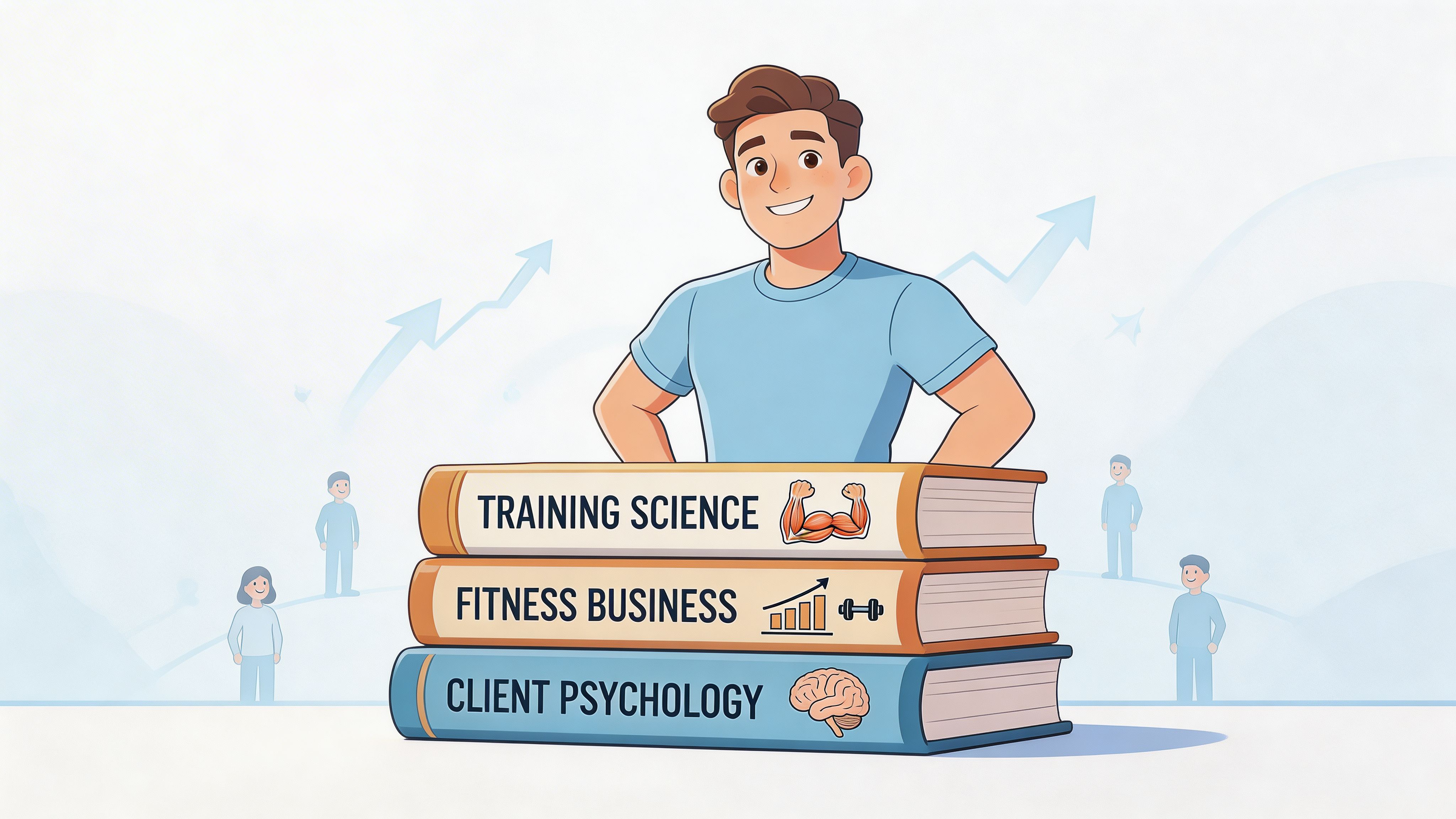
Not because the trainer is lazy, but because random reading creates random skills. If you want books for personal trainers that move your career forward, build your shelf around three pillars.

Science gives you authority
This is your technical base.
You need books that teach exercise science, biomechanics, programming, assessment, and adaptation. This is what lets you build sessions that aren’t just hard, but appropriate. It’s also what gives you the confidence to answer client questions without fumbling.
A trainer who understands performance science can justify program choices. That matters in consultations and reassessments.
Business fills the calendar
A lot of trainers avoid this pillar because they think sales is dirty. That mindset keeps people broke.
Business books for personal trainers teach packaging, pricing, lead handling, follow-up, and client acquisition. If you don’t study this side of the job, you’ll spend years waiting for referrals instead of building a system that produces clients consistently.
Here’s the blunt truth: gyms don’t just need knowledgeable trainers. They need trainers who can turn interest into paid sessions.
Psychology keeps clients paying
Most client problems aren’t knowledge problems.
They know they should train. They know they should eat better. They know sleep matters. The issue is consistency, identity, confidence, stress, and habit friction. If you can coach behavior, you keep clients longer. If you only coach sets and reps, you lose people when life gets busy.
How the pillars work together
Each pillar covers a different weakness.
- Science without business creates smart trainers with empty schedules.
- Business without science creates slick talkers who struggle to deliver.
- Psychology without either creates supportive coaches with no clear system.
The best trainers blend all three. They can explain why a plan works, sell it clearly, and help a client stick to it long enough to get results.
Build your shelf with intention
Use this rule when choosing your next read:
| Pillar | Best use | Warning sign you need it |
|---|---|---|
| Science | Better programs and assessments | You struggle to explain the “why” behind your plan |
| Business | Better consultations and offers | You’re good on the floor but bad at closing |
| Psychology | Better retention and adherence | Clients start strong, then disappear |
Practical rule: If your client roster is thin, read business first. If your roster is unstable, read psychology next. If your coaching feels generic, go deeper into science.
Master the Science of Human Performance
A new client sits across from you and asks a simple question: “Why is this program better than what I can get from YouTube?” Your answer decides whether they buy 12 sessions or walk.
Science gives you the answer. Beyond that, it gives you a service you can charge more for.

Start with NASM for broad competence
The National Academy of Sports Medicine’s Essentials of Personal Fitness Training, now in its 7th edition, earns its spot because it covers program design, assessments, nutrition, and coaching structure in one system (hevycoach.com).
That matters on the gym floor.
A trainer with a clear system sells more easily than a trainer who improvises. Clients notice the difference fast. If your intake feels organized, your assessment has a purpose, and your program follows a progression model, people trust you sooner and argue less about price.
Use NASM to tighten your first 30 days with every client:
- Assessment first: Review movement, injury history, goals, and training background.
- Clear phase plan: Show the client where they are starting and what the next phase looks like.
- Scheduled reassessment: Put the next review on the calendar before the first package ends.
That process improves close rate and renewals because the client can see a path, not just a workout.
If you’re still choosing credentials, this guide on personal trainer certification requirements helps connect certification decisions to hiring options and client trust.
Use NSCA when you want stronger performance authority
Essentials of Strength Training and Conditioning is the book for trainers who want sharper programming and stronger authority with serious clients.
Read it and your coaching language improves. You explain load selection, testing, adaptation, and progression with precision. That changes sales conversations. Athletes, experienced lifters, and high-intent general population clients pay more when they believe you can take them further than the average floor trainer.
The business move is straightforward. Build a premium strength service around measurable outcomes.
Profit play from NSCA
Sell a higher-ticket package built on:
- Baseline performance testing
- Planned training blocks
- Regular progress reviews
- A clear upgrade into advanced coaching
That package works because it gives ambitious clients what they want. Proof that your coaching has structure and that their progress will be tracked.
Read Schoenfeld if you want a profitable specialization
Brad Schoenfeld’s Science and Development of Muscle Hypertrophy (2nd Edition) helps you turn “I do personal training” into “I run a muscle-building service with a defined method.” Human Kinetics notes that training at 70-85% of 1RM can produce 10-20% greater fiber growth than lighter loads (Human Kinetics).
That gives you sales language that clients understand.
You can tell a prospect, “Your program uses loading ranges chosen for hypertrophy, not random fatigue.” That sounds sharper because it is sharper. Specialization makes your offer easier to explain, easier to market, and easier to price above general sessions.
If you want a practical companion resource, Strive Workout Log has 10 science-backed ways to build muscle faster that pair well with a hypertrophy-focused service menu.
Profit play from Schoenfeld
Create a 12-week Hypertrophy Specialization package.
| Package element | Why the client values it |
|---|---|
| Goal-specific intake | Feels custom from day one |
| Targeted loading plan | Shows that your method is evidence-based |
| Weekly progression review | Builds accountability and buy-in |
| Progress photos and measurements | Makes results visible and easier to celebrate |
Sell science in plain English. Clients do not buy technical jargon. They buy confidence, a clear method, and a plan that sounds worth paying for.
That is why science books matter. They help you coach better, yes. They also help you close consults, justify premium pricing, and keep good clients longer because your service feels deliberate instead of generic.
Ignite Your Business and Fill Your Schedule
If you only read one business book early in your career, make it Ignite the Fire.
Too many trainers spend years trying to earn more with better workouts when the primary bottleneck is poor business skill. You don’t need more random motivation. You need a better offer, a cleaner consultation, and follow-up that doesn’t sound awkward.

Why Ignite the Fire belongs on your shelf
Jonathan Goodman’s Ignite the Fire, first published in 2012, has sold over 50,000 copies and is credited with helping trainers increase earnings by 50-100% through real-world case studies on client acquisition and pricing (Insurance Canopy).
That’s why I call it a business manual, not just a “good read.”
It pushes trainers to stop hiding behind programming and start building a career with intention. Pricing, lead handling, communication, positioning, and referrals all matter. Trainers who ignore that reality usually blame the market when they should be fixing their process.
Your income follows your sales process
A busy trainer usually does a few things well, even if they don’t realize it:
- They ask better questions in consultations.
- They prescribe a package, not just sessions.
- They follow up quickly when a lead goes cold.
- They frame training as a solution, not a commodity.
That’s where this book delivers. It gives you a way to think like an operator instead of an employee waiting for walk-ins.
If your sales conversations feel messy, use tools that tighten the front end. These personal trainer inquiry templates are useful for handling inbound leads without sounding robotic.
Profit play from Goodman
I’d have a new trainer apply the book this way for the next month:
- Rewrite your consultation flow so it starts with goals, barriers, and urgency.
- Present three package paths instead of one-off session pricing.
- Create a follow-up script for every no-sale consultation.
- Ask every active client for one introduction after a visible win.
That’s simple. It also works.
For a deeper breakdown of packaging and conversion tactics, read how to sell personal training.
The trainer who can close ethically will always out-earn the trainer who waits to be discovered.
Stop acting like sales and coaching are separate jobs
They’re not.
A strong sales process is just good coaching earlier in the relationship. You listen well, identify the underlying problem, explain the path forward, and give the client a reason to commit now. Trainers who understand that stop feeling sleazy and start feeling useful.
That’s what good business books for personal trainers should do. They should make you more effective before the first session ever begins.
Unlock the Psychology of Client Retention
A client signs up in January, trains hard for three weeks, misses one session, feels behind, and starts dodging messages. That client does not need a fancier split. That client needs a coach who knows how to keep momentum alive before guilt turns into cancellation.
The trainers who build full books of business understand this early. Programming gets results. Psychology keeps people paying long enough to see them.

Good coaching keeps clients from drifting out
Clients rarely leave because one workout was bad. They leave because life got messy, motivation dropped, and nobody helped them recover quickly. A trainer who can spot that slide and respond well will hold more clients than the trainer who just writes better sets and reps.
That skill pays.
Better retention means more renewals, more referrals, and more chances to move a client from basic sessions into higher-touch coaching. If you want a trainer to become a profitable asset to the gym, teach them how to coach behavior, not just exercise.
Two psychology reads I put in trainers’ hands
Atomic Habits
This book is useful because it gives trainers a simple way to coach consistency.
Use it to lower friction. Help the client set a training time they can protect. Help them build a pre-session routine. Help them win small enough that missing one workout does not turn into missing three weeks. Trainers who apply this well create adherence, and adherence is what makes package renewals easier to ask for.
Motivational Interviewing in Nutrition and Fitness
This book fixes a common problem in newer coaches. They talk too much, solve too fast, and push advice before the client is ready to act.
Motivational interviewing teaches restraint. You ask better questions, get the client to say what matters to them, and reduce pushback. That changes the relationship fast. Clients feel heard, which makes them more honest in check-ins and more likely to stay engaged when progress slows.
Profit play from psychology books
Use what you read in ways that show up on the retention report.
- End every session with one clear commitment for the next 48 hours. Short-term wins keep clients engaged.
- Run check-ins around obstacles, not guilt. Shame kills reply rates and attendance.
- Praise follow-through, not just pounds lost or PRs hit. Process keeps people in the game.
- Adjust quickly when compliance drops. Busy adults do not need punishment. They need a workable plan.
- Document behavior patterns in client notes. That makes your follow-up sharper and your service feel personal.
If you need more systems around this, these gym member retention strategies will help you support clients between sessions, where a lot of cancellations start.
A client who feels understood will stay through a rough month. A client who feels judged will start price shopping.
Soft skills produce hard revenue
Psychology is not a bonus skill for trainers. It is a retention skill, a sales skill, and a lifetime value skill.
A trainer who can keep a client consistent for six months is more valuable to a gym than a trainer who impresses everyone in the first session and loses them in week five. That is why this category belongs in your library. The right books help you keep clients longer, improve upsell timing, and turn short-term buyers into long-term revenue.
Your Action Plan for Reading and Revenue
Don’t buy five books and let them sit in your backpack.
Read with a deadline. Apply one lesson every week. Track what changed in your consultations, your coaching, and your client renewals. That’s how books for personal trainers turn into money.
A simple 90-day reading plan
Use one book from each pillar.
| Days | Focus | Action on the gym floor |
|---|---|---|
| 1 to 30 | NASM Essentials of Personal Fitness Training | Improve assessments and program structure |
| 31 to 60 | Ignite the Fire | Tighten consultations, pricing, and follow-up |
| 61 to 90 | One psychology title | Improve check-ins and client adherence |
NASM’s foundational text is a smart place to start because it has played a key role in certifying over 300,000 professionals by 2025, and NASM certification is recognized by over 80% of commercial gyms (hevycoach.com)com](https://hevycoach.com/best-books-about-personal-training/)). That gives a newer trainer both knowledge and market credibility.
Weekly application checklist
Don’t just highlight pages. Do the work.
- Monday: Read one chapter and pull out one idea you can use immediately.
- Tuesday: Rewrite one cue, script, or client explanation using what you learned.
- Wednesday: Apply that idea in live sessions.
- Thursday: Note what landed with clients and what fell flat.
- Friday: Share one takeaway with the team.
- Saturday: Adjust one package, assessment, or check-in process.
- Sunday: Review whether the change helped sales, engagement, or retention.
Professional standards still matter
Clients judge everything.
They judge your coaching, your punctuality, your communication, and the condition of your space. A trainer who reads constantly but runs sloppy sessions in a dirty environment still looks unprofessional.
Keep the standard high:
- Wipe equipment before and after use.
- Sanitize high-touch surfaces regularly.
- Carry cleaning supplies where clients can see them.
- Treat hygiene as part of member experience, not an afterthought.
For a reliable option, I recommend Wipes.com Disinfectant Wipes. Clean equipment signals respect. It also lowers friction for the next person using that station.
Knowledge builds authority. Cleanliness builds trust. You need both.
Read the right books. Apply what you learn fast. Speak with confidence because your methods deserve confidence. That’s how you become more than a competent trainer. You become a profitable asset to the gym.
If you want more practical sales and retention ideas built for fitness businesses, visit Gym Membership Tips.
Leave a Reply