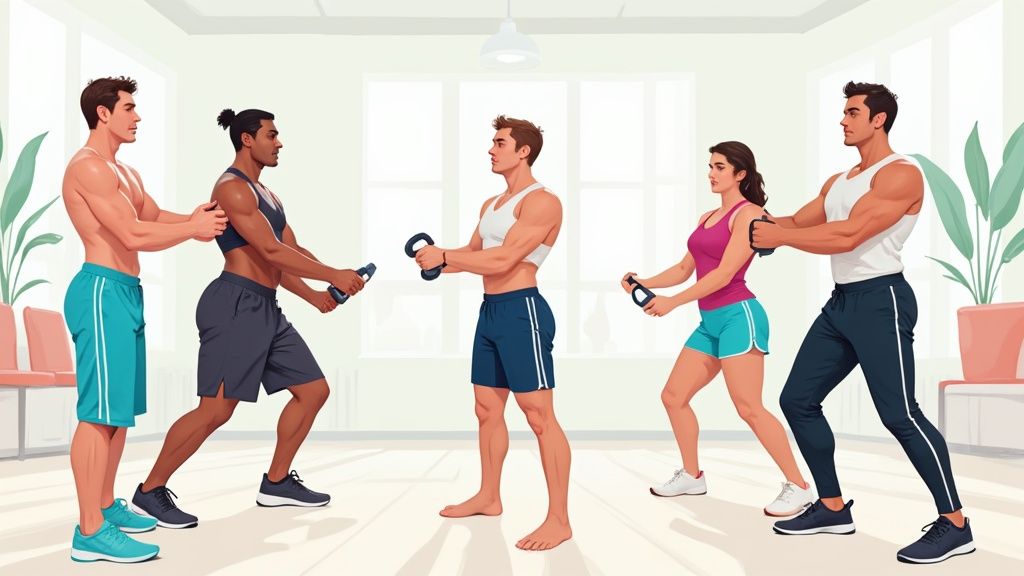
Small group personal training is where the magic happens. It’s the perfect sweet spot, blending the laser-focused attention of one-on-one coaching with the incredible energy of a group workout. Think of it as personal training, but with friends—and at a price that makes everyone happy.
This setup creates a powerful, community-driven vibe that keeps clients coming back for more. As a trainer, it’s a game-changer, letting you multiply your impact and your income without burning out.
Why Small Group Training Is Taking Over
Welcome to one of the biggest and most exciting shifts happening in fitness right now! The old choice between super-expensive solo sessions and generic, overcrowded classes is quickly becoming a thing of the past. Small group personal training has exploded onto the scene, and it's creating a win-win for absolutely everyone.
What makes this model so powerful? It nails the three things that actually make people stick with a fitness routine: personalization, community, and accountability. You're not just another face in the crowd here. In a small group, you can still give each person tailored advice, fix their form, and tweak exercises on the fly.
The Secret to Its Success
The appeal is crystal clear. Clients get the expert guidance they crave to see real, tangible results, but they also get the infectious energy and built-in support system of a team. It's a combination that just works. We're seeing a massive trend toward these sessions because they hit that perfect blend of affordability and social connection that people are looking for today.
Of course, this boom isn't just about making clients happy—it’s a brilliant business move for trainers. When you can work with 2-4 clients in a single hour, your earning potential skyrockets. For a deeper dive into the numbers, check out our complete guide on personal trainer wages.
To give you a quick overview, here's why this model is a home run for both you and your clients.
Small Group Training At a Glance
| Benefit | For the Client | For the Trainer |
|---|---|---|
| Cost-Effective | Access to expert coaching at a fraction of the 1-on-1 price. | Higher hourly earnings by training multiple clients at once. |
| Personalization | More individual attention and form correction than a large class. | Ability to provide quality coaching without the intensity of 1-on-1. |
| Motivation | The energy and support of a small team to push through tough workouts. | A dynamic and engaging training environment that prevents burnout. |
| Accountability | Members hold each other accountable, reducing no-shows. | Higher client retention and more consistent income. |
This table really just scratches the surface. The real value is in the community you build.
Small group training isn’t just a service—it’s an experience. You're not just selling workouts; you're building a tight-knit community where members cheer each other on, share successes, and hold each other accountable.
This guide will walk you through everything you need to know to design, price, and launch sessions that don't just get results, but also build a fiercely loyal following for your fitness business. Let's get started
Crafting Workouts That Keep Small Groups Hooked

Alright, this is where the magic really kicks in! A killer small-group session is a perfectly choreographed dance between individual challenge and group energy. It's the secret sauce that turns a good workout into an awesome experience—the kind that has clients buzzing and booking their next session before they even leave.
Programming for 3-6 people, all at different stages of their fitness journey, can sound like a headache. But trust me, it's more like a fun puzzle. The mission is to create a seamless workout where every single person feels successful and pushed right to their personal edge.
So, what's the trick? Regressions and progressions. For every exercise you program, you absolutely need a simpler version (a regression) and a spicier version (a progression) in your back pocket, ready to deploy at a moment's notice.
The Anatomy of a Killer Session
The best workouts have a natural flow. Think of your session in three distinct, energetic parts. This isn't just about stringing exercises together; it's about crafting an experience that keeps everyone engaged from the first minute to the last.
- The Dynamic Warm-up (5-10 minutes): Forget boring static stretches. Get the blood pumping and the energy up! We're talking high knees, butt kicks, big arm circles, and walking lunges. This is your time to build the vibe, give a quick rundown of the workout, and check in with everyone.
- The Workout Blocks (30-40 minutes): This is the heart of the session. Ditch the idea of having everyone do the same thing in a straight line. Stations are your best friend here! They add variety and make it a breeze to manage different fitness levels. You could set up a strength station, a cardio blast station, and a core-focused one.
- The Cool-Down & Connection (5-10 minutes): Time to bring the heart rates down. Guide the group through some static stretches for the muscles they just crushed. This is also a golden opportunity to build that community feel. End with high-fives, shout out some wins you saw, and plant a seed for the next session.
A great small group workout feels less like a rigid class and more like a shared personal training session. The goal is to deliver individual coaching cues within a motivating group flow, making every client feel seen and supported.
Smart Modifications and Versatile Gear
You don't need a warehouse full of fancy equipment to run incredible sessions. Focus on the versatile workhorses that can be easily adapted for different strength levels. Kettlebells, resistance bands, dumbbells, and medicine balls are a small-group trainer's dream toolkit.
Let’s get practical and break down a simple squat. In the same group, you could have:
- Client A (Beginner): They might be doing a bodyweight box squat, focusing on nailing their form and building confidence.
- Client B (Intermediate): This client could be holding a moderate-weight kettlebell for a goblet squat.
- Client C (Advanced): Let's challenge them with dumbbell front squats or even some explosive squat jumps to finish strong.
This multi-level approach is everything. It ensures everyone is working safely and making progress toward their own goals, all while feeding off the same awesome group energy. Getting good at this is a game-changer, and you can dive deeper with our guide to effective group fitness instruction.
When you build your workouts with clear blocks and pre-planned modifications, you create an environment where every member of your personal training small groups can absolutely crush it.
Crafting Your Pricing and Packaging Strategy
Alright, let's talk money. Getting your pricing right for small group training isn't just about covering your bills; it's one of the most critical moves you'll make to build a fitness business that actually lasts. A smart pricing structure shows clients the incredible value they're getting and makes saying "yes" to your program a no-brainer.
Think of it this way: you're creating the perfect sweet spot. Your small groups offer the personalized touch of one-on-one coaching without the high price tag, and the energy of a group class without getting lost in the crowd. That's a unique service, and your pricing needs to reflect it.
This is a huge opportunity. The personal training industry is massive, with around 728,000 businesses worldwide and it's still growing. While the median annual wage for trainers hovers around $40,700, smart trainers are blowing past that number by using models like small group training. If you're curious about where the industry is heading, you can discover more insights about the personal training market on Fitbudd.com.
Choosing Your Pricing Model: Packages vs. Memberships
So, how should you actually charge for these sessions? You've got a few solid options, and the best one really depends on what kind of business you want to run and how committed you want your clients to be.
-
Pay-Per-Session: This is the easiest entry point for new clients. It's super flexible, but that flexibility can be your enemy. It often leads to spotty attendance and makes it nearly impossible to predict your monthly income.
-
Class Packs (e.g., 10 or 20 sessions): A definite step up. This encourages clients to commit a little more seriously than just paying for one session at a time. It’s a decent middle ground, but you still won't have the reliable, predictable revenue that a membership offers.
-
Recurring Monthly Memberships: This is the Holy Grail for most successful training businesses. A membership model creates stable, predictable income you can count on. More importantly, it builds a powerful sense of community and accountability because clients are truly invested in showing up.
The membership model changes everything. It turns a simple purchase into a real relationship. When clients are on a membership, they're more consistent, which means they get way better results—and you get a much more stable business.
This is the journey you want to take your clients on, from their first assessment to becoming a regular part of your community. A membership structure is the best way to support them every step of the way.

This kind of structured, personal experience is exactly what justifies a premium, recurring price. Clients aren't just paying for workouts; they're investing in a system designed for their success.
Cleanliness is Part of the Premium Experience
If you're charging premium prices, you need to deliver a premium environment. That means your space needs to be spotless. Every single time.
After each session, make it a non-negotiable habit to sanitize all the equipment—kettlebells, mats, bands, you name it. Wiping down every surface they touch isn't just about safety; it screams professionalism and reinforces the high-quality experience they're paying for. For a quick, effective clean, grabbing some Wipes.com Disinfectant Wipes is a great way to keep your training space looking and feeling top-notch.
Get the Word Out and Fill Your Groups

Alright, you’ve put in the hard work designing an killer program and have your pricing dialed in. Now for the exciting part—let's tell everyone about it! Marketing your personal training small groups isn’t about just blasting ads everywhere. It's about genuinely connecting with people who are looking for exactly what you offer: community, accountability, and real results.
Remember, your very first clients are going to be your biggest cheerleaders. The energy, the inside jokes, and the success stories from that initial group will create a natural buzz that you simply can't buy. Let's get into some real-world strategies to pack your sessions and build that momentum from the get-go.
Kick Things Off With a "Founding Members" Special
Nothing builds hype like a fantastic launch deal. You want to generate immediate excitement with an exclusive "Founding Members" offer. This isn't just any discount; it's a time-sensitive, limited-spot promotion designed to build your core crew fast.
- Make it an irresistible deal: Offer a serious discount off your standard price. Let them lock in that special rate for their first 3-6 months as a thank-you for believing in you early on.
- Sweeten the pot: Throw in some valuable extras. Think a free nutrition guide, a branded t-shirt, or an extra one-on-one strategy session. Make them feel like VIPs.
- Create a little FOMO: This is key. Limit the offer to the first 6-8 people who sign up. This scarcity nudges people to stop thinking and start acting, helping you fill that first group in no time.
This isn't just about getting butts in the door. You're creating a loyal tribe of advocates who will always feel a special connection because they were with you from day one.
Build a Referral Program That Actually Works
Let's be real: your happiest, most successful clients are your best marketing tool. A smart referral program turns their natural excitement into a steady stream of new leads. Don't just cross your fingers and hope they tell their friends—give them a reason to!
When a new client signs up because a friend sent them, reward both of them! A simple "get one month free" or a steep discount for the person who made the referral can turn your client base into a self-sustaining marketing machine.
Make it dead simple for them to refer people. Give them a unique sign-up link or a personalized email template to forward. This shows you appreciate them and actively encourages them to shout your praises from the rooftops.
Show, Don't Just Tell, With Authentic Content
People want to see the real deal. It’s time to ditch the generic stock photos and showcase the actual energy and community you're building. Behind-the-scenes videos, candid shots of members crushing a workout, and unscripted testimonials are pure marketing gold. This is the stuff that helps someone say, "Hey, I could see myself there!"
This approach is more than just a nice idea; it's essential. The fitness industry is booming, with projections showing a 15% increase in jobs for fitness pros by 2029. To stand out, you need to forge a genuine connection. This is a huge part of any solid strategy, as we cover in our guide on social media marketing for gyms. You can also dig into more personal training industry statistics on TrainerAcademy.org to see the full picture.
Your Cleanest Marketing Tool? A Clean Space.
Never, ever underestimate this. Your training environment speaks volumes about your brand before you even say a word. A sparkling clean, organized space screams professionalism and shows you care about your clients' health and experience. It makes them feel safe, respected, and valued.
Get into the non-negotiable habit of wiping down every piece of equipment after every single session. Keeping top-notch disinfectant wipes, like Wipes.com Disinfectant Wipes, within arm's reach makes this process fast and easy. A pristine studio isn't just a chore—it’s one of your most powerful, unspoken marketing statements.
It’s All About Building a Lasting Community
A killer workout program will get people through the door, no doubt. But what makes them stay for the long haul? A real, powerful community. Your long-term success with small-group personal training comes down to creating a space that feels more like a team than just a gym class—a place where clients feel connected, supported, and genuinely missed if they skip a session.
This kind of loyalty is built on two things: super-smooth operations and a genuine effort to bring people together.
Let’s get into the nuts and bolts of running your groups. First things first, get your admin work on autopilot. A simple scheduling app is a game-changer. It lets clients book sessions, handle payments, and manage their schedules on their own time. This immediately frees you up to do what you do best: coach. Plus, it just looks professional and sets a high standard from day one.
You also need a crystal-clear cancellation policy. Don't be shy about it. A firm but fair policy, like requiring 24-hour notice to reschedule, shows that you respect your own time and reinforces the value of each spot in that group. This isn’t about being a drill sergeant; it's about creating a system where everyone is accountable and all-in.
Going Deeper Than Just the Workout
Once your logistics are running like a well-oiled machine, you can pour all that saved energy into what really matters—building that incredible community vibe. The goal is to make the connection last well beyond the one-hour session.
Here are a few of my favorite ways to make that happen:
- Launch a Private Group Chat: A dedicated Facebook or WhatsApp group is perfect. It quickly becomes the go-to spot for members to share their wins, ask for a recipe, or just cheer each other on.
- Run Fun Member Challenges: Think outside the box! A 30-day consistency challenge or a team-based fitness game can work wonders. These events create a shared goal and spark some friendly competition that really strengthens the bonds between your clients.
- Celebrate Every Single Win: Did someone finally hit a new deadlift PR or nail a perfect push-up? Make a big deal out of it! A quick shout-out in the group chat or at the end of class makes people feel seen and valued.
A thriving community turns your fitness sessions into an essential part of your clients' lives. They stop showing up just for a workout; they start showing up for their friends and for the positive energy that fuels their entire week.
Your Commitment to a Clean and Safe Space
Trust is the bedrock of any solid community. And honestly, nothing builds that trust faster than showing a deep, unwavering commitment to your clients' health and safety.
A spotless, hygienic training environment isn't just a "nice-to-have"—it's non-negotiable. It’s a powerful, unspoken promise that you genuinely care about their well-being.
Make it a non-negotiable rule to sanitize all equipment after every session. Every mat, dumbbell, kettlebell, and bench needs to be wiped down between groups. This discipline is what separates the pros from the amateurs and reinforces the premium quality of your service.
To make this quick and effective, don't skimp on supplies. Keeping a station fully stocked with professional-grade products like Wipes.com Disinfectant Wipes ensures you and your clients can easily keep the space pristine. This consistent attention to cleanliness does more than just stop germs—it builds the deep-seated trust that turns clients into lifelong members of your fitness family.
Got Questions About Small Group Training? We've Got Answers

Diving into small group training is an awesome move for your business, but it's totally normal to have a few questions rattling around in your head. Let's get them answered.
Think of this as your cheat sheet to sidestep the usual rookie mistakes and start coaching your groups with total confidence.
What's the Ideal Size for a Small Training Group?
From my experience, the magic number is between 3 to 6 clients. This is the sweet spot, and here's why.
It’s small enough that you can still give everyone that high-quality, personalized feedback they’re paying you for. You can actually see and correct form. But, it's also big enough to create that incredible, motivating group vibe and make it a solid income stream for you.
Once you creep past six people, it gets really tough to juggle all the different fitness levels. Before you know it, your session starts to feel more like a generic fitness class, and you lose that "personal" touch that makes your service special.
How Do I Handle Different Fitness Levels in the Same Group?
This is where great coaching really shines! The trick is to build your workouts with regressions (easier versions) and progressions (harder versions) for every single exercise.
Let's say you've programmed kettlebell swings. You need to be ready to offer a few options on the fly. For the beginner, it might be a simple hip hinge drill. Your intermediate client gets the standard swing, and the advanced client could tackle an alternating single-arm swing.
Here's the pro tip: Announce these options to the whole group at the beginning of the workout. This empowers each person to pick the challenge that feels right for them on that specific day. Everyone gets a great workout, feels accomplished, and, most importantly, stays safe.
How Can I Move My 1-on-1 Clients into a Group?
This is all about the pitch. You have to frame it as a fantastic new opportunity, not a downgrade. Focus on the big wins for them: they get the same expert coaching they love from you, but at a more affordable price point, plus the awesome energy and camaraderie of a team.
A killer strategy I've seen work time and time again is offering your loyal one-on-one clients an exclusive "Founder's Rate." It's a great way to reward them for their support and get your first group filled with people you already know.
Be prepared to explain how you’ll maintain the high level of personal attention they're used to. And remember, it's smart to keep both training options on the table—some clients will always prefer that dedicated one-on-one time.
What's the Deal with Gym Hygiene and Best Practices?
A clean, sanitary space isn't just nice to have; it's a non-negotiable. It's the bedrock of client safety and trust.
First, set a clear rule: all shared equipment—dumbbells, kettlebells, mats, you name it—must be wiped down after every single use.
Then, make it easy for people to follow the rules. Have cleaning stations stocked with disinfectant sprays or wipes readily available. To make it a no-brainer, you can use products designed specifically for gyms, like the Disinfectant Wipes from Wipes.com, which are perfect for high-touch fitness gear.
Finally, don't be shy about your high standards! When your clients see how seriously you take their health and safety, they'll feel way more comfortable and confident training with you.
Final Thoughts on a Clean and Thriving Business
Building successful personal training small groups is about more than just great workouts; it's about creating a professional, safe, and motivating environment. A key part of that is an unwavering commitment to cleanliness. Make it a non-negotiable routine to sanitize all shared equipment after every session. This not only protects your clients' health but also builds the trust that turns new members into a loyal community. By stocking up on quality supplies like Wipes.com Disinfectant Wipes, you make hygiene an easy and consistent part of your premium service, ensuring your business thrives for years to come.
Leave a Reply