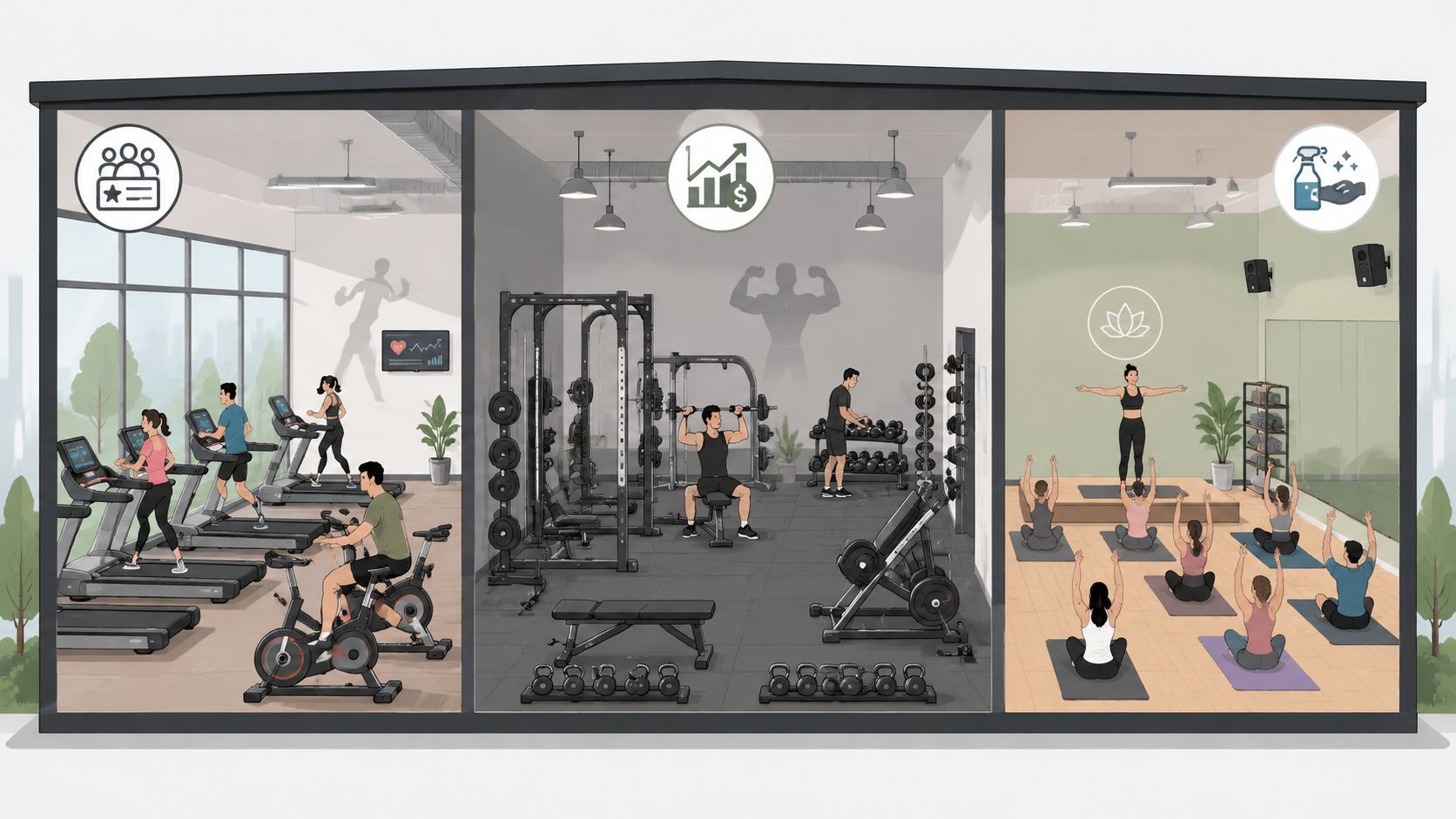
A commercial gym is a pay-to-use health and fitness facility operating at scale, built around memberships, equipment access, and related services. In 2019, worldwide clubs generated US$96.7 billion and served more than 184 million members across nearly 210,000 facilities, according to the IHRSA global industry report.
The definition goes beyond treadmills and dumbbells. A commercial gym is a recurring-revenue operation with heavy daily traffic, where equipment uptime, cleaning procedures, staffing, safety compliance, and member support shape retention and profitability. Design must make cleaning practical, isolate high-contact surfaces, and keep maintenance access clear. Operators who treat hygiene and facility reliability as operating systems, rather than cosmetic details, create a safer experience and protect revenue. The result is a facility engineered for consistent service, not filled with equipment.
Defining the Modern Commercial Gym
The United States recorded 77 million gym members in 2024, showing how far fitness facilities have moved into mainstream consumer services. For an owner, that scale matters because a commercial gym is not just a room full of equipment. It is a revenue-generating operation that must deliver dependable access, safe conditions, and consistent service across a broad membership base.
The “commercial” label describes the operating model, not the building's size. A smaller facility qualifies when it accepts paying customers and runs with systems for sales, staffing, maintenance, cleaning, and member support. A larger facility fails commercially when those systems cannot protect uptime, safety, or customer experience.

The operating features that define the model
A modern commercial gym usually combines these operating components:
- High-capacity floor planning: The layout must support varied training styles, experience levels, and peak-period traffic without unsafe congestion. Clear circulation also gives staff better sightlines and makes cleaning faster.
- Tiered membership access: Entry access, premium amenities, training packages, and specialized services let owners match price and usage without selling every member the same package.
- Professional staffing: Front-desk employees, personal trainers, group instructors, maintenance personnel, and managers each own a different part of the member experience.
- Multiple revenue channels: Memberships provide the base. Personal training, group programming, retail, vending, recovery services, and rentals can raise revenue per member.
- Standardized operating procedures: Opening checks, equipment inspections, cleaning schedules, incident reports, and sales follow-up must produce the same result across shifts.
The facility may also include functional training zones, recovery areas, group exercise rooms, app-based engagement, and digital coaching. These services expand the experience without changing the commercial model. Online classes and mobile accountability still support a commercial gym when they reinforce paid access and member retention.
Why scale changes the owner's priorities
A home gym serves one household. An apartment gym usually functions as a limited amenity. A commercial facility must serve people with different goals, schedules, and tolerance for crowding, while keeping equipment available and surfaces clean throughout the day.
That requirement turns every design choice into an operating decision. Evaluate each square foot, machine, staff hour, and membership tier by its effect on utilization, safety, satisfaction, and retention. Put maintenance access near equipment, specify surfaces that withstand repeated cleaning, and track recurring failure points instead of waiting for complaints.
For a practical comparison of facility formats, review this guide to different types of gyms. The defining standard remains straightforward: a commercial gym sells reliable, repeatable access to a managed fitness environment, and its facility systems determine whether members keep paying.
Commercial Gyms vs Boutique and Private Facilities
Commercial gyms, boutique studios, and private clubs may all sell fitness access, but their economics and operating requirements differ sharply. The commercial model prioritizes throughput, equipment variety, and repeatable service delivery. A boutique studio sells a narrower experience, often centered on one training method. A private club sells access within a more exclusive environment, where social amenities and concierge service can matter as much as exercise capacity.
| Feature | Commercial Gym | Boutique Studio | Private Club |
|---|---|---|---|
| Member profile | Broad public membership | Targeted interest or training modality | Selective or premium membership |
| Equipment mix | Diverse cardio, strength, and functional equipment | Specialized equipment for a focused format | Fitness equipment combined with club amenities |
| Pricing approach | Tiered access and recurring memberships | Premium pricing for a specialized experience | Higher-fee access linked to exclusivity and service |
| Facility design | Larger, flexible floor plan | Dedicated studio room or compact footprint | Fitness areas plus hospitality and social spaces |
| Staffing model | Front desk, trainers, instructors, maintenance, and management | Leaner team of instructors and operators | Concierge, hospitality, fitness, and facilities teams |
| Main operational challenge | Traffic, wear, retention, and service consistency | Class utilization and premium experience | High service standards and member expectations |
Throughput is the commercial gym advantage
A commercial gym needs equipment that can handle repeated use by people with different movement patterns, training experience, and body mechanics. That means reinforced frames, durable upholstery, serviceable components, and maintenance planning calibrated for higher wear than home-use equipment.
The facility layout matters just as much as the machines. Cardio equipment shouldn't create a bottleneck at the entrance. Selectorized strength stations need enough clearance for safe use and staff access. Free-weight areas require clear movement paths, appropriate flooring, and a layout that prevents one popular station from blocking several others.
Practical rule: Design for the busiest realistic period, not the quietest hour you hope to enjoy.
Boutique studios have a different advantage. A cycling, barre, or HIIT operator can create a tightly curated experience with fewer equipment categories and a narrower programming promise. The business doesn't need to support every training preference, but it must deliver its chosen format with strong coaching, consistent scheduling, and a distinctive atmosphere.
Private clubs sell more than exercise
Private facilities typically compete through exclusivity, hospitality, privacy, and social amenities. Their members may value quieter spaces, personal attention, changing-room quality, or the ability to conduct business as much as they value a full equipment selection.
That changes the staffing profile. A commercial gym needs broad operational coverage because different teams manage access control, cleaning, repairs, group classes, personal training, and member concerns. A boutique studio may operate with a smaller team, while a private club may need more hospitality-oriented staff to support its service promise.
The choice also affects real estate and risk planning. A commercial gym may need a larger footprint and stronger floors because it accommodates more equipment and higher traffic. A boutique operator can often work within a more focused layout. A private club may accept a different lease structure because its revenue model depends on premium experience rather than maximum equipment throughput.
Don't copy a boutique model and expect commercial-gym economics. Decide whether you're selling broad access, specialized instruction, or an exclusive club experience, then build the site and staffing plan around that decision.
Revenue Models and Membership Economics
A commercial gym survives on recurring access revenue. Monthly and annual memberships create predictable billing, while paid services increase revenue per member. In 2025, subscription fees accounted for 51.73% of health and fitness club revenue, according to market reporting from Straits Research. Protect the membership base first. Side businesses cannot compensate for weak retention, poor service, or an overcrowded floor.
Build the revenue architecture in four layers:
- Core access: Monthly or annual memberships provide facility entry and the services included in each tier.
- Training and programming: Personal training, small-group coaching, workshops, and premium classes add paid depth around the basic membership.
- Retail and convenience: Apparel, accessories, supplements, vending, and other on-site purchases capture demand already present in the facility.
- Digital and partnership revenue: Apps, on-demand content, employer partnerships, and corporate wellness programs extend the customer relationship beyond the gym floor.

For a practical breakdown of gym revenue streams, connect every offer to its staffing, space, equipment, and service costs. A revenue line is useful only when it adds contribution without damaging the member experience.
Build the membership model before adding extras
Large commercial operators may set low entry prices and enroll more members than the facility could hold at one time, relying on attendance patterns to spread demand. That approach can work, but new owners should not sell beyond capacity without measuring actual peak-hour use.
Start with a clear access promise. Define which areas each tier includes, whether classes require an add-on, how guests are handled, and what happens during freezes or cancellations. Keep the language simple. Confusing policies create front-desk friction, refund requests, and avoidable churn.
Initiation fees, prepaid terms, freeze policies, and cancellation rules affect cash flow and lifetime value. They also shape trust. A policy that produces an immediate payment while making members feel trapped can reduce referrals and renewals.
Use ancillary services to deepen engagement
Personal training is often the clearest way to raise revenue per member because payment connects to a defined outcome and a named professional. Group training can serve the same purpose when the schedule, coaching quality, and class capacity support a consistent experience.
Digital services add another layer. More than 60% of gymgoers prefer hybrid fitness models, according to Fact.MR's health and fitness club market report. An app can handle booking, workout plans, reminders, challenges, and on-demand content. Use it to support attendance and accountability. Technology will not repair poor maintenance or inattentive service.
Corporate wellness partnerships can create another acquisition channel through employers and organized member groups. Set clear rules for eligibility, billing, access, and reporting before accepting the arrangement.
Gym Membership Tips publishes material on membership packages, sales processes, and retention operations. Use such resources to standardize workflows, then assess every offer by its effect on attendance, service load, and long-term retention.
Hygiene Engineering and Compliance Standards
Cleanliness is not a decorative feature in a commercial gym. It is part of the facility's technical specification, operating license, risk controls, and customer experience. Shared machines, handles, mats, benches, locker-room fixtures, and touchscreens create repeated contact points, so the owner needs a documented system rather than occasional housekeeping.
Health-club guidance emphasizes cleaning and disinfection programs, visible emergency contacts, covered waste bins, towel-handling procedures, and other controls for shared-use environments. The health-club hygiene guidelines also support a broader operational conclusion: members should see evidence that the facility manages hygiene deliberately.
Engineer the cleaning workflow by zone
Divide the facility into cardio, strength, functional training, group exercise, locker-room, reception, and staff-only zones. Each area needs an assigned frequency, responsible employee, approved product, and verification method.
High-touch cardio equipment, touchscreens, cable handles, and selector pins require repeated attention during operating hours. Commercial-gym cleaning guidance recommends wiping equipment before and after use where appropriate, while ensuring that the disinfectant remains on the surface for the product's labeled contact time. Apply the product to a cloth or wipe rather than spraying directly onto equipment, because moisture can enter openings and damage electronics. (Commercial gym equipment cleaning guidance)
Use EPA registered disinfecting wipes when the objective is disinfection. EPA-registered disinfecting wipes are intended to kill listed viruses and bacteria, while sanitizing wipes primarily reduce bacteria counts and aren't always effective against viruses. The distinction between disinfecting and sanitizing wipes should guide purchasing, signage, and staff training.

Protect equipment, people, and records
Cleaning products must match the surface. Johnson Fitness recommends a soft cloth with mild soap and water and warns against ammonia- or alcohol-based cleaners on aluminum and plastics because they can discolor surfaces. It also advises owners never to pour solution onto equipment. (Johnson Fitness equipment cleaning guidance)
TRUE gives similar direction, including applying cleaner to a cloth, avoiding direct spraying, and using different solutions for different surfaces. Screens, grips, upholstery, painted frames, rubber flooring, and stainless-steel fixtures shouldn't all receive the same treatment.
Ventilation deserves equal attention. Inspect air-handling systems, document filter changes, and evaluate whether high-use zones need additional air movement. Where a facility needs supplemental filtration, owners can review options such as heavy-duty air purifiers from EcoQuest Purifiers, then confirm compatibility with the building's HVAC and safety requirements.
Maintain digital cleaning logs with timestamps, staff initials, zone identifiers, product names, and exception notes. Train employees to avoid cross-contamination by separating locker-room tools from strength-floor tools and replacing visibly soiled cloths promptly. A clean facility supports trust, reduces operational surprises, and gives managers an auditable response when a member raises a concern.
Equipment Selection and Facility Durability
Commercial equipment earns its place through reliability, serviceability, and total cost of ownership. Don't select machines because they look impressive in a showroom. Select them because they can withstand sustained use, remain safe under varied loading, and return to service quickly after a failure.
Prioritize heavy-duty frames, durable upholstery, accessible service panels, modular components, and manufacturer support. Cardio machines need strong construction and motors suited to repeated operation. Cable stations need dependable cables, pulleys, and adjustment points. Free-weight areas need bars, plates, racks, and flooring chosen for repeated loading rather than occasional home workouts.
| Specification | Commercial Grade | Residential Grade |
|---|---|---|
| Intended use | Sustained use by a diverse membership base | Personal or household use |
| Construction | Reinforced frames and durable finishes | Lighter construction |
| Serviceability | Parts access, service support, replaceable components | More limited repair infrastructure |
| Layout needs | Planned for traffic, clearance, and staff access | Planned around household space |
| Purchasing priority | Uptime and total cost of ownership | Initial price and convenience |
Plan the floor around movement and maintenance
Place high-maintenance machines where technicians can reach them without closing large parts of the floor. Keep walking routes clear, separate free-weight activity from stretching or beginner zones, and preserve required accessibility clearances.
Flooring should match the activity. Drop zones need impact protection, functional areas need suitable shock absorption, and locker rooms need moisture-resistant materials with safe drainage. The cheapest surface often becomes the most expensive choice after repeated damage, replacement work, or member complaints.
Use a commissioning checklist before opening:
- Load and movement checks: Test racks, cable stations, benches, and plate-loaded machines under realistic operating conditions.
- Electrical and safety checks: Confirm power, emergency stops, guards, anchors, and equipment spacing.
- Service planning: Record serial numbers, warranty terms, recommended maintenance, and replacement parts.
- Cleaning compatibility: Verify that chosen fitness wipes and other products won't damage plastics, upholstery, screens, or coated metal.
Owners should also keep a preventive maintenance calendar. The gym equipment maintenance guide can help organize inspections, lubrication, repairs, and documentation. Preventive work costs less than avoidable downtime because members experience a broken machine as a service failure, not as an internal maintenance task.
Launching and Evaluating Your Commercial Gym
A successful opening depends on operational readiness, not just a finished interior. Before admitting members, secure the certificate of occupancy, commission and load-test equipment, verify staff certifications, confirm the insurance binder, and run a soft launch with controlled member onboarding.

Use the first 90 days as a systems test
Track check-in frequency, peak-hour capacity utilization, equipment downtime, cleaning audit scores, and month-over-month retention during the first 90 days. These measures show whether your sales promise matches the actual member experience.
Review complaints by category. If members report crowded equipment, adjust layout or access rules. If downtime rises, change the maintenance schedule or equipment mix. If hygiene audits fail, assign ownership by zone and retrain staff rather than just buying more products.
Schedule quarterly operational reviews after launch. Compare retention, utilization, repairs, cleaning performance, and revenue mix against your own targets, then approve capital spending before failures or compliance gaps undermine trust.
A commercial gym is an integrated system. Membership pricing brings people in, reliable equipment keeps them training, hygiene protects confidence, and responsive staff turn access into loyalty.
Choose your facility model, map every revenue stream, and write the cleaning and maintenance SOPs before signing your equipment orders. If you're preparing to open or improve a gym, start today by auditing peak-hour capacity, equipment condition, membership policies, and hygiene compliance, then turn the findings into a 90-day operating plan.
Leave a Reply