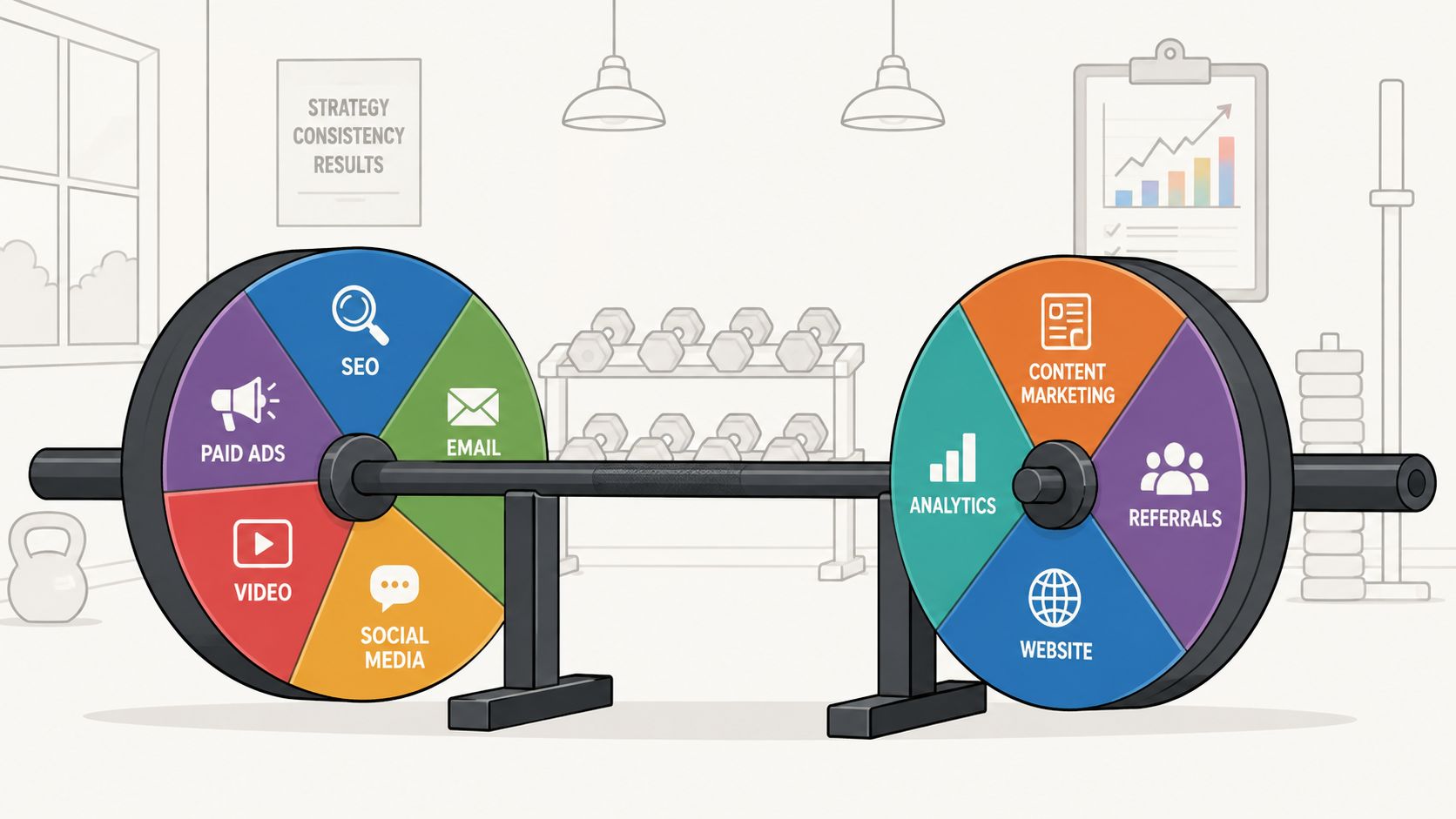
You've got a full class schedule, a membership target, and a marketing budget that refuses to grow. Meanwhile, paid search wants more funding, social platforms keep changing, and your front desk team says member retention needs attention. The difficult question isn't whether digital marketing matters. It's which activity deserves the next dollar when every channel competes for the same limited pool.
Marketing budget allocation works better when you treat it as an active portfolio rather than a list of monthly bills. Acquisition brings prospects through the door, retention protects the revenue you've already earned, and local partnerships give your gym credibility that an ad can't always create. The job is to connect all three, measure their contribution, and move money when the evidence changes.
Why Most Gym Marketing Budgets Fail Before They Start
The budget is unchanged, paid search costs more, and your front desk is still trying to improve member follow-up. A gym owner in that position cannot fund every promising channel. The practical question is which investment can produce measurable memberships, protect current revenue, or strengthen the local relationships that keep the gym relevant.
Marketing budgets averaged 7.7% of company revenue in 2025 and 2024. Later reporting for 2026 places the figure at about 7.8%, compared with a level near 11% in 2020. That extended period of relatively flat spending gives owners little room to cover weak decisions with extra money. The historical marketing budget benchmark and its revenue-share context reinforces the need to rank initiatives by business impact.
Start with the economics
Separate acquisition spending from retention infrastructure and community activity. Paid search can reach someone actively looking for a gym, while onboarding, coaching check-ins, and member communication can reduce cancellations. Local partnerships may produce fewer immediate leads than an ad, yet they can build trust and referrals in the neighborhoods you serve. Each category needs its own outcome and tracking method.
Common budget failures follow a familiar pattern:
- Platform chasing: Teams add another social account because it is popular, without connecting it to trials, tours, or memberships.
- Awareness without a conversion path: Reach and views look healthy, but prospects have no clear route to a booking page, phone call, or visit.
- Retention neglect: Lead generation keeps receiving funding while onboarding, follow-up, and member communication remain improvised.
- Legacy spending: A sponsorship or printed promotion continues by habit, even though nobody can show what it produces.
Practical rule: Protect a channel when it has a defined role, a measurable outcome, and enough operating history for a fair decision.
Treat the budget as a working portfolio. Fund dependable acquisition sources, reserve money for retention systems and useful local partnerships, and keep a controlled amount for testing. Review results regularly, then move funds when membership data supports the change instead of locking the entire mix for a year.
Calculating Your Total Marketing Spend
Before you divide dollars by channel, you need to know what the total pot is. Two approaches anchor that number: revenue percentage or per-member spend.
The revenue method starts with projected revenue and applies a selected marketing rate. It gives owners a planning anchor, but the right level depends on growth stage, local competition, retention performance, and operating capacity. Count staff time, creative production, software, agency fees, events, and promotional materials alongside ad spend. Otherwise, a paid media report can look efficient while the full program costs far more than expected.
The per-member method connects the pool to the size of your active base.
Two ways to set the pool
Revenue percentage method: Multiply projected revenue by your chosen marketing percentage. Use the result as a working budget, then adjust it when acquisition costs, cancellations, or available staff capacity make the original allocation impractical.
Per-member method: Divide the planned monthly marketing pool by active members. This does not replace revenue analysis. It helps compare locations and check whether acquisition spending is proportionate to the member base.
A flat budget forces a choice between acquiring more members and funding the systems that keep them. If onboarding, coaching check-ins, or member communication are underfunded, additional lead spend can feed a leaky process. Local partnerships may also require time and event support before referrals appear, so record those costs rather than treating community activity as free.
Use actual figures for your facility instead of invented assumptions. The formulas are:
Total marketing pool = projected revenue × selected allocation rate
Marketing cost per active member = total marketing pool ÷ active members
A tight budget still needs a clear order. Pay for the conversion path first, then the follow-up process that keeps leads from going cold. Delay activities that lack a measurable outcome instead of scattering small amounts across every available channel.
For broader planning context, budget planning for elective medical practices shows how service businesses can connect budget choices with operating capacity. Review the monthly cost of running a gym as you assess what your facility can sustain without cutting delivery quality.

The 70/20/10 Rule for Gym Marketing
The 70/20/10 framework gives a gym owner a practical way to balance safety and discovery. Put 70% into proven channels, 20% into promising channels that need more evidence, and 10% into experiments. The framework is also available in a similar form through this 2026 allocation guide.
Put each channel in the right bucket
The proven bucket should contain activities with dependable tracking and a meaningful history of performance. For a gym, that might include a well-maintained Google Business Profile, search campaigns tied to tour bookings, an email database, or a landing page that consistently turns interest into consultations.
The promising bucket is for tactics showing potential but not yet mature enough to receive the majority of funding. Instagram campaigns, a new referral partnership, or a refreshed local landing-page strategy may belong here. Give each activity a defined test question, such as whether it can generate qualified trial bookings at an acceptable payback period.
The experimental bucket protects curiosity without putting core revenue at risk. A podcast sponsorship, creator collaboration, or new video format can be tested here. If an experiment has no conversion event, decide in advance what evidence would justify continuing it.
Use this decision tree during a quarterly review:
- Can you connect the activity to a business action? If not, keep it experimental or redesign the measurement.
- Does the activity have enough historical data to compare fairly? If yes, assess its efficiency and consistency.
- Does it produce qualified prospects or improve member value? If yes, consider promotion into the promising or proven group.
- Does performance weaken after additional spend? If yes, cap the channel and test another use of the money.
The framework isn't permission to spend automatically. A proven channel can still saturate, and an experimental idea can reveal a valuable audience. Review results by location, offer, audience, and member quality, not only by lead count.

Channel-by-Channel Allocation Templates
Pick a gym type, urban studio, suburban family facility, or community-focused location, and the channel split shifts with it. The right allocation depends on who lives nearby, how members decide, and where your sales process can handle more demand.
| Channel | Urban Digital-Heavy | Suburban Balanced | Community-Focused |
|---|---|---|---|
| Paid search | 25% | 15% | 10% |
| Paid social | 20% | 15% | 10% |
| Email and lifecycle | 10% | 15% | 15% |
| Content and SEO | 15% | 15% | 15% |
| Local events | 5% | 15% | 20% |
| Community partnerships | 5% | 15% | 25% |
| Traditional advertising | 5% | 5% | 5% |
| Measurement and testing | 15% | 5% | 0% |
These are editorial allocation examples, not verified market statistics. Treat the percentages as a starting point, then adjust for member demographics, competitor activity, geographic reach, class capacity, and the quality of your conversion data.
The digital-heavy model fits a gym with strong landing pages, fast lead response, and enough search demand to capture active intent. Paid search can produce inquiries quickly, but it consumes budget as competition rises. Paid social supports awareness and retargeting, yet it cannot compensate for a vague offer or slow follow-up.
A suburban facility usually needs more repeated contact. Email and lifecycle campaigns can keep families engaged while they compare options, and local events give prospects a reason to visit before they are ready to join. Partnerships with employers, schools, and neighborhood organizations can reduce reliance on paid acquisition, though they require consistent relationship work.
Community-focused gyms place more budget into events and partnerships. That choice can produce stronger local trust, but referral activity is harder to scale and must be tracked through referral codes, consultation records, or source questions at signup. If the table assigns no separate testing line, treat partnerships as structured experiments rather than free promotion.
A small studio should avoid broad reach when its coaches already have strong relationships with nearby businesses, clubs, schools, or apartment communities. Reserve enough capacity for follow-up and retention infrastructure before expanding acquisition. For practical execution ideas, this guide to social media marketing for gyms can support the plan without making social activity the whole strategy.
Tracking KPIs and Measuring ROI
A budget becomes useful only when your team can explain what happened after the money moved. Start by tracking lead source, inquiry date, response time, booked tour, attended tour, trial start, membership sale, membership type, and cancellation date. These fields connect acquisition spending with the retention work that determines whether a new member becomes profitable.
Use consistent source labels across Google Ads, Meta, email, partnerships, and offline promotions. Keep likes, impressions, and follower counts as creative and distribution diagnostics, then judge the budget through qualified inquiries, attendance, sales, and cancellations.

Build one shared scorecard
Review paid channels for pacing, cost per lead, qualified lead rate, booking rate, and membership conversion. Review retention channels for reactivation, attendance behavior, referral activity, and renewal patterns, because a flat budget may produce better returns by fixing follow-up or member experience instead of buying more reach.
Full-funnel attribution matters when a channel influences the decision without receiving the final click. In a survey of 631 marketing decision-makers, 45% of B2B marketers with full-funnel attribution said they significantly exceeded their primary goals, compared with 24% without it. The attribution benchmark and measurement workflow supports shared definitions rather than isolated platform reports.
Compare attribution windows across 1-day, 7-day, and 28-day periods, and check whether the pattern holds across models. Do not move money because one platform claims credit. Confirm each lead in your CRM and connect the eventual membership sale to its original source where possible.
For the calculation method, use this guide to calculating return on investment. The formula is:
Marketing ROI = attributable contribution from members minus marketing cost ÷ marketing cost
Track payback period and member value alongside acquisition cost. A cheap lead that never attends is not a win, while a community referral that renews consistently may justify more relationship work than a high-volume campaign.
Sample Budgets for Different Gym Sizes
Sample budgets are useful only when they clarify priorities, not when they pretend to predict results. The requested examples of $2,000, $8,000, and $20,000 monthly budgets can be shown as planning scenarios, but the associated member counts and line-item outcomes are not verified data. Treat the following as allocation exercises and replace them with your own revenue, capacity, and performance figures.
Small boutique studio
For a $2,000 monthly planning pool, a studio might assign $600 to search, $300 to social, $200 to email software and lifecycle work, $250 to content, $250 to local partnerships, $250 to community events, and $150 to retention initiatives. The point isn't the exact split. The point is protecting follow-up and local trust instead of spending the full amount on ads.
A studio with limited capacity should measure booked consultations and attendance quality. If coaches can personally follow up with every inquiry, operational execution may create more value than another campaign.
Mid-size gym
An $8,000 planning pool could assign $2,400 to search, $1,600 to Facebook and Instagram, $800 to email and CRM work, $1,000 to content, $800 to local sponsorships, $800 to community events, and $600 to retention programs.
This structure gives a larger facility enough acquisition reach while funding the member experience after enrollment. Keep event spending tied to a registration list, offer code, or referral workflow. Otherwise, the event becomes a cost center with a pleasant atmosphere but no usable marketing evidence.
Large multi-location facility
A $20,000 planning pool might direct $6,000 to search, $4,000 to social campaigns, $2,000 to email and lifecycle work, $2,500 to content, $1,500 to local sponsorships, $1,500 to community events, and $2,500 to retention and measurement infrastructure.
Large facilities need location-level reporting. A campaign can look efficient overall while wasting money in one branch and working well in another. During a tight period, preserve conversion tracking, lead response, and retention communication before expanding into another broad awareness channel.
Implementation Templates and Final Recommendations
Your final step is a one-page operating template. It needs five fields: projected revenue, total marketing pool, channel assignments, testing funds, and the conversion event for each.

Use a simple operating template
Budget plan: Record committed costs, retention investment, and the monthly amount assigned to each channel. Mark every activity as proven, promising, or experimental so a flat budget does not spread money evenly across options with different evidence.
Quarterly review: Compare planned and actual spend with qualified leads, memberships, payback, member value, cancellations, and referral activity. Decide which channel deserves more funding, which needs a cap, and which requires a clearer measurement path.
Channel scorecard: Grade each activity on business contribution, data quality, consistency, scalability, and operational fit. Lead volume has value only when it connects to consultations, memberships, and durable member value.
A gym's marketing budget also funds the experience that supports conversion and retention. Prospects notice clean equipment, stocked supplies, and maintained training areas, so assign cleaning responsibilities in the operating plan rather than leaving them to emergency tasks.
For high-traffic areas, compare bulk gym wipes, commercial disinfecting wipes, and a mounted gym wipe dispenser by usage, staff workflow, surface compatibility, and disposal requirements. Keep suitable wipes for gym equipment near strength machines and cardio areas, and place yoga mat wipes where members share mats. Follow the product label and your facility's safety procedures, since disinfecting products may suit different surfaces. Wipes.com disinfecting wipes are one option to evaluate alongside other sanitizing supplies.
Protect the conversion paths that already produce qualified memberships, reserve money for controlled tests, and keep retention work funded when acquisition costs rise. Local partnerships deserve the same discipline. Track registrations, offer codes, referrals, or booked consultations so a community event earns another investment.
Open your budget sheet, classify every current expense, and move the next available dollar toward the channel producing qualified memberships and durable member value. Clean equipment on a documented schedule, place gym equipment wipes where members can reach them, and train staff to sanitize high-touch surfaces throughout the day.
Book a 30-minute budget review with your general manager this week. Bring channel costs, lead sources, membership conversions, cancellations, and cleaning-supply expenses. Then create a 70/20/10 plan that protects acquisition, funds retention, and gives local partnerships a measurable test.
Leave a Reply